



THE MAN BEHIND THE ELEVATOR DOORS
There are inventions that arrive with enormous publicity, inventions that make newspapers, attract crowds, and immediately become associated with the people who created them. Then there are inventions and improvements that become so deeply woven into everyday life that people eventually stop thinking about them altogether. The elevator belongs in that second category. Millions of people step into elevators every day without giving much thought to the machinery around them. The doors open, we walk inside, the doors close, we press a button, and we rise to another floor. It feels so ordinary that we rarely stop to consider that this simple process once contained serious dangers. Before modern elevator-door systems became standard, an open elevator shaft could become a deadly hazard, and Alexander Miles was one of the Black inventors who looked directly at that problem and decided it needed a better solution.
Alexander Miles wasn’t born into a world that was waiting to celebrate his genius. He was born in 1838 in Ohio, during a period when America was deeply divided by slavery, racial inequality, and restrictions on Black freedom and opportunity. The historical record doesn’t give us a detailed diary of his childhood, so there are parts of his early life that remain unknown. That’s something we have to acknowledge honestly because history becomes distorted when we fill missing information with stories that sound good but can’t be proven. What we do know is that Miles eventually developed into a man who understood the value of work, trade, business, invention, property ownership, and self-reliance. Long before his name became connected to elevators, he was already developing the mindset that would shape the rest of his life.
Miles entered the barbering profession as a young man, eventually working in Wisconsin before moving to Minnesota. At first glance, barbering might appear completely unrelated to mechanical invention, real estate, or the development of modern cities, but that’s where his story becomes particularly interesting. A barber in the 19th century wasn’t simply somebody who cut hair. A successful barber could develop a steady clientele, establish relationships with businessmen and professionals, create a respected local reputation, and build a business that became the foundation for other investments. Miles understood how to turn a skill into income, and then how to turn income into opportunity. He eventually began experimenting with hair-care products and received patents for improvements involving hair cleansing and hair tonics. Before the elevator patent ever carried his name, he had already learned an important lesson about innovation: an idea becomes powerful when you can turn it into something useful.
That pattern would continue throughout his life. Miles didn’t seem content to remain inside one narrow definition of himself. He wasn’t satisfied with being known only as a barber. He became a businessman, a property owner, an inventor, an investor, and eventually someone involved in the insurance business. His life therefore gives us a much broader picture of Black entrepreneurship during the 19th century than we normally receive from the short biographies that appear in history books. His story wasn’t simply about creating a machine. It was about learning how to build a life in an environment where Black people were often forced to create their own opportunities because the larger society wasn’t interested in making those opportunities easy.
That’s why I believe Alexander Miles deserves to be understood as a complete human being rather than simply as the man associated with an elevator patent. His invention is important, but the journey that brought him to that invention is even more revealing. He experienced business success, accumulated property, built wealth, suffered major financial setbacks, endured personal loss, moved across the country, changed professions, and eventually faced the realities of aging and illness. His life didn’t follow the neat upward line that biographies sometimes create. It moved in every direction, and that’s precisely why there’s something to learn from it.
FROM BARBERING TO BUILDING WEALTH
Miles eventually established himself in Duluth, Minnesota, where his barbering business became an important part of his growing economic life. He operated a shop in the St. Louis Hotel, placing him directly in an environment where travelers, businessmen, workers, and other members of the growing city passed through every day. This was an important location because the hotel itself represented the rapid development taking place in American cities during the late 19th century. Buildings were becoming larger, businesses were becoming more sophisticated, and mechanical technology was changing the way people moved through those buildings.
There’s a particularly interesting detail surrounding Miles’ barber shop that helps us imagine the environment in which his elevator-related ideas may have developed. Historical research indicates that his shop was located next to an elevator. We can’t honestly say that this proves the elevator directly inspired his invention, because the historical record doesn’t give us a definitive account of exactly when or how the idea first entered his mind. There are popular stories claiming that an incident involving his daughter and an exposed elevator shaft motivated him, but those stories haven’t been firmly established by primary evidence. What we can say is that Miles was working extremely close to elevator machinery and would have had repeated opportunities to observe how elevators operated and where their weaknesses existed.
Sometimes invention doesn’t come from one dramatic moment. Sometimes it comes from seeing the same problem again and again until the problem becomes impossible to ignore. A person might walk past a dangerous situation once and forget about it, but somebody who encounters that same situation hundreds of times begins to think differently. That may be closer to what happened with Miles. He lived and worked around elevators, he understood that people had to interact with them, and he could see that the opening to an elevator shaft presented a serious danger when it wasn’t properly secured. Whether the idea came from one specific incident or years of observation, the result was the same: Miles began working toward a safer system.
At the same time, he was building something much larger than an invention. He invested his earnings in real estate and became increasingly involved in property ownership. This was a significant move because property represented a form of wealth that could outlast a day’s labor. A barber could only cut so many heads of hair in a day, but a property owner could generate rental income and benefit from rising property values. Miles recognized the difference between earning money through personal labor and building assets that could produce value beyond his immediate physical work.
By the 1880s, his financial position had become substantial. He owned property, operated businesses, and constructed commercial buildings. His name became associated with economic activity in Duluth, and he eventually became the first Black member of the Duluth Chamber of Commerce. That achievement wasn’t merely ceremonial. It placed a Black businessman inside an important commercial institution during an era when racial barriers were deeply embedded in American economic life. Miles wasn’t simply earning a living on the margins. He was building a visible presence within the economic structure of the city.
THE DANGER HIDING BEHIND THE ELEVATOR DOOR
To understand why Miles’ invention mattered, we have to temporarily forget what elevators look like today. Modern elevator systems have conditioned us to expect doors that automatically open and close, shaft openings that remain protected, and safety mechanisms that prevent the elevator from operating under dangerous conditions. We step into an elevator almost without thinking because the system has been designed to make the experience feel effortless. But that effortless experience represents generations of engineering improvements.
Early elevator systems required considerably more human involvement. Doors could be opened and closed manually, and the relationship between the elevator car and the openings on each floor wasn’t protected by the sophisticated interlocking systems people take for granted today. An open shaft could be extremely dangerous because somebody could step into an opening without realizing that the elevator car wasn’t there. In a busy building, where people were distracted, rushing, carrying objects, or simply unaware of the machinery around them, the potential for tragedy was obvious.
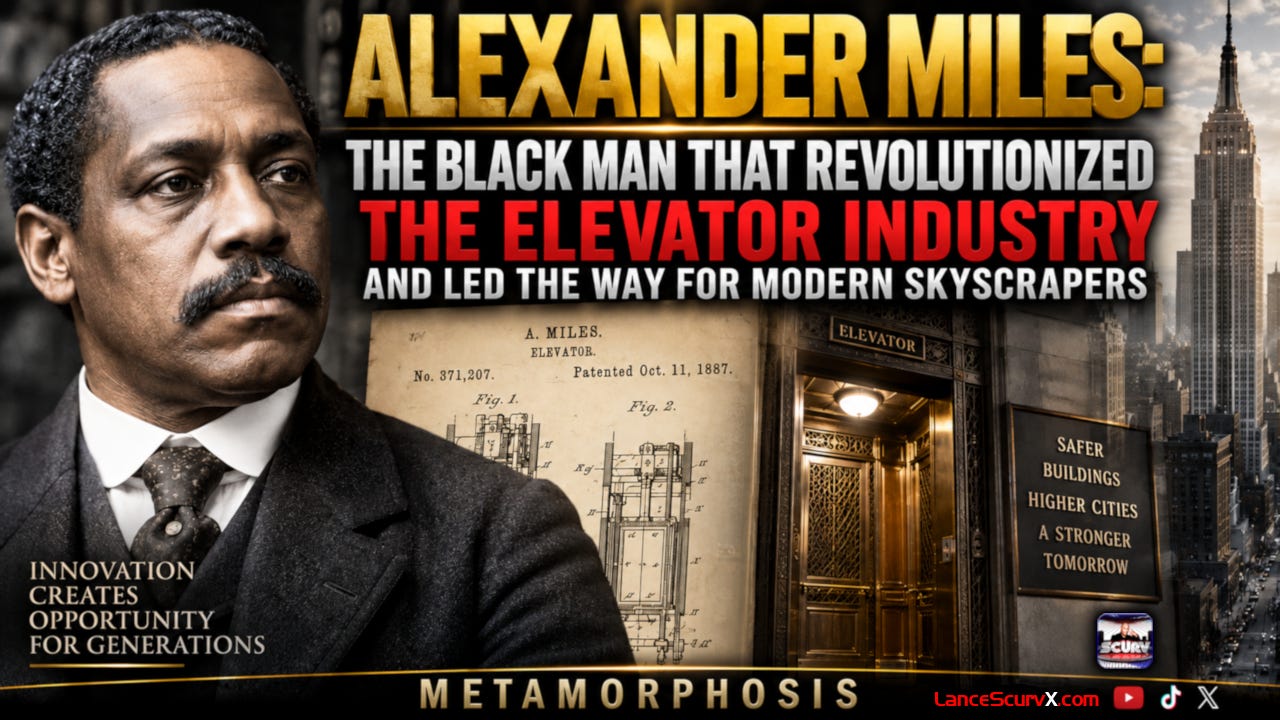
This was the problem Miles chose to address. His 1887 patent, U.S. Patent No. 371,207, focused on improvements involving the operation of elevator-cage doors and the closing of elevator shaft openings. His design incorporated a flexible belt connected with the elevator cage, along with drums, levers, and rollers that could help coordinate the movement of the doors with the elevator itself. In practical terms, Miles was working toward a system where the elevator’s movement could help control the opening and closing process rather than forcing people to rely entirely on manual action.
That distinction is extremely important because Alexander Miles didn’t invent the elevator itself. He also wasn’t the first person in history to experiment with automatic elevator doors. Other inventors had already developed concepts involving automatic or self-closing doors. Miles’ documented contribution was an improvement to the mechanism used to operate elevator-cage doors and secure shaft openings. His invention addressed a specific weakness within an existing technology and helped push elevator systems toward the safer automation that eventually became standard.
That’s actually a more valuable lesson about invention than the popular version of the story. Innovation doesn’t always mean creating something from nothing. Sometimes innovation means looking at an existing machine and identifying the part that remains dangerous, inefficient, inconvenient, or unnecessarily dependent on human judgment. Miles recognized that elevator technology could be improved by changing how its doors operated. He didn’t need to reinvent the entire elevator. He needed to solve the problem that was sitting directly in front of him.
TURNING AN IDEA INTO A PATENT
Miles filed his elevator patent application on May 23, 1887, and the patent was granted on October 11 of that year. The patent described improvements designed to make elevator operation safer by coordinating the doors and shaft openings with the movement of the elevator cage. This wasn’t simply an idea discussed in a barbershop. Miles had developed a mechanical concept that could be documented, illustrated, examined, and protected as intellectual property.
That’s an important part of understanding his intelligence as an inventor. There’s a major difference between complaining about a problem and engineering a solution. Plenty of people can see something that doesn’t work correctly. Plenty of people can imagine what they would like to see happen instead. The difficult part comes when you have to figure out the mechanical details that make the solution possible. Miles took that extra step.
His patent also demonstrates that he understood the value of protecting an invention. During the 19th century, patents were becoming an increasingly important part of American industrial development. A patent could give an inventor legal recognition and certain rights over an invention, but obtaining one required more than simply saying, “I thought of this first.” The invention had to be described in sufficient technical detail to establish what was being claimed.
Miles understood that his idea needed to move from imagination into documentation. That’s what transforms an idea into intellectual property. His name therefore became permanently attached to a specific improvement in elevator technology, even though the full story of his life eventually became much less widely remembered than the invention itself.
THE ENTREPRENEUR BEHIND THE INVENTOR
One of the biggest mistakes we make when discussing Black inventors is separating their inventions from the economic lives surrounding those inventions. We sometimes imagine an inventor as somebody who exists only inside a workshop, surrounded by tools and mechanical parts. Alexander Miles doesn’t fit that picture. He was deeply involved in business, property, and financial development.
His real-estate investments became a major part of his wealth. He understood that a growing city could create opportunities for people who were positioned correctly. Property could generate rent, appreciate in value, and provide a physical foundation for business activity. Miles used his earnings to acquire assets and construct buildings, and for a time his strategy worked extremely well.
His commercial success eventually made him one of the most prominent Black businessmen in his region. That achievement is especially significant when we remember the era in which he lived. Black Americans faced discrimination in employment, housing, finance, education, politics, and countless other areas of life. Yet Miles managed to build a business network and accumulate enough property to become a recognizable economic figure.
His success also challenges the lazy idea that Black economic achievement began recently. Black Americans were building businesses, purchasing land, creating products, establishing institutions, and accumulating wealth long before the modern civil-rights era. They were doing it under circumstances that were often much more hostile than anything we encounter today. Alexander Miles belongs to that larger history of people who understood that economic independence could become a form of protection.
WHEN THE FORTUNE STARTED TO FALL
But this is where Alexander Miles’ story becomes much more human because his success didn’t last forever. The real-estate market that had helped build his fortune eventually turned against him. Property values declined, rents fell, and investments that had once looked extremely secure became much more difficult to maintain.
This part of his life deserves attention because it demonstrates how fragile wealth can become when it depends heavily on a particular economic environment. A person can make every decision based on the information available at the time and still lose because the larger market changes. Miles had accumulated property during a period of growth, but when the market weakened, the same properties that had represented wealth became financial burdens.
He was forced to surrender or sell property to meet obligations, and the fortune he had spent years building was reduced dramatically. The man who had once occupied a position of considerable economic strength now had to deal with the consequences of financial decline. That’s a reminder that entrepreneurship isn’t a straight line from poverty to wealth. It’s a constant negotiation with risk.
And that’s one of the most important parts of his story for me. Alexander Miles wasn’t successful because everything went right. He was successful because he repeatedly adapted when things changed. His wealth eventually declined, but the knowledge he had accumulated couldn’t simply be taken away. He still knew how to work. He still understood business. He still possessed the experience of an inventor and entrepreneur.

FROM ELEVATORS TO INSURANCE
In 1899, Miles moved to Chicago and became involved in the insurance business. Once again, he entered an entirely different field, but when you look closely, there’s a connection between what he had done before and what he was doing now. Insurance is fundamentally about risk. It’s about recognizing that unexpected events can destroy financial stability and creating a system that provides protection when those events occur.
Miles had already spent years thinking about physical safety through elevator technology. Now he was thinking about financial safety. He helped establish an insurance company aimed at serving Black customers who often had difficulty obtaining adequate insurance coverage from existing institutions.
That decision tells us something important about his understanding of the Black community. Economic advancement wasn’t only about making money personally. It could also involve creating institutions that helped other people protect what they had. A family that owned a home, operated a business, or accumulated savings could lose much of that progress if a death occurred without financial protection. Insurance could help prevent one tragedy from becoming an economic catastrophe.
Miles therefore continued doing what he had done throughout his life: identifying vulnerabilities and trying to create systems that reduced their impact. The elevator problem involved physical danger. The insurance problem involved financial danger. The underlying instinct was remarkably similar.
FAMILY, LOSS, AND THE HUMAN BEING
Behind all of these businesses and inventions was a family. Miles married Candace Dunlap, and they had a daughter, Grace. The family experienced the same mixture of hope, ambition, responsibility, and uncertainty that families everywhere experience. Yet because historical records about ordinary private life are often incomplete, we have to be careful not to invent conversations or emotions that weren’t preserved.
What we can say is that family remained an important part of his life while his professional world continued changing. His wife eventually died in 1905, and that loss came after decades of building a life together. By then Miles had already experienced tremendous professional success and major financial changes, but personal loss presented a different kind of challenge.
Money can solve certain problems, but it can’t reverse death. Property can be replaced. A business can be rebuilt. A machine can be redesigned. But people cannot simply be reconstructed after they’re gone. The older Miles became, the more his life moved away from the expansion of wealth and toward the realities of aging, loss, and survival.
That’s the part of history that often disappears when we turn people into symbols. We remember the inventor but forget the husband. We remember the businessman but forget the father. We remember the patent but forget the man who had to wake up every morning and continue living after experiencing disappointment and loss.
THE FINAL YEARS
Miles eventually moved to Seattle, beginning another chapter in his already unusual life. By this stage, he was an older man who had lived through enormous changes in America. He had seen cities grow, transportation change, businesses expand, technology develop, and Black economic life evolve. He had also experienced the destruction of much of the wealth he had accumulated earlier.
In Seattle, he returned to barbering, the trade that had helped him begin his professional life decades earlier. There’s something deeply revealing about that return. The inventor who had patented an improvement to elevator technology and the businessman who had accumulated substantial property was once again relying on a trade that depended primarily on his own hands and skill.
That doesn’t mean his life had become meaningless. Quite the opposite. It shows how adaptable he had always been. When circumstances changed, he went back to something he knew how to do. There’s dignity in that kind of resilience, especially when we understand that his earlier wealth had been real and his later hardship was also real.
By 1918, Miles was seriously ill. His health had deteriorated, and friends were helping care for him. Eventually his condition became too difficult to manage privately, and he was taken to a county hospital. The man who had spent much of his life building businesses and solving problems was now confronting a problem that no invention could solve: the limitations of an aging human body.
Alexander Miles died in Seattle on May 7, 1918, just eleven days before his 80th birthday. He was cremated two days later. His death marked the end of a life that had traveled through several different versions of America, from the era of slavery and Reconstruction through industrial growth and the transformation of American cities.
THE LEGACY HIDING IN PLAIN SIGHT
What makes Alexander Miles’ legacy so unusual is that most people who benefit from the type of elevator-door safety he helped advance will never know his name. They’ll walk into elevators every day, watch the doors open and close, and never think about the generations of engineers and inventors who made that ordinary experience possible.
That’s actually the nature of successful technology. When a technology works well, it becomes invisible. People stop thinking about the invention because they’re focused on the convenience it provides. The better the technology becomes, the less attention we give to the people who helped create it.
But that doesn’t make the contribution less important. Miles identified a danger in an emerging technology and worked on a solution. His patent became part of the long history of improvements that eventually helped produce modern elevator systems. His contribution therefore lives not only in a patent archive but in the everyday experience of moving through modern buildings.
There’s also a larger architectural lesson here. The skyscraper depends heavily on vertical transportation. Buildings can rise dozens of stories into the sky, but those upper floors only become practical when people can move between them efficiently. Elevators transformed the economics of urban construction by making height useful rather than merely impressive.
Alexander Miles didn’t invent the skyscraper, and he didn’t single-handedly create the modern elevator. But his improvement addressed one of the safety problems that had to be solved as elevators became increasingly important. That’s how technological progress usually works. One person improves one component. Another person improves something else. Someone else develops a new safety system. Eventually all of those improvements combine into a technology that looks completely different from where it started.
WHAT ALEXANDER MILES REALLY TEACHES US
The greatest lesson in Alexander Miles’ life may have nothing to do with elevators. His life demonstrates the power of refusing to remain trapped inside one definition of yourself. He started in barbering, but he didn’t remain only a barber. He became an inventor, but he didn’t become only an inventor. He became a property owner, a businessman, an investor, and an insurance entrepreneur. He moved when circumstances required it. He changed direction when opportunities changed. He experienced wealth and then experienced financial hardship.
That kind of adaptability is something we should talk about more often because modern society loves simple success stories. We want to believe that successful people simply make the right decisions and continue moving upward forever. Alexander Miles’ life tells us something more honest. Success can be real and temporary at the same time. Wealth can be accumulated and lost. A person can reach the top of one mountain and later find themselves climbing another.
His life also reminds us that invention isn’t limited to laboratories filled with expensive equipment. Sometimes the inventor is standing behind a barber chair. Sometimes the inventor is working inside a small business. Sometimes the inventor is simply watching the world and asking questions. The critical ingredient isn’t always money. It’s observation. It’s curiosity. It’s the willingness to challenge something everybody else has accepted.
And that’s where Alexander Miles becomes relevant to every generation. Young people can look at his life and understand that their first job doesn’t have to define their entire future. Entrepreneurs can look at him and understand the importance of building assets. Inventors can look at him and understand that solving one specific problem can have enormous consequences. Older people can look at him and recognize that reinvention doesn’t belong exclusively to the young.
Most importantly, Alexander Miles reminds us that history is filled with people whose contributions are much larger than the amount of attention they receive. His name may not be as familiar as it should be, but his work became part of an everyday technology used around the world. That’s a powerful form of legacy because it doesn’t depend on people remembering your name every day. The work continues whether the applause continues or not.
CLOSING PERSPECTIVES…
When I look at the life of Alexander Miles, I don’t see a man who simply invented something and walked away from the story. I see a Black man who spent nearly eight decades navigating an America that was changing rapidly while still carrying the heavy realities of race, class, business competition, family responsibility, financial risk, and aging. I see a man who learned a trade, built businesses, experimented with inventions, accumulated property, entered civic life, suffered financial losses, experienced personal grief, changed careers, and continued working. His life wasn’t perfect, and that’s exactly why his story matters.
I also see a lesson about the difference between having an idea and doing something with it. Alexander Miles saw a problem that other people could have ignored. He recognized that elevator doors and shaft openings could create danger, and instead of simply accepting that danger as part of modern life, he worked on a mechanical solution. That’s what separates an inventor from somebody who merely notices a problem. The world is full of people who complain about what doesn’t work. Progress comes from the people who eventually ask themselves what they can do to make it work better.
His financial story also deserves to remain attached to his legacy because it makes him more than an inspirational character. He accumulated substantial wealth, but that wealth didn’t protect him from economic forces beyond his control. The property market changed, his fortune declined, and he eventually experienced financial hardship. His life therefore teaches us that wealth should never be confused with immortality. Money can create opportunities and provide protection, but it can’t stop markets from changing, people from dying, or human bodies from aging.
And perhaps that’s why the elevator itself is such an appropriate symbol for his life. Alexander Miles experienced his own rises and falls. He rose from a skilled trade into entrepreneurship. He rose into property ownership and considerable wealth. He rose into the world of invention and business leadership. Then he experienced financial decline, personal loss, illness, and the realities of old age. Yet his contribution continued moving upward even when his personal circumstances were moving in the opposite direction.
So when those elevator doors open in front of you, don’t look at them as just another piece of machinery. Look at them as part of a much larger human story about people who saw problems and refused to accept them as permanent. Alexander Miles didn’t create the entire elevator industry, and he didn’t single-handedly build the skyscrapers that dominate modern cities. His contribution was more specific, but it was also meaningful. He helped solve a dangerous problem inside an important technology, and that solution became part of the long road toward the elevators we use today. The man eventually disappeared into history, but the doors kept opening. The machinery kept moving. The buildings kept rising. And that’s perhaps the most powerful legacy an inventor can leave behind: creating something useful enough that future generations can benefit from it without ever realizing how much thought, struggle, and determination went into making it possible.
