


IS AFRICA BECOMING THE NEW CELEBRITY PUBLICITY TOUR?
There’s something I’ve been thinking about that deserves a much deeper conversation. Every so often, we see a Black celebrity travel to Africa, receive a huge welcome, take photographs with important people, visit beautiful locations, talk about the Motherland, and return home surrounded by attention. On the surface, it can look inspiring. It can look like reconnection. It can look like somebody finally remembering where they came from. But sometimes I have to stop and ask myself a simple question: are we watching genuine reconnection, or are we watching another publicity campaign? I’m not saying every Black celebrity who travels to Africa has bad intentions. I’m not inside anyone’s heart, and I can’t tell another person what their real motivation happens to be. But I can question patterns. I can question timing. I can question the amount of publicity surrounding these trips. I can question what happens after the cameras leave. Because if somebody travels thousands of miles to Africa, receives a royal welcome, takes beautiful photographs, talks about ancestral connection, and then disappears until the next publicity opportunity, I think we have every right to ask what the trip actually accomplished.
I’m not saying every Black celebrity who travels to Africa has bad intentions, because none of us can see inside another person’s heart, but I do believe we can examine patterns and ask legitimate questions about what we’re seeing. Africa has become extremely attractive to the global Black imagination, and for many people, Africa represents ancestry, identity, history, spirituality, culture, possibility, and home. That emotional connection is powerful, but anything that carries that much emotional power can also become useful as a marketing tool. When somebody’s career needs fresh energy, a carefully publicized African journey can create headlines, social-media conversations, interviews, photographs, and renewed public interest. Suddenly, people who weren’t talking about that person yesterday are talking about them today, and that alone raises an important question about whether the journey is primarily about connection or whether the connection itself has become part of the celebrity’s brand.
Africa has become extremely attractive to the global Black imagination because it represents something much deeper than tourism. For many people in the diaspora, Africa represents ancestry, identity, history, spirituality, culture, possibility, and home. That emotional connection is powerful, but anything carrying that much emotional power can also become useful as a marketing tool. A celebrity can place themselves inside that emotional story and suddenly create an entirely different public narrative around their career. They can be presented as someone reconnecting with ancestry, discovering themselves, embracing the Motherland, and becoming connected to something larger than entertainment. There’s nothing wrong with any of those things when they’re genuine, but the problem begins when the symbolism becomes more important than the substance.
THAT’S WHERE THE CONVERSATION GETS UNCOMFORTABLE
I believe we need to separate the idea of visiting Africa from the idea of connecting with Africa, because those two things aren’t automatically the same. You can visit a continent without building a relationship with its people. You can take photographs without understanding the history. You can attend ceremonies without understanding their meaning. You can receive a tremendous welcome without ever asking what you can contribute in return. You can even speak beautifully about the Motherland while still treating the Motherland like a backdrop. That’s the part that bothers me, because Africa shouldn’t simply be a place where celebrities go to refill their public image, and Africa shouldn’t become a cultural battery where somebody comes to recharge their relevance, collect some powerful photographs, generate emotional headlines, and then fly back home.
If the connection is real, then something deeper should remain after the cameras disappear. There should be relationships, investment, education, collaboration, business, mentorship, and cultural exchange. There should be something that continues when the celebrity plane takes off. Africa has spent far too much time being viewed through the eyes of outsiders, and I believe the relationship between Africa and the diaspora deserves more depth than another carefully presented celebrity moment. If someone truly sees Africa as the Motherland, then there should eventually be a desire to understand the people, participate in the future, create opportunities, and contribute something meaningful rather than simply consume an emotional experience.
THE DIFFERENCE BETWEEN BEING SEEN AND ACTUALLY CONNECTING
We live in an attention economy where attention has become currency. A person can be talked about today and forgotten tomorrow, and a career can be extremely successful for years before suddenly entering a quieter period. The public moves on quickly, new entertainers appear, new influencers emerge, new controversies dominate the conversation, and new personalities capture the audience’s attention. So what happens when somebody who once dominated the spotlight suddenly isn’t receiving the same attention? Sometimes they reinvent themselves, sometimes they change their image, sometimes they announce a new project, and sometimes they travel somewhere that carries enormous emotional and cultural meaning.
Africa can provide all of that because the imagery alone can be powerful. A Black celebrity standing on African soil can create an entirely different narrative, and suddenly the person isn’t simply an entertainer anymore. They’re presented as somebody reconnecting with ancestry, discovering themselves, and embracing the Motherland. There’s nothing wrong with any of those things when they’re genuine, but I believe we have to become more intelligent as an audience and understand that being seen connecting isn’t necessarily the same thing as actually connecting. If the photograph is the main event, we have to question the event. If the announcement is bigger than the relationship, we have to question the relationship. If the celebrity receives enormous publicity but leaves behind little meaningful work, we have to ask whether Africa was actually the destination or whether Africa was the content.
AFRICA HAS BECOME POWERFUL BRANDING
The modern celebrity understands branding, and everything matters. Clothing matters, locations matter, associations matter, who you stand next to matters, where you’re photographed matters, and what story accompanies the photograph matters. Africa carries a powerful story, especially for Black people around the world, because Africa can represent something much deeper than tourism. It can represent the beginning of a story that was interrupted by slavery, colonialism, displacement, and generations of separation. That makes African symbolism extremely emotional, and a celebrity who understands that emotional connection can create an entirely new public narrative simply by placing themselves inside that symbolism.
But here’s where I believe we have to become more intelligent as an audience. We shouldn’t automatically applaud every African visit simply because a famous Black person is standing on African soil. We should ask what they’re actually doing there, who they’re meeting, what they’re learning, what they’re building, what they’re investing, who benefits, what happens after they leave, whether they’re returning, whether they’re creating opportunities, whether they’re bringing other people with them, and whether they’re developing relationships that last beyond the photograph. Those questions aren’t disrespectful, and those questions aren’t attacks. Those questions are responsible because genuine interest should eventually produce genuine action.
THE CAMERA CAN CREATE AN ILLUSION OF DEPTH
One of the biggest problems with celebrity culture is that a photograph can make something look much deeper than it actually is. A person can stand in front of an African landscape and suddenly the photograph carries enormous emotional weight. Add traditional clothing, local cultural elements, smiling children, respected community leaders, beautiful scenery, and a few emotional statements about ancestry, and the entire presentation can feel profound. But photographs don’t tell us what happens behind the scenes. A photograph can show us where somebody stood, but it can’t automatically show us what they understood. A photograph can show us who somebody met, but it can’t show us whether a meaningful relationship developed. A photograph can show us what somebody experienced for one afternoon, but it can’t show us whether they cared enough to return.
That’s why I’m less interested in the photograph than I am in what comes afterward. If somebody genuinely falls in love with Africa, that relationship should eventually become visible through action. Maybe they invest in a business, support education, create jobs, collaborate with African artists, build something that connects African communities with the diaspora, learn about the history and continue teaching others, or return year after year. Maybe they stop talking about Africa as some exotic destination and start talking about African people as partners. That’s when the conversation changes, because genuine connection eventually produces responsibility. If you love a place, you become interested in its future. If you respect a people, you become interested in their wellbeing. If you claim a cultural connection, you eventually have to ask what responsibility comes with that connection.
THE AFTERMATH TELLS THE STORY
If somebody truly wants to build a relationship with Africa, I believe the relationship should be judged by what remains after the spotlight moves somewhere else. Celebrity careers rise and fall, and that’s the nature of entertainment. People who were once everywhere can eventually become less visible. Their music may not receive the same attention, their movies may not dominate the conversation, their interviews may not generate the same excitement, and younger audiences may not even know who they are. That can create a powerful incentive to reinvent themselves, and Africa can become part of that reinvention.
A celebrity can suddenly appear deeply connected to the continent, the media can pick up the story, social media can begin circulating photographs, people can debate the meaning of the trip, fans can celebrate the connection, critics can question it, and either way, the celebrity becomes relevant again. That’s the genius of attention. You don’t necessarily need everybody to love you; you just need people talking about you. But Africa shouldn’t have to become the marketing department for somebody’s fading career. The Motherland deserves more than being turned into a temporary stage for somebody else’s personal branding strategy.
THE MOTHERLAND DESERVES MORE THAN A PHOTO OP
Africa has spent centuries being photographed by outsiders. Explorers photographed it, colonial officials photographed it, tourists photographed it, journalists photographed it, documentary crews photographed it, and now celebrities photograph it. But photography doesn’t automatically create progress. Africa doesn’t need to become another beautiful background for somebody else’s personal story, because Africa has its own story. Africa has entrepreneurs, artists, scientists, farmers, engineers, educators, builders, young people creating businesses and technologies, and communities dealing with real problems while creating real solutions.
So when someone comes from the diaspora claiming a connection to the Motherland, I believe the conversation should eventually move beyond emotion and ask what we can build together. That’s the question. If the only thing that comes out of the relationship is a series of photographs, interviews, headlines, and social-media posts, then I believe we’re missing an opportunity. The connection between Africa and the diaspora could be one of the most powerful relationships in the world, but that power can’t be built on celebrity appearances alone. It has to be built through relationships, investment, knowledge, cooperation, and a willingness to remain involved after the excitement has faded.
WHAT DOES AUTHENTIC RECONNECTION ACTUALLY LOOK LIKE?
Authenticity doesn’t require perfection. Someone can travel to Africa for the first time and genuinely be learning. Someone can arrive without knowing much and leave with a completely different understanding of themselves. Someone can be moved emotionally by standing on African soil, and someone can begin a relationship that takes years to develop. That’s completely possible, and I don’t want to dismiss genuine experiences simply because celebrity culture has taught us to be suspicious.
But authentic connection has a characteristic that publicity doesn’t have: consistency. You don’t have to announce every meaningful thing you do. You don’t have to make everything a production. You don’t have to turn every cultural experience into a headline. Sometimes the most meaningful work happens quietly, and that’s why I become suspicious when the spectacle becomes bigger than the substance. If the trip becomes a major media event but the relationship disappears afterward, what exactly happened? If the celebrity talks about ancestral connection but never develops a lasting relationship with African communities, what was actually connected? If the entire journey produces millions of impressions but no meaningful investment, who benefited? These are uncomfortable questions, but uncomfortable questions are sometimes necessary.
AFRICA SHOULD NOT BE USED TO REPAIR A PUBLIC IMAGE
There’s another layer to this conversation that we have to confront. Celebrity careers rise and fall, and people who were once everywhere can eventually become less visible. When somebody’s public relevance begins to cool, there can be pressure to create a new narrative around that person. A highly publicized African journey can provide that narrative because it offers something that ordinary publicity cannot always provide: emotional depth, cultural symbolism, ancestral meaning, beautiful imagery, and an opportunity for the audience to see the celebrity in an entirely different light.
That can create headlines, social-media engagement, interviews, photographs, and renewed public interest. The person may suddenly become associated with ancestry, African culture, self-discovery, and the Motherland. But Africa shouldn’t have to become part of somebody’s comeback story. The continent shouldn’t have to carry the emotional weight of repairing somebody else’s public image. If the relationship is genuine, then Africa should be more than a tool for changing the conversation around a celebrity. The relationship should exist whether or not the celebrity needs attention.
THE DIASPORA ALSO HAS RESPONSIBILITY
I don’t place all of the responsibility on celebrities. The African diaspora has to examine itself too. Why do we become so excited when a famous person arrives in Africa? Why do we automatically assume their intentions are pure? Why do we sometimes give celebrities more respect simply because they’re famous? Why do we treat celebrity attention toward Africa as though Africa has finally been validated? Africa doesn’t need validation from celebrities. The Motherland existed before the celebrity arrived, African civilizations existed before the celebrity arrived, African cultures existed before the celebrity arrived, and African people had dreams, businesses, families, communities, creativity, intelligence, and ambition before the celebrity arrived.
So the relationship shouldn’t be built around Africa being grateful that somebody famous finally noticed it. The relationship should be based on mutual respect, and that’s a completely different mindset. We should be able to welcome people while still asking questions. We should be able to celebrate cultural exchange while still demanding substance. We should be able to appreciate a celebrity’s interest in Africa without automatically treating that interest as proof of authenticity.
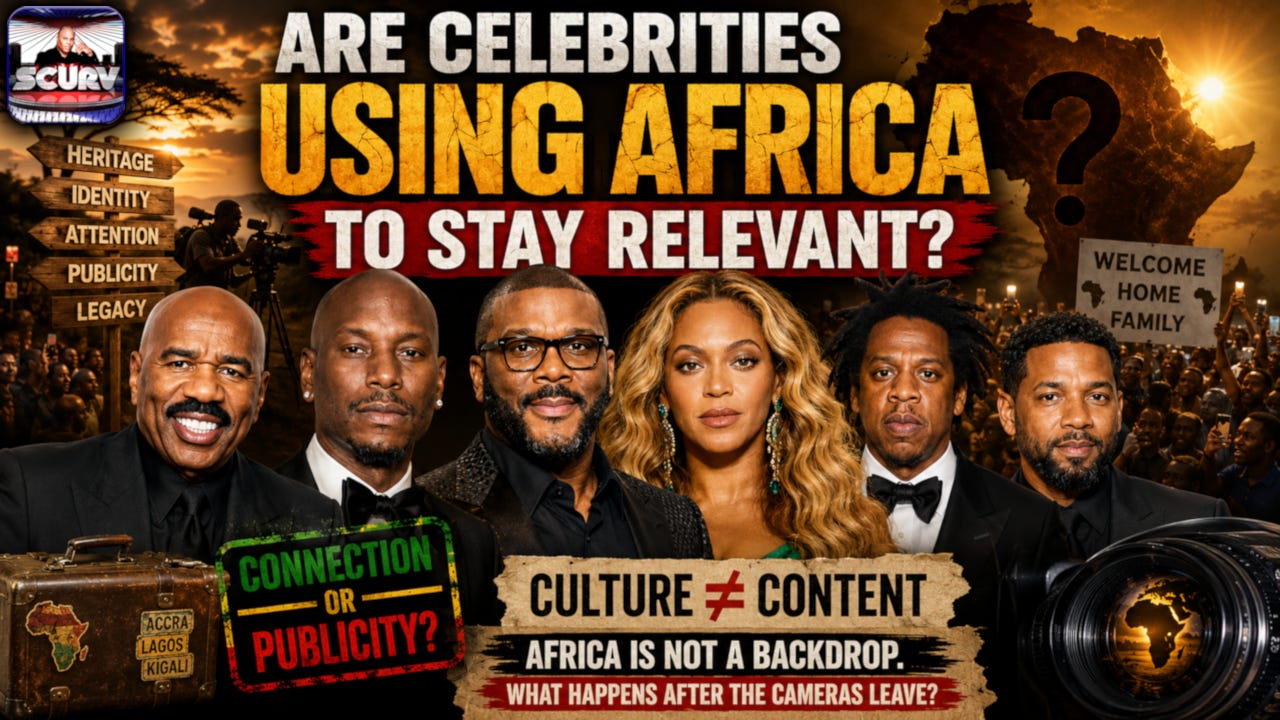
WE HAVE TO STOP CONFUSING ACCESS WITH AUTHENTICITY
One of the easiest ways to make a trip look important is to surround yourself with important people, but access doesn’t automatically equal authenticity. Being welcomed into a palace doesn’t mean you understand the people. Being photographed with leaders doesn’t mean you understand the country. Being surrounded by traditional culture doesn’t mean you understand its history. Being called family doesn’t mean you’ve actually built a family relationship. These things can be meaningful, but they have to become more than moments.
A relationship is built over time. Trust is built over time. Respect is built over time. Community is built over time. Investment is built over time. If somebody really wants to connect with Africa, there’s nothing wrong with taking that time. There’s nothing wrong with learning slowly, asking questions, making mistakes, listening to people, and developing relationships that don’t immediately produce a headline. In fact, that may be the strongest evidence that the connection is real.
THE QUESTION ISN’T WHETHER THEY WENT TO AFRICA
The question I’m asking isn’t why this person went to Africa, because people should absolutely go to Africa. Black people from the diaspora should go. Families should go. Young people should go. Older people should go. Entrepreneurs should go. Artists should go. Students should go. Anyone who wants to understand the continent should go. The question is what happens when you get there. Are you going simply to consume an experience? Are you going to take photographs? Are you going to tell everybody that you found yourself? Or are you willing to actually develop a relationship with the place?
Africa isn’t Disneyland for the diaspora. Africa isn’t an ancestral theme park, and Africa isn’t a backdrop for somebody’s personal transformation story. Africa is home to hundreds of millions of people living real lives, and if you claim a connection to those people, then eventually your actions should reflect that connection. The relationship should become deeper than the emotional excitement of arriving, deeper than the attention generated by the visit, and deeper than the photographs that remain after the plane takes off.
THE CELEBRITY DOESN’T HAVE TO PROVE ANYTHING
There’s also something liberating about realizing that authentic connection doesn’t require a publicity campaign. If you genuinely love Africa, you don’t need to convince everybody. If you genuinely respect African culture, you don’t need to perform respect for the camera. If you genuinely want to build relationships, you don’t need every meeting documented. If you genuinely want to invest, you don’t need applause for every dollar. Sometimes authenticity becomes more powerful when it doesn’t need an audience.
That’s the irony of the celebrity world. The person may need attention, but the relationship doesn’t. The relationship needs time, honesty, consistency, and mutual benefit. Africa doesn’t need somebody famous to prove that it has value, and African people don’t need celebrity approval to validate their own existence. What’s needed is a relationship where both sides recognize what they can learn from one another and what they can build together.
THAT’S THE STANDARD WE SHOULD DEMAND
I don’t want to discourage Black celebrities from going to Africa. I want more of them to go, but I want them to go with a different mindset. Don’t just go where the cameras are; go where the people are. Don’t just meet famous people; meet ordinary people. Don’t just visit beautiful places; learn the history. Don’t just talk about ancestry; study the culture. Don’t just take pictures; build relationships. Don’t just receive; contribute. Don’t just make an announcement; follow through. That’s how you turn a publicity moment into a meaningful connection.
Ultimately, I don’t believe we can determine somebody’s intentions simply by watching a video or looking at photographs. Maybe some celebrity journeys are completely genuine. Maybe some are partly genuine and partly promotional. Maybe some are carefully designed publicity opportunities. We can’t know what’s inside somebody’s mind unless they tell us, but we can observe behavior, and behavior tells us much more than speeches. So I’m watching what happens after the plane leaves. Does the relationship continue? Does the investment continue? Does the learning continue? Does the collaboration continue? Does the conversation continue? Does the celebrity return? Does anything meaningful remain? Because when the cameras disappear, that’s when the truth becomes much easier to see.
THE MOTHERLAND IS NOT A PUBLICITY PROP
Africa deserves better than being used as a temporary stage for somebody’s personal branding. The Motherland deserves people who come with curiosity, humility, respect, and a willingness to contribute. If somebody genuinely discovers something about themselves while visiting Africa, I’m all for it. But discovering yourself shouldn’t require exploiting the symbolism of an entire continent. Africa shouldn’t have to become part of somebody’s comeback story because Africa already has its own story, and that story deserves to be told, understood, respected, and supported whether or not a celebrity happens to be standing in front of the camera.
THAT’S THE CONVERSATION I BELIEVE WE NEED TO HAVE
I’m not interested in attacking anybody simply because they traveled to Africa. I’m interested in questioning a culture that sometimes rewards appearances more than substance. We’ve become so accustomed to celebrity spectacle that we can mistake visibility for authenticity, access for connection, photographs for relationships, and emotional speeches for meaningful action. I believe we have to become smarter than that because if Africa is truly the Motherland, then our relationship with it should be deeper than a vacation, deeper than a photograph, and deeper than a publicity campaign.
Because eventually, the cameras turn off. The headlines disappear. The social-media posts stop circulating. The celebrity moves on to the next project, and Africa remains. That’s when we find out whether the visit was simply a moment of attention or the beginning of something real.
SCURV