
Political cartoons have always had one job: to make people laugh while making them think. Long before social media memes dominated the internet, artists sharpened their pencils instead of their keyboards, creating illustrations that captured an entire political moment with a single image. Sometimes they were clever. Sometimes they were brutal. But the best ones were impossible to ignore.
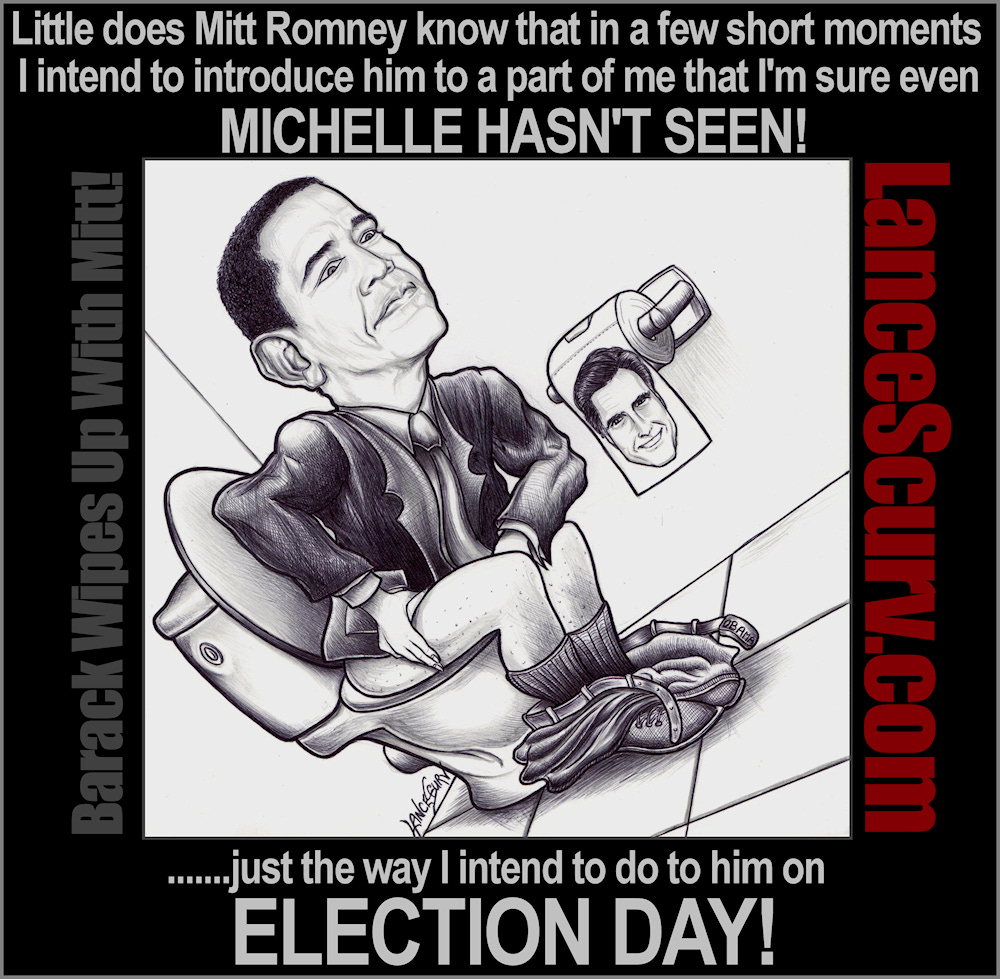
The illustration featured here was created during the heated 2012 presidential election between President Barack Obama and Republican challenger Mitt Romney. That’s important to understand because this artwork belongs to that specific chapter in American politics. It’s a time capsule from one of the most watched elections in modern history, when emotions ran high and every speech, debate, and campaign stop became material for comedians, cartoonists, and late-night television.
I’ve always believed that political art works best when it refuses to play it safe. Whether someone agreed or disagreed with the message was never the point. The purpose was to create a reaction. If people laughed, argued, or even became uncomfortable, then the illustration had already done what good satire has always done throughout history.
This particular drawing uses one of the oldest forms of comedy known to mankind: bathroom humor. While some people may roll their eyes at it, others immediately understand the joke. The image doesn’t show anything indecent, but it pushes the viewer just close enough to the edge to deliver the punchline through suggestion instead of explicit imagery.
That’s where the artwork becomes more than just a funny picture. It’s an example of how visual metaphors can say something that words alone never could.
THE DOUBLE MEANING MAKES THE JOKE WORK
The title, “Barack Wipes Up With Mitt,” operates on two completely different levels.
The first meaning is political. To “wipe up with” an opponent is an old expression suggesting someone completely defeats another person in a contest. Athletes say it. Fans say it. Political supporters say it during election season. It’s colorful language that’s meant to express confidence before a major competition.
The second meaning comes from the illustration itself.
President Obama is seated on a toilet, with a roll of toilet paper displaying Mitt Romney’s face. Nothing graphic is shown, yet the implication is obvious. The visual joke transforms the common expression into something much more literal, creating a humorous collision between language and imagery.
Then the dialogue pushes the joke even further.
Across the top, Obama humorously says that Mitt Romney doesn’t realize he’s about to be introduced to a part of him that even Michelle hasn’t seen. It’s exaggerated, ridiculous, and intentionally over-the-top. The line exists purely to amplify the absurdity of the visual setup.
At the bottom, the final caption delivers the second punchline by tying everything back to Election Day. Suddenly the bathroom scene becomes a metaphor for political victory, suggesting that Romney would be treated just as harshly at the ballot box as the toilet paper in the illustration.
That’s classic editorial cartoon construction.
Every element works together toward one joke.
WHY POLITICAL CARTOONS HAVE ALWAYS BEEN SO AGGRESSIVE
Political cartoons were never designed to be polite.
For centuries they’ve exaggerated noses, ears, facial expressions, body language, clothing, and personalities. Leaders have been drawn as pigs, snakes, clowns, babies, kings, robots, monsters, and every other symbol imaginable.
Nobody escaped.
The goal wasn’t realism.
The goal was impact.
Editorial cartoonists understood that exaggeration grabs attention much faster than a carefully worded essay. A single drawing could summarize weeks of political headlines before a reader even reached the first paragraph of a newspaper.
That’s what makes this illustration part of a much larger artistic tradition.
Whether someone loved Barack Obama or supported Mitt Romney, the cartoon wasn’t pretending to be neutral. It openly embraced one viewpoint while using humor as its delivery system.
That’s exactly what political satire has always done.
THE 2012 ELECTION CREATED ENDLESS MATERIAL
The 2012 presidential race generated an enormous amount of political comedy.
Every debate became instant material for cartoonists.
Every campaign stop produced new jokes.
Every television commercial inspired another parody.
Supporters on both sides confidently predicted overwhelming victory while opponents mocked every speech, every campaign promise, and every public appearance.
This illustration captures that atmosphere perfectly.
Instead of relying on statistics or policy discussions, it expresses political confidence through visual comedy. The message couldn’t be much clearer. According to the cartoon, Obama wasn’t simply planning to win. He intended to completely embarrass his opponent.
Whether history ultimately justified that confidence isn’t even the main point of the drawing.
The humor comes from the certainty.

WHEN ART BECOMES A HISTORICAL TIME CAPSULE
One of the things I enjoy most about older illustrations is how they preserve emotions that statistics can’t.
Election results tell us who won.
History books explain what happened.
But cartoons reveal how people actually felt during the campaign.
Years later, viewers may smile because they remember the debates, the campaign commercials, the nonstop political advertisements, and the heated conversations that surrounded that election.
The artwork instantly transports people back to that specific moment in time.
That’s why it’s important to remember that this illustration wasn’t created as commentary on today’s political climate. It belongs to a different era, reflecting the humor, emotions, and campaign atmosphere surrounding the Obama-Romney election.
Viewed through that historical lens, it becomes less about modern politics and more about preserving a memorable chapter of American political culture.
HUMOR HAS ALWAYS BEEN A POLITICAL WEAPON
Some speeches inspire.
Some debates persuade.
Some advertisements convince.
But laughter reaches people in a completely different way.
A joke can sometimes travel farther than a campaign speech because people remember how it made them feel. Political humor has always been one of the fastest ways to challenge authority, celebrate victory, or mock an opponent without delivering a lengthy argument.
This illustration embraces that tradition without apology. It’s loud, exaggerated, and impossible to mistake for anything other than satire. Whether someone laughs or shakes their head, they’re still engaging with the artwork exactly as political cartoons were always intended.
Years after the election ended, the drawing now serves another purpose. It reminds us how quickly political moments become history. Campaign slogans fade. Television commercials disappear. News headlines are forgotten. But a memorable cartoon often survives because it captures the emotion of an era in one unforgettable image.
Looking back now, the illustration feels almost like opening an old scrapbook. It doesn’t ask us to relive old arguments as much as it invites us to remember the atmosphere that surrounded one of the country’s most closely watched presidential contests.
That’s the lasting power of editorial art. It freezes a moment that would otherwise disappear. Whether you agreed with the message or completely rejected it, the illustration still succeeds because it tells a story with humor, symbolism, and fearless exaggeration.
Political cartoons have always been at their best when they refuse to whisper. They shout. They provoke. They entertain. And years later, they remind us that even the most serious elections have always inspired artists to find laughter in the middle of the fight.