


A NAME THEY WHISPERED BUT NEVER SHOUTED
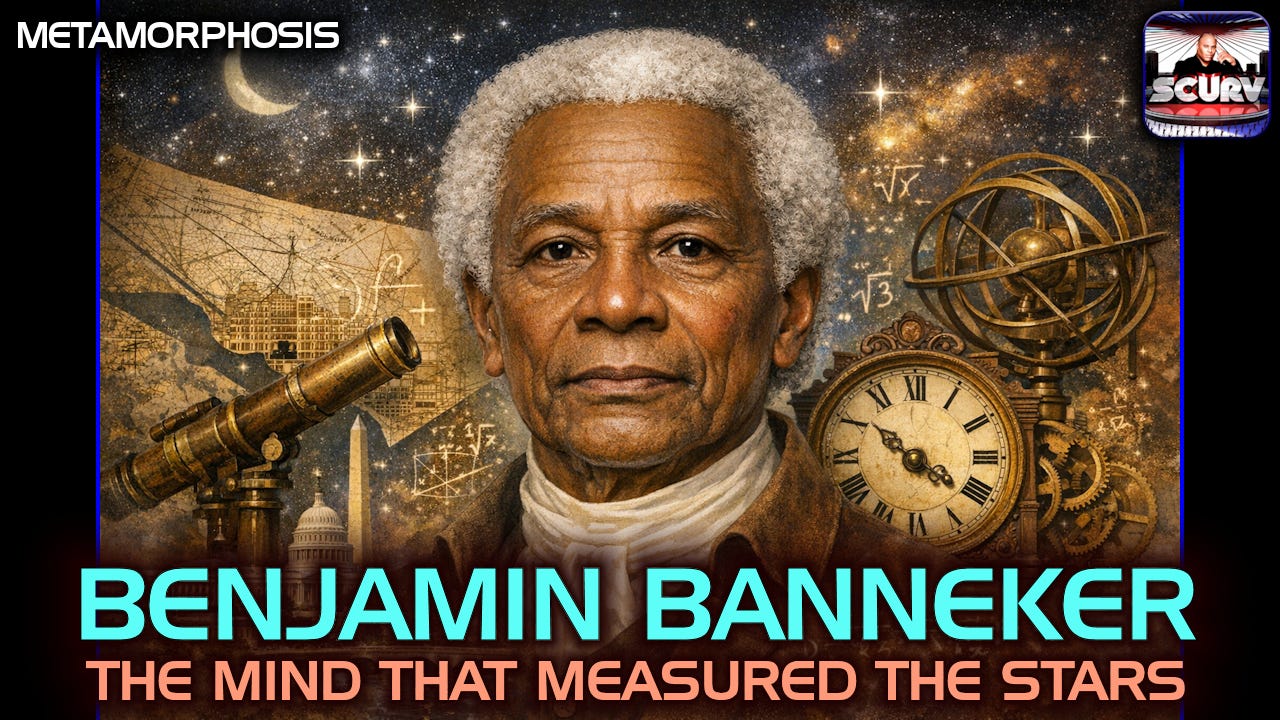
When we talk about early American genius, certain names are pushed to the front. But there was a free Black man born in 1731 who mastered mathematics without formal schooling, charted the movements of the stars without a telescope like modern astronomers, built a wooden clock that ran for decades, and helped survey the land that became the nation’s capital. His name was Benjamin Banneker.
He was born on November 9, 1731, in Baltimore County, Maryland. He was not born into wealth. He was not born into privilege. He was born into a time when most people who looked like him were enslaved. Yet he was free. That fact alone shaped his life in powerful ways.
His grandmother was an English woman who had come to America as an indentured servant. After gaining her freedom, she bought land and even purchased two enslaved men, later freeing one of them and marrying him. That union created a rare free Black family in colonial America. That free land became the foundation of Banneker’s future.
From a young age, he showed signs of brilliance. But understand this: he had little formal education. A small Quaker school for a short time. After that, he was largely self-taught. Everything he became, he built from curiosity, discipline, and relentless focus.
And today, I’m not giving you the watered-down version. I’m giving you the full 360-degree truth about the farmer, the mathematician, the astronomer, the writer, the surveyor, and the fearless thinker who dared to challenge the hypocrisy of a young nation.
ROOTS OF FREEDOM IN A LAND OF CHAINS
Banneker grew up on a tobacco farm. Farming was not optional; it was survival. He learned how to plant, harvest, rotate crops, and manage land. But while his hands worked the soil, his mind studied numbers and patterns.
He borrowed books whenever he could. One of the most important influences in his early life was access to scientific texts from neighbors who saw his hunger to learn. He studied geometry and astronomy from borrowed books, copying entire sections by hand because books were rare and expensive.
At around age 21, he did something that shocked his community. He built a fully functioning wooden clock. Not a toy. A large, striking clock carved entirely from wood, based on studying a pocket watch. That clock reportedly kept accurate time for over 40 years. Think about that. No YouTube tutorials. No engineering school. Just observation and genius.
But Banneker did not stop at mechanics. He turned his attention upward.
A MAN WHO READ THE SKY
Astronomy became his obsession. He taught himself to calculate solar and lunar eclipses. He tracked the movement of planets. He predicted celestial events with stunning accuracy.
In 1789, he correctly predicted a solar eclipse. Many white scholars at the time doubted his ability. But when the eclipse occurred as he said it would, critics had to fall silent.
He began publishing almanacs in 1792. These were not simple calendars. They included astronomical data, weather predictions, tide tables, and essays challenging slavery and racial injustice. These almanacs were printed and distributed across several states. For a Black man in the 1700s, this was revolutionary.
His almanacs also included mathematical puzzles and complex calculations that proved beyond question that he was operating at a high intellectual level. He used science not just as knowledge, but as proof of equality.
THE SURVEY OF WASHINGTON, D.C.
In 1791, Banneker was appointed to assist in surveying the land that would become Washington, D.C.. This was the new federal district being carved out along the Potomac River.
He worked as part of a team mapping boundaries for what would become the capital city. Contrary to popular myth, he did not design the street layout itself, but he played a key role in the astronomical calculations that helped determine the district’s boundaries.
He used the stars to establish precise positions. Surveying in that era required astronomical observation. His mathematical skills were essential in helping to map out the ten-mile square that defined the district.
After several months, he returned to his farm. But his work had already placed his fingerprints on American soil in a permanent way.
THE LETTER THAT SHOOK POWER
One of the boldest acts of his life came in 1791 when he wrote a letter to Thomas Jefferson. In that letter, Banneker challenged Jefferson’s published beliefs about Black intellectual inferiority.
He reminded him of the words written in the Declaration of Independence about equality. He confronted him with calm but firm logic. And he included a copy of his almanac as proof of Black intellectual capability.
Jefferson responded respectfully and even sent Banneker’s almanac to the French Academy of Sciences. But let’s be clear: Banneker was not begging. He was holding America accountable to its own words.
A QUIET LIFE, A POWERFUL MIND
Banneker never married. He lived most of his life on his family farm. He preferred study and solitude. He kept detailed journals about weather patterns, bees, and natural cycles. His scientific curiosity extended into agriculture and ecology.
In 1806, at age 74, he died peacefully in his sleep. On the day of his funeral, a mysterious fire destroyed his home and many of his papers. Whether accident or sabotage, we do not know. What we do know is that much of his written work was lost.
But his impact was not.
Schools, streets, and institutions now carry his name. Yet even today, many people know only fragments of his story.
WHY HIS STORY MATTERS NOW
Banneker represents self-education in its purest form. He represents intellectual resistance. He represents the power of the mind over circumstance.
He lived in a slave society but was not mentally enslaved. He mastered mathematics when many believed he should not even read. He measured the stars in a time when many tried to measure his worth.
His life forces us to ask hard questions about hidden genius. How many others like him were silenced? How many contributions were erased?
When we speak his name, we are not just remembering a man. We are reclaiming a truth that brilliance cannot be contained by chains.
And that truth still shakes the ground beneath us today.

A must-read for anyone interested in both American and scientific history!
'How many others like him were silenced? How many contributions were erased?' The possible number is mind-boggling. Even in regards to famous scholars from antiquity, many of their writings only survive as fragments or via descriptions in others' works. Man's habit for destroying libraries throughout history has left incalculable gaps in our collective knowledge and the world is a lot worse-off for it.