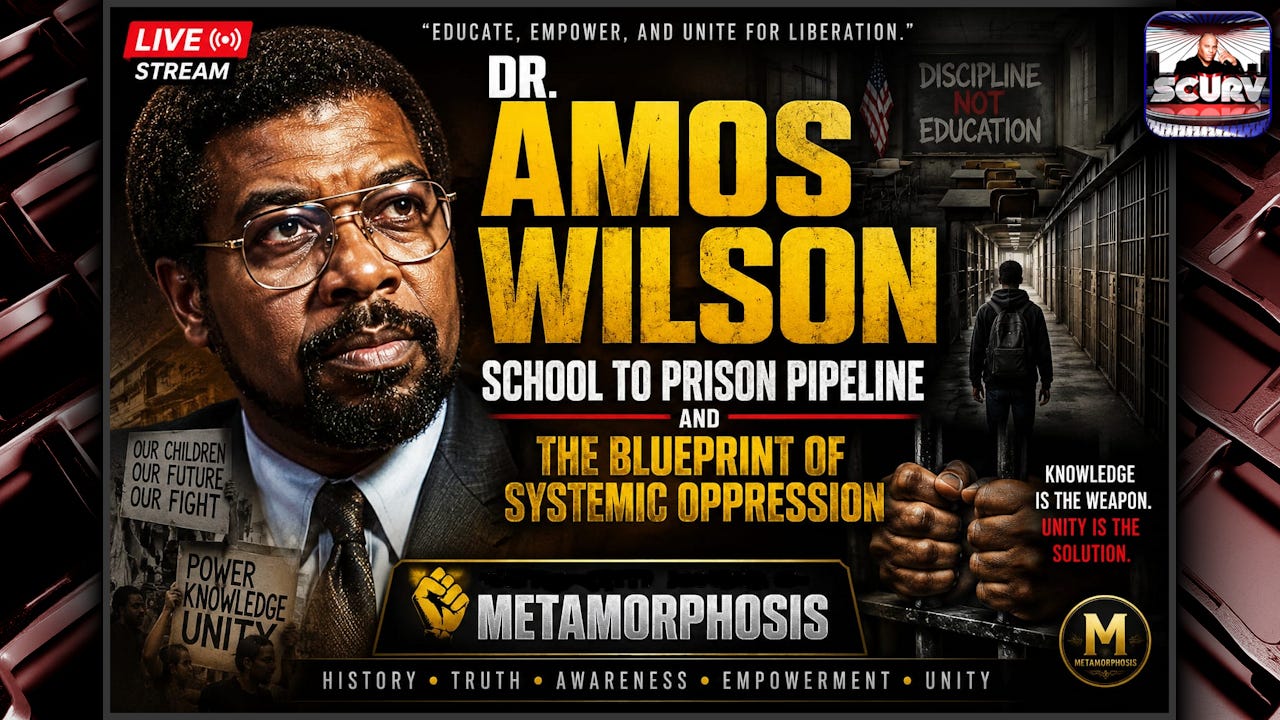

THE MAN WHO SAW THROUGH THE SYSTEM
There are certain men who come into this world with eyes so sharp that they can see through lies that most people are too distracted, too comfortable, or too afraid to confront. Dr. Amos Wilson was one of those men. He was not a celebrity in the mainstream world. He was not promoted heavily on television. He was not celebrated by institutions of power. But among those who were serious about understanding the condition of Black people in America and across the world, his words hit like thunder. He spoke with precision, intelligence, pain, and purpose. He did not waste time trying to entertain people. He came to wake people up.
Dr. Amos Wilson understood something that many still refuse to admit today. He understood that oppression is not random. It is organized. It is designed. It is planned. And one of the most dangerous tools used against Black people was not only physical violence or economic deprivation, but psychological warfare. He believed that if you can shape the mind of a people, you can shape their future. If you can confuse a child about who they are, what they are capable of, and what their purpose is, then you can control generations without chains.
What made Dr. Wilson different from many scholars was that he did not hide behind complicated language to impress people. He spoke plainly enough for everyday people to understand him while still operating on an intellectual level that challenged professors and academics. He wanted Black people to understand systems. He wanted us to understand how schools, media, economics, politics, religion, entertainment, and even psychology were often used as tools to maintain power structures that worked against us.
Long before the phrase “school to prison pipeline” became popular, Dr. Wilson was already dissecting the machinery behind it. He spoke deeply about the ways educational systems failed Black children. He explained how many schools did not nurture Black minds but instead disciplined, suppressed, and redirected them toward failure. He saw how Black boys especially were criminalized at young ages. He saw how intelligence was overlooked while behavioral punishment increased. He saw children medicated, suspended, isolated, and pushed out instead of developed.
This is why his work remains so powerful today. The conditions he warned us about decades ago have only expanded. We are now living in a time where many young people are emotionally disconnected, spiritually exhausted, culturally confused, and economically trapped. Dr. Amos Wilson did not simply complain about these conditions. He dedicated his life to exposing the roots of them and challenging Black people to rebuild themselves mentally, culturally, economically, and politically.
THE EARLY LIFE THAT SHAPED HIS MISSION
Dr. Amos Wilson was born in Hattiesburg, Mississippi, during a time when racial segregation and open racism shaped every aspect of life in the South. To understand the power of his later work, people must understand the environment that shaped him early on. He grew up in a society where Black people were expected to remain in a permanent state of limitation. Every institution around him reinforced inequality. Schools were unequal. Economic opportunities were unequal. Justice was unequal. Respect itself was unequal.
Yet from a young age, Dr. Wilson displayed a hunger for knowledge and understanding. He did not simply accept the world as it appeared on the surface. He wanted to know why things were the way they were. This desire for deeper understanding would eventually define his entire life’s mission.
He later attended Morehouse College, one of the most respected historically Black colleges in America. This experience exposed him to intellectual traditions rooted in Black self-determination, leadership, and scholarship. Morehouse was not simply a school. It was a place where Black intellectual thought was cultivated in an environment that understood the importance of identity and history. This environment sharpened Dr. Wilson’s awareness of the larger systems operating against Black people worldwide.
After Morehouse, he continued his education and eventually earned advanced degrees in psychology. But unlike many psychologists who became disconnected from the struggles of ordinary people, Dr. Wilson stayed rooted in the realities of Black life. He believed psychology could not be separated from politics, economics, history, or race. He argued that many psychological theories were built around European experiences while ignoring the cultural realities of African people.
This became one of the major foundations of his work. He challenged the idea that Black people were mentally or culturally deficient. Instead, he argued that many so-called deficiencies were actually the result of systematic oppression, economic deprivation, cultural destruction, and institutional manipulation. He wanted Black people to stop blaming themselves for conditions that had been strategically engineered over generations.
THE SCHOOL TO PRISON PIPELINE BEFORE IT HAD A NAME
One of the most important areas of Dr. Amos Wilson’s work involved education. He recognized that many Black children entered school systems already carrying the burdens of poverty, stress, racial discrimination, and cultural disconnection. Instead of helping these children heal and grow, many schools treated them as problems to be controlled.
Dr. Wilson saw that Black boys were especially targeted. He noticed that they were often punished more harshly than white students for similar behavior. They were labeled disruptive, aggressive, or dangerous at very young ages. Once these labels were attached, teachers and administrators often viewed them through a lens of suspicion instead of possibility.
He also believed that many educational systems destroyed creativity and independent thought. Instead of teaching children how to think critically, schools often trained them to obey authority without question. Black children who challenged systems or expressed frustration were frequently disciplined rather than understood.
This pattern helped create what we now call the school to prison pipeline. Suspensions increased. Expulsions increased. Police presence in schools increased. Young Black children became familiar with handcuffs before adulthood. Dr. Wilson warned that when schools begin operating like prisons, it becomes easier for prisons to become the next destination.
What many people do not know is that Dr. Wilson also connected this issue to economics. He argued that Black youth were being prepared for economic irrelevance in a society that no longer needed large amounts of industrial labor. As jobs disappeared from urban communities, social control increased. Instead of investing in Black communities, systems invested in surveillance, policing, and incarceration.
He believed this was not accidental. He argued that economic systems and racial systems worked together. When people lose economic power, they become easier to control politically and socially. This is why Dr. Wilson constantly emphasized ownership, economic development, and self-sufficiency. He believed Black communities could never become truly free while remaining economically dependent on systems that historically exploited them.
THE PSYCHOLOGICAL WARFARE AGAINST BLACK PEOPLE
One of Dr. Amos Wilson’s most powerful contributions was his explanation of psychological warfare. He believed oppression was not only physical. It was mental. It was emotional. It was spiritual. He often explained that if a people are taught to hate themselves, fear themselves, and distrust themselves, then they will destroy themselves without needing outside force every moment.
He spoke about media imagery and how constant negative portrayals of Black people damage self-perception. He criticized entertainment industries that promoted violence, hypersexuality, materialism, and self-destruction while minimizing intelligence, discipline, family structure, and cultural pride.
Dr. Wilson also warned about cultural dependency. He believed Black people had been conditioned to seek validation from systems that historically denied their humanity. He argued that true liberation required psychological independence. Black people had to redefine success for themselves instead of measuring themselves through standards created by others.
Another deep area of his work focused on language and thought patterns. He believed words shape reality. The stories people hear repeatedly become internalized truths. This is why he emphasized the importance of controlling narratives within Black communities. If children constantly hear that they come from failure, violence, and inferiority, they eventually begin to believe those ideas about themselves.
What made Dr. Wilson’s message so dangerous to established systems was that he connected everything together. He did not view racism as isolated incidents. He saw interconnected systems operating across education, economics, media, politics, and psychology. He argued that many people misunderstood racism because they focused only on personal prejudice while ignoring institutional power.
THE BOOKS, LECTURES, AND IDEAS THAT STILL SHAKE PEOPLE TODAY
Dr. Amos Wilson left behind a body of work that continues to influence scholars, activists, educators, and everyday people seeking truth. His books were not light reading meant for entertainment. They were intellectual weapons designed to wake people up mentally.
His work “Black-on-Black Violence” challenged simplified explanations about crime in Black communities. He argued that violence could not be understood outside of economic deprivation, social engineering, psychological stress, and historical trauma. He rejected the idea that Black people were naturally violent. Instead, he examined how systemic conditions create desperation and instability.
In “The Falsification of Afrikan Consciousness,” he explored how colonization affected the minds of African-descended people. He examined how Western systems shaped identity, values, and thinking patterns in ways that disconnected people from their roots and collective interests.
His lectures were equally powerful. People who attended them often described feeling mentally transformed afterward. Dr. Wilson had a way of speaking that combined scholarship with urgency. He did not sound detached from reality. He sounded like a man trying to warn people before it was too late.
What many younger people may not realize is that Dr. Wilson delivered these messages before social media existed. There was no viral internet system spreading his ideas instantly. Much of his work spread through cassette tapes, VHS recordings, independent bookstores, community gatherings, and word of mouth. Yet despite those limitations, his influence spread globally because his analysis resonated deeply with people who recognized the realities around them.
Another lesser-known aspect of his life was the personal sacrifice involved in his mission. Scholars who challenge power structures often pay heavy prices. They are marginalized. Ignored. Misrepresented. Financially unsupported. Dr. Wilson did not receive the mainstream recognition given to scholars who comfortably fit inside dominant systems. But he continued his work anyway because he believed the survival of Black people required truth, not popularity.
WHY DR. AMOS WILSON STILL MATTERS TODAY
Everything Dr. Amos Wilson warned about can still be seen today. Schools continue failing many Black children. Mental health struggles continue increasing. Economic inequality continues widening. Media manipulation continues shaping public perception. Mass incarceration continues devastating families and communities.
But perhaps the most painful part is that many people still do not fully understand the depth of the systems operating around them. Dr. Wilson wanted Black people to think strategically. He wanted communities to stop reacting emotionally to every crisis while ignoring the larger structures producing those crises repeatedly.
He believed education had to be redefined. Real education was not simply memorizing information for tests. Real education meant understanding power, economics, psychology, history, and culture. It meant developing the ability to solve problems collectively.
Dr. Wilson also believed healing was necessary. Oppression creates trauma that can pass from generation to generation. Communities struggling under pressure often turn pain inward. This is why he stressed self-knowledge and collective awareness. He believed people who understand themselves are harder to manipulate.
In many ways, Dr. Amos Wilson was not simply a psychologist. He was a strategist of liberation. He studied the battlefield of the mind. He studied how systems maintain power. And he tried to equip Black people with the tools necessary to fight for their future intellectually, culturally, economically, and spiritually.
THE LEGACY THAT REFUSES TO DIE
Dr. Amos Wilson passed away in 1995, but his ideas never died. In fact, many people believe his work has become even more relevant with time. Young people discovering his lectures today often react with shock because they realize how accurately he described conditions that still exist decades later.
His legacy continues because truth has endurance. Systems can suppress voices temporarily, but powerful ideas survive because reality keeps confirming them. Every time another young Black child is criminalized in school instead of nurtured, people hear echoes of Dr. Wilson’s warnings. Every time economic inequality deepens while prisons expand, people hear echoes of his analysis.
What made Dr. Wilson special was not simply intelligence. It was courage. He refused to water down his message for acceptance. He refused to separate psychology from politics. He refused to pretend that racism was only about individual behavior while ignoring institutions and systems.
He wanted Black people to stop seeing themselves through the eyes of oppression. He wanted communities to develop independent thinking, economic strength, educational power, and cultural pride. He believed liberation started in the mind but could not stop there. It had to become action.
And today, as more people search for answers in a world filled with confusion, instability, and manipulation, the words of Dr. Amos Wilson continue to rise again. Not because they are trendy. But because they still speak directly to conditions that millions of people live through every single day.
FINAL PERSPECTIVES…
Dr. Amos Wilson did not spend his life chasing applause. He spent his life trying to save minds. He understood that once a people lose control of their minds, their future becomes controlled by others. His work was not comfortable because truth is rarely comfortable. He forced people to examine painful realities that many would rather avoid.
The school to prison pipeline was never just about schools and prisons. It was about power. It was about who gets nurtured and who gets discarded. It was about whose potential is protected and whose future is criminalized before adulthood even begins. Dr. Wilson saw this clearly long before mainstream society was willing to admit it.
His teachings remain a warning and a blueprint at the same time. They warn us about systems designed to weaken communities mentally, economically, and culturally. But they also provide a blueprint for rebuilding through education, self-awareness, economic cooperation, and cultural understanding.
The reason his message still hits so hard today is because many of the problems he exposed were never truly solved. They evolved. They adapted. They became more sophisticated. But the core structure of inequality remains. That is why studying Dr. Amos Wilson is not simply about history. It is about survival in the present moment.
And as we continue this powerful conversation on this livestream, understand that this is bigger than one man. This is about reclaiming the ability to think deeply, question systems fearlessly, and recognize the psychological warfare being waged against our communities every single day. Dr. Amos Wilson may be gone physically, but his mission continues through every person brave enough to seek truth without fear.