

SHE STARTED WITH A FARM, A DREAM, AND A LONG WALK TO SCHOOL
There are some people whose accomplishments are so deeply woven into modern life that we use the fruits of their labor every day without ever knowing their names. We pick up a phone, type in an address, watch that little blue dot move across a screen, and trust that somehow the technology knows exactly where we are and where we need to go. We rarely stop to think about the satellites orbiting hundreds of miles above us, the mathematics operating behind the scenes, or the extraordinary amount of scientific work required to make that little blue dot possible. Even less often do we think about a Black girl from rural Virginia who grew up in a world that gave her very few reasons to believe she would someday have anything to do with such technology.
That girl was Gladys Mae West, born on October 27, 1930, in Sutherland, Virginia, during the Great Depression. She entered a world where segregation shaped nearly every part of American life and where opportunities for Black families in rural communities were severely restricted. Her family worked hard, and agriculture was central to their lives. Gladys knew what physical labor felt like, understood the expectations placed upon children in working families, and saw firsthand how easily one generation could become trapped inside the same economic circumstances as the generation before it. Yet even while she participated in that life, something inside her kept looking beyond the fields. She could work the farm, but she refused to believe the farm had to become the boundary of her imagination.
Her education began in a segregated schoolhouse that was miles from home, and getting there required walking through the countryside. The educational resources available to Black children were often inferior to those available to white children, and the differences were not accidental. They were part of a larger system designed to limit opportunity. Yet inside that modest school environment, Gladys discovered something that could not easily be taken away from her. She discovered the power of learning. Books introduced her to possibilities that didn’t depend upon the circumstances surrounding her, and mathematics in particular began to reveal itself as something more than a school requirement. Numbers offered a way of understanding the world, and education offered her a pathway toward a future that looked very different from the one she had inherited.
That’s what makes her childhood so important to understanding the woman she eventually became. Gladys wasn’t born knowing she would contribute to GPS technology. She didn’t grow up with some grand prophecy hanging over her head. She was simply a young girl who understood that education could make her life larger. She worked, studied, helped her family, and kept moving forward. Somewhere along that journey, academic excellence became more than something that brought praise from teachers. It became the key that could unlock doors that society had largely kept closed to people like her.
And perhaps that’s where the real story of Gladys West begins. Long before satellites, computers, mathematical models, government laboratories, and GPS, there was simply a young Black girl looking at the life available to her and quietly deciding that it wasn’t going to be the final version of her story.
THE GIRL WHO REALIZED EDUCATION COULD BE AN EXIT
Gladys excelled academically, particularly in mathematics and science, and her performance eventually created an opportunity that could transform the direction of her life. At the time, scholarships were incredibly important for students from families who couldn’t simply write a check for college tuition. For Gladys, becoming the valedictorian of her high school class wasn’t merely an impressive academic accomplishment. It became the doorway through which she could step into a much larger world. She earned a scholarship to Virginia State College, now Virginia State University, and became the first person in her immediate family to attend college.
That transition represented far more than moving from one school to another. She was moving from a rural environment shaped by segregation into an institution where she could seriously develop her intellectual abilities. She studied mathematics and earned a bachelor’s degree in the subject in 1952. She then worked as a teacher, saved money, and returned to Virginia State to earn a master’s degree in mathematics in 1955. That decision says a great deal about her personality. She wasn’t satisfied with merely getting through the door. Once she had an opportunity, she wanted to make sure she had the knowledge and preparation necessary to take full advantage of it.
Teaching gave her valuable experience, but Gladys wanted to work directly in mathematics rather than simply teach it. That ambition placed her against the realities of 1950s America. A Black woman with advanced mathematical training could be highly educated and still encounter assumptions about what she should or shouldn’t be doing. Her degrees didn’t erase racism. Her intelligence didn’t erase sexism. Her academic accomplishments didn’t automatically make every workplace welcoming. She would have to enter spaces where she was an exception and then prove, again and again, that she belonged there.
In 1956, that opportunity finally came when she was hired as a mathematician at the Naval Proving Ground in Dahlgren, Virginia. Her arrival was historically significant because she was the second Black woman hired at the facility and one of very few Black employees working there. She wasn’t entering an environment where diversity had already been normalized. She was entering a workplace where being a Black woman in a highly technical position made her unusual before she had even completed her first assignment.
That kind of environment creates a pressure that doesn’t always appear in official biographies. When you’re one of the first, your work can feel like it’s being judged twice: once as an individual employee and again as evidence of whether people like you belong. Your mistakes can become stereotypes, while your successes can be treated as exceptions. Gladys West had to navigate that reality while simultaneously mastering highly complicated mathematics and technology. Her answer wasn’t to make a spectacle of herself. She focused on learning the work, understanding the systems, and becoming so good at what she did that the mathematics would speak louder than anyone’s assumptions.
WHEN MATHEMATICS BECAME SOMETHING MUCH BIGGER
Gladys West entered the workforce at a fascinating moment in technological history. Computers were beginning to transform scientific research, but they were nothing like the machines we casually carry in our pockets today. They were enormous, expensive systems that required specialized knowledge, careful programming, and extraordinary patience. A calculation that can now be performed almost instantly could once require extensive preparation and hours of computer processing.
West became part of that early generation of mathematicians and programmers who were learning how to turn complicated mathematical problems into instructions machines could process. Her work involved military systems, satellite orbits, astronomical calculations, and eventually the mathematical modeling of Earth itself. She was working at the intersection of mathematics and computing during a period when both fields were rapidly developing, and the accuracy of the work mattered enormously.
One project during the early 1960s involved calculating the relationship between Pluto and Neptune. The project required more than five billion calculations and approximately 100 hours of computer time. The work was eventually recognized with a Navy merit award for group achievement. The achievement wasn’t simply about the size of the number of calculations. It demonstrated that West had developed the ability to work with extremely complex mathematical problems at a scale that demanded both technical skill and extraordinary concentration.
That ability would become increasingly important as satellite technology advanced. The world was beginning to look at Earth from space in ways previous generations could never have imagined, but observing the planet wasn’t enough. Scientists needed accurate mathematical models that could turn satellite measurements into useful information. The more precise those models became, the more precisely human beings could understand the planet beneath them.
This is where Gladys West’s story moves from impressive to extraordinary. She wasn’t simply operating computers. She was helping develop the mathematical understanding necessary to interpret what those computers were telling scientists about Earth.
THE EARTH WASN’T THE PERFECT BALL WE THOUGHT IT WAS
Most people grow up looking at pictures of Earth and seeing a beautiful blue sphere floating in space. That image is useful, but it’s not mathematically precise enough for the kind of satellite positioning systems that would eventually become part of everyday life. Earth isn’t a perfect sphere. It bulges around the equator, its surface rises and falls, its gravitational field varies, and oceans and tides constantly influence measurements.
If you want a satellite system to determine where something is with extraordinary accuracy, you need an extraordinarily accurate mathematical model of the planet itself. That’s where geodesy comes into the story. Geodesy is the science of measuring and understanding the size, shape, orientation, and gravitational characteristics of Earth. To most people, that might sound abstract and even boring, but the work has enormous practical consequences. The accuracy of navigation technology depends upon accurately understanding the planet on which that navigation is taking place.
West became deeply involved in this work. She used satellite data and increasingly sophisticated computer systems to develop more accurate models of Earth’s shape. Her work involved accounting for the many physical forces that could influence measurements, including gravity, tides, Earth’s rotation, and other factors. The objective was to reduce error and make the mathematical representation of Earth increasingly precise.
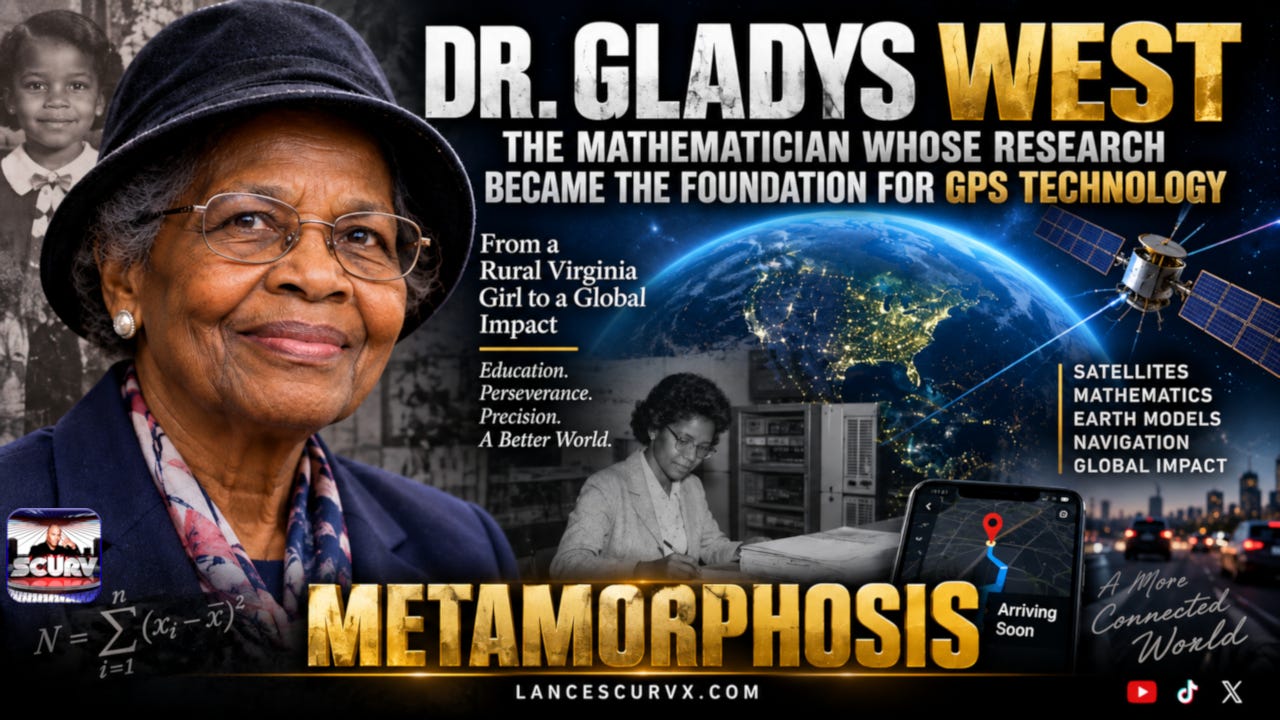
That’s why describing Gladys West as “the woman who invented GPS” doesn’t quite tell the truth, even though the phrase makes for a catchy headline. GPS was developed through the work of many scientists, engineers, military programs, and technological advances over decades. West’s contribution was different and, in its own way, fundamental. Her work helped create the precise mathematical model of Earth needed for satellite positioning to work accurately.
Every time someone uses GPS to locate a restaurant, navigate through an unfamiliar city, track a delivery, guide an airplane, monitor a vehicle, or find a destination, they’re benefiting from an enormous technological chain. Satellites, clocks, computers, orbital mathematics, communication systems, reference frames, and models of Earth all have to work together. Gladys West contributed to that chain by helping humanity understand the shape and behavior of the planet with extraordinary mathematical precision.
THE WOMAN INSIDE THE COMPUTER ROOM
There’s another part of Gladys West’s story that deserves attention because historical biographies sometimes turn brilliant people into machines themselves. We hear that someone calculated satellite orbits, processed data, developed mathematical models, or wrote computer programs, and suddenly the human being disappears behind the accomplishment. But Gladys West wasn’t simply a mathematician performing equations. She was a woman living through one of the most turbulent periods in American history.
The Civil Rights Movement was unfolding while she was building her career. Segregation was still a powerful force, racial discrimination remained part of everyday life, and Black Americans were fighting across the country for rights that should never have been denied to them. West supported the movement, but the nature of her government work and the sensitive projects surrounding her career meant she couldn’t simply transform her professional position into a public political platform.
There was also a strange isolation that came from working on highly technical and sometimes classified projects. Even the people around her might not have understood the larger significance of what she was doing. She could spend her day working with satellite data and complex mathematical models and then return home without being able to explain the full importance of her work.
Imagine that kind of existence. You’re contributing to technology that will eventually influence billions of lives, but you can’t walk around telling everybody what you’re doing. There’s something profoundly humble about that. You perform the work because the work needs to be performed. You solve the problem because the problem is sitting in front of you. You go home and return the next morning to do it again.
That kind of discipline doesn’t create celebrities. It creates foundations.
LOVE, FAMILY, AND A LIFE OUTSIDE THE EQUATIONS
While working at Dahlgren, Gladys West met another mathematician employed there, and the two eventually married. Together they built a family and raised three children while pursuing demanding professional careers. That part of her life matters because biographies about scientific pioneers can sometimes make them sound as though they lived exclusively inside laboratories and computer rooms.
Gladys West had a life outside the mathematics. She was a wife, a mother, a daughter, a professional, and eventually a grandmother. She had family responsibilities that existed alongside the demands of her career. She had to balance professional expectations with the ordinary responsibilities that come with building a family. Her accomplishments didn’t happen in some perfectly controlled environment where every hour could be devoted to scientific work.
That makes her story even more relatable. Great accomplishments don’t always come from people who have unlimited time, unlimited money, and unlimited support. Sometimes they come from people who have to figure out how to keep moving while carrying several responsibilities at the same time.
West’s career demonstrates that intellectual excellence and ordinary human responsibilities can exist together. She didn’t have to stop being a mother to become a mathematician, and she didn’t have to stop being a mathematician to have a family. She had to build a life in which both could exist, and that required the same determination she had displayed since childhood.
THE SEASAT YEARS
By the 1970s, West’s expertise had grown significantly, and she took on increasingly important responsibilities involving satellite data. She became project manager for the Seasat radar altimetry project, which involved using satellite measurements to study Earth’s oceans. This work represented another major development in the ability to observe the planet from space.
The satellite could gather enormous amounts of information, but information is only useful when you can process and understand it. West worked on improving the mathematical and computational methods used to handle that data. Her ability to organize complex information and turn it into useful measurements demonstrated that she had moved far beyond the role of someone simply completing calculations assigned by someone else.
She was becoming a leader in highly technical work.
That evolution is important because it shows how long her development really was. She didn’t arrive at the Naval Proving Ground already knowing everything she needed to know. She spent decades learning, adapting, mastering new technology, and taking on increasingly difficult responsibilities. Her career was a progression rather than a single breakthrough.
That’s something people often forget when they look backward at successful people. We see the finished accomplishment and imagine that the person must have possessed all the answers from the beginning. Gladys West’s life tells a different story. She became exceptional through years of preparation.
THE GEOSAT WORK AND THE MATHEMATICS OF EARTH
West’s work eventually took her deeper into satellite geodesy, where she focused on using satellite measurements to create increasingly accurate models of Earth’s shape. Working with GEOSAT data and powerful computers, she developed calculations that accounted for numerous factors influencing the planet’s measurements.
The machines were impressive, but the real intellectual challenge wasn’t simply pressing buttons. Someone had to understand the problem, develop the mathematical approach, organize the data, evaluate the results, identify errors, and refine the model. West was part of that intellectual process.
The work was painstaking. It required patience because improving the accuracy of a mathematical model isn’t always dramatic. Sometimes the difference between one result and another is tiny. Sometimes an improvement might be measured in fractions that mean little to the average person but have enormous consequences for precision navigation.
That’s the nature of scientific progress. It often happens in increments too small to attract attention.
West spent years making those increments.
In 1986, she published a technical guide explaining how to process GEOSAT radar-altimeter data to improve the accuracy of geoid measurements. Her work became an important part of the scientific chain leading toward the precision satellite positioning systems that would eventually become central to modern life.
The significance of that contribution becomes clearer when we remember what GPS actually requires. A satellite system has to know where satellites are, where Earth is, how Earth’s shape affects measurements, how time is behaving across the system, and how to correct for countless sources of error. West’s work helped solve one of the fundamental problems underneath all of that: developing an accurate mathematical representation of the Earth.
THE INVISIBLE COST OF BEING THE FIRST
There’s an uncomfortable truth in Gladys West’s story that deserves to be spoken about honestly. She didn’t always receive recognition equal to the importance of her work.
Part of that was because of the nature of government research. Some of her work was classified or obscure to the general public. Part of it was because she wasn’t the kind of person who spent her career seeking publicity. But the realities of race and gender also mattered. She worked in an era when Black women were frequently underestimated, particularly in fields dominated by white men.
Being the first can sound glamorous when viewed from decades later. At the time, it can be exhausting. When you’re one of the few people who looks like you, you don’t always get to simply be an employee. You become aware that your behavior is being noticed. You may feel pressure to perform at a level that leaves no room for stereotypes to be attached to you.
West navigated that environment by concentrating on competence. She didn’t allow the prejudice around her to become the center of her identity. She learned the work, performed the work, and continued building expertise.
That doesn’t mean discrimination didn’t hurt. It means she refused to let discrimination determine the size of her future.
That’s a very different thing.
RETIREMENT DIDN’T MEAN THE END
After approximately 42 years at Dahlgren, Gladys West retired in 1998. For many people, that would have marked the natural end of a long and demanding career. But West wasn’t finished learning.
She pursued another advanced degree and earned a doctorate in public administration from Virginia Tech in 2000. What’s especially remarkable about that achievement is that she completed the degree after suffering a stroke that affected her hearing, vision, balance, and mobility.
Think about the determination required to continue pursuing a doctorate after such a major setback. She had already spent more than four decades working in science and mathematics. She had already raised a family. She had already retired. She could have reasonably decided that she had done enough.
Instead, she continued.
That decision tells us something about her that a list of technological accomplishments never could. Learning wasn’t simply a career strategy for Gladys West. It was part of who she was. The girl who had discovered the power of education in rural Virginia remained inside the older woman who continued pursuing knowledge decades later.
THE WORLD FINALLY DISCOVERS GLADYS WEST
Perhaps the strangest part of the entire story is that Gladys West’s public recognition came so late. For decades, she had been performing work of enormous scientific importance without becoming a household name. Her story only began receiving wider attention after she prepared a short biography for a sorority-related event in 2017. Someone who read about her background recognized the significance of what she had accomplished, and her story began spreading beyond her immediate circle.
Suddenly, the world was learning about the woman who had spent decades helping develop the mathematical understanding behind satellite navigation. Awards and honors followed, including recognition from the U.S. Air Force Space and Missile Pioneers Hall of Fame, the BBC’s 100 Women, the Royal Academy of Engineering, and the IEEE.
There’s something almost ironic about receiving worldwide recognition after you’ve spent your entire career working quietly. By that point, Gladys West had already done the work. She didn’t need the applause to validate the decades she had spent studying, calculating, programming, analyzing, and refining.
The recognition was meaningful, but it couldn’t change what had already happened. Her contribution existed whether the world knew her name or not.
That’s an important distinction in an age where people often measure success by visibility. Gladys West demonstrates that influence and fame aren’t the same thing. A person can change the world without becoming famous while they’re doing it.
THE IRONY OF THE GPS PIONEER WHO PREFERRED MAPS
There’s a wonderful human irony in Gladys West’s story. The woman whose mathematics helped establish the foundation for modern satellite navigation wasn’t particularly dependent upon GPS herself. She preferred traditional maps.
That detail might sound funny, but it actually reveals something about her personality. She came from a generation that learned to understand geography directly. A map wasn’t simply something an app displayed on a screen. It was something you could hold, study, and understand. You could follow roads, recognize landmarks, and develop your own sense of direction.
Technology had become one of West’s greatest contributions to humanity, but she never seemed to confuse technological power with human wisdom. She could appreciate what technology could accomplish while still appreciating older ways of understanding the world.
That’s a useful lesson for all of us. Creating the future doesn’t require abandoning everything that came before it.
THE WOMAN BEHIND THE LEGEND
When we call Gladys West a hidden figure, we have to be careful not to turn her into something mythical. She wasn’t a machine. She wasn’t a flawless superhero. She was human.
She experienced frustration. She had responsibilities. She had to learn new technology as it emerged. She had to balance family and career. She lived through racial discrimination and social upheaval. She had to work in environments where she was often one of the few Black people present. She experienced a major stroke later in life. She continued learning anyway.
That’s what makes her story powerful. Her greatness wasn’t based upon never encountering difficulty. Her greatness came from continuing to move forward despite it.
She didn’t wake up one morning knowing she would contribute to GPS technology. She simply kept taking the next step that was available to her. Education led to college. College led to mathematics. Mathematics led to teaching. Teaching led to graduate school. Graduate school led to professional opportunities. Professional opportunities led to increasingly complex scientific work. Years of that work eventually became part of the technological foundation that helps people navigate the planet.
That’s how many great lives actually happen. Not through one magical moment. Through thousands of ordinary decisions.
WHAT GLADYS WEST REALLY CONTRIBUTED
The easiest way to describe Gladys West’s contribution is to say that her mathematical modeling of Earth helped provide an important foundation for accurate satellite navigation. But if we stop there, we’re still missing something.
Her work demonstrated the enormous importance of invisible mathematics in modern civilization. We celebrate the smartphone. We celebrate the satellite. We celebrate the application. We celebrate the little blue dot moving across the screen.
But behind every one of those visible technologies are people doing work most of us will never see. They’re calculating. They’re programming. They’re testing. They’re correcting errors. They’re refining models. They’re questioning assumptions. They’re repeating calculations until the result becomes more accurate.
Gladys West was one of those people.
Her contribution wasn’t necessarily the kind that produced a dramatic photograph or a famous product launch. Her contribution lived inside the mathematics. It lived inside the accuracy. It lived inside the reduction of error.
And sometimes the most important work in civilization is exactly that kind of work.
A BLACK WOMAN FROM RURAL VIRGINIA CHANGED HOW THE WORLD MOVES
There’s something almost poetic about where Gladys West began. She started in rural Virginia. She worked the land. She walked miles to school. She studied with limited resources. She lived under segregation. She entered a profession where Black women were rarely represented. She worked with some of the earliest generations of computers and spent decades developing mathematical models of Earth.
Then the world changed.
The technology she helped advance eventually became something ordinary people could carry in their pockets. A driver could ask a phone for directions. A traveler could locate an unfamiliar street. A delivery driver could find an address. A person could look at a screen and see their approximate position on the planet.
The girl who wanted an education so she could create a different future eventually helped create technology that allows billions of people to determine where they are.That’s not merely a career story. That’s transformation.
THE LESSON ISN’T JUST ABOUT GPS
If we reduce Gladys West’s life to GPS, we’re missing the greatest lesson she left behind. Her story is really about preparation, discipline, education, patience, and refusing to allow limited circumstances to become a limited imagination.
The opportunity she needed didn’t initially look like fame. It looked like a scholarship. It looked like a classroom. It looked like a teaching position. It looked like graduate school. It eventually looked like a government mathematics job in a facility where she was one of very few Black people.
None of those moments necessarily looked historic while they were happening.
That’s the point.
Sometimes the opportunity that changes your life doesn’t arrive wearing a crown. Sometimes it arrives disguised as hard work. Gladys West understood that. She kept preparing herself. She kept learning. She kept accepting challenges. She kept improving. And she kept doing the work even when there was no guarantee that the world would ever know her name.
HER LEGACY BELONGS TO EVERYONE
Gladys West died on January 17, 2026, at the age of 95, leaving behind children, grandchildren, and a scientific legacy that reaches far beyond her own lifetime. By then, the work she had performed quietly for decades had become part of a technological world that would have been almost impossible for that young girl from rural Virginia to imagine.
But her legacy isn’t simply the GPS signal.
Her legacy is the example.
It’s the image of a Black girl looking at a society that had already decided what people like her were supposed to become and deciding that she would become something else. It’s the image of a woman entering a scientific environment where people like her were rare and refusing to make herself smaller simply because the room wasn’t designed with her in mind.
It’s the image of a professional who didn’t need constant applause to continue doing excellent work. It’s the image of a lifelong learner who pursued another doctorate after retirement and after a major stroke. And it’s the image of a woman whose greatest accomplishments remained largely invisible until late in her life.
SHE DIDN’T NEED TO BE FAMOUS TO BE GREAT
That’s perhaps the part of Gladys West’s story that hits hardest. She didn’t spend her life chasing celebrity. She didn’t build her career around making sure everybody knew her name. Much of what she did was hidden behind government institutions, technical language, complex mathematics, and projects that ordinary people could never have understood from the outside.
She simply worked.
She worked when the work was difficult. She worked when the recognition was absent. She worked when she was one of the few Black people in the room. She worked when technology was changing around her. She worked while raising a family. She worked through decades of professional development, and she continued learning even after retirement.
Then, eventually, the world looked up and realized that this quiet mathematician had helped change the way humanity understands its own location on Earth.
That’s an important lesson in an age where everybody wants immediate recognition. Gladys West’s life reminds us that significance doesn’t always arrive quickly. Sometimes you can spend forty years building something before anybody outside your immediate circle understands what you’ve accomplished.
THE GIRL WHO WANTED OUT OF THE FIELDS
When I look at Gladys West’s childhood, I don’t simply see a future mathematician. I see a young girl living inside circumstances that could easily have convinced her that her future was already predetermined.
She came from a working family. She knew physical labor. She understood the limitations placed around Black communities. She walked to a segregated school. She didn’t have unlimited resources or a famous family name opening doors for her.
But she had curiosity. She had intelligence. And she had an understanding that education could become a pathway to something larger.
That’s what makes her early life so important. Before she became a scientist, she had to become someone who believed that a different life was possible. That belief came first. The mathematics came later.
THE WORLD NEEDS TO REMEMBER HER PROPERLY
So when we talk about Gladys West, we should stop treating her as a footnote attached to GPS technology. She deserves to be remembered as a complete human being whose life contained far more than one technological contribution.
She was a daughter who grew up in difficult circumstances. She was a student who understood the power of education. She was a teacher who continued learning. She was a mathematician who entered spaces where Black women were rarely seen. She was a programmer working during the early years of the computer age. She was a scientist studying the planet from space. She was a wife and mother. She was a lifelong learner who continued pursuing education long after many people would have considered her career complete.
She was also a woman who experienced the realities of racism and sexism but refused to allow either one to define the limits of her imagination. That’s why her story matters. Not because she was perfect. Not because her path was easy. But because she kept going.
SHE HELPED THE WORLD FIND ITS WAY
There’s a beautiful symmetry in Gladys West’s life. As a child, she wanted education to help her find a way beyond the circumstances surrounding her. As an adult, her mathematics helped create technology that allows billions of people to find their way around the world.
The little girl needed a path, and the grown woman helped create one.
That’s why her story deserves more emotion than a list of dates, awards, and accomplishments can provide. The real story isn’t simply about GPS. It’s about a Black girl from rural Virginia who looked beyond the boundaries of her circumstances and refused to believe that the world she was born into was the only world available to her.
Maybe that’s the message we should carry forward.
You don’t always know what your work is going to become while you’re doing it. You don’t always know who will benefit from it. You don’t always know whether people will recognize you. You don’t even know whether history will remember your name. But if you prepare yourself, develop your gifts, keep learning, and refuse to quit when the world makes the road harder than it needs to be, your work can travel much farther than you ever will.
Gladys West proved that with her life. She walked miles to school, but she didn’t stop there. She walked into a segregated America and still pursued education. She walked into a male-dominated scientific world and still mastered mathematics. She walked through decades of difficult work without knowing whether the public would ever understand its significance. She walked through retirement, continued her education, endured a major stroke, and still kept moving toward another goal.
Eventually, the world caught up with the woman who had been moving forward all along. That’s Dr. Gladys West, not merely a mathematician, not merely a GPS pioneer, and not merely a Black woman who broke a barrier. She was a dreamer who turned education into freedom, discipline into opportunity, mathematics into possibility, and a lifetime of quiet work into a legacy that helps the entire world find its way.