

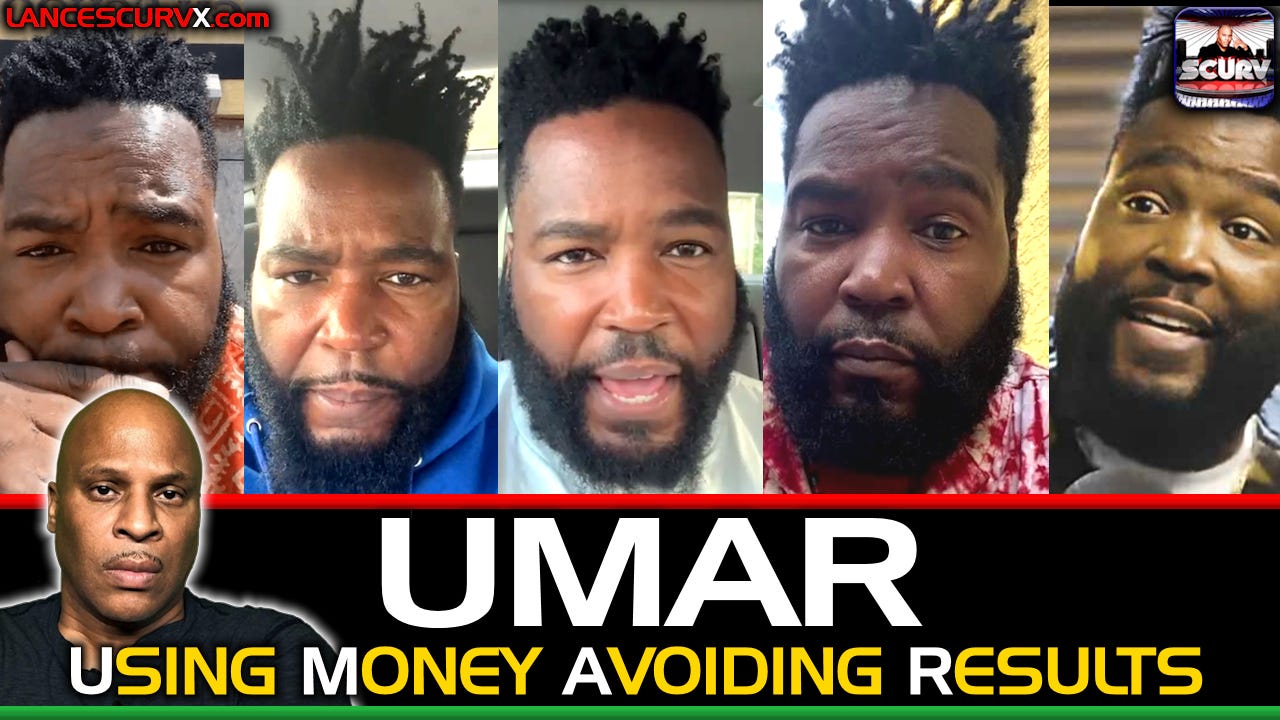
For more than a decade, Dr. Umar Johnson has positioned himself as one of the most visible voices in Black social media discourse. With credentials as a psychologist, frequent appearances on major platforms, and a massive online following, he has cultivated an image of authority, intellect, and cultural leadership. Central to that image is a long-promised institution: the Frederick Douglass Marcus Garvey Academy, a school intended to educate Black boys and restore a sense of purpose and discipline to a struggling community.
Yet after roughly fifteen years of fundraising, touring, speaking engagements, and viral content, the school remains largely unrealized. This reality has led many supporters, former supporters, and observers to ask a simple but uncomfortable question: where did the money go?
That question alone does not constitute an accusation. It is, however, a reasonable inquiry—especially when the project has been used consistently as the moral and financial centerpiece of a public brand.
A PATTERN WITHOUT RESOLUTION
Over the years, Dr. Johnson has repeatedly assured his audience that progress is being made. Photos of a purchased building circulate. Videos show walkthroughs. Social media posts suggest momentum. But tangible, verifiable outcomes—permits finalized, construction milestones completed, operational timelines established—remain elusive.
In contrast, what is visible is constant travel, paid speaking engagements, online monetization, and a lifestyle that appears disconnected from a project allegedly consuming millions of donated dollars. Again, perception is not proof. But perception matters when donations are solicited from working-class people who believe they are investing in a future institution, not a perpetual promise.
When questioned directly about finances or timelines, Dr. Johnson often responds not with documentation or transparency, but with hostility—insulting critics, questioning their intelligence, or framing inquiries as attacks on Black unity. This response style has become part of the pattern itself.
THE ACCOUNTABILITY GAP
The larger issue is not merely about one man. It is about how someone can fundraise publicly, repeatedly, and indefinitely without the same scrutiny others face. History is filled with cases where far smaller operations were quickly audited, investigated, or dismantled by the IRS or other authorities for financial irregularities.
So why does this situation appear different?
There are several possible explanations—none of which require conspiracy to be plausible.
First, fundraising framed as “donations” rather than investments often exists in a gray zone. If no explicit return is promised, accountability thresholds can be surprisingly low unless formal nonprofit violations are proven.
Second, charismatic figures who operate within cultural or ideological movements often benefit from community protection. Supporters may silence critics, discourage questions, and treat skepticism as betrayal. In that environment, scrutiny dies internally long before it ever reaches institutions.
Third, outrage alone does not trigger investigations. Paper trails do. If funds are technically reported, even if ethically questionable in use, enforcement agencies may see no immediate cause for action.
THE DISTRACTION ECONOMY
There is also a more uncomfortable possibility worth examining—not as an accusation, but as a historical pattern.
Throughout American history, particularly during COINTELPRO-era operations, the government has demonstrated a willingness to monitor, manipulate, and sometimes tolerate figures who neutralize collective action by absorbing attention without producing structure. Loud voices that keep communities emotionally engaged but organizationally stagnant have, at times, served as pressure valves rather than threats.
Whether Dr. Umar Johnson fits this category is unknown. But the effect is measurable: years of energy, money, and hope channeled into a single figure rather than distributed into multiple concrete, local initiatives for Black children.
A dream that neever materializes can be more effective at immobilizing people than outright opposition.
THE COST OF ETERNAL VISION WITHOUT EXECUTION
There is nothing wrong with focusing on Black boys. There is nothing wrong with dreaming big. But leadership is ultimately measured by results, not rhetoric. Smaller pilot programs could have been launched. Partnerships could have been formed. Transparency could have been embraced. Instead, the model has remained centralized, opaque, and personality-driven.
That structure benefits the messenger more than the mission.
At some point, asking questions stops being divisive and starts being responsible.
THE INEVITABLE RECKONING
Rumors of investigations circulate online, as they often do when patience runs out. Whether any agency ever intervenes is uncertain. What is certain is that public trust erodes when time passes without accountability.
This is not a call for punishment. It is a call for clarity.
If the money was used properly, show it.
If delays were legitimate, document them.
If mistakes were made, acknowledge them.
Anything less invites suspicion—and suspicion grows fastest where transparency is absent.
MY CLOSING THOUGHTS…
Movements fail not only because of external sabotage, but because communities sometimes place faith in individuals instead of systems. Charisma can inspire, but it can also distract. Dreams can motivate, but they can also delay action indefinitely.
At a certain point, belief must give way to evidence.
And when that moment arrives, the most dangerous thing a community can do is silence itself in the name of loyalty.