
BEFORE THE SCIENTIST, THERE WAS A CURIOUS LITTLE GIRL
There are people whose lives make you wonder how much human potential has been lost simply because somebody decided that a child wasn’t supposed to be interested in something. Long before Dr. Valerie Thomas became a NASA scientist, physicist, inventor, computer specialist, project manager, educator, and mentor, she was simply a curious Black girl growing up in Baltimore, Maryland. She wanted to understand how things worked. She wanted to look beneath the surface of ordinary objects and discover what made them function. The painful reality is that the world surrounding her wasn’t necessarily prepared to encourage that curiosity, especially when it came from a young Black girl interested in science and technology. The triumph of her life is that the world couldn’t destroy it.
Valerie LaVerne Thomas was born in Baltimore, Maryland, in February 1943, during an America where racial segregation wasn’t something found in history books. It was part of everyday life. She entered a society where opportunities could be limited before a Black child ever had the chance to demonstrate what was inside of them. When gender was added to that equation, especially for a girl interested in mathematics, physics, electronics, and technology, the pathway became even narrower. America wasn’t preparing large numbers of Black girls to become physicists, scientists, computer specialists, or inventors. Society wasn’t waiting with open arms for Valerie Thomas. She would eventually have to create room for herself inside worlds where people like her had historically been given very little room at all.
That’s what makes her story so powerful to me, because we often discover accomplished people after the struggle has already happened. We see the awards, professional photographs, degrees, patents, scientific achievements, and prestigious institutions connected to their names. We see NASA beside Valerie Thomas’ name and automatically view her through the lens of success. But that’s like looking at a finished building without examining the ground where its foundation had to be poured. Valerie Thomas didn’t begin her journey surrounded by people constantly telling her she was destined to become one of America’s remarkable scientific minds. Her curiosity had to survive before her talent could ever receive recognition.
One childhood experience captures this reality better than almost anything else. When Valerie was around eight years old, she discovered a book about electronics at a library. Even the title reflected the expectations of the time because the book was aimed at boys. She brought it home excited because her father understood electronics and photography and knew how to work with radios and televisions. Young Valerie believed she’d found the perfect person to help her explore the projects inside the book. Her father apparently understood those projects, but he didn’t teach her how to complete them. Valerie later remembered receiving the impression that electronics wasn’t something meant for girls. Eventually, the library book had to be returned, and those projects weren’t completed. Yet something far more important remained in that house after the book disappeared: Valerie’s curiosity.
That’s where we have to begin if we’re ever going to understand Dr. Valerie Thomas as a human being rather than simply another historical figure whose accomplishments are summarized in a few paragraphs. NASA wasn’t the beginning of her story. The illusion transmitter wasn’t the beginning. Her physics degree wasn’t the beginning. The beginning was curiosity surviving discouragement. The beginning was a little girl looking at technology and wondering, “How does this work?” while receiving subtle messages from the world around her that perhaps she wasn’t supposed to be asking those questions. Valerie Thomas kept asking them anyway, and decades later, that same hunger to understand how things worked would carry her into some of the most advanced scientific and technological environments in America.
GROWING UP WHEN THE DOORS WERE ALREADY HALF CLOSED
It’s difficult for younger generations to fully understand the world Valerie Thomas entered as a child because we’re looking backward through decades of social and technological change. She wasn’t growing up in a world where a Black girl interested in electronics could search online for tutorials, watch instructional videos, join internet communities, download educational software, or instantly discover thousands of women scientists whose careers might inspire her. None of that existed. Information itself was harder to reach, educational resources were more limited, and encouragement from the adults surrounding a child could determine whether an interest developed into a lifelong passion or quietly disappeared.
Thomas attended an all-girls high school during an era when science and advanced mathematics weren’t automatically presented to girls as natural career paths. She later explained that she wasn’t encouraged toward the advanced mathematics courses that would’ve better prepared her for the scientific journey ahead. That’s important because discrimination doesn’t always arrive as somebody standing directly in front of you and declaring, “You can’t do this.” Sometimes discrimination operates through expectations. Nobody tells you about the advanced class. Nobody encourages you to apply. Nobody introduces you to the career. Nobody places the tool in your hand or tells you that you’re capable of mastering it. Years later, society looks at the small number of people from your group in that profession and wonders why they aren’t there.
Yet Valerie Thomas kept moving forward. She managed to take physics in high school, and that decision helped give language to something she’d been carrying since childhood: the desire to understand the physical world. Physics offered a doorway into questions involving light, motion, energy, matter, electricity, machines, and the invisible rules beneath visible reality. These weren’t merely academic subjects disconnected from the little girl who had once carried an electronics book home from the library. They were extensions of the same question that had fascinated her from childhood: What makes things work? That question would follow Valerie Thomas throughout her life.
MORGAN STATE AND THE MOMENT THE WORLD BEGAN TO OPEN
College became the environment where Valerie Thomas finally had greater room to discover how far her mind could take her. She enrolled at Morgan State College, now Morgan State University, in Baltimore and chose physics as her major. That decision deserves more attention than it normally receives. Here was a young Black woman who hadn’t been pushed toward advanced mathematics during high school deliberately choosing one of the most demanding scientific disciplines available to her. She became one of only two women majoring in physics in her graduating class, which meant that nearly every classroom reminded her that she was entering territory where women were still uncommon.
Imagine the psychological weight of that experience. When you’re one of very few people from your background inside a demanding environment, you’re rarely allowed the luxury of simply being an individual. Your mistakes can feel larger because people may interpret your failure as evidence that people like you don’t belong there. Your successes may be treated as exceptions instead of proof that opportunity should’ve existed all along. Valerie Thomas had to learn difficult material while navigating an environment where being both Black and female made her presence unusual. Instead of allowing that isolation to push her away, she excelled and graduated with honors in 1964 with a bachelor’s degree in physics.
There’s another detail from this period that makes everything she accomplished afterward even more remarkable. Before arriving at NASA, Valerie Thomas had never even seen a computer. The woman who would eventually become deeply involved with computer systems, satellite data, scientific networks, image processing, and major NASA technology programs entered the agency without having previously worked with one. That’s not a weakness in her biography. That’s one of its strongest lessons because it tells us something about intelligence that people often misunderstand. Being intelligent doesn’t mean already knowing everything. Intelligence includes the ability to encounter something unfamiliar without allowing unfamiliarity to convince you that you don’t belong.
Thomas learned. She taught herself. She studied programming and learned FORTRAN. She discovered how computers processed scientific information and gradually developed expertise in technologies that had once been completely foreign to her. The little girl who couldn’t get the help she wanted building electronics projects from a children’s library book was now learning the language of machines inside one of America’s most technologically advanced scientific institutions. That’s more than career advancement. That’s transformation.
NASA IN 1964: WALKING INTO THE UNKNOWN
In 1964, at approximately twenty-one years old, Valerie Thomas began working at NASA’s Goddard Space Flight Center as a mathematician and data analyst. The historical context matters because computers weren’t sitting on everybody’s desk. There were no smartphones, consumer internet connections, search engines, online courses, or video tutorials waiting to explain programming to beginners. Computing itself was entering a revolutionary period, and Valerie Thomas walked directly into that revolution.
Her early work involved data-processing programs connected with Orbiting Geophysical Observatory satellites. These spacecraft gathered scientific information about the environment surrounding Earth, but raw information isn’t automatically useful. A satellite can collect enormous amounts of data, yet scientists still need systems capable of receiving that information, processing it, organizing it, and transforming it into something meaningful. That’s where Thomas began developing the expertise that would eventually make her valuable far beyond the job description she had when she first walked through NASA’s doors.
From roughly 1964 through 1970, she worked with real-time computer data systems supporting satellite operations control centers. This is where popular retellings of her story often move too quickly because people want to jump directly to the invention that later earned her a patent. Inventions make good headlines, but Valerie Thomas was already doing important work before the illusion transmitter existed. She was learning how information moved, how machines communicated, how scientific observations became usable knowledge, and how complex technological systems interacted with one another. Those abilities would eventually place enormous responsibility in her hands.
SEEING EARTH FROM ABOVE
During the 1970s, Valerie Thomas became deeply involved with the technology surrounding what developed into the Landsat program, one of the most important Earth-observation efforts of the modern era. The concept was revolutionary. Instead of studying Earth only from the ground, scientists could repeatedly photograph and measure the planet from space. Forests, cities, coastlines, agricultural regions, water systems, environmental changes, natural resources, and patterns of human development could increasingly be studied from above.
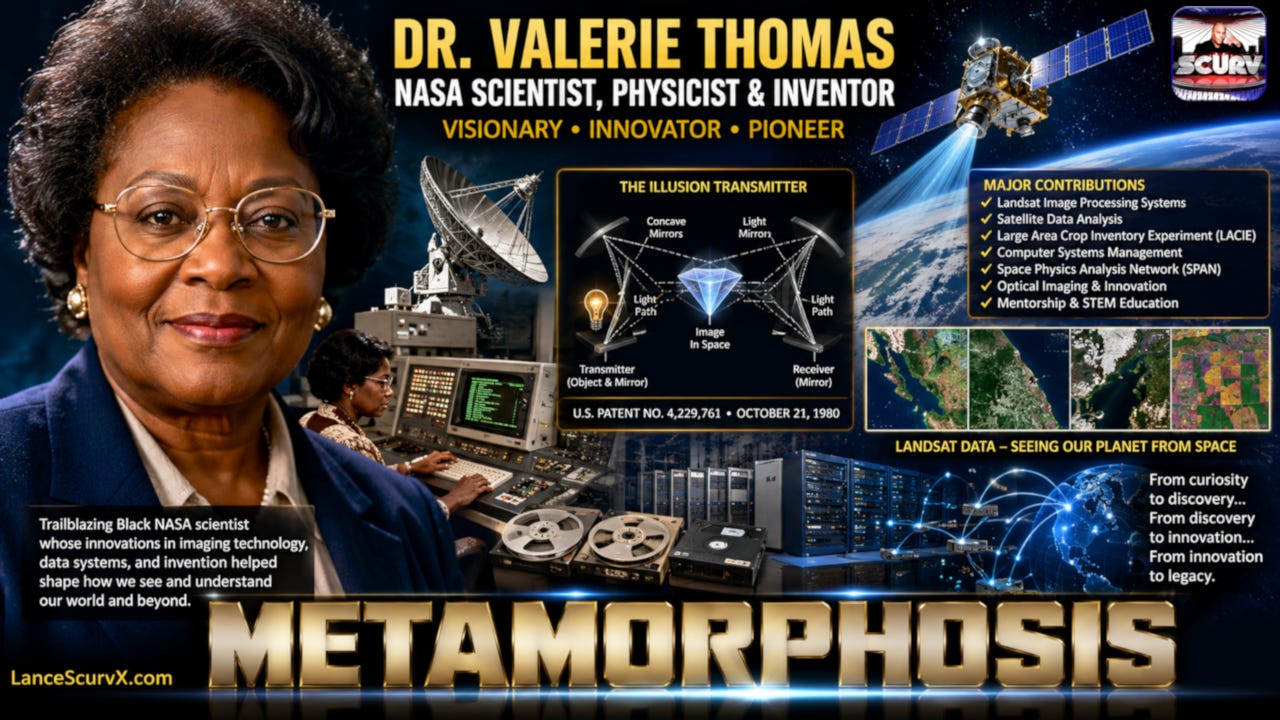
But collecting information was only part of the challenge. The information had to become usable. Thomas worked with image-processing systems and digital formats that allowed Landsat information to be transformed into material scientists could actually analyze. She became highly knowledgeable about the computer-compatible tapes containing early Landsat information, eventually developing such a deep understanding of the system that she produced guidance scientists could use when working with the data.
Think about the distance between the beginning of that story and where she now stood. The little girl who once checked an electronics book out of a neighborhood library had become someone other scientists could look toward when they needed to understand sophisticated information arriving from satellites orbiting Earth. That’s why reducing Valerie Thomas’ life to one patent does her a tremendous disservice. The patent matters, but long before receiving it, she was already helping build systems of scientific knowledge.
WHEN LEADERSHIP BECAME PART OF THE JOURNEY
Another major test arrived through the Large Area Crop Inventory Experiment, commonly known as LACIE. The idea may sound ordinary today because satellite technology has become woven into modern life, but at the time it represented an ambitious scientific challenge. Researchers wanted to determine whether satellite imagery could help identify wheat-growing regions and eventually assist in estimating agricultural production around the world. Food production isn’t merely about farming. Food affects economics, national planning, international stability, trade, and survival itself.
Thomas was given leadership responsibility over a team of roughly fifty people involved in developing processing capabilities for the experiment. At this point, we’re no longer talking about a young woman simply proving she could solve equations. We’re talking about leadership, management, deadlines, technology, hardware, software, scientific expectations, personnel, pressure, and accountability. She had to coordinate complicated work inside an environment where being Black and being female didn’t magically stop mattering simply because she’d already proven herself capable.
Competence doesn’t automatically erase prejudice. Sometimes competence actually makes prejudice uncomfortable because excellence destroys the excuses traditionally used to justify exclusion. Valerie Thomas continued delivering. LACIE helped demonstrate that satellite information could be used to identify agricultural areas and support estimates of global wheat production. Once again, Thomas was involved in transforming information gathered from space into knowledge that could affect life on Earth.
THE SCIENCE EXHIBITION THAT SPARKED AN INVENTION
Then something happened in 1976 that demonstrates how an inventor’s mind can turn an ordinary experience into something much larger. Valerie Thomas attended a scientific exhibition where she encountered an optical illusion involving a light bulb and concave mirrors. The arrangement created the appearance of a glowing bulb in a location where the physical bulb wasn’t actually sitting. Most people could’ve looked at the display, admired it for several seconds, and continued walking. Valerie Thomas didn’t simply see an interesting demonstration. She saw possibility.
That’s one of the differences between observing something and truly seeing it. Inventors look at ordinary experiences and ask extraordinary questions. Thomas became fascinated by the way concave mirrors could create what optics describes as a real image. Unlike the familiar reflection appearing behind an ordinary flat mirror, certain curved mirrors can manipulate reflected light in ways that cause an image to appear in physical space. Her childhood instinct immediately returned. How does this work, and what else could it become?
She began wondering whether an image created through this optical effect could somehow be captured, transmitted, and reproduced somewhere else. Could realistic three-dimensional-looking images eventually become part of communications technology? Could the principles she was observing have applications beyond the exhibition itself? Those questions followed her back into experimentation, and once again, curiosity became the engine pushing Valerie Thomas into territory that didn’t yet have obvious answers.
FROM CURIOSITY TO THE ILLUSION TRANSMITTER
Around 1977, Thomas began investigating relationships between physical objects, reflected images, and concave mirrors. She experimented with positioning and studied how changing the relationship between an object and a mirror affected the resulting image. But she wasn’t satisfied merely understanding the optical effect. She began developing a system that could use those principles in a larger technological process.
The basic concept involved producing an optical image through a concave mirror, capturing information about that image, transmitting it, and using another optical arrangement at the receiving end to reproduce the illusion. Her work eventually became known as the illusion transmitter, and on October 21, 1980, Valerie Thomas was granted United States Patent No. 4,229,761.
That patent matters for reasons extending far beyond technical achievement. Remember the eight-year-old girl holding that electronics book. Remember the child who wanted someone to help her understand those projects. Remember the student who wasn’t encouraged toward advanced mathematics. Remember the young woman entering physics when women were rare in the field. Remember the new NASA employee who had never previously seen a computer. Now look at the inventor receiving a United States patent for an optical transmission system. That’s the complete picture, and that’s why biographies matter. If we simply say, “Valerie Thomas invented the illusion transmitter,” we erase the human victory contained inside the invention.
WHAT THE ILLUSION TRANSMITTER REALLY REPRESENTED
There’s been a great deal of exaggerated information circulated about Valerie Thomas supposedly inventing three-dimensional movies or being directly responsible for every modern three-dimensional display technology. Her actual achievement doesn’t need exaggeration. The illusion transmitter used optical principles involving concave mirrors to create the appearance of a three-dimensional image, exploring the possibility of making visual information appear more physically present than a conventional flat image.
Thomas recognized that realistic optical images might eventually have applications in communications, scientific visualization, entertainment, and other fields. The deeper significance was conceptual because she was exploring ways of transmitting and displaying visual information so that an image could appear to occupy physical space. Today we live in a world filled with three-dimensional computer graphics, virtual reality, augmented reality, advanced medical imaging, immersive displays, holographic research, and increasingly realistic visual environments. Those technologies don’t all descend directly from Thomas’ invention, and historical accuracy matters, but her patent unquestionably belongs in the broader history of scientists and inventors who explored realistic three-dimensional visual information.
A Black woman physicist working at NASA received a patent in 1980 for an optical image transmission system inspired by something she’d noticed at a scientific exhibition. That’s extraordinary without adding anything to it. Her achievement becomes more powerful, not less powerful, when we tell it accurately.
SHE DIDN’T STOP AFTER BECOMING AN INVENTOR
This is another place where Valerie Thomas’ story is often shortened because people hear about the patent and assume they’ve reached the climax. They haven’t. Her NASA career continued for approximately another fifteen years, and the responsibilities placed in her hands became increasingly significant.
By 1985, Thomas was managing the computer facility at NASA’s National Space Science Data Center. She was responsible for consolidating and reconfiguring previously separate computer facilities while helping introduce newer technology into the operation. Scientific organizations depend on information, and when computer systems fail, information stops moving. When information stops moving, research can stop with it. Thomas was no longer simply experimenting with optical systems. She’d become responsible for technological infrastructure supporting scientific work.
The world of computing was also changing rapidly. Personal computers were spreading, networks were expanding, and digital communication was transforming the way researchers exchanged information. Thomas was positioned directly inside that transformation, bringing decades of experience in scientific data systems into an era where computers were becoming increasingly connected.
BUILDING CONNECTIONS BEFORE MOST PEOPLE UNDERSTOOD NETWORKS
From 1986 through 1990, Valerie Thomas served as project manager for NASA’s Space Physics Analysis Network, known as SPAN. When she entered that leadership role, the network connected approximately one hundred computer nodes. During the period of expansion she managed, the network grew to approximately 2,700 directly connected nodes around the world.
Today, we’re accustomed to instant digital communication. We send files, open websites, participate in video calls, upload information to remote servers, and communicate across continents without thinking about the infrastructure making those actions possible. But scientific networking had to be built. Researchers needed ways to communicate with other researchers, computers needed ways to communicate with other computers, and institutions needed reliable methods for exchanging scientific information. Networks had to be designed, expanded, maintained, protected, and managed.
Thomas helped lead that transition within NASA science. Her networking work supported research involving space physics, atmospheric studies, satellite science, and other major scientific efforts. Once again, the pattern becomes impossible to ignore. Her career wasn’t one narrow road. She moved through physics, programming, data analysis, satellite operations, Earth imaging, agricultural analysis, optics, invention, computer management, networking, education, administration, and leadership. That’s why Valerie Thomas can’t be accurately summarized simply as “the woman who invented the illusion transmitter.” She was a problem solver whose abilities repeatedly evolved with the technology surrounding her.
THE WOMAN WHO NEVER STOPPED BEING A STUDENT
There’s another dimension of Valerie Thomas’ life that deserves much more attention because it reveals the mentality behind everything else she accomplished. While carrying major responsibilities at NASA, she continued her own education. In 1985, she earned a master’s degree in engineering administration, combining her scientific experience with the organizational and management knowledge required to lead increasingly complex technological operations.
Years later, after retiring from NASA, she continued studying. In 2004, at approximately sixty-one years old, Valerie Thomas earned a Doctor of Education degree in educational leadership with a focus connected to educational technology. The scientist, inventor, manager, and NASA veteran was still learning decades after beginning her career.
I love this part of her story because it destroys another limitation society places on people: the idea that learning belongs primarily to the young. We’re constantly encouraged to believe that education has an expiration date, that reinvention belongs to people in their twenties or thirties, and that once somebody reaches a certain age, intellectual growth should gradually slow down. Valerie Thomas spent decades working in advanced science and technology and still pursued a doctorate later in life. The reason becomes obvious when we understand the thread running through her entire journey. Curiosity never retired.
SUCCESS DIDN’T MAKE HER FORGET THE CHILDREN COMING BEHIND HER
Perhaps one of the most meaningful dimensions of Valerie Thomas’ life is that she remembered what it felt like not to receive the encouragement she wanted as a child. Instead of repeating that experience with another generation, she became the encouragement she once needed. Over the years, Thomas visited schools, participated in educational programs, mentored students, judged science fairs, supported young people in summer programs, and became involved with efforts encouraging women and minority students to enter science and technology.
This wasn’t separate from her scientific legacy. It was part of it because Valerie Thomas understood something that society still struggles to confront: talent exists everywhere, but opportunity doesn’t. There are brilliant children sitting in classrooms right now who may never discover what they’re capable of because nobody exposes them to the right subject. There are children who believe mathematics isn’t for them because they struggled with one teacher. There are girls who still absorb subtle messages about what careers supposedly belong to men, and there are Black children who may rarely encounter scientists who resemble them.
There are also poor children whose intelligence can remain hidden because their environment doesn’t provide the tools necessary to reveal it. Potential doesn’t always announce itself loudly. Sometimes it appears as a child asking too many questions, taking something apart, staring at the stars, drawing strange machines, experimenting with objects, or becoming obsessed with understanding how something works. Valerie Thomas understood the danger of wasted potential because she’d lived close to that danger herself.
RETIREMENT DIDN’T MEAN DISAPPEARING
At the end of August 1995, after approximately thirty-one years at NASA, Valerie Thomas retired. By that time, she’d served in positions including associate chief of the Space Science Data Operations Office and had become involved with technological security, data operations, educational programs, and other important areas within the agency. Her honors included the Goddard Space Flight Center Award of Merit and the NASA Equal Opportunity Medal, recognition reflecting both her scientific contributions and her commitment to expanding opportunity.
But retirement didn’t mean disappearing. Thomas continued participating in education and science, mentoring younger people, speaking about her experiences, and encouraging students to pursue technical fields. She later worked with research and educational initiatives and spent time substitute teaching in Baltimore-area schools. Imagine being a student sitting inside an ordinary classroom and discovering that the substitute teacher standing before you had spent more than three decades at NASA and held a United States patent. That’s not simply retirement. That’s knowledge being transferred from one generation to another.
WHAT HER STORY SAYS ABOUT RACE, GENDER, AND LOST GENIUS
When I study Valerie Thomas’ life, one uncomfortable question keeps coming to mind: How many Valerie Thomases did America lose? We know her name because she broke through. History usually records the people who made it through the barrier, but history rarely records everyone the barrier stopped.
How many brilliant Black girls never became scientists because nobody encouraged their curiosity? How many potential inventors never entered laboratories because their families couldn’t afford the educational opportunities that might’ve revealed their gifts? How many mathematical minds never reached universities? How many children had questions adults dismissed as foolish? How many young people interpreted a lack of encouragement as evidence that they lacked ability? These aren’t abstract questions because every society pays a price when human talent is wasted.
That’s why representation isn’t merely about placing different faces inside photographs. It’s about unlocking human potential. When children see possibility, possibility becomes easier to imagine. Valerie Thomas became proof, not because she spent her life talking about what women or Black people might theoretically accomplish, but because she accomplished extraordinary things herself. Her career became evidence that intellectual ability was never owned by one race, one gender, one social class, or one generation.
THE MOST POWERFUL PART OF HER LEGACY MAY NOT BE THE PATENT
The illusion transmitter will always remain an important part of Valerie Thomas’ biography, but I believe her deeper legacy is persistence driven by curiosity. Nobody had to force Valerie Thomas to wonder about the world. She naturally wondered, and that’s one of humanity’s greatest gifts. Children are born asking questions about everything around them, from why the sky looks the way it does to how machines operate, why lights turn on, what exists inside an object, and what might happen if they take something apart.
Then somewhere along the way, adults sometimes train curiosity out of them. Children hear that they’re asking too many questions, touching too many things, dreaming too big, choosing subjects that are too difficult, or pursuing careers that supposedly aren’t for people like them. Some eventually accept those messages as truth. Valerie Thomas didn’t.
Her life demonstrates what can happen when curiosity refuses to die. The little girl fascinated by electronics became a physicist. The physicist became a programmer. The programmer became a satellite data specialist. The data specialist became a project leader. The project leader became an inventor. The inventor became a computer systems manager. The manager became an educator and mentor. Every chapter grew from the willingness to keep learning.
THE LITTLE ELECTRONICS BOOK MEANS SOMETHING DIFFERENT NOW
I keep returning to that childhood electronics book because the image carries almost the entire meaning of Valerie Thomas’ life inside it. A little Black girl finds a book designed for boys. She brings it home excited. She wants help understanding the projects. She doesn’t receive the encouragement she hoped for. Eventually, the book returns to the library, and from the outside, nothing significant appears to have happened.
But something happened inside Valerie.
A question remained alive.
Decades later, that child had become a physicist, NASA scientist, programmer, manager, inventor, patent holder, technology leader, mentor, and eventually a doctor of education. Sometimes destiny doesn’t arrive with applause. Sometimes destiny looks like a disappointed eight-year-old returning a library book without completing the projects inside it.
The world would’ve had no way of knowing what was developing inside that little girl’s mind. That’s why we should never judge a child’s future by the resources surrounding them in the present. Potential can exist before opportunity arrives. Genius can exist before recognition appears. Talent can exist before anybody knows what to call it.
WHAT DR. VALERIE THOMAS TEACHES US ABOUT FAILURE
Thomas’ story also forces us to rethink what failure actually means. Failure isn’t always receiving a bad grade, losing a job, or watching an experiment go wrong. Sometimes failure means allowing somebody else’s expectations to become your limitations.
If Valerie Thomas had accepted the message that electronics wasn’t for girls, we might never have heard her name. If she’d looked around her college physics program, noticed how few women were present, and decided she didn’t belong there, we might never have heard her name. If she’d arrived at NASA, encountered computers she’d never seen before, became intimidated, and walked away, we might never have heard her name. Instead, she repeatedly entered unfamiliar territory and learned how to function inside it.
That’s one of the greatest lessons contained in her life. You don’t have to know everything before entering the room. You have to be willing to learn once you’re inside it. Confidence doesn’t always arrive before action. Sometimes confidence grows because you acted while you were still uncertain.
FROM SEGREGATION TO SATELLITES
Think about the distance traveled within one lifetime. Valerie Thomas was born in 1943, when segregation shaped the America surrounding her. She grew up in a society obsessed with determining where Black people could live, learn, work, travel, eat, and participate. Yet that little Black girl eventually helped process information coming from spacecraft orbiting the Earth.
There’s something almost poetic about that journey. A society obsessed with separating human beings according to race produced a Black girl who eventually helped humanity observe the entire planet from above. From space, many of the boundaries people fight over become invisible. Earth doesn’t display racial categories when viewed from orbit. Humanity occupies one planet, and Valerie Thomas spent part of her career helping scientists understand that planet.
She worked with systems allowing researchers to observe crops, landscapes, natural resources, environmental changes, and the physical world on a scale previous generations couldn’t have imagined. The child born into segregation became part of a generation that helped humanity look back at itself from space. That’s history, and it’s the kind of history that deserves to be told with the human struggle included rather than reduced to a handful of dates and accomplishments.
THE LATER YEARS OF A LIFE BUILT AROUND LEARNING
Dr. Valerie Thomas didn’t simply disappear from public life after NASA. She continued encouraging younger generations to pursue science, technology, engineering, mathematics, aviation, and education while emphasizing the importance of lifelong learning. In later interviews, one idea continues to shine through her story: she still wants to understand what makes things tick.
That thought connects the accomplished woman directly back to the curious child in Baltimore. The technology changed. America changed. Computers changed. NASA changed. The world changed. Valerie Thomas accumulated degrees, responsibilities, awards, accomplishments, and decades of experience, but the central question remained remarkably consistent: How does this work?
That’s beautiful because it tells us who she really is beneath the résumé. Before the awards, before NASA, before the patent, before the leadership positions, and before the doctorate, there was curiosity. Curiosity was the engine, and almost everything else grew from it.
THE WOMAN BEHIND THE ACHIEVEMENTS
When I look at Dr. Valerie Thomas’ life, I don’t simply see a successful Black scientist. I see what can happen when a human being refuses to allow society’s imagination to become the boundary of their own. Society didn’t have to imagine Valerie Thomas becoming a physicist before she could become one. Her childhood environment didn’t have to imagine her becoming an electronics expert before she could master technology. Her school didn’t have to imagine her becoming a scientist before she could earn a physics degree. The world doesn’t have to understand your potential before you begin developing it.
I also see a warning to parents, teachers, mentors, relatives, and every adult who has influence over a child: be extremely careful what you discourage. The child asking you questions today may be trying to discover the field that will define their life tomorrow. The little girl taking something apart may become an engineer. The child staring at the stars may become a scientist. The youngster drawing strange machines may become an inventor. You don’t know what you’re looking at yet. Don’t crush a seed simply because it doesn’t resemble the tree it’s capable of becoming.
There’s another lesson in the fact that Dr. Thomas entered NASA without having previously seen a computer. Too many people refuse opportunities because they don’t feel ready. They believe everybody else knows more than they do. They believe they’re behind, underqualified, or somehow standing in a room where everybody else belongs more than they do. Valerie Thomas demonstrates something completely different. Sometimes you walk into the room first and grow into the responsibility afterward. Sometimes courage isn’t knowing that you can do something. Courage is deciding that you’re willing to learn how.
Her commitment to mentoring younger people carries another powerful message. True greatness doesn’t simply climb a ladder and pull the ladder up afterward. Greatness reaches downward and helps somebody else climb. Dr. Thomas understood that her success could become somebody else’s evidence. A young Black girl didn’t have to wonder forever whether somebody who looked like her could work in advanced science because Valerie Thomas existed. She became living proof, and that’s why telling stories like hers matters. History isn’t simply about remembering yesterday. History can give somebody courage tomorrow.
When history remembers Dr. Valerie LaVerne Thomas, I hope people remember far more than the illusion transmitter. Remember the little girl carrying the electronics book home from the library. Remember the student entering physics when women were scarce. Remember the young NASA employee confronting computers she’d never encountered before. Remember the scientist teaching herself programming, the woman managing teams and worldwide networks, the inventor experimenting with mirrors, the NASA leader carrying serious responsibility, the mentor reaching back toward younger generations, and the woman who pursued a doctorate later in life. Most of all, remember the curiosity, because somewhere right now there’s another child wondering how something works while receiving very little encouragement. Dr. Valerie Thomas’ extraordinary life speaks across generations to that child with one powerful message: keep wondering anyway.