

THE MAN HISTORY TRIED TO KEEP IN THE SHADOWS
History has a funny way of celebrating inventions while quietly forgetting the people who created them. It’s easy to admire powerful locomotives charging across the countryside, massive steamships crossing oceans, and booming factories that fueled the Industrial Revolution. Yet few stop to ask the simple question that changes everything: Who made these machines reliable enough to transform the modern world? When you follow that question to its source, you discover the remarkable life of Elijah McCoy, a brilliant Black mechanical engineer whose mind forever changed transportation, manufacturing, and industrial engineering.
It’s amazing how many people have heard the phrase “the real McCoy” without ever knowing the extraordinary man whose name has become part of everyday language. Whether or not the popular expression truly originated with Elijah McCoy remains a matter of historical debate, but there’s absolutely no debate about the importance of his inventions. His mechanical genius solved one of the greatest engineering problems of the steam age, allowing machines to operate longer, safer, faster, and more efficiently than ever before.
What’s equally remarkable is that Elijah McCoy accomplished these breakthroughs while living in a society that often refused to recognize the intelligence, education, and abilities of Black people. His greatest obstacle wasn’t a lack of talent. It wasn’t a lack of vision. It wasn’t even a lack of education. His greatest obstacle was convincing a prejudiced world that a Black engineer possessed solutions capable of transforming entire industries.
That’s a lesson that still echoes today. Throughout history, many Black inventors have contributed ideas that changed everyday life, only to have their names overlooked while their inventions became household necessities. Their brilliance often became invisible even as the products of their minds became indispensable. Elijah McCoy’s life reminds us that genius doesn’t ask permission before changing the world. It simply finds a way to solve problems that everyone else accepts as impossible.
This isn’t simply the story of an inventor. It’s the story of perseverance, discipline, education, family sacrifice, and unwavering belief in one’s own abilities. It’s also the story of how one determined Black engineer quietly helped build the industrial foundation upon which much of the modern transportation system still stands.
ROOTS OF COURAGE BEFORE HIS BIRTH
To understand Elijah McCoy, you’ve got to understand the family that shaped him long before he entered the world.
His parents, George and Mildred McCoy, were born into slavery in Kentucky during one of America’s darkest periods. Like countless enslaved Africans and their descendants, they endured conditions designed to strip away freedom, dignity, education, and hope. Yet even under such crushing oppression, the desire to live free burned stronger than the chains meant to contain them.
Determined to escape bondage, they risked everything by fleeing north through the Underground Railroad. Every mile of that dangerous journey carried the possibility of capture, imprisonment, violence, or death. Freedom wasn’t guaranteed. Survival wasn’t guaranteed. Yet they chose uncertainty over slavery because they believed future generations deserved something better.
Eventually, they reached Upper Canada, known today as Ontario, where they could finally begin rebuilding their lives beyond slavery’s reach. Canada became home to thousands of formerly enslaved people seeking liberty, and the McCoy family joined that growing community determined to create a future that slavery had tried to deny them.
Those sacrifices created opportunities that simply wouldn’t have existed had they remained enslaved. The freedom Elijah would later enjoy wasn’t accidental. It had been purchased through extraordinary courage, unimaginable risk, and parents willing to gamble everything for children they hadn’t even met yet.
A CHILD BORN INTO POSSIBILITY
Elijah J. McCoy was born on May 2, 1844, in Colchester Township, Canada West, now part of Ontario, Canada. While many Black children elsewhere entered the world under laws that viewed them as property, Elijah entered life as a free child. That single difference would shape every opportunity that followed.
Growing up, Elijah displayed an unusual curiosity about how mechanical devices worked. Instead of simply accepting that machines performed certain tasks, he wanted to know why they worked. If something moved, he wanted to understand what caused the movement. If something broke, he wanted to know how it could be improved.
Stories passed down through the years describe him taking apart mechanical objects simply to understand their inner workings before carefully putting them back together. While some children saw toys, Elijah saw systems. While others admired machines from the outside, he imagined the invisible forces operating inside them.
That kind of curiosity often marks the minds of great engineers. They don’t merely observe the world. They constantly question it.
His parents quickly recognized that their son’s abilities were exceptional. Rather than limiting his education to basic reading and writing, they encouraged him to pursue knowledge wherever it could be found. They understood that education represented something slavery had tried to deny their people for generations.
Knowledge wasn’t merely information.
Knowledge was freedom.
AN EDUCATION FEW BLACK MEN COULD OBTAIN
Recognizing Elijah’s remarkable talent, his parents made an extraordinary decision. At only fifteen years old, he was sent across the Atlantic Ocean to Scotland, where he studied mechanical engineering through an apprenticeship combined with formal technical education.
This decision reflected incredible sacrifice. International education during the mid-1800s wasn’t a simple matter. It required money, planning, trust, and tremendous faith in a young man’s future.
Scotland had developed a reputation as one of the world’s centers for engineering education during the Industrial Revolution. Steam technology, manufacturing, machining, metallurgy, and precision engineering were advancing rapidly. It was the ideal place for a gifted mechanical mind eager to master the newest industrial sciences.
There, Elijah learned far more than how to repair equipment. He learned engineering principles. He studied machine design, precision machining, steam power, mechanical systems, metallurgy, drafting, lubrication methods, and the practical application of physics to industrial machinery.
Although people today often associate thermodynamics with college textbooks filled with complicated formulas, Elijah learned those principles through practical engineering. He understood that heat produces expansion. He understood pressure creates motion. He understood that friction creates resistance. He understood that lubrication reduces wear while allowing machines to convert heat energy into useful mechanical work more efficiently.
Those ideas would later become the foundation of the invention that changed transportation forever.
RETURNING TO A COUNTRY THAT WOULDN’T SEE HIS VALUE
Armed with an engineering education that many white workers never received, Elijah returned to North America expecting to build a career worthy of his training.
Instead, he collided with racism.
Despite possessing advanced technical skills, employers refused to hire many Black engineers solely because of their race. His education suddenly mattered less than the color of his skin.
Imagine spending years mastering one of the world’s most demanding professions only to discover that society considered your qualifications irrelevant.
It’s a painful reminder that discrimination doesn’t merely rob people of jobs. It robs society of innovation.
Unable to secure engineering work equal to his education, Elijah accepted employment with the Michigan Central Railroad as a fireman and oiler. Many people would have viewed this as failure.
History would prove it was destiny.
THE JOB THAT CHANGED THE WORLD
A railroad fireman’s work was exhausting.
Steam locomotives demanded constant attention. Coal had to be shoveled into blazing furnaces. Water levels required continuous monitoring. Steam pressure had to remain within safe limits. Every moving component required regular inspection because failure could lead to catastrophic accidents.
One of the biggest challenges involved lubrication.
Every axle, piston, bearing, valve, connecting rod, and moving surface generated tremendous friction while operating. Heat built rapidly as metal rubbed against metal. Without adequate lubrication, parts wore out quickly, overheated, seized together, or broke apart entirely.
The problem became even worse as railroads expanded.
Engines traveled longer distances at greater speeds while hauling heavier loads than ever before. Existing lubrication methods required trains to stop repeatedly so workers could manually apply oil to critical moving parts. Each stop delayed deliveries, increased costs, reduced efficiency, and interrupted transportation schedules.
For railroad companies, this wasn’t merely inconvenient.
It was one of the greatest engineering problems of the age.
Most workers accepted the situation as unavoidable.
Elijah McCoy didn’t.
Where others saw routine maintenance, he saw a design flaw waiting for someone with enough knowledge to solve it.
Standing beside those roaring steam locomotives day after day, surrounded by heat, pressure, vibration, and moving machinery, Elijah wasn’t simply doing a job.
He was studying a problem that would eventually make him one of history’s greatest mechanical engineers.
And without realizing it, the world itself was waiting for the solution only he could see.
SEEING WHAT EVERYONE ELSE OVERLOOKED
History often celebrates the finished invention while overlooking the countless hours of observation that gave birth to it. That’s exactly what happened with Elijah McCoy. His revolutionary lubricating system wasn’t born from luck or a sudden burst of inspiration. It grew out of years spent watching steam locomotives struggle against the same mechanical problems day after day. While many workers accepted those problems as unavoidable, McCoy viewed every breakdown, every delay, and every overheated bearing as evidence that the machine itself could be improved. He possessed the rare ability to look beyond what existed and imagine what was possible.
Working for the railroad gave him something few engineering schools could ever provide: a front-row seat to the daily challenges of industrial transportation. Every locomotive became a moving laboratory where he could study the relationship between heat, pressure, friction, and motion. Rather than simply performing his assigned duties, he paid close attention to how each mechanical component behaved under stress. He wasn’t just keeping trains running. He was quietly gathering the knowledge that would eventually reshape the entire transportation industry.
UNDERSTANDING THE TRUE ENEMY OF EVERY MACHINE
The greatest obstacle facing steam-powered machinery wasn’t a lack of power. It was friction. Every moving part inside a locomotive constantly rubbed against another surface, creating resistance that generated tremendous amounts of heat. It’s the same principle anyone experiences by rubbing their hands together quickly. The faster the movement, the more heat is produced. Now imagine replacing those hands with massive steel components weighing hundreds or even thousands of pounds, operating continuously for hours while pulling enormous loads across long distances. The amount of heat generated inside those machines became one of the greatest engineering challenges of the nineteenth century.
As temperatures increased, metal parts naturally expanded. Bearings wore down, shafts became damaged, and precision components slowly lost their ability to fit together correctly. Eventually the machinery began to fail, forcing trains to stop so workers could manually lubricate every critical moving part before continuing the journey. Those repeated interruptions weren’t simply inconvenient. They slowed commerce, increased operating costs, delayed passengers and freight, and placed enormous financial pressure on railroad companies trying to expand across North America.
McCoy recognized that the problem wasn’t simply mechanical wear. It was the constant battle against friction itself. If friction could be controlled more effectively, nearly every other problem affecting steam locomotives would become easier to manage. That realization became the foundation for one of the most important engineering breakthroughs of the Industrial Revolution.
THERMODYNAMICS WITHOUT THE CONFUSING LANGUAGE
Many people hear the word “thermodynamics” and immediately imagine complicated scientific formulas that only engineers can understand. In reality, the basic principles are part of everyday life. Heat changes materials. Pressure creates movement. Energy is constantly being transferred from one place to another. Steam engines depended entirely on those relationships. Coal heated water until it became steam, the expanding steam created enormous pressure, and that pressure drove pistons back and forth, transforming heat into mechanical motion capable of pulling trains weighing hundreds of tons.
The challenge was that the same heat needed to produce power also threatened to destroy the machinery that generated it. Every moving part experienced tremendous stress while operating under high temperatures. Without proper lubrication, metal surfaces began grinding directly against one another, dramatically increasing friction and causing even more heat to build. It became a vicious cycle in which rising temperatures accelerated wear, while increased wear created even greater friction.
Lubricating oil served as a protective barrier between those moving surfaces. Instead of allowing steel to scrape directly against steel, the oil formed a thin film that reduced resistance while helping carry excess heat away from critical components. Better lubrication meant lower operating temperatures, less expansion of metal parts, greater mechanical precision, and significantly longer equipment life. Elijah McCoy understood these relationships not simply as scientific theories, but as practical engineering principles that could be used to solve real-world industrial problems.
THE IDEA THAT CHANGED INDUSTRIAL TRANSPORTATION
Once McCoy fully understood the relationship between heat, friction, and lubrication, his attention shifted toward finding a permanent solution. The existing method required railroad workers to stop locomotives regularly so oil could be applied manually to bearings and moving components. While that approach had become standard practice, McCoy recognized its fundamental weakness. Machines generated friction continuously, yet lubrication was only being supplied periodically. There was a clear mismatch between the problem and the solution.
Rather than asking how workers could lubricate machinery faster, McCoy asked an entirely different question. What if the machine could lubricate itself while it continued operating?
That single idea represented a complete shift in engineering thinking. Instead of treating lubrication as an occasional maintenance task, McCoy envisioned it as a continuous process that would work alongside the machine itself. Today that concept seems perfectly logical, but during the late nineteenth century it challenged long-standing assumptions about how steam-powered equipment should operate.
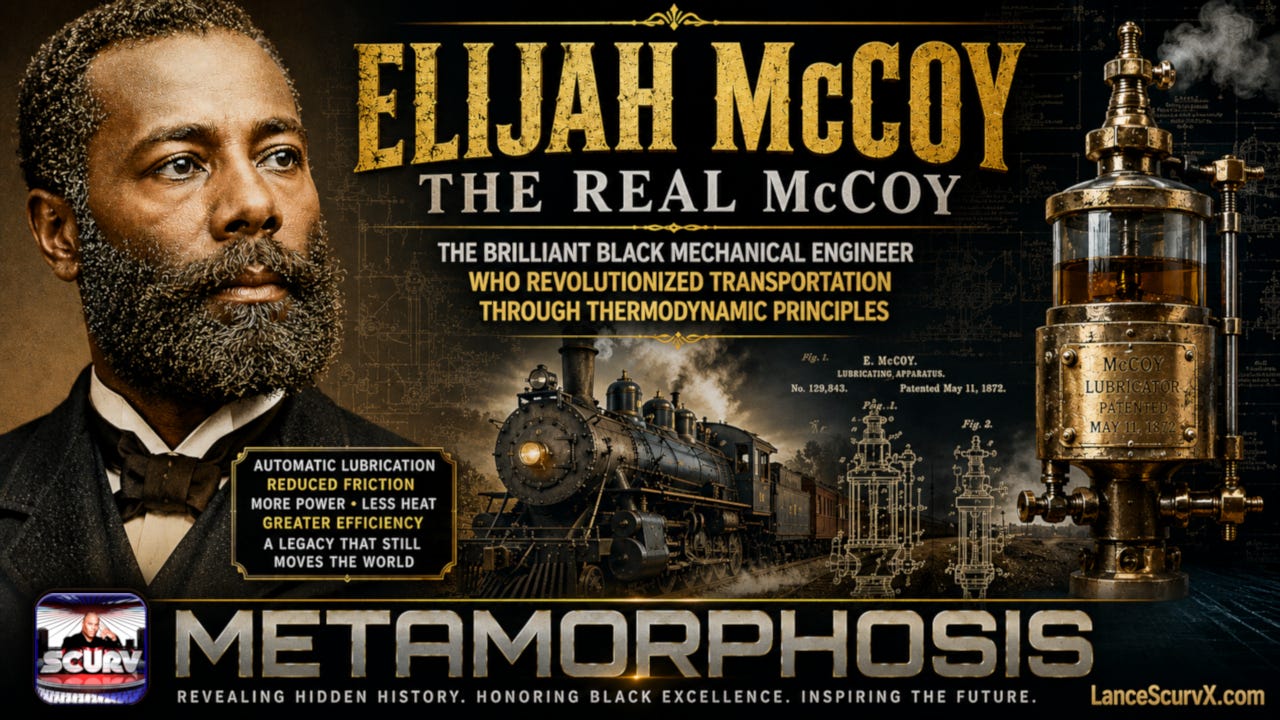
THE AUTOMATIC LUBRICATING CUP
In 1872, Elijah McCoy received one of his most significant patents for an automatic lubricating device designed specifically for steam engines. Although the invention appeared relatively simple from the outside, its engineering was remarkably sophisticated. Using carefully controlled valves and the existing steam pressure generated by the locomotive, the device continuously delivered precise amounts of lubricating oil directly to the machinery while the engine remained in motion.
The brilliance of the design wasn’t found in complexity but in precision. Instead of overwhelming the machinery with excessive amounts of oil or allowing components to run dry between maintenance stops, McCoy’s lubricator delivered exactly what the engine required at exactly the right time. This steady flow dramatically reduced wear, stabilized operating temperatures, and allowed locomotives to remain in service for much longer periods without interruption.
His invention demonstrated one of engineering’s greatest lessons: the most revolutionary breakthroughs are often those that solve enormous problems with elegant simplicity.
THE INVENTION THAT KEPT INDUSTRY MOVING
The impact of McCoy’s lubricating system extended far beyond the railroad industry. As manufacturers recognized its effectiveness, similar principles began improving steam-powered machinery wherever continuous operation mattered. Steamships crossing oceans, mining equipment operating deep underground, factory machines producing goods around the clock, and countless other industrial systems all benefited from more reliable lubrication.
The improvements weren’t limited to mechanical performance alone. Longer operating times increased productivity, reduced maintenance expenses, lowered repair costs, and allowed businesses to transport more passengers, ship more freight, and manufacture more products with greater efficiency. Entire industries became more profitable because one engineer had found a way to reduce unnecessary downtime.
It’s difficult to measure the true economic impact of McCoy’s invention because its influence spread into nearly every corner of industrial society. His lubricating principles quietly became part of the machinery powering the modern world, helping industries grow without drawing attention to the remarkable mind responsible for making that growth possible.
A MIND THAT NEVER STOPPED INVENTING
Although the automatic lubricator became his most celebrated achievement, Elijah McCoy never allowed one successful invention to define his entire career. Throughout his lifetime he secured nearly sixty patents covering lubrication systems, steam technology, industrial machinery, ironing equipment, and numerous other mechanical improvements. Each patent reflected the same disciplined process that had shaped his earliest work: observe the problem carefully, understand the underlying science, design a practical solution, and continue refining it until it performed reliably under real-world conditions.
His approach reminds us that true innovation rarely comes from chasing fame. It grows from relentless curiosity and a willingness to improve what others have accepted as permanent limitations. Every invention solved one challenge while revealing another opportunity for improvement, and McCoy embraced that lifelong pursuit of better engineering with remarkable consistency.
RESULTS THAT SPOKE LOUDER THAN PREJUDICE
Perhaps the most remarkable aspect of Elijah McCoy’s career is that his inventions succeeded in a society that often refused to recognize the brilliance of the man behind them. Many employers underestimated him because of the color of his skin, yet the machinery they depended upon couldn’t afford the luxury of prejudice. Steam pressure obeyed the laws of physics, not the opinions of society. Bearings either remained properly lubricated or they failed. Machines either operated efficiently or they broke down.
Because McCoy’s engineering consistently delivered results, industries embraced his innovations even when many people refused to fully acknowledge his accomplishments. His inventions earned respect through performance rather than publicity, proving that excellence possesses a power capable of outlasting discrimination. Long after the arguments of prejudice faded into history, the practical value of Elijah McCoy’s ideas continued moving trains, powering factories, and reminding the world that genuine genius can never be permanently confined by the limitations of its time.
BUILDING A LEGACY ONE PATENT AT A TIME
As Elijah McCoy’s reputation as an inventor grew, so did his determination to keep improving the machines that powered an industrializing world. While many inventors spend a lifetime searching for one breakthrough idea, McCoy treated every solved problem as the beginning of another challenge. His remarkable curiosity refused to stand still. He continued studying machinery, identifying weaknesses, and designing practical improvements that made engines more dependable, more efficient, and more economical to operate. By the end of his career, he had earned nearly sixty patents, an extraordinary achievement during a period when Black inventors faced obstacles that extended far beyond the drawing board.
Those patents covered much more than locomotive lubrication. McCoy developed improvements for steam engines, industrial machinery, lubrication systems, and other mechanical devices used in manufacturing and transportation. Each invention reflected the same disciplined approach that defined his engineering philosophy. He believed machinery should work with greater precision, waste less energy, and require less unnecessary maintenance. It wasn’t enough for a machine to function. In McCoy’s mind, every machine could be made better.
His work demonstrated an important truth that still applies today. Innovation isn’t always about creating something that has never existed before. Sometimes it’s about refining an existing idea until it performs so well that it transforms an entire industry. That ability to recognize hidden opportunities for improvement separated Elijah McCoy from many of his contemporaries and established him as one of the great mechanical minds of his generation.
SUCCESS DIDN’T ERASE THE BARRIERS
Despite his growing list of patents and the widespread use of his inventions, Elijah McCoy never escaped the racial discrimination that shaped much of his professional life. During the late nineteenth century, many Black inventors struggled to receive the same financial rewards, public recognition, or business opportunities that often accompanied major inventions. While industries eagerly adopted his engineering solutions, society remained reluctant to celebrate the engineer himself.
This contradiction reveals one of history’s cruelest ironies. Companies were willing to profit from McCoy’s brilliance, but many remained unwilling to fully acknowledge the man whose intellect generated those profits. His inventions crossed racial boundaries far more easily than he could. Machinery recognized excellence without prejudice, yet the culture surrounding that machinery frequently failed to do the same.
Rather than allowing bitterness to consume him, McCoy remained focused on the work itself. His response to discrimination wasn’t to stop inventing. Instead, he continued doing what he had always done best—solving problems that others could not. In many ways, his greatest act of resistance was refusing to allow prejudice to define the limits of his imagination.
A PERSONAL LIFE FILLED WITH BOTH JOY AND HEARTBREAK
Behind every inventor is a human being whose life extends far beyond patents and engineering drawings. Elijah McCoy experienced moments of happiness, companionship, disappointment, and loss just like anyone else. He married Ann Elizabeth Stewart, and together they built a life during a time when opportunities for Black families remained limited by widespread discrimination. Their marriage represented stability and partnership during years filled with demanding work and constant innovation.
Their happiness, however, was marked by profound sorrow. Ann suffered serious health challenges later in life and eventually passed away following an accident. Her death deeply affected McCoy, leaving a personal emptiness that no professional accomplishment could ever replace. It’s easy to focus on inventors only through the lens of their achievements, but moments like these remind us that even history’s greatest minds carry private burdens invisible to the outside world.
McCoy devoted much of his life to his work, yet those closest to him knew that behind the engineer stood a man who understood love, grief, perseverance, and sacrifice. His personal experiences shaped the quiet determination that characterized so much of his career.
THE TRUTH ABOUT “THE REAL McCOY”
Few phrases have generated as much curiosity as “the real McCoy.” For generations, many people have believed the expression originated because railroad companies specifically requested Elijah McCoy’s authentic lubricating devices instead of cheaper imitations. According to the popular story, buyers insisted on receiving “the real McCoy” because they trusted the quality of his engineering above all competitors.
It’s a compelling story, and it’s easy to understand why it has endured. McCoy’s inventions earned an exceptional reputation for reliability, making it entirely believable that customers would seek out his original products rather than settle for inferior copies. The phrase has become deeply woven into American culture, often used to describe something genuine, authentic, or of the highest quality.
Historians, however, continue to debate the true origin of the expression. Evidence suggests that similar phrases may have existed before Elijah McCoy’s inventions became widely known, and several competing explanations have been offered over the years. While it’s impossible to state with certainty that the saying originated exclusively from McCoy’s lubricators, it’s equally impossible to ignore how naturally the story fits the extraordinary reputation he earned through his work.
Whether or not the phrase began with him, one fact remains beyond dispute. Elijah McCoy represented authenticity in the truest sense of the word. His engineering wasn’t based on exaggerated claims or clever marketing. It was built upon results that industries trusted because they consistently performed under the harshest working conditions. In that sense, he truly embodied what people mean whenever they speak of the genuine article.

THE FINAL YEARS OF A REMARKABLE LIFE
As the twentieth century progressed, technology continued evolving, yet Elijah McCoy never lost his passion for engineering. Even as newer forms of power gradually emerged and industries changed, the principles behind his inventions remained essential to mechanical design. Continuous lubrication, efficient energy transfer, and careful attention to reducing friction remained cornerstones of modern engineering long after the steam era began giving way to new technologies.
McCoy spent his later years continuing to invent while witnessing a world transformed in part by ideas he had helped bring into existence. Railroads stretched farther across continents. Factories became increasingly productive. Industrial transportation expanded at an astonishing pace. Although countless innovations contributed to that progress, McCoy’s work formed one of the quiet foundations supporting this remarkable period of growth.
Elijah McCoy passed away on October 10, 1929, in Detroit, Michigan. He was eighty-five years old. His death came only weeks before the stock market crash that ushered in the Great Depression, closing the chapter on a life that had spanned slavery’s aftermath, the explosive growth of industrial America, and the dawn of the modern technological age.
A LEGACY THAT STILL MOVES THE WORLD
The true measure of an inventor isn’t how often history books mention their name. It’s how deeply their ideas become woven into everyday life. By that standard, Elijah McCoy stands among the most influential mechanical engineers of all time. Every modern machine that depends upon carefully controlled lubrication, reduced friction, efficient energy transfer, and continuous operation reflects principles that his work helped advance. While technology has evolved dramatically since the nineteenth century, engineers continue designing systems around many of the same mechanical realities McCoy understood so well.
His legacy also extends far beyond engineering. Elijah McCoy’s life challenges long-standing assumptions about who shapes history. Too often, the accomplishments of Black innovators have been minimized, overlooked, or omitted altogether, leaving generations with an incomplete understanding of the people who helped build the modern world. Recovering those stories isn’t about rewriting history. It’s about completing it.
Perhaps the greatest lesson Elijah McCoy leaves behind is that excellence possesses a quiet power that outlives prejudice. His inventions couldn’t erase the discrimination he faced during his lifetime, but they did something equally remarkable. They proved that truth eventually reveals itself through results. Long after critics are forgotten, genuine innovation continues serving humanity.
That’s why his story deserves to be told again and again. Every young person with an inquisitive mind deserves to know that curiosity can become invention, that persistence can overcome barriers, and that one disciplined individual can improve life for millions of people they will never meet. Elijah McCoy didn’t simply build a better lubricator. He demonstrated that the human mind, when guided by purpose and perseverance, possesses the power to move the world forward.
WHY ELIJAH McCOY’S STORY MATTERS MORE THAN EVER
There are certain people whose lives become larger than their own generation. Elijah McCoy belongs in that rare company. His inventions solved problems that affected railroads, factories, shipping, and heavy industry, yet his greatest contribution may have been demonstrating what becomes possible when knowledge refuses to surrender to discrimination. Every challenge placed before him could have become an excuse to quit. Instead, each obstacle became another reason to think harder, work longer, and invent something better. That’s the difference between ordinary talent and extraordinary purpose.
Today’s world moves at breathtaking speed. Technology evolves almost daily, artificial intelligence is changing industries, and machines perform tasks once thought impossible. Yet every modern innovation still rests upon timeless principles that engineers like McCoy helped refine. Machines still battle friction. Heat still affects performance. Precision still determines reliability. The tools have changed, but the scientific truths remain the same. McCoy’s work reminds us that the greatest advances are often built upon mastering the fundamentals before reaching for the future.
His life also forces us to examine how history remembers achievement. Too often, society celebrates finished products while overlooking the people whose determination made those products possible. It’s easy to admire technological progress without asking who sacrificed to create it. Elijah McCoy deserves recognition not simply because he was a brilliant Black inventor, but because he was one of the great mechanical engineers of the Industrial Age whose ideas quietly improved the lives of millions of people he would never meet.
For young people searching for direction, McCoy’s story offers a powerful lesson that reaches beyond race, nationality, or profession. Curiosity has value. Education has value. Discipline has value. Persistence has value. Those qualities can carry an individual farther than circumstances ever could. The world may delay recognizing excellence, but genuine excellence has a remarkable way of proving itself through consistent results. That lesson remains just as relevant today as it was more than a century ago.
As we close the pages of Elijah McCoy’s remarkable life, we’re left with more than admiration for a gifted inventor. We’re reminded that civilization advances because courageous people refuse to accept unnecessary limitations. They study problems others ignore. They imagine solutions others cannot see. Then they dedicate themselves to making life better for generations they will never know. Elijah McCoy did exactly that, and every time modern machinery operates more efficiently because friction has been conquered and energy has been harnessed with greater precision, a small part of his legacy continues moving the world forward.