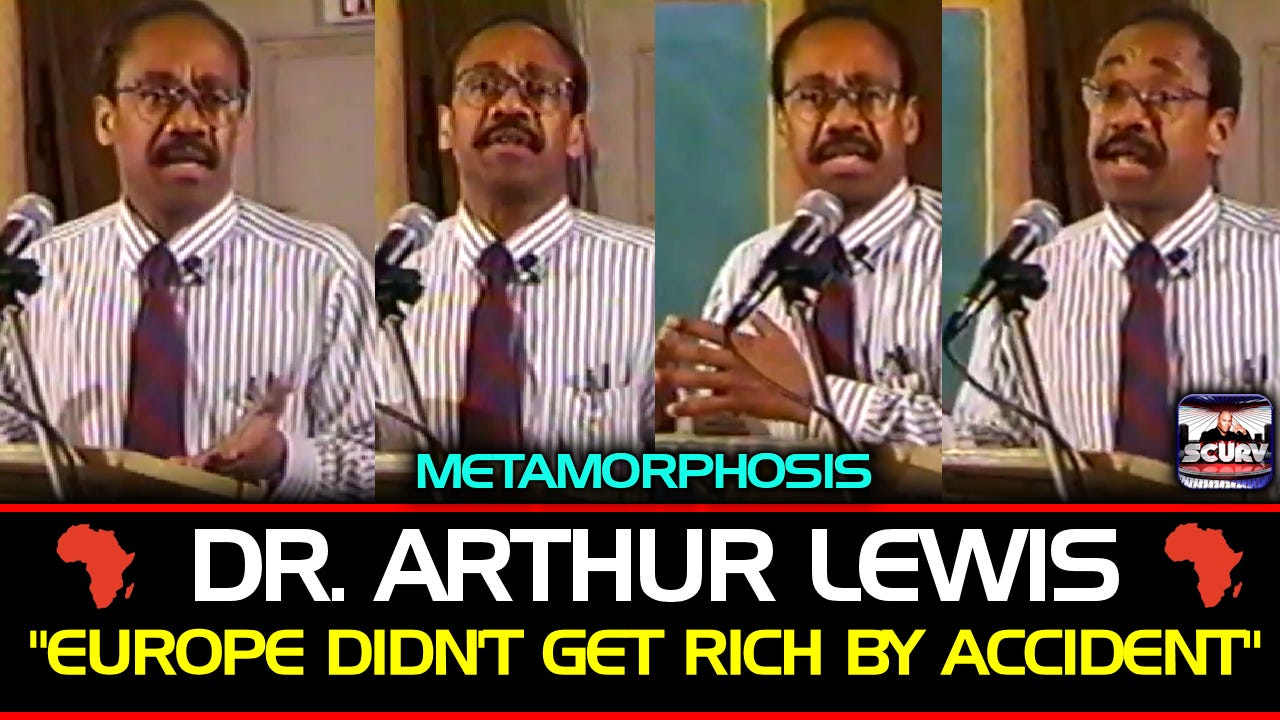

The global economy did not form by accident. It was shaped through force, planning, and long-term strategy. Dr. Arthur Lewis of New York City dedicated his work to explaining how European powers structured the world economy to benefit themselves while restricting African progress. His words challenged comfortable narratives and forced listeners to confront the systems beneath modern inequality.
Dr. Lewis did not speak in abstractions or theory alone. He spoke directly about power, control, and economics as tools of domination. His speech, European World Economic Domination and Its Impact on Africa and African People, broke down how wealth was extracted, redirected, and protected through global systems that still exist today.
Many people are taught that Africa’s struggles come from internal failure. Dr. Lewis rejected that idea. He showed how African nations were intentionally locked into roles that served European economic growth while limiting African independence. His work exposed how dependency was manufactured, not accidental.
What made Dr. Lewis stand out was his ability to connect history to the present. He did not treat colonialism as something that ended. He explained how it evolved into economic agreements, trade rules, and financial systems that continue to shape African life today.
This biography focuses on Dr. Arthur Lewis’s ideas, message, and impact. It is not about titles or praise. It is about understanding how global systems were designed and why that knowledge still matters for African people and the diaspora today.
EUROPEAN WORLD ECONOMIC DOMINATION AND ITS IMPACT
Dr. Arthur Lewis explained that Europe’s rise to global power was driven by control over resources, labor, and trade routes. Africa was central to that process. Raw materials were taken from African land at low cost, processed elsewhere, and sold back at higher prices. This structure ensured Europe accumulated wealth while Africa remained dependent.
He emphasized that economic domination replaced direct rule. Even after political independence, African nations were tied to foreign banks, currencies, and trade policies that limited true freedom. Loans came with conditions. Aid came with control. Markets were opened for extraction, not growth.
Dr. Lewis pointed out that education systems were also shaped to support this structure. African people were trained to serve systems created elsewhere instead of building independent industries. Skills were encouraged only when they fit into global labor needs controlled by Europe.
He explained how currency systems played a major role. African economies were often tied to foreign currencies, making them vulnerable to decisions made outside the continent. This removed financial sovereignty and kept African nations reacting instead of leading.
Dr. Lewis also addressed how global media shaped perception. Africa was portrayed as unstable and incapable, which justified continued intervention. These images were not accidental. They supported economic control by framing dominance as assistance rather than exploitation.
Throughout his speech, Dr. Lewis made it clear that this system affected African people everywhere. Whether on the continent or in the diaspora, economic power determined political influence, cultural respect, and opportunity. Without control over economics, other forms of freedom remained limited.
He stressed that understanding the system was the first step toward change. Ignorance kept people trapped. Knowledge created the possibility of strategy. Dr. Lewis did not offer false hope, but he offered clarity, and clarity itself was power.
CLOSING THOUGHTS…
Dr. Arthur Lewis’s work remains relevant because the systems he described are still operating. The names may change, but the structure remains familiar. Wealth continues to flow upward and outward, while Africa is pressured to remain a supplier rather than a producer.
His message was not rooted in anger but in awareness. He believed that people who understand the system can no longer be easily controlled by it. Silence and confusion were tools of domination, and education was a form of resistance.
Dr. Lewis challenged listeners to rethink independence. Flags and borders meant little without economic control. True freedom required ownership of land, resources, labor, and financial systems.
He also reminded African people that history matters. The present cannot be understood without acknowledging the past. Economic patterns repeat because they are designed to do so.
The legacy of Dr. Arthur Lewis is not found in institutions but in understanding. His work remains a guide for those seeking clarity in a world shaped by unequal power.