

A STORY TOO BIG TO FORGET
There are stories buried in history that never get the attention they deserve. Stories of minds that shaped the world in ways most people use every single day without ever knowing the name behind it. This is one of those stories. It is about a man whose work touches your food, your medicine, and even the way the modern world moves supplies across long distances.
This is not just about invention. It is about survival, innovation, and the kind of thinking that breaks limits when the world tries to box someone in. It is about a mind that saw a problem and refused to accept that it could not be solved.
When we look at modern life, refrigerated trucks are everywhere. They carry food across countries, keep medicine stable, and make global trade possible. But there was a time when none of that existed. There was a time when distance meant decay, and decay meant loss.
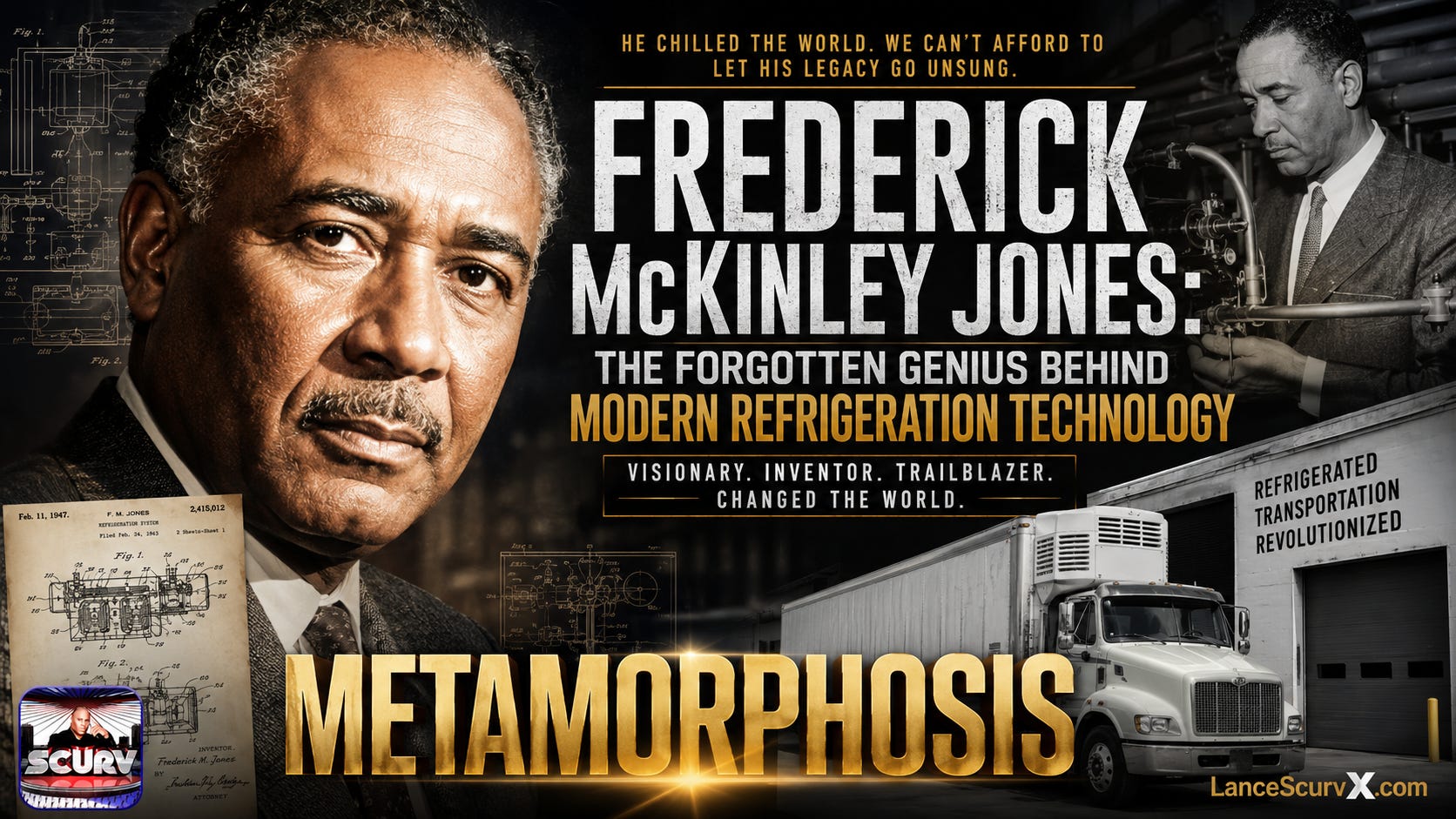
This is where the story begins to matter. Because someone had to change that reality. Someone had to see beyond the limits of the time and build something that could preserve life in motion. That someone was Frederick McKinley Jones.
And his journey was not easy. It was built on struggle, isolation, and relentless creativity in a world that did not always recognize his value.
EARLY LIFE: BUILT FROM STRUGGLE AND SURVIVAL
Frederick McKinley Jones entered the world in the late 1800s during a time when opportunity was limited and hardship was normal for many. His early life was marked by instability and loss. He was raised without the comfort and structure many children rely on, and he had to grow up fast in a world that demanded resilience.
He did not have a smooth path through formal education. Instead, he learned by observing, experimenting, and doing. That kind of learning builds a different type of intelligence. It builds practical genius. The kind that understands how things work in real time, not just in theory.
As a young man, he developed a strong interest in mechanics. Machines, engines, and systems fascinated him. While others saw broken equipment, he saw puzzles waiting to be solved. That mindset would become the foundation of everything he later created.
Life forced him to move from place to place, picking up skills along the way. He worked in environments where he had to prove himself over and over again. But every challenge sharpened his ability to think differently.
This was not a life of comfort. It was a life of constant adaptation. And that adaptation would later become the very fuel of his innovation.
THE MIND OF AN INVENTOR: SEEING WHAT OTHERS COULD NOT
What separated him from many others was not just intelligence, but perception. He saw problems that most people accepted as permanent. One of those problems was food spoilage during transport.
Back then, transporting perishable goods over long distances was risky. Ice would melt. Food would spoil. Businesses lost money. Communities suffered shortages. There was no reliable way to preserve freshness while moving goods across states or regions.
Instead of accepting that limitation, he asked a different question. He asked what would happen if cooling could travel with the goods. Not stored in a building. Not dependent on ice. But built into motion itself.
That question changed everything.
He began working on systems that could create consistent refrigeration in moving vehicles. This required deep understanding of mechanics, airflow, insulation, and power systems. It was not a simple idea. It was a complex challenge that demanded precision and creativity.
And through trial, error, and relentless persistence, he developed a portable cooling system that could operate during transportation. This breakthrough would eventually reshape entire industries.
BREAKTHROUGH: THE INVENTION THAT CHANGED EVERYTHING
The invention of mobile refrigeration did not just improve transport. It transformed it completely. Suddenly, food could travel farther without spoiling. Medical supplies could be preserved during long-distance delivery. Entire supply chains became more efficient and reliable.
This innovation led to the development of refrigerated transport systems used across trucks, trains, and military supply chains. It solved a problem that had limited trade and distribution for generations.
He eventually co-founded a company focused on refrigeration technology for transport systems. This company became a major force in advancing cold storage solutions that would be adopted across industries worldwide.
His work was not just mechanical. It was structural. It changed how society thought about distance and preservation. It allowed cities to receive fresh food from faraway farms. It allowed emergency supplies to reach critical locations without losing effectiveness.
During major global conflicts, his refrigeration systems played a key role in preserving food and medical materials for troops. That contribution alone shows how deeply his invention affected human survival and logistics.
Even though his work was groundbreaking, recognition did not come easily or quickly. Like many innovators ahead of their time, his impact was fully appreciated long after the foundation had already been laid.
LEGACY OF IMPACT: MORE THAN JUST A MACHINE
The true legacy of his work is not just the invention itself, but what it made possible. Modern supermarkets, global food trade, pharmaceutical storage, and disaster relief systems all depend on refrigeration in transit.
Without this breakthrough, the modern world would look very different. Food scarcity would be more common. Supply chains would be shorter and less reliable. Global distribution would be severely limited.
His contribution represents something deeper than technology. It represents transformation. It represents the power of applied intelligence combined with persistence in the face of limitation.
He proved that innovation does not require privilege. It requires vision, discipline, and the refusal to accept unnecessary boundaries.
His life stands as a reminder that some of the most important contributions to society come from those who are not always given the loudest platform.
CLOSING REFLECTION: THE POWER OF ONE MIND
When we look at the systems we rely on today, it is easy to forget where they came from. It is easy to assume they have always existed. But every system has a beginning. Every advancement has a creator behind it.
This story is a reminder that greatness can come from unexpected places. It shows that environment does not define destiny when determination is strong enough.
It also forces us to think about how many other contributions remain under-recognized in history. How many other minds shaped the modern world without the credit they deserved.
The truth is that innovation is often invisible until we remove it. Only then do we realize how essential it was.
This inventor’s work continues to move through our lives every single day. In the food we eat, the medicine we trust, and the systems that keep global trade alive, his influence is still present.
His story is not just history. It is ongoing impact.
And it challenges all of us to think bigger, build smarter, and refuse to accept limits that were never meant to be permanent.
Because when one mind decides to change the rules, the entire world eventually follows.