


There are some inventions that have become so ordinary in our lives that we barely stop to think about the people who made them possible. We put clothes into a dryer, close the door, press a button, and walk away expecting warm, dry clothing to be waiting for us later, but the simplicity of that modern experience can make us forget that drying clothes was once a long, difficult, inconvenient, and sometimes dangerous household task. Before modern appliances transformed domestic life, people had to depend on outdoor weather, indoor heat, open flames, drying lines, racks, and hours of physical labor just to accomplish something that we can now do with the push of a button. Somewhere along that long road of technological development was a Black inventor named George T. Sampson, whose work deserves far more attention than the small amount of historical recognition it has received.
George T. Sampson’s name doesn’t have the instant recognition attached to it that many famous inventors have received, yet his surviving patent tells us that his mind was working on practical mechanical solutions more than a century ago. In 1892, he received U.S. Patent No. 476,416 for an improved clothes-drier, a device designed to suspend clothing near a stove using a system of frames, hinges, supports, wires, and adjustable components. His invention wasn’t the first device ever conceived for drying clothes, and that distinction is important because the truth doesn’t need exaggeration, but what Sampson did accomplish was significant: he developed and patented an improvement to an existing problem at a time when household technology was still developing rapidly.
There’s something about Sampson’s story that interests me even more than the patent itself because when we look at a person like this, we have to resist the temptation to reduce his entire existence to whatever object he happened to create. A patent can tell us what somebody invented, but it can’t tell us everything about the person who invented it. It doesn’t tell us about the frustrations that came before the finished design, the questions that occupied his mind, the people who encouraged or discouraged him, or the private moments when an idea that seemed impossible suddenly began to make sense. Unfortunately, much of George T. Sampson’s personal biography has disappeared into history, leaving us with considerably more evidence about his inventions than about the man himself, and that absence should make us more thoughtful rather than more willing to fill the gaps with stories that cannot be proven.
That missing information is important because history is often uneven in what it chooses to preserve. We tend to preserve the documents that society considers valuable at the time, and those documents don’t always capture the human experience behind an accomplishment. Sampson’s patent survived because the patent system was designed to document inventions and protect intellectual claims, while his childhood experiences, family relationships, private struggles, personal ambitions, and everyday life were not preserved with the same level of detail. That leaves us with a fascinating historical contradiction: more than a century later, we can examine the machinery he designed, study his patent drawings, read the technical description of his invention, and identify the dates connected to his work, while still knowing far too little about the human being who carried those ideas from his mind into the physical world.
That’s precisely why George T. Sampson’s story deserves to be approached as more than a piece of invention trivia. His life should make us think about the mindset behind innovation and about what it means to look at an everyday problem and refuse to accept the existing solution as the final answer. His story should also make us think about the thousands of people throughout history whose contributions survived while their personal stories disappeared, because a person can leave evidence of extraordinary intelligence without leaving behind enough personal documentation for future generations to understand the full journey. Sampson gives us an opportunity to examine not only what a Black inventor accomplished, but also what his surviving work reveals about curiosity, mechanical reasoning, persistence, and the courage to challenge the ordinary.
THE MAN BEHIND THE PATENT
One of the greatest challenges in writing about George T. Sampson is separating documented history from stories that have grown around his name over the years. There are modern accounts that provide specific details about his birth, childhood, family, education, and personal circumstances, but many of those claims aren’t firmly supported by the primary records that remain available. That creates a serious responsibility for anyone telling his story because when information is missing, there’s a temptation to fill the empty spaces with a dramatic narrative simply because a dramatic narrative feels more satisfying than uncertainty. If we’re going to talk about Black history with seriousness, however, we have to be willing to say that we don’t know when the evidence doesn’t give us an answer.
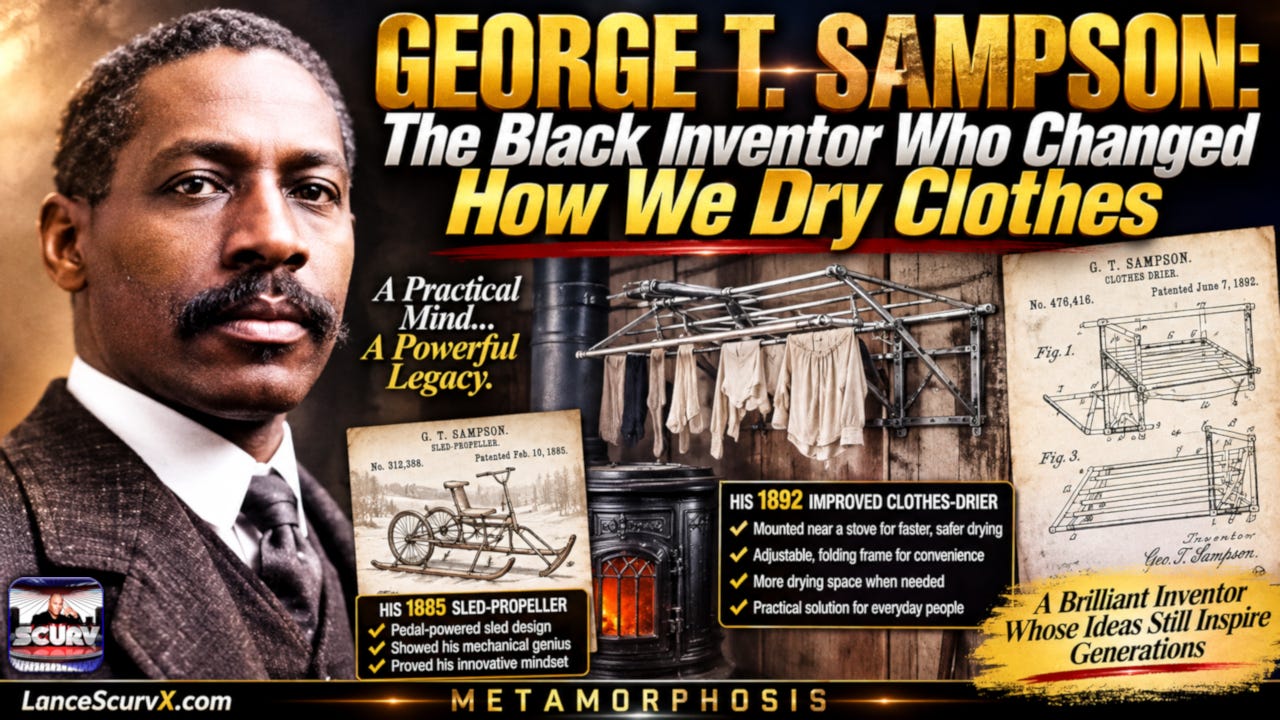
That doesn’t weaken Sampson’s story; in many ways, it makes the documented portions of his life even more significant because we aren’t depending on mythology to make him impressive. The inventions themselves give us something solid to examine, and what they show is that Sampson was living in Dayton, Ohio, when his patents were issued and that his first known patent came years before his clothes-drier invention. In 1885, he received U.S. Patent No. 312,388 for a sled-propeller, and that invention becomes extremely important when trying to understand Sampson because it demonstrates that his mechanical thinking didn’t suddenly appear when he began working on clothes-drying technology. He had already demonstrated an ability to take familiar mechanical concepts and reorganize them into something new.
The sled-propeller was designed around a tricycle-like frame that could be adapted for use as a sled, with wheels replaced by runners and a pedal-operated system used to generate motion. The design incorporated mechanical elements that transferred the rider’s movement through a crankshaft, pulleys, and a chain toward a driving wheel, while a steering arrangement allowed the sled to be directed. That may sound primitive to modern ears, but the important issue isn’t whether the machine looks technologically advanced by today’s standards; what matters is the thinking required to create it. Sampson had to understand how individual mechanical parts could interact as one system, and he had to consider movement, support, steering, propulsion, balance, and the relationship between the rider and the machine.
That kind of thinking is what separates an inventor from someone who simply knows how to use technology. Most people see an object for what it currently does, but an inventor can look at the same object and start asking what else it might be capable of doing. That ability to see possibility where other people see limitation is one of the strongest themes running through the surviving evidence of Sampson’s work, and it becomes especially important when we examine the later clothes-drier patent because the same practical mindset appears again in a completely different setting.
THE FIRST INVENTION REVEALS THE MIND
The sled-propeller patent gives us a glimpse into Sampson’s imagination because he wasn’t simply taking an existing object and making a cosmetic change. He was rethinking how a familiar mechanical arrangement could operate under completely different conditions. A tricycle is designed to move on wheels over a hard surface, while a sled is designed to move over snow using runners, and Sampson saw enough mechanical similarity between those systems to imagine a way to adapt one for the other. That kind of thinking is worth emphasizing because invention is often misunderstood as a lightning bolt of genius when, in reality, meaningful invention usually involves observation, questioning, experimentation, adjustment, failure, redesign, and persistence.
The finished invention may look simple when we examine it years later, but the thinking behind it can be complicated. Sampson’s later clothes-drier patent follows that same basic philosophy because he looked at something already happening in everyday life and asked whether the process could be improved. He wasn’t trying to create heat from nothing, nor was he claiming to have invented the basic concept of drying clothes with heat; instead, he was thinking about how existing household heat could be used more effectively while creating a structure that could be adjusted, expanded, supported, and moved when necessary.
That distinction is important because it changes the way we understand invention. Instead of believing that every important inventor has to create something from absolutely nothing, we can recognize that some of the most useful advances come from people who examine an existing idea and make it work better. Sampson’s surviving patents suggest that he had the habit of doing exactly that, and that habit may be more valuable as a lesson than the specific devices themselves.
THE WORLD BEFORE MODERN LAUNDRY
To understand why Sampson’s clothes-drier mattered, we have to step outside the modern world for a moment and remember that laundry was once a much more demanding process than it is today. Modern laundry is largely hidden behind machines, with clothing going into washers and dryers while much of the physical labor is transferred from people to appliances. The process has become so automatic that many people have never had to think seriously about how much work laundry once required, but during the nineteenth century, clothing had to be washed, handled, wrung out, transported, hung, monitored, and dried without the convenience of the machines we now take for granted.
Weather could become a major obstacle because rain could delay drying, cold temperatures could make outdoor drying difficult, humidity could slow the removal of moisture, and limited indoor space could create another problem when households needed to dry large amounts of clothing. Heat offered an obvious solution, but heat also introduced danger because clothing placed too close to an open fire or stove could become damaged, scorched, smoky, or even ignite. The challenge therefore wasn’t simply to make clothes warmer; the challenge was to create a controlled arrangement where heat could help remove moisture without turning the drying process into a dangerous household situation.
That’s the problem Sampson was addressing with his invention, and understanding that context makes the patent more meaningful. We aren’t looking at a modern electric dryer in primitive form, and we shouldn’t pretend that’s what it was. We’re looking at a nineteenth-century mechanical solution to a practical household problem, developed around the technology available at the time. Sampson was working with the stove, frames, supports, hinges, wires, and mechanical arrangements available to him, and he was attempting to make those elements work together in a more useful way.
THE IDEA BECOMES AN ENGINEERING SOLUTION
Sampson filed his clothes-drier patent application on June 24, 1891, and the patent was granted on June 7, 1892. U.S. Patent No. 476,416 described an improved clothes-drier designed to position clothing near a stove using a series of frames and supporting components, and the word “improvement” is particularly important because it places Sampson’s contribution in the proper historical context. Earlier attempts to use heat for drying clothes already existed, so Sampson wasn’t creating the entire concept from nothing; his contribution was in the design and arrangement of the equipment and in the practical way the components worked together.
The patent describes a main frame that could be secured behind a stove, along with a drying frame that could be raised when it wasn’t being used and lowered into position when clothes needed to be dried. Supporting wires helped hold the frame in place, while extension brackets allowed the structure to be adjusted. A supplemental folding frame could also provide additional drying space, giving the user greater flexibility without requiring a permanent structure to occupy the same amount of space all the time. When we look at those details together, the invention becomes much more interesting than the simple phrase “clothes dryer” suggests.
Sampson was thinking about space, movement, support, capacity, storage, and convenience at the same time. He wasn’t merely asking how to get clothing close to a heat source; he was thinking about how the entire device would function while it was being used and what would happen after the task was completed. That’s engineering thinking because good engineering isn’t simply about making one component function. It’s about making multiple components work together in a way that serves a practical purpose.
TRIAL, ERROR, AND THE PART HISTORY DOESN’T SHOW
Here’s where we have to separate what we can document from what we can reasonably infer. We don’t have George T. Sampson’s personal notebooks showing every experiment he conducted, and we don’t have photographs of his workshop or a diary describing every failed prototype. We don’t know how many versions he built before reaching the design represented in the patent, and we shouldn’t invent dramatic stories about failures that the historical record doesn’t preserve. At the same time, anybody who has ever tried to construct a mechanical device understands that a finished patent drawing rarely tells the entire story of how an invention came into existence.
The final design is the cleaned-up version, representing the solution after the inventor has already wrestled with the problem. When we see hinges, brackets, wires, supports, extension mechanisms, folding frames, and adjustable components working together, we’re looking at the result of mechanical reasoning that had to account for stability, movement, weight, positioning, and practical use. Something had to remain stable, something had to fold, something had to extend, something had to support weight, something had to remain in position, and something had to move when the user needed it to move. Those requirements tell us that the final design involved considerable thought even though we don’t have the personal notes documenting every stage.
Innovation almost never works as neatly as the finished product makes it appear. The world sees the victory, while the inventor experiences the process, and the process is where the real struggle usually lives. People celebrate the patent, but they don’t see the uncertainty that came before it, just as they see the finished machine without seeing the problem-solving required to make it work. Sampson’s surviving record doesn’t allow us to reconstruct every setback he experienced, but it does allow us to understand that the finished invention represented a serious effort to solve a practical mechanical problem.
THE SECOND INVENTION CHANGES EVERYTHING
When we place the 1885 sled-propeller beside the 1892 clothes-drier, Sampson’s story becomes much larger because we’re no longer looking at a person associated with only one invention. We’re looking at somebody who demonstrated mechanical creativity across very different problems. The sled required him to think about movement and propulsion, while the clothes-drier required him to think about heat, positioning, support, folding, adjustment, capacity, and household space, yet the underlying method remained remarkably similar.
Sampson observed something, studied how it worked, identified an opportunity for improvement, imagined another possibility, and created a mechanical arrangement designed to accomplish that new purpose. That’s the mentality behind innovation, and it’s one of the most important things we can take from his story today. Creativity doesn’t necessarily come from having one perfect idea; sometimes creativity becomes a habit of seeing possibilities everywhere.
A person who sees a tricycle and imagines a sled is thinking differently, just as a person who sees a stove and imagines a safer and more flexible clothes-drying system is thinking differently. A person who sees a folding mechanism and realizes that it can solve a space problem is also thinking differently. That kind of thinking can become a way of life because once someone develops the habit of questioning how things work, the world starts looking less like a collection of finished objects and more like a collection of possibilities waiting to be explored.
THE COURAGE TO SOLVE AN ORDINARY PROBLEM
There’s another reason George T. Sampson’s story deserves attention: his invention wasn’t glamorous. He wasn’t trying to build something that would make him look important, and he wasn’t working on an invention that immediately sounds revolutionary when we hear its name. He was dealing with laundry, which may sound ordinary, but ordinary problems are often where some of the most useful innovations begin.
Somebody gets tired of carrying something, somebody gets tired of wasting time, somebody gets tired of cleaning something, somebody gets tired of doing the same task manually, or somebody notices that millions of people are struggling with the same inconvenience. Eventually, somebody asks why the problem has to exist in the first place, and that question can become the beginning of invention. Sampson’s clothes-drier demonstrates how a mundane household problem can become an opportunity for mechanical creativity.
The problem doesn’t have to sound impressive for the solution to be valuable. In fact, some of the most important technological improvements throughout history have been created by people who simply wanted to make everyday life work a little better. Sampson’s contribution belongs within that tradition because he wasn’t chasing novelty for novelty’s sake; he was working toward a practical improvement that could make a household task more manageable.
THE STRUGGLE OF BEING REMEMBERED
There’s something almost painful about the historical position George T. Sampson occupies today because we know his inventions while knowing surprisingly little about his personal life. We know the patent numbers, the dates, the locations attached to the patents, and the technical descriptions, and we can still examine the drawings, but much of the man behind those documents has disappeared.
That’s a strange form of historical survival because his mechanical work survived better than his personal story, his invention survived better than his voice, and his signature survived better than his memories. That should make us question what we mean when we say somebody has been remembered because being remembered isn’t simply having your name appear in a textbook. It’s having people understand that there was a human being behind the accomplishment, somebody who woke up in the morning, experienced frustration, thought about possibilities, made decisions, encountered obstacles, and continued moving forward.
We can’t reconstruct all of that for Sampson, and pretending that we can would be dishonest. What we can do is refuse to reduce him to the machine he created and refuse to treat the missing parts of his biography as permission to invent whatever story sounds best. Sometimes historical honesty means admitting that a portion of someone’s life has been lost while still giving that person full credit for the contributions that can be documented.
THE PROBLEM WITH CALLING HIM THE FIRST DRYER INVENTOR
There’s a popular version of Sampson’s story that describes him as the inventor of the first automatic clothes dryer, but that claim needs to be handled carefully because the historical record doesn’t support such a simple statement. Earlier clothes-drying devices existed, including an 1882 U.S. patent for a clothes-drier, and Sampson’s own 1892 patent identifies his device as an improvement rather than the first invention of the general concept.
There’s no reason to exaggerate his contribution because the documented story is already powerful. George T. Sampson was a Black American inventor who patented a clothes-drier improvement in 1892, creating a frame-based system for suspending clothing near a stove with components that could be adjusted, supported, expanded, and folded. Seven years earlier, he had patented a mechanical sled-propeller, giving us evidence that his inventive work extended beyond the household technology for which he’s most often remembered.
That distinction actually makes his story stronger because it allows us to discuss his contribution honestly. We don’t have to turn him into something he wasn’t in order to prove that he mattered. We simply have to stop allowing what he actually accomplished to disappear beneath a simplified version of history.
THE REAL VICTORY
The real victory wasn’t simply the moment the patent was granted because the deeper victory was the movement from thought to design, from design to invention, and from invention into the permanent historical record. Imagine what it meant to place an invention into the patent system during nineteenth-century America, a period when Black Americans were living within a society filled with racial barriers and restrictions that affected education, employment, business opportunities, wealth, and social mobility. Yet Sampson’s work entered the official American patent record, and his name became permanently connected to the inventions he had developed.
His drawings were preserved, his mechanical explanation was preserved, and his intellectual claim was documented in a way that allowed future generations to examine the work. More than a century later, we can still open the patent record and see what he created, even though we can’t reconstruct everything about his private life. That’s important because recognition doesn’t always arrive when we expect it, and sometimes the contribution outlives the person who made it.
There are people who work for applause and people who work because they see something that needs to be done. The historical record doesn’t tell us everything about Sampson’s motivations, so we shouldn’t pretend that we know what was in his heart, but his surviving inventions show that he was willing to engage with problems that required imagination and persistence. Whether or not he received the level of recognition he deserved during his lifetime, the work itself survived, and that survival gives us the opportunity to recognize his contribution today.
THE LESSON HIDDEN INSIDE THE MACHINE
The most powerful part of Sampson’s story may have nothing to do with laundry at all because it’s really about intellectual independence. He didn’t simply accept the world as he found it; he looked at existing technology and asked how it could be improved. That mentality remains valuable because we live in a world filled with problems that people complain about every day, yet complaining and solving are two very different activities.
We complain about broken systems, inefficient technology, transportation, housing, education, communication, food, energy, waste, and countless other problems, but progress depends on people who eventually move beyond the complaint and start asking what can actually be changed. Why does this work this way? How could it work differently? What happens if this component moves? What happens if the structure folds? What happens if the process becomes safer or more efficient? Those are the kinds of questions that turn frustration into innovation.
Sampson’s patents reveal a mind that was willing to engage with those kinds of questions. He wasn’t simply accepting the world as something finished and untouchable. He was looking at existing systems and asking whether they could be reorganized to serve a better purpose, and that mindset is one of the most valuable parts of his legacy because it applies to far more than mechanical inventions.
THE POWER OF IMPROVEMENT
One of the most important lessons in Sampson’s story is that invention doesn’t always require creating something that never existed before. Sometimes the breakthrough is an improvement, and that’s important because people can easily talk themselves out of creativity by believing somebody else has already done everything worth doing. They look around and say that somebody already invented the thing, so there’s nothing left for them to contribute.
But maybe somebody invented it without making it safe enough. Maybe they created a version that was too expensive, too large, too difficult to operate, too inefficient, or too limited for another purpose. Maybe the existing design solved one problem while creating another. That’s where improvement becomes innovation, because progress often comes from people who refuse to accept that the current version is necessarily the best version.
Sampson’s clothes-drier patent is a useful example of that principle. His contribution becomes clearer when we stop asking whether he created the first possible clothes-drying device and start asking what problem his particular design was attempting to solve. Once we make that shift, we can appreciate the invention for what it actually was rather than judging it against a claim it never needed to make.
THE MAN WHO LEFT MORE THAN ONE IDEA BEHIND
It would be a mistake to remember George T. Sampson only because of the clothes-drier because his 1885 sled-propeller patent demonstrates that his mechanical imagination reached beyond household technology. He had already shown an ability to rethink mechanical movement before he turned his attention toward clothes drying, and that matters because it reveals range rather than a single isolated moment of creativity.
The problems were different, but his approach was similar. He was interested in mechanisms, possibilities, movement, structure, and practical use. He looked at familiar things and considered whether they could perform their functions differently, and that kind of thinking can produce innovation in almost any field.
An inventor doesn’t have to remain trapped inside one category. Somebody who learns how to solve one kind of problem can carry that way of thinking into another area, and Sampson’s surviving patents give us an example of that broader creative mentality. The sled and the clothes-drier may appear unrelated, but both reveal a person who was willing to question how existing mechanical arrangements could be used.
WHEN HISTORY DOESN’T GIVE YOU THE WHOLE STORY
I wish we knew more about George T. Sampson because there are obvious questions that naturally arise when we examine his inventions. We want to know about his childhood, his education, the people who encouraged his curiosity, the circumstances that shaped his mechanical abilities, the environment in which he worked, the experiments that preceded his patents, and the response he received from the people around him. We would also like to know whether his inventions brought him financial success and what he thought about his own place in history.
Unfortunately, the reliable record available to us doesn’t provide satisfying answers to all of those questions, and wishing for evidence doesn’t create evidence. That means we have to respect the historical record even when it leaves us frustrated. We can acknowledge what’s missing without turning those missing pieces into fictional certainty, and that’s especially important when telling stories about people whose lives have already been poorly preserved.
There’s something powerful about that honesty because it reminds us that historical erasure isn’t always a deliberate act. Sometimes documents simply disappear, families lose records, communities move on, and the people who knew an individual personally are eventually gone. What remains can be only a fraction of an entire life, and Sampson’s story shows us why preserving history while people are still alive matters so much.
THE INVENTION THAT OUTLIVED THE INVENTOR
Look closely at Sampson’s clothes-drier design and something becomes obvious: he was thinking about the person who would actually have to use the device. The frame could be raised when it wasn’t needed, lowered when clothes needed drying, and supplemented with additional drying space when necessary, while various components allowed the structure to be adjusted and supported.
The device therefore wasn’t simply about producing heat. It was about creating a usable system around heat, and that distinction matters because good technology isn’t simply about making something function. Good technology also considers how human beings are going to live with it, where it will go, how much space it will occupy, how it will be operated, and what happens when the task is finished.
Those questions may sound modern, but they aren’t. People have always needed technology to fit into their lives rather than forcing their lives to revolve completely around technology. Sampson was wrestling with those practical concerns in the nineteenth century, and that’s another reason the patent deserves more attention than a simple reference to a “clothes dryer” can provide.
WHAT GEORGE T. SAMPSON CAN TEACH THE NEXT GENERATION
For anyone listening to this story today, especially someone who believes invention belongs to somebody else, Sampson offers a different message. Innovation doesn’t necessarily begin with a giant laboratory, a huge financial investment, or a famous institution behind you. Sometimes it begins with a person who notices something that doesn’t work as well as it should and becomes unwilling to stop thinking about it.
Start with the problem, study it, understand it, ask why it exists, and then ask what could make it better. That process may lead nowhere at first, and the first attempt may fail, but failure doesn’t necessarily mean that the effort was wasted because every unsuccessful attempt can reveal something about what needs to change. The important thing is to remain willing to think, test, adjust, and try again.
That lesson applies far beyond invention. It applies to business, art, education, relationships, technology, community development, and personal growth because progress almost always requires somebody to look at the existing situation and decide that improvement is possible. Sampson’s life gives us a historical example of that mentality, even though the surviving record doesn’t allow us to document every step of his personal journey.
THE POWER OF PUTTING YOUR NAME ON YOUR WORK
There’s something deeply symbolic about seeing George T. Sampson’s name attached to his patent because the technical language may feel distant, the machinery may look primitive, and the illustrations may appear old-fashioned, but the name remains. He put his intellectual work into the official record, and that act created a historical trail that survived long after the details of his personal life became difficult to recover.
An idea that remains only inside someone’s head can disappear when that person dies, but a sketch can preserve the concept, a design can clarify it, a prototype can demonstrate it, and a patent can establish a public record. Sampson moved his ideas far enough along that they became part of the documented history of American invention, and that’s a powerful reminder that creating something and documenting what you create can be two important parts of the same legacy.
His name survived because his work was recorded, and that gives us something valuable today. We can examine his patents and understand that there was once a person who looked at mechanical problems, thought about solutions, and took the additional step of placing those solutions into the public record. That evidence may not tell us everything about him, but it tells us that he was here, he was thinking, and he was creating.
THE REAL INSPIRATION
The most inspirational part of George T. Sampson’s story isn’t simply that he created something we now take for granted. The deeper inspiration comes from the fact that he looked at an existing problem and worked toward a better answer. That mentality is needed everywhere today because every generation inherits problems from the generation before it, and every generation has to decide whether those problems will simply be tolerated or whether somebody will attempt to improve them.
We live in a world where people complain about broken systems, inefficient technology, waste, transportation, housing, education, communication, and countless other challenges, but somebody eventually has to move beyond the complaint. Somebody has to ask what can be changed, somebody has to sit down and think, somebody has to draw something, somebody has to build something, and somebody has to be willing to discover that the first attempt isn’t good enough and then return to the work.
That’s where George T. Sampson becomes more than an inventor from the past. He becomes an example of what can happen when curiosity is turned into action. We may not know every struggle he experienced, but we know that he produced inventions that required mechanical thought, and we know that his work survived long enough for us to examine it more than a century later.
THE MAN WAS BIGGER THAN THE MACHINE
So when we remember George T. Sampson, we shouldn’t reduce him to a clothes dryer or treat him as nothing more than a trivia question attached to an old patent. We should remember the mind behind the invention, the problem-solving mentality reflected in his designs, and the fact that his known inventions crossed different areas of mechanical thinking. His 1885 sled-propeller and 1892 clothes-drier patent give us evidence of a person who was willing to look at existing systems and imagine different possibilities.
At the same time, we should remember what we don’t know because historical honesty is part of historical respect. We don’t know enough about his childhood, his private struggles, his family, his financial circumstances, or everything that happened to him after his inventions entered the patent record. Those gaps should not be covered with convenient fiction, and they shouldn’t cause us to dismiss the importance of what remains. The right response is to preserve the evidence, acknowledge the uncertainty, and give him credit for what history can actually prove.
THE HISTORY WE CAN PROVE IS STILL POWERFUL
George T. Sampson doesn’t need a manufactured legend because the documented history is already enough. In 1885, he patented a mechanical sled-propeller, and in 1892, he patented an improved clothes-drier that used frames and supports to position clothing near a stove while allowing the structure to be adjusted and folded. Those inventions establish something important: George T. Sampson was an inventor, and his work deserves to be part of the larger story of Black innovation in America.
His contribution doesn’t become smaller because somebody else had already attempted to solve the problem of drying clothes. In fact, his story becomes more useful when we understand invention as a process of development and improvement rather than a contest over who can claim the earliest possible version of an idea. Technology develops because one person creates something, another person studies it, another person improves it, and somebody else eventually takes the concept somewhere new.
That’s how progress works, and Sampson’s story gives us a clear opportunity to understand that process. His importance isn’t dependent upon calling him the first person in history to dry clothes with technology. His importance comes from what he actually contributed, from the mechanical imagination demonstrated in his patents, and from the fact that his work provides another piece of evidence showing that Black Americans were participating in the development of American technology during a period when their contributions were often overlooked.
CLOSING PERSPECTIVES…
George T. Sampson’s name deserves to live beyond a patent number because his 1892 clothes-drier represents a documented piece of Black technological history, while the larger lesson is found in the thinking behind it. He looked at an everyday problem and worked toward a more practical solution, and that kind of thinking is timeless because every generation inherits problems that require somebody willing to question the old way of doing things. His invention reminds us that innovation doesn’t have to begin with something spectacular; sometimes it begins with the simple realization that something ordinary could work better.
His story also reminds us that innovation doesn’t always arrive looking impressive. Sometimes it looks like a frame, a hinge, a wire, a bracket, a stove, and a person thinking about how to make an everyday task easier and safer. We have a tendency to celebrate spectacular inventions while overlooking the countless practical improvements that quietly change everyday life, but Sampson’s work belongs in that conversation because usefulness is one of the clearest measures of invention. A technology doesn’t have to look futuristic to represent meaningful progress.
Perhaps the most important thing we can take from Sampson’s story, however, is the distinction between the invention and the inventor. The patent tells us what Sampson created, but it doesn’t tell us everything about who he was, and his private life remains partly hidden behind the passage of time. That gap should make us more careful about the stories we repeat rather than more willing to create details that history hasn’t preserved. We can honor him without pretending to know everything about him, and sometimes telling the truth means admitting what we don’t know while giving full credit for what we can prove.
For anyone who feels overlooked today, Sampson’s story carries another message because recognition isn’t always immediate, and sometimes the people who benefit from your work may never know your name. That doesn’t mean the work has no value because an idea can travel farther than its creator ever imagined, and a contribution can remain useful long after the person who made it has disappeared from public memory. The world may not applaud every useful thing you do, but usefulness doesn’t depend on applause, and the absence of immediate recognition shouldn’t become an excuse to stop creating.
So when we think about George T. Sampson, let’s think beyond the machine and think about the mind that refused to accept an existing problem as permanently unsolvable. Think about the inventor whose personal story was largely lost while his mechanical work survived, and think about the lesson sitting quietly inside those old patent drawings: observe carefully, question boldly, improve what you can, document your work, and don’t allow the absence of recognition to convince you that your contribution doesn’t matter. George T. Sampson’s name may not be as famous as it should be, but his surviving work gives us something that fame alone can never provide—a documented example of a person who looked at the world not as something finished, but as something that could be made better.
