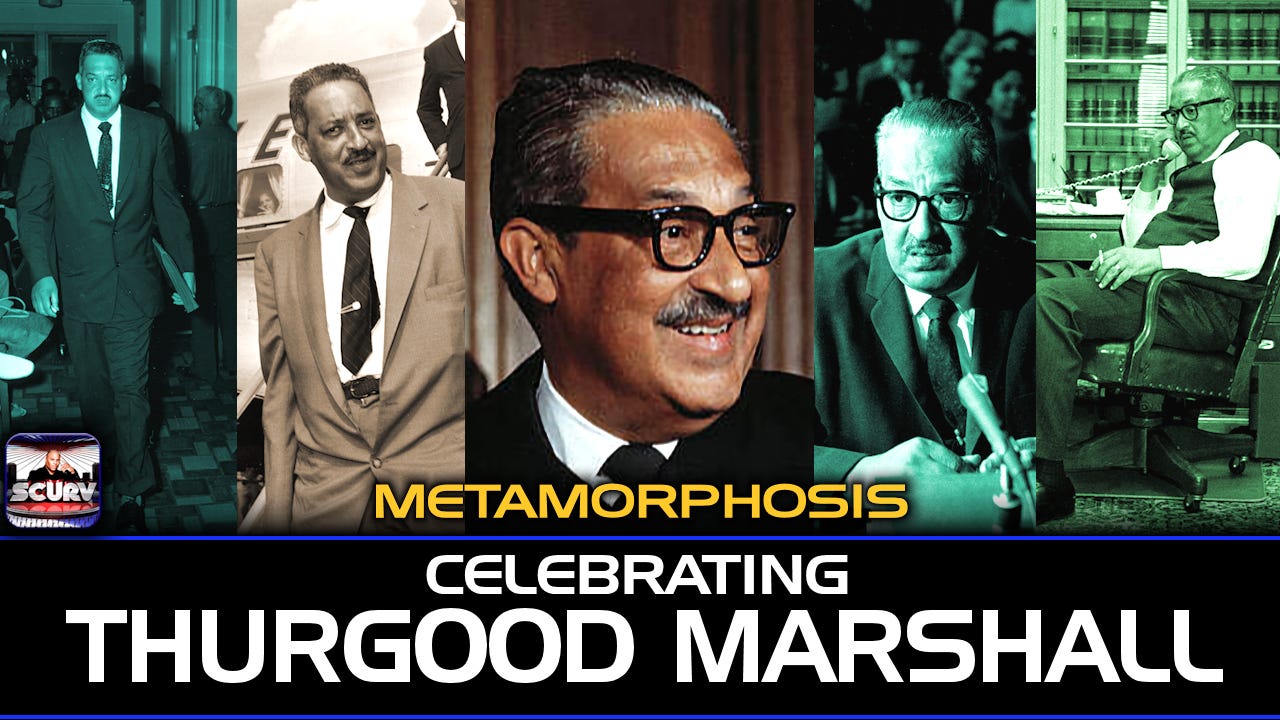

There are some lives that feel bigger than history books. Some people don’t just exist in a moment, they reshape the moment itself. Thurgood Marshall was one of those people. His life was not about chasing fame, status, or applause. It was about standing firm in a world designed to break him, speaking when silence was safer, and pushing forward when retreat would have been easier. His story is not just the story of a man who became a Supreme Court Justice. It is the story of a boy who grew up surrounded by struggle, learned how to think, learned how to fight with his mind, and chose to use his life for something bigger than himself.
What makes his story powerful is not only what he achieved, but how he lived. He did not come from comfort. He did not come from privilege. He did not come from protection. He came from a world where Black dignity had to be defended daily, where intelligence had to be sharpened for survival, and where character mattered more than reputation. His upbringing shaped his mindset, and his mindset shaped his mission.
Thurgood Marshall was not just a legal figure. He was a cultural figure, a moral figure, and a symbol of discipline and purpose. He understood that power is not loud, and strength is not aggression. He believed in structure, patience, and long-term thinking. He moved like someone who knew that systems do not fall overnight, and freedom is not won in one speech or one case.
This story is not about dates and titles alone. It is about who he was when no one was watching. It is about the mind he built, the values he carried, and the discipline he lived by. It is about how a young boy from Baltimore became a man who helped reshape the meaning of justice in America.
When people hear his name, they think of courts and cases. But his real legacy is deeper than law. His real legacy is the example of a man who understood that change begins with self-control, education, patience, and courage. This is not just a biography. This is a life lesson in motion.
ROOTS, FAMILY, AND FOUNDATION
Thurgood Marshall was born into a working-class Black family in Baltimore, Maryland. His household was not wealthy, but it was rich in values. His father believed in discipline, structure, and strong thinking. His mother believed in education, order, and pride. Together, they built a home where character mattered, words mattered, and learning mattered. Conversations in the home were not small. Ideas were discussed. Opinions were challenged. Thinking was trained.
His father, especially, shaped his mental strength. He would take Thurgood to courtrooms just to sit and watch trials. Not for entertainment, but for education. He wanted his son to learn how arguments were built, how logic worked, and how truth could be defended with words instead of fists. This planted something deep in him. It taught him that power did not always come from force. Sometimes it came from thinking better than the person across from you.
His mother believed that education was protection. She made sure he stayed in school. She believed that knowledge created options, and options created freedom. In a society that limited Black opportunity, she understood that the mind was the first battlefield.
Thurgood was not a perfect child. He was known to challenge authority and test limits. But even that energy was shaped into something productive. His environment didn’t crush his fire, it focused it. Instead of breaking him, it trained him.
He grew up understanding injustice early. He saw it. He felt it. He lived inside it. But instead of letting it turn into anger alone, it became purpose. He learned that rage without direction leads nowhere, but discipline with direction changes everything.
EDUCATION AND MENTAL FORMATION
Education became his weapon. He attended Lincoln University, where he sharpened his thinking and built confidence in his voice. Later, he went to Howard University School of Law, a place that would shape his future deeply. There, he was trained not just to know the law, but to understand its power. He learned how systems functioned, how injustice was structured, and how legal strategy could dismantle oppression piece by piece.
Howard didn’t just teach law. It taught mission. It taught responsibility. It taught purpose. Thurgood Marshall did not see law as a career path alone. He saw it as a tool for change.
He studied harder because he knew what was at stake. He didn’t have the luxury of failure. He didn’t have the safety net of privilege. His success had to be earned, defended, and protected.
This is where his discipline formed. His patience formed. His long-game thinking formed. He became someone who could delay gratification, handle pressure, and think several steps ahead.
THE FIGHT FOR JUSTICE
Thurgood Marshall entered the legal world not chasing comfort, but chasing justice. He worked on cases that challenged segregation, discrimination, and unfair treatment. He traveled through dangerous areas, faced threats, and stood firm anyway. His courage was quiet, steady, and controlled. He did not perform bravery. He lived it.
He believed in strategy over chaos. He believed in structure over noise. He believed in systems over slogans. He understood that lasting change comes through building foundations, not just making statements.
One of his most powerful beliefs was that justice should not depend on skin color, wealth, or status. He believed the law should protect the weak, not just serve the powerful. That belief guided every move he made.
When he became the first Black Supreme Court Justice, it was not just a personal achievement. It was symbolic. It showed what disciplined thinking, moral strength, and patience could produce. He did not represent ego. He represented progress.
He once believed deeply that “none of us got where we are solely by pulling ourselves up by our bootstraps.” That mindset shows how he saw community, support, and responsibility. He understood that success is connected, not isolated.
CHARACTER, VALUES, AND INNER LIFE
Thurgood Marshall was not driven by image. He was driven by principle. He valued fairness, dignity, and human worth. He believed in humor, humility, and humanity. He was known to be warm, relatable, and grounded, even with power.
He did not separate his personal values from his professional life. He lived what he believed. Integrity was not branding. It was behavior.
He believed that fear should never guide decisions. He believed courage was not the absence of fear, but the refusal to be controlled by it.
His life showed that real strength is quiet, real power is controlled, and real influence is built over time.
LEGACY AND MEANING
Thurgood Marshall’s legacy is not just in books, courts, or history lessons. It lives in mindset. It lives in discipline. It lives in purpose. It lives in the example of a man who chose to serve instead of dominate, build instead of destroy, and educate instead of intimidate.
He showed that change is not magic. It is method. It is patience. It is structure. It is sacrifice. It is consistency.
His life proves that character creates impact, not popularity. Vision creates legacy, not attention. Discipline creates freedom, not noise.
He was more than a judge. He was more than a lawyer. He was a builder of pathways, a defender of dignity, and a man who lived with purpose.
CLOSING PERSPECTIVES…
Thurgood Marshall’s life reminds us that greatness is built long before recognition arrives. It begins in the home, in the mind, and in daily choices. It begins with discipline, learning, and values.
His story shows that you don’t have to be loud to be powerful. You don’t have to be aggressive to be strong. You don’t have to be famous to be impactful.
He lived proof that consistency beats chaos, patience beats pressure, and purpose beats pride.
He didn’t chase history. He built it quietly.
His life teaches that true legacy is not what people say about you, but what your life makes possible for others.
And that is the highest form of success.