


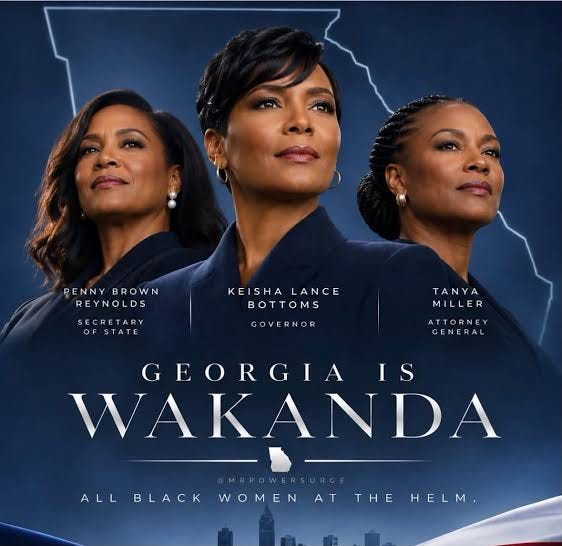

A particular image circulating online recently caught my attention. The three women featured in the image (above) are Keisha Lance Bottoms, Governor of Georgia; Penny Brown Reynolds, Georgia Secretary of State; and Tanya Miller, Georgia Attorney General. It presented these politically accomplished Black women against the backdrop of Georgia, accompanied by the bold declaration, “GEORGIA IS WAKANDA.” The imagery was powerful, the presentation was polished, and the symbolism was unmistakable. It was celebrating Black women in positions of political influence and presenting their presence as something worthy of cultural pride. But as I looked at that image, I couldn’t help asking myself a question that I suspect many people would rather avoid. What exactly does this kind of representation mean for the Black community as a whole, and more importantly, what does it mean for the Black family?
Before anyone misunderstands the direction of this conversation, let me make something clear. There’s absolutely nothing wrong with Black women achieving positions of influence, leadership, and authority. Their accomplishments deserve to be recognized, and nobody should feel threatened simply because a Black woman has reached a position that previous generations were denied. But when we begin celebrating political representation as though the mere presence of Black faces automatically translates into Black progress, shouldn’t we slow down and examine what those individuals actually stand for? Shouldn’t their policies, priorities, decisions, and willingness to advocate for their own communities matter more than their appearance?
Because here’s where the conversation becomes uncomfortable. If we’re going to use Wakanda as a symbol of Black independence, Black unity, Black technological advancement, Black economic strength, and Black self-determination, then shouldn’t we examine whether the political leadership being celebrated actually reflects those principles? Can we honestly call something a victory for the Black nation simply because Black people occupy important positions, or must we also examine whether those positions are being used to advance the interests of Black people who have been historically neglected?
And where does the Black man fit into this picture? Where does Black masculinity, Black fatherhood, Black male achievement, and the protection of Black boys enter the conversation? Why does the celebration of Black political advancement so often seem to become a conversation about who has reached the top rather than what those who reach the top intend to do for the people still struggling at the bottom? These aren’t attacks. They’re legitimate questions about representation, responsibility, and accountability.
I’m particularly interested in why asking these questions can sometimes be interpreted as an act of hostility toward Black women. Can we not celebrate the accomplishments of our sisters while simultaneously demanding that Black men receive meaningful political attention? Can we not recognize the challenges facing Black women without pretending that Black men aren’t experiencing their own forms of social, economic, political, and institutional hardship? If we’re serious about building a stronger community, shouldn’t we be mature enough to have both conversations without treating one as an insult to the other?
DOES REPRESENTATION AUTOMATICALLY MEAN LIBERATION?
One of the greatest political illusions of our time is the belief that seeing somebody who looks like you in a position of authority automatically means that your interests are being represented. That’s a dangerous assumption because political office doesn’t come with an automatic commitment to the people who share your racial background. A person can look exactly like you, share your cultural background, and still support policies that do absolutely nothing to improve your circumstances.
We have to understand the difference between representation and responsibility. Representation is about who occupies the position. Responsibility is about what that person does with the authority they’ve been given. Those are two completely different things, and confusing them is one of the easiest ways for a community to become emotionally invested in political personalities instead of measurable progress.
If a Black politician takes office, what should we expect? Should we simply celebrate the photograph, the inauguration, the television appearances, and the impressive titles? Or should we be examining employment opportunities, educational outcomes, criminal justice reform, business development, housing affordability, economic mobility, and the condition of Black families under that person’s leadership?
Why should a Black community accept less accountability simply because somebody who looks like them has reached an influential position? Wouldn’t that be the very opposite of political maturity?
The uncomfortable truth is that political power is not a family reunion. It isn’t a cultural festival, and it certainly isn’t a beauty pageant where the presence of familiar faces is enough to satisfy the audience. Political power is supposed to produce results. If it doesn’t, the people being represented have every right to ask why.
WHAT DOES WAKANDA REALLY REPRESENT?
Let’s talk about Wakanda for a moment because that symbolism deserves more than a superficial celebration.
Wakanda represents an imagined African civilization that developed its own resources, protected its independence, built extraordinary technology, and refused to surrender its identity to outside domination. It represents a powerful fantasy of what African people might accomplish when they control their resources, protect their interests, and work toward a common purpose.
But notice something important about that vision. Wakanda isn’t simply about having Black people in expensive clothing occupying impressive positions. It’s about a functioning civilization. It’s about infrastructure, security, education, economic independence, scientific advancement, leadership, and collective responsibility.
So when somebody declares that a particular political development means Georgia has become Wakanda, shouldn’t we ask whether the substance matches the symbolism? Where is the economic independence? Where is the collective investment? Where are the institutions designed to strengthen Black families? Where are the opportunities for Black-owned businesses to compete and expand? Where are the measurable improvements in the lives of ordinary Black citizens?
And perhaps most importantly, where is the commitment to protecting Black men and boys?
If Wakanda is supposed to represent a thriving Black civilization, then the well-being of Black men cannot be treated as an optional subject. Neither can the well-being of Black women or Black children. A civilization cannot thrive while entire segments of its population are ignored, stereotyped, economically abandoned, or politically neglected.
We cannot borrow the language of Black liberation while avoiding the responsibilities that liberation demands. We cannot celebrate the appearance of a Black nation while refusing to examine whether our institutions are actually serving Black people.
That’s the question behind the photograph. Not whether the women deserve their accomplishments, but whether the political symbolism being celebrated translates into something meaningful for the community.

WHERE ARE THE BLACK KINGS IN THE CONVERSATION?
Now let’s address the issue that often makes people uncomfortable. Where are the Black men in these conversations about Black political advancement?
Why is it so difficult to have an equally passionate discussion about Black male leadership, Black fatherhood, and Black masculine development? Why should a Black man have to carefully explain that he wants to see more opportunities for Black men without somebody immediately interpreting his position as hostility toward Black women?
Can we not acknowledge that Black men are experiencing serious challenges in employment, education, criminal justice, mental health, economic advancement, and family stability? Can we not discuss the disproportionate impact of incarceration and the barriers facing Black men who are trying to rebuild their lives after involvement with the criminal justice system?
These aren’t imaginary problems. They’re issues that deserve sustained attention, serious research, and meaningful political action.
What happens when a young Black boy grows up surrounded by negative images of Black masculinity but rarely encounters institutions specifically committed to developing his intellectual, emotional, financial, and leadership potential? What happens when a Black father wants to become more involved in his child’s life but encounters economic pressures, family instability, and systems that make his responsibilities even more difficult?
And what happens when the community’s political conversations become so focused on celebrating certain achievements that other pressing concerns are pushed to the margins?
We need Black men who are prepared to lead, build, protect, educate, and contribute. We need Black fathers who are present. We need Black husbands who understand partnership. We need Black sons who are taught discipline, self-respect, financial responsibility, and emotional intelligence. We need Black male entrepreneurs, educators, scientists, elected officials, community organizers, and institution builders.
But here’s another question. Why should Black women have to carry the responsibility of uplifting Black men, and why should Black men expect Black women to carry that responsibility alone? Shouldn’t this be a shared commitment? If we’re going to speak about Black liberation, shouldn’t everybody have a role in building the conditions that make liberation possible?
Black men must also examine their own shortcomings. We cannot demand protection while refusing accountability. We cannot demand respect while disrespecting the very women and children we’re supposed to love. We cannot criticize the absence of strong Black families while refusing to do the work necessary to create them.
This conversation has to go in both directions.
IS BLACK POLITICAL LOYALTY BEING CONFUSED WITH BLACK POLITICAL PROGRESS?
One of the most important distinctions we can make is between supporting a Black politician and supporting the Black community. Those two things are not automatically interchangeable.
A politician can be Black and still make decisions that don’t benefit the Black working class. A politician can speak beautifully about diversity while remaining silent about the specific economic problems affecting Black neighborhoods. A politician can participate in cultural celebrations while refusing to support policies that would create lasting opportunities for Black families.
And this isn’t limited to women. Black male politicians deserve exactly the same scrutiny.
The question should never be whether a politician is sufficiently Black in appearance, speech, or cultural presentation. The question should be whether that politician is willing to use their authority to address the needs of the people they claim to represent.
Think about the larger political environment. Other communities organize around their interests. They establish institutions, support economic development, protect cultural priorities, and demand accountability from their elected officials. They understand that political influence must eventually translate into practical benefits.
So why should Black people be satisfied with less?
Why should we applaud a political victory without asking what comes next? Why should we defend politicians who have not demonstrated a commitment to the specific challenges affecting Black communities? And why should anyone be considered disloyal simply because they refuse to accept symbolic victories as substitutes for tangible results?
A community that cannot question its leadership is a community that risks becoming politically powerless, regardless of how many of its members occupy prominent positions.
WHAT ABOUT THE BLACK MAN’S EXPERIENCE WITH THE SYSTEM?
Let’s take this conversation beyond political imagery and examine the circumstances facing Black men in America.
For generations, Black men have experienced barriers in employment, education, housing, criminal justice, and economic advancement. The consequences of mass incarceration, aggressive policing, limited employment opportunities, and the school-to-prison pipeline have affected families and communities in ways that cannot be dismissed with a few inspirational speeches.
And when we discuss these issues, we must be willing to examine the institutions responsible for them.
How many Black men have been removed from their families through incarceration? How many have struggled to find meaningful employment after serving their sentences? How many young Black boys have been labeled troublemakers before their intellectual potential was ever recognized? How many Black fathers have been reduced to stereotypes instead of being treated as human beings with the ability to grow, contribute, and lead?
And where are the political voices demanding sustained attention to these problems?
We should also be careful not to simplify the drug crisis by pretending that Black communities have no responsibility for the decisions made within them. Drug trafficking, addiction, and incarceration involve complicated networks of supply, demand, enforcement, economics, and social conditions. But shouldn’t we examine whether enforcement and sentencing have been applied fairly? Shouldn’t we question why some communities experience harsher consequences than others?
If Black men are disproportionately affected by certain institutional practices, shouldn’t that be a central political concern?
And here’s where the conversation returns to the image. If we’re going to celebrate Black political authority as a representation of collective advancement, shouldn’t the people celebrating also demand that Black male issues receive a prominent place on the political agenda?
We don’t need another round of empty speeches. We need measurable commitments, transparent policies, and leaders who understand that Black men are not disposable members of the community.
CAN BLACK WOMEN’S ADVANCEMENT AND BLACK MEN’S ADVANCEMENT EXIST TOGETHER?
Absolutely. In fact, why would anyone want to build a future in which one group must diminish for another group to rise?
Black women deserve opportunities. Black men deserve opportunities. Black girls deserve protection and encouragement. Black boys deserve protection and encouragement. Black mothers deserve support, and Black fathers deserve support.
The problem begins when legitimate conversations about one group’s challenges are treated as an attack on another group’s existence.
We have allowed too many social and political discussions to become competitions over who has suffered more, who deserves more attention, and who should receive the greatest recognition. That’s a losing strategy for everybody involved.
A Black woman who achieves a powerful position should not have to apologize for her success. But neither should she be offended when members of her community ask what she intends to accomplish with that power.
Likewise, a Black man who advocates for stronger Black male leadership should not be automatically labeled as threatened by successful Black women. His argument should be examined on its merits.
The real question is whether we can develop a political culture where accountability isn’t mistaken for disrespect.
Can Black women challenge Black men when they fall short? Absolutely. Can Black men challenge Black women when they fall short? Absolutely. Can both groups demand better from politicians, institutions, and community leaders without turning every disagreement into a gender war? They should.
But that requires something we’re desperately missing: the willingness to listen without immediately reaching for the nearest insult.
THE DIFFERENCE BETWEEN PASSION AND ANGER
There’s something else worth considering in this conversation. Sometimes the way we communicate an important message determines whether people hear the message or become distracted by the delivery.
Anger can be understandable, especially when people believe that their community is being neglected. But anger without direction can become a weapon that damages the very relationships necessary to accomplish something meaningful.
Passion, on the other hand, can be disciplined. It can be direct, uncomfortable, and unapologetic without becoming destructive. You can challenge somebody’s political decisions without questioning their humanity. You can demand accountability without humiliating an entire group of people.
And perhaps that’s the approach we need when discussing the future of Black political leadership.
Instead of asking why certain women are in power, ask what they’re doing with that power. Instead of declaring that Black men have been abandoned, ask what specific policies and programs are being developed to address their circumstances. Instead of attacking Black women for celebrating their accomplishments, ask how those accomplishments can become part of a broader movement that strengthens the entire community.
The questions are powerful because they force people to examine the substance behind the celebration.
And if the answers are good, everybody benefits. If the answers are disappointing, then the community has every right to demand better.
WHO IS BUILDING THE BLACK FAMILY WHILE EVERYBODY IS CELEBRATING POLITICAL VICTORIES?
This may be the most important part of the entire discussion.
What good is political advancement if the Black family continues to struggle? What good is cultural pride if our children grow up without adequate educational opportunities, economic security, and positive examples of healthy relationships? What good is a celebration of Black excellence if we cannot create the conditions for that excellence to flourish in our own neighborhoods?
We have to stop treating the Black family as though it’s a secondary issue that can be addressed after every other political and social battle has been fought.
The Black family matters. Black fathers matter. Black mothers matter. Black marriages matter. Black children matter. And the institutions that help families survive and thrive matter.
We need to encourage healthy Black relationships without pretending that every relationship will look the same. We need to recognize the contributions of Black men and women without forcing either group into a position of permanent competition. We need to protect children from instability, abuse, neglect, and the social conditions that rob them of their potential.
And we need to understand that a strong community cannot be built through resentment alone.
If Black women are advancing, let’s ask how their success can help create more opportunities for Black families. If Black men are advancing, let’s ask how their success can help create more opportunities for Black families. If Black politicians are gaining influence, let’s ask how that influence can be converted into meaningful improvements for ordinary people.
The objective should be collective progress, not a competition for cultural bragging rights.
SO, IS GEORGIA REALLY WAKANDA?
Now we return to the original image and the question it inspired.
Is Georgia Wakanda because three Black women are being presented as powerful political figures? Or would Georgia become a more meaningful example of Black political progress when its leadership, regardless of gender, demonstrates a measurable commitment to the economic, social, educational, and institutional advancement of Black people?
Can we celebrate Black women without forgetting Black men? Can we advocate for Black men without disrespecting Black women? Can we demand accountability from our elected officials without allowing racial or gender loyalty to interfere with our judgment?
And if the answer to those questions is yes, then why aren’t we having more of these conversations?
Maybe the real issue isn’t who gets to stand at the top of the political structure. Maybe the real issue is whether the people at the top remember who is standing at the bottom, waiting for something to change.
A title doesn’t make somebody a liberator. A photograph doesn’t make somebody an advocate. A familiar face doesn’t guarantee a familiar interest. And a political victory doesn’t automatically become a victory for the people who share the politician’s background.
That’s the distinction we must never lose.
MY CLOSING THOUGHTS…
I don’t want Black people celebrating political imagery while ignoring political reality. I don’t want us confusing a symbolic victory with a practical achievement, and I certainly don’t want us defending politicians simply because we feel some cultural obligation to protect them from criticism. If somebody has the authority to make decisions affecting our communities, they also have the responsibility to answer questions about those decisions. That’s not disrespect. That’s democracy, and it’s the minimum standard any serious community should demand.
Black women should continue to climb, achieve, lead, and break barriers. But as they climb, let’s have an honest conversation about how their influence can benefit the entire community. Black men should also rise, develop, and reclaim their rightful place as constructive contributors to their families and communities. Neither group should have to disappear for the other to succeed. The objective isn’t to replace one form of exclusion with another. The objective is to build something stronger than what we inherited.
And to my brothers, understand that we cannot simply demand that somebody else protect our interests while we refuse to develop ourselves. We have to become better fathers, husbands, sons, business owners, educators, and community leaders. We have to build institutions, create economic opportunities, mentor our young men, and become more disciplined in how we respond to challenges. Nobody is going to hand us a thriving community because we complained loudly enough. We have to build it, defend it, and sustain it.
To our sisters, the question isn’t whether you’re allowed to celebrate your accomplishments. You absolutely are. The question is whether the power you’re celebrating can become part of a larger commitment to the Black family. Can we move beyond political symbolism and discuss practical solutions? Can we recognize the challenges facing Black men without interpreting every discussion as an attempt to diminish Black women? Can we become partners in progress instead of competitors for recognition? Those are questions worth answering, and nobody should be afraid to ask them.
So I’ll leave you with this: If Wakanda represents a strong, independent, prosperous, and unified Black civilization, what are we actually doing to build it? Where are the institutions? Where are the economic foundations? Where are the strong families? Where are the opportunities for our boys and girls? Where are the men and women prepared to work together for something bigger than themselves? Because I’m not interested in celebrating the appearance of a Black kingdom while the people who are supposed to inherit that kingdom are still struggling to survive. I want more than a picture. I want more than a slogan. I want more than a political victory. I want to see a stronger Black people. And if we’re going to call it Wakanda, then let’s start building something worthy of the name.
I TRULY WANT TO HEAR WHAT YOU HAVE TO SAY ABOUT THIS! SHARE A WHATSAPP VOICEMAIL SO I CAN SHOWCASE YOUR RESPONSE ON AN UPCOMING VIDEO: 1.407.590.0755
