

THE WAR MOST PEOPLE DON’T REALIZE WE’RE IN
Most people think world wars start with loud announcements, massive invasions, and dramatic speeches on television. They imagine tanks rolling across borders and jets filling the skies. But the truth is that modern wars don’t always begin that way. Sometimes the most dangerous wars are the ones happening quietly while the public is distracted with everyday life.
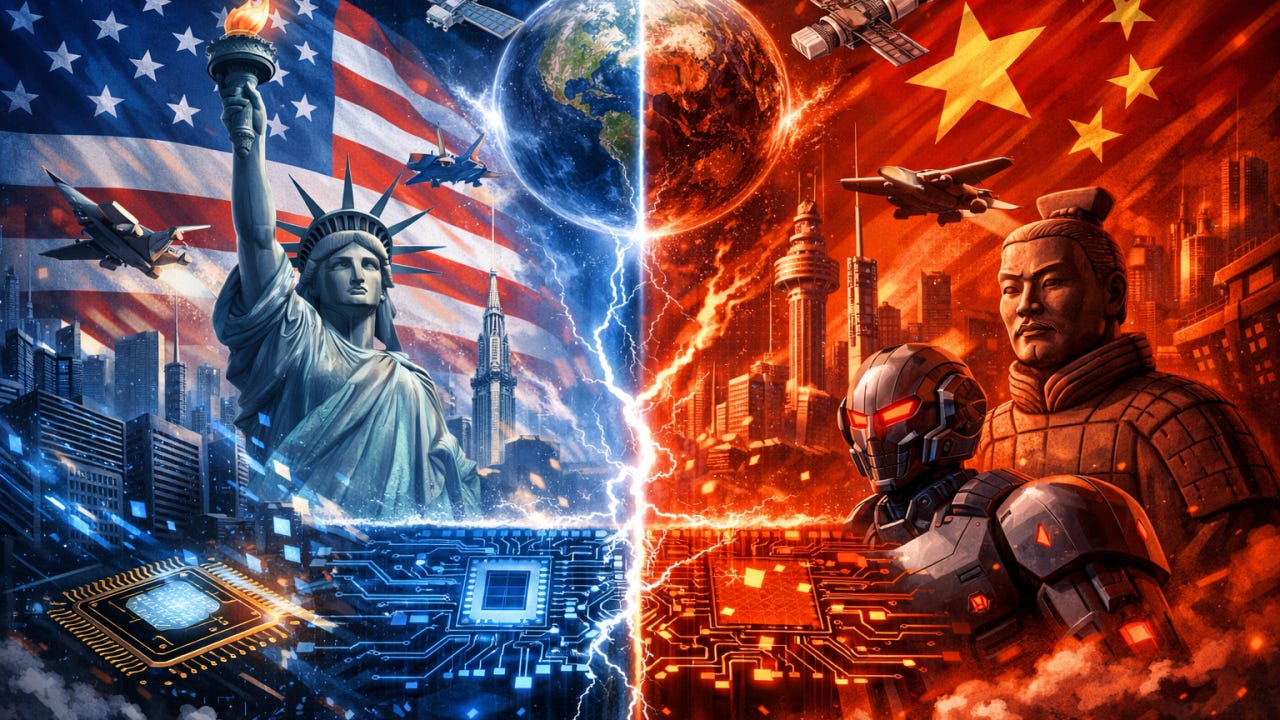
Right now, there is a growing conversation behind the scenes that many people in Washington don’t want everyday Americans to hear. The idea is simple but frightening. The United States may already be fighting a proxy war with China. The battlefield just isn’t where most people think it is.
Instead of China and America firing directly at each other, the conflict is unfolding through other countries. Iran has become one of the key places where this silent confrontation is taking shape. Every missile strike, every military movement, and every piece of battlefield data may be feeding information back to powerful forces watching closely from the other side of the world.
If this analysis is true, then something much bigger than a regional conflict is happening. What looks like a war between America and Iran may actually be something far deeper and more strategic. It may be part of a larger chess match between global superpowers.
And in this kind of game, the side that fires the most weapons is not always the side that wins.
WHEN TECHNOLOGY BECOMES THE REAL WEAPON
One of the most alarming developments in modern warfare is the rise of hypersonic weapons. These missiles travel at speeds many times faster than sound. At those speeds, traditional missile defense systems struggle to stop them. By the time a radar system detects the launch, the weapon may already be seconds away from its target.
Iran has begun showcasing its own hypersonic missile capabilities. But many experts believe that Iran did not develop these systems entirely on its own. Reports have suggested that Chinese technical specialists may be assisting in developing and maintaining these advanced weapons systems.
If that is happening, then every missile fired in the Middle East becomes something much more valuable than just a military strike. It becomes a real-time experiment. It becomes battlefield data.
Every time a missile challenges American air defenses, the results can reveal weaknesses. The response times, interception attempts, and defense patterns can all be studied. And the lessons learned from those tests can travel thousands of miles back to engineers and strategists who are preparing for future conflicts.
In other words, the battlefield becomes a laboratory.
The country doing the fighting may be Iran, but the country doing the learning may be China.
THE EYES IN THE SKY
Modern warfare is not only fought with missiles and tanks. It is also fought with satellites.
Orbiting above the planet are networks of surveillance systems capable of tracking movement across oceans, deserts, and military bases. These satellites can observe aircraft, ships, and troop movements with incredible accuracy.
China has been building a massive constellation of reconnaissance satellites over the last several years. These systems can capture detailed imagery and signals intelligence from across the globe. In some cases, they can even monitor targets multiple times within minutes.
If satellite intelligence is being shared with allied nations, it dramatically increases their ability to strike precise targets. Real-time intelligence can guide missiles toward military installations, airfields, or naval facilities.
This kind of cooperation represents a new form of warfare where technology replaces traditional alliances. One nation provides the intelligence. Another nation provides the battlefield.
Together, they form a powerful strategic partnership.
THE STRATEGY OF EXHAUSTION
There is an old military concept that says the strongest way to defeat an enemy is not always through direct combat. Sometimes the best strategy is to make that enemy exhaust itself.
War is expensive. Every missile costs money. Every damaged base requires repairs. Every aircraft sortie burns fuel and strains equipment.
If a conflict drags on long enough, the financial burden alone can weaken even the most powerful military force. Supply chains get stretched. Weapons stockpiles begin to shrink. Maintenance demands grow larger.
Meanwhile, the side that is not actively fighting can watch carefully and prepare for the future.
This is where the idea of a proxy war becomes important. If one nation can observe another nation spending billions of dollars in prolonged conflict, that observer gains valuable time and information without suffering the same costs.
The longer the conflict lasts, the more data is collected.
And knowledge, in modern warfare, can be just as powerful as weapons.
INDUSTRIAL POWER AND THE LONG GAME
Another factor that many analysts point to is industrial capacity. Wars are not only won on battlefields. They are also won in factories.
A country that can produce weapons faster than its rivals can often sustain a longer conflict. Ships, missiles, drones, and aircraft all require enormous manufacturing capacity.
China has become the largest manufacturing power in the world. Its industrial base produces a huge share of global goods, and that same manufacturing strength can support military production when necessary.
If a long conflict ever expanded into a larger global confrontation, industrial strength could play a major role in determining who has the advantage. The ability to replace lost equipment quickly can decide the outcome of prolonged wars.
This is why some strategists are deeply concerned about the long-term balance of power.
Technology matters. Strategy matters. But production capacity may ultimately matter the most.
THE IMAGE OF POWER AND THE REALITY OF DECLINE
For decades, the United States has been viewed as the dominant military power on the planet. Its aircraft carriers, global bases, and advanced weapons systems have projected strength across the world.
But power is not just about hardware. It is also about perception.
If military installations are damaged and the public receives limited information about the true extent of the destruction, questions begin to emerge. When governments appear uncertain or unprepared, global observers notice.
Other nations watch carefully for signs of weakness. They analyze political divisions, supply shortages, and military setbacks.
In international politics, perception can shape reality. A nation that appears unstoppable commands respect. A nation that appears overstretched invites challenges.
And once the world begins to sense a shift in power, the global balance can change very quickly.
THE DAWN OF A NEW GLOBAL ORDER
Many analysts believe the world is entering a new era known as a multipolar system. Instead of one dominant superpower, multiple powerful nations compete for influence across different regions.
This shift does not happen overnight. It develops slowly through economic changes, technological competition, and geopolitical strategy.
Conflicts like the one unfolding in the Middle East may be part of that transition. They reveal how alliances are forming, how technology is being shared, and how global strategies are evolving.
The question that many people are now asking is simple but profound.
Is this the beginning of a new balance of power?
Or is it the moment when the old system begins to fade?
MY CLOSING THOUGHTS
The truth is that most people will never hear these conversations discussed openly on mainstream television. The bigger the issue, the quieter the discussion often becomes.
But history teaches us that global shifts rarely happen without warning signs. Economic pressure, military conflicts, and rising alliances all point toward deeper changes taking place behind the scenes.
Whether this moment becomes a turning point for the United States or simply another chapter in global competition remains to be seen.
What is clear is that the world is watching closely.
And in the game of international power, the winners are often the ones who learn the most while others are busy fighting.
China today is exemplifying “The Art Of War” to the max against The United States without even lifting a finger!
Tell me what you think about this global mess…
Sincerely,
SCURV
407.590.0755 (WhatsApp Text)
