


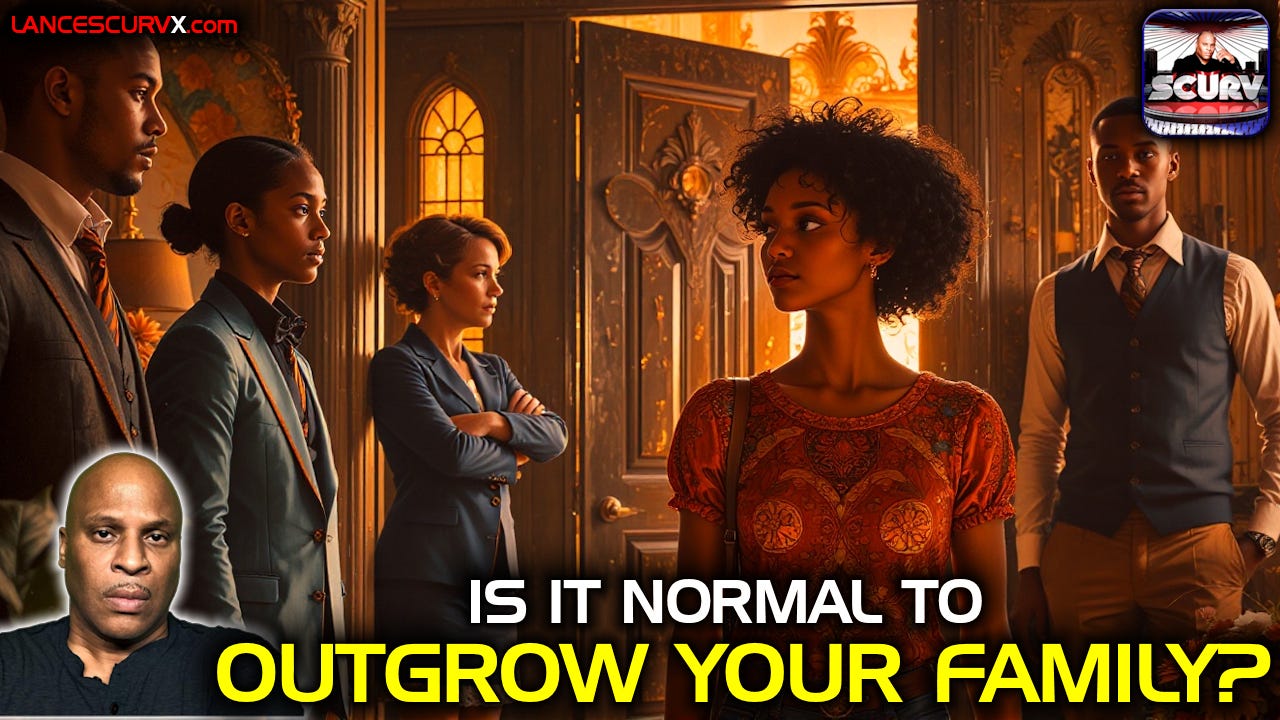
There comes a moment when you realize you have outgrown your family. Not just disagreed with them. Not just needed space. Not just created distance. But truly outgrown them. You think differently. You see differently. You value different things. You move through the world with a level of awareness they don’t understand. And suddenly, the people who once felt like home feel unfamiliar.
This realization doesn’t feel like freedom at first. It feels like grief. A deep, quiet grief that sits in your chest and changes how you see everything. Because this isn’t like losing friends or changing jobs. These were the people who shaped your first understanding of life. Your first sense of safety. Your first sense of belonging. When you outgrow them, you don’t just lose relationships — you lose your original world.
It feels confusing because growth is supposed to feel good. Healing is supposed to feel good. Becoming more aware is supposed to feel empowering. But this kind of growth feels heavy. It feels lonely. It feels like standing between two worlds — who you were and who you’re becoming — without fully belonging to either.
You start to notice that conversations feel shallow. The old family roles feel fake. The old expectations feel tight and uncomfortable. You feel pressure to shrink again just to keep the peace. You feel guilt for changing. You feel shame for seeing what you now see. And part of you wonders if something is wrong with you for feeling this way.
But the truth is simple. Growth changes relationships. Awareness changes identity. And healing changes belonging. When you evolve, you don’t just grow forward — you grow away from what can no longer hold you.
THE FAMILY SYSTEM AND IDENTITY FORMATION
From the moment you are born, you are shaped by your family system. Not just by words, but by patterns. By unspoken rules. By emotional expectations. By roles that form without anyone ever naming them. You are taught who to be, how to behave, what is acceptable, what is rewarded, and what is punished. You learn where love comes from and what you must do to receive it.
Every family system assigns roles. One becomes the responsible one. One becomes the emotional one. One becomes the strong one. One becomes the quiet one. One becomes the problem one. These roles keep balance in the system. They make the family function. But they don’t always allow people to be real.
For a long time, most people don’t realize they are playing a role. They think it’s their personality. They think it’s who they are. They think it’s natural. They shape their identity around what keeps the system stable, not around what makes them whole.
As long as you stay unconscious to this, life feels normal. You perform your role. You manage emotions. You protect patterns. You follow invisible rules. You seek approval. You chase acceptance. You adjust yourself to fit the system.
Then something shifts.
You gain awareness. You gain perspective. You start questioning what you were taught. You start noticing patterns. You start seeing dysfunction where you once saw normal. You start recognizing that many of your beliefs were inherited, not chosen. Many of your behaviors were learned, not natural. Many of your fears were planted, not real.
And once you see it, you can’t unsee it.
This is where growth begins. And this is where the separation starts.

DENIAL, AWAKENING, AND IDENTITY SHOCK
At first, most people resist the truth. They minimize it. They excuse it. They normalize it. They say every family has problems. They say they’re just being sensitive. They say it’s not that bad. They try to stay comfortable inside the old story.
Because accepting the truth means accepting something painful: the foundation of your identity was built inside a system that didn’t fully support your wholeness.
Eventually, the gap becomes too big. The person you’re becoming no longer fits the role you were given. You can’t pretend anymore. You can’t perform anymore. You can’t ignore what you see anymore. You feel fake when you’re around them. You feel smaller. You feel tense. You feel disconnected from yourself.
And then the grief starts.
Not grief for losing people — grief for losing illusions. Grief for the family you thought you had. Grief for the love you believed was unconditional. Grief for the safety you assumed was real. Grief for the version of yourself that only existed to survive the system.
You begin rethinking your memories. You start questioning what was real and what was performance. You realize that much of what felt like closeness was actually silence. Much of what felt like love was actually approval. Much of what felt like belonging required self-abandonment.
This grief is isolating because you can’t share it with them. The people you would normally grieve with are the people you’re grieving. So you carry it alone. Quietly. Privately. Internally.
And many people try to go back. They try to shrink again. They try to perform again. They try to fit again. They try to unsee what they saw. But awareness doesn’t reverse. Growth doesn’t rewind. Consciousness doesn’t collapse.
Once you see the system, you cannot return to being unconscious inside it.
DIFFERENTIATION AND FAMILY RESISTANCE
This is where separation begins — not physical at first, but psychological. You start thinking for yourself. You start setting boundaries. You stop agreeing automatically. You stop managing emotions that aren’t yours. You stop carrying roles that no longer fit.
This creates fear in the family system. Because the system depends on stability. It depends on predictability. It depends on roles. When one person changes, the system feels threatened.
So resistance appears.
Guilt. Pressure. Blame. Gaslighting. Emotional manipulation. Labeling. Silence. Rejection. Control. Distance. Conflict.
Not because you are wrong — but because your growth disrupts comfort.
Your healing exposes patterns.
Your awareness exposes dysfunction.
Your authenticity exposes performance.
Your boundaries expose control.
And that feels unsafe to people who depend on the system staying the same.
This is where many people internalize guilt. They feel selfish. They feel wrong. They feel cruel. They feel like they are abandoning their family.
But growth is not betrayal. Healing is not abandonment. Awareness is not cruelty. Boundaries are not violence.
Choosing yourself is not an attack on others.
THE LONELY GAP BETWEEN WHO YOU WERE AND WHO YOU ARE
This stage is the hardest. You are no longer who you were. But you are not yet fully who you are becoming. You feel alone. Unanchored. Disconnected. You question yourself. You doubt yourself. You miss what was familiar even if it was unhealthy.
You feel guilt for leaving.
You feel guilt for staying attached.
You feel guilt for growing.
You feel guilt for grieving.
You still care. You still feel. You still wish things were different. You still want love. You still want understanding. You still want connection. That doesn’t mean you are failing. It means you are human.
Healing does not erase love. Growth does not kill attachment. Awareness does not delete history.
This phase is uncomfortable because identity is being rebuilt. Old programming is dissolving. Old patterns are breaking. Old beliefs are falling apart. You are forming a new self that is not defined by roles, fear, approval, or survival.
REBIRTH AND SELF-SOVEREIGNTY
Eventually, something changes. You begin to stabilize. You begin to trust yourself. You begin to live from your values instead of your conditioning. You begin choosing peace over approval. Truth over comfort. Health over belonging.
You develop a sense of identity that does not depend on validation. You build relationships based on respect, not obligation. You create connections based on truth, not roles. You choose environments that support your growth instead of suppressing it.
Some people can maintain limited contact with family while staying emotionally grounded. Others need distance to protect their healing. Both are valid. What matters is psychological separation — the ability to be yourself without fear, guilt, or collapse.
True freedom is not cutting people off.
True freedom is no longer being controlled by their expectations.
True freedom is no longer defining yourself through their limitations.
True freedom is no longer needing their approval to exist.
You stop living in reaction.
You stop living in rebellion.
You stop living in performance.
You start living in truth.
And you realize something powerful: you didn’t lose your family — you lost an illusion of what family was supposed to be.
What you’re grieving is not just people.
You’re grieving a dream.
A hope.
An idea.
A version of connection that never fully existed.
You’re grieving what you deserved but didn’t receive.
You’re grieving what you needed but didn’t get.
You’re grieving what you hoped would change but never did.
And that grief is real. It is valid. It is necessary.
CLOSING THOUGHTS…
Outgrowing your family is not a failure. It is not a weakness. It is not betrayal. It is not selfishness. It is a sign that you are becoming conscious, whole, and self-aware.
The pain you feel is not proof that you are wrong. It is proof that you are changing. It is proof that you are separating from patterns that no longer serve your health.
You are not broken for seeing what you see. You are not wrong for feeling what you feel. You are not cruel for choosing growth over comfort. You are not evil for choosing peace over chaos.
You are becoming whole.
This process is painful because it costs illusions. It costs fantasies. It costs false safety. It costs familiar roles. It costs old identities. But what it gives you is real.
Real peace.
Real identity.
Real freedom.
Real connection.
Real self-trust.
You are not losing your family. You are losing the version of yourself that only existed to survive inside a system that couldn’t hold your truth.
And on the other side of that loss is something powerful.
You get your life back.
You get your voice back.
You get your identity back.
You get your wholeness back.
You get to become who you were always meant to be — not who you were trained to be.
…….and there should be no regrets in that happening!
Sincerely,
SCURV