


Some people inherit wealth, some inherit opportunity, and others inherit nothing but the determination to survive. Madam C. J. Walker belonged to that last group. Born into a world still struggling with the wounds of slavery, she rose from poverty, domestic labor, personal heartbreak, and racial discrimination to build a beauty business that changed the economic lives of thousands of Black women. Her story wasn’t simply about hair products or money. It’s about what happens when a woman who has every reason to give up decides that her circumstances will not have the final word.
Walker lived during a period when Black Americans were fighting to establish themselves in a country that had freed them from slavery without freeing them from the many systems designed to keep them poor. For Black women, the barriers were especially severe. They faced racism, sexism, limited access to education, restricted employment opportunities, and a society that often treated their labor as cheap and their ambitions as unreasonable. Yet, within those conditions, Walker recognized something that many people with far greater advantages failed to see: a business could become more than a source of personal income. It could become a vehicle for independence, dignity, employment, and community advancement.
What makes her story so remarkable is that she didn’t begin with a wealthy family, a university education, a powerful network of investors, or a government program designed to help her succeed. She began with lived experience. She knew what it meant to work hard and remain poor. She knew what it meant to raise a child without a husband beside her. She knew what it meant to have her choices limited by circumstances she hadn’t created. And she understood that if she wanted a different future, she would have to do more than wish for one. She would have to build it, one decision, one customer, and one opportunity at a time.
But we shouldn’t turn Madam C. J. Walker into a distant statue or a perfect historical character. She was a human being, not a myth. She experienced love and disappointment, ambition and insecurity, triumph and conflict. She made decisions that changed her life, and some of those decisions affected the people closest to her. Her success came with responsibilities, difficult relationships, public pressure, and the challenge of protecting an expanding enterprise in a society that offered Black business owners very little room for error. To understand her, we must look beyond the millionaire and meet the woman who had to live through every step of the journey.
This is the story of Sarah Breedlove, the woman who became Madam C. J. Walker. It’s a story about beauty, but also about business. It’s about personal ambition, but also about collective progress. And above all, it’s about a woman who refused to allow the world she was born into to determine the limits of the world she could create. Her life offers lessons that reach far beyond her time, speaking directly to anyone who has ever had to start over, overcome rejection, or build something meaningful without being handed the tools to do it.
BORN INTO A WORLD HER PARENTS HAD NEVER BEEN ALLOWED TO ESCAPE
To understand Madam C. J. Walker, we must begin before she became Madam C. J. Walker. Her birth name was Sarah Breedlove, and she was born on December 23, 1867, near Delta, Louisiana. Her parents, Owen and Minerva Breedlove, had been enslaved before the American Civil War. After emancipation, they worked as laborers and sharecroppers, trying to survive in a society where freedom on paper didn’t automatically bring land ownership, financial security, education, or equal treatment.
Sarah was born into a family whose opportunities had been shaped by generations of forced labor. Her parents were no longer legally enslaved, but the economic and social conditions surrounding them remained harsh. Sharecropping could trap families in debt, while racial discrimination limited their choices and left them vulnerable to exploitation. The promise of freedom was real, but the ability to turn that freedom into a stable life remained painfully unequal.
Imagine beginning your life in a society where your parents had only recently gained the legal right to control their own labor, yet still had to struggle for the basic resources needed to feed their children. There was no guarantee that hard work would bring prosperity. There was no assurance that talent would be recognized. For a Black child born in that environment, survival itself could demand a level of strength that other children would never have to develop so early.
Sarah was one of several children in the Breedlove family, and her early years were marked by hardship. Historical accounts describe a childhood in which she performed labor at a young age, including work connected to cotton farming and washing clothes. These weren’t simply chores designed to teach responsibility. They were part of the economic reality of a family trying to make ends meet in a country that offered newly freed Black families little protection against poverty.
Then tragedy arrived before Sarah had the chance to build a life of her own. By the time she was about seven years old, both of her parents had died. Think about the weight of that experience. A child who should have been learning about the world through the safety of a family suddenly had to face a world in which the people responsible for protecting her were gone. She hadn’t chosen her circumstances, yet she would spend much of her early life trying to escape their consequences.
The death of her parents left Sarah dependent on relatives, and her childhood became even more difficult. She lived with her older sister and brother-in-law, and later accounts describe the mistreatment and harsh domestic conditions she endured. As a young Black girl in the post-slavery South, she had few meaningful ways to protect herself or demand a better situation. The adults around her held power over her daily life, and leaving home wasn’t a simple decision backed by money or a safety net.
By the time Sarah was a teenager, marriage became one of the paths available to her. At approximately fourteen, she married Moses McWilliams. We should be careful not to judge a nineteenth-century girl through the expectations of a modern adult. Her choices were shaped by the time, the society, and the difficult household conditions in which she lived. Marriage could offer a possible escape from one form of hardship, even though it couldn’t guarantee freedom from hardship itself.
In 1885, Sarah gave birth to her daughter, Lelia, who later became known as A’Lelia Walker. Motherhood gave Sarah someone to love, protect, and provide for, but it also placed another responsibility on the shoulders of a young woman who was still trying to find her own footing. She was a teenager raising a child in a world where Black women had limited access to secure work and little public support.
Then, around 1887, Moses died. Sarah was approximately twenty years old, and she was suddenly a widow with a young daughter to support. She had lost her parents as a child, endured a difficult early home life, entered marriage young, and now faced the future without the husband she had expected to build a household with. The life she had imagined, whatever its possibilities, had been taken in another direction.
Her story could easily have ended there as one more account of a poor Black woman struggling to survive. There were countless women in similar circumstances whose names never entered the history books. The difference wasn’t that Sarah had been spared pain. It was that, through a combination of persistence, changing circumstances, personal initiative, and opportunities she learned to recognize, she eventually found a way to turn her experiences into something much larger than herself.
THE YEARS OF WASHING OTHER PEOPLE’S CLOTHES
Following her husband’s death, Sarah worked as a laundress and domestic worker. Washing clothes for other people was physically demanding, especially in an era before modern washing machines made the process easier. It required long hours, hot water, strong soaps, heavy lifting, and repeated scrubbing. The work could leave a woman exhausted, with little time to care for herself or her family.
Her earnings were modest. Historical accounts often describe her labor as bringing in approximately $1.50 a day, although wages varied and historical figures should be treated with care. Whatever the exact amount on a particular day, the larger truth remains clear: Sarah was working hard for limited financial reward, with few opportunities to move beyond the conditions that kept her dependent on low-paid labor.
There’s a part of her story that deserves particular attention here. We often celebrate entrepreneurs once they become successful, but we rarely stop to consider the years when their labor seemed to lead nowhere. Before a business becomes an empire, there’s usually a period when the person building it is tired, uncertain, underpaid, and forced to make decisions about what can be sacrificed to keep going.
For Sarah, that struggle wasn’t theoretical. It involved the daily cost of food, housing, clothing, and raising her daughter. It meant spending her time earning money for immediate needs rather than building savings for some distant dream. It meant that a difficult week could become a financial emergency. It meant that the future had to be planned while the present was already demanding everything she had.
Yet those years also gave her firsthand knowledge of the lives of ordinary working women. She knew women who spent their days cleaning homes, washing clothes, caring for children, and serving households that could afford to employ them. She understood that many Black women were not simply looking for products that promised a better appearance. They needed practical solutions, personal confidence, and opportunities to improve their financial position.
Her later business would draw upon that understanding. She wasn’t building for a customer whose life she could only imagine. She was selling to women whose working conditions, family responsibilities, and financial pressures she knew intimately. Her own experiences helped her recognize the relationship between personal care and economic opportunity, even though the needs of Black women were far more varied than any single product line could address.
Sarah also spent time in St. Louis, where she lived near relatives and worked to support herself and her daughter. The city provided a different setting from rural Louisiana, and its Black community offered social, religious, and cultural connections that helped shape her later life. She became connected with the church and encountered people who broadened her world beyond the immediate demands of domestic labor.
But she wasn’t simply waiting for a miracle. She was gathering experience, watching the world around her, and searching for a way to make her labor produce something more lasting than a day’s wages. The work that kept her alive also showed her the limits of the life she was living. She could continue washing clothes for other people, or she could try to create a source of income that belonged to her.
That distinction would eventually change everything.
THE PERSONAL STRUGGLE THAT HELPED SHAPE HER BUSINESS
One of the most important parts of Walker’s story concerns her own hair and scalp problems. Historical accounts describe her experiencing hair loss and searching for ways to improve the condition of her scalp and hair. The exact medical cause of her hair loss isn’t firmly established in the surviving record, and it would be irresponsible to assign her a modern diagnosis without sufficient evidence.
What matters historically is that the problem affected her personally and led her to explore hair-care treatments at a time when Black women had limited access to reliable information about scalp health. Many women dealt with hair breakage, scalp irritation, and damage associated with harsh products, poor water conditions, illness, nutritional problems, and the demands of daily life. Their needs created a market, but they also revealed a gap in products and services designed with Black women’s experiences in mind.
Walker experimented with hair-care approaches and learned from the products and practices already circulating in Black communities. She also became familiar with a growing Black beauty-care industry. The popular version of her story sometimes presents her as though she suddenly invented an entirely new product in isolation. The historical picture is more complicated. She developed her business within an existing world of Black hair-care knowledge, commercial experimentation, and women entrepreneurs who were already serving this market.
In 1905, Sarah moved to Denver, Colorado, where she began working as a sales agent for another Black beauty entrepreneur. This experience exposed her to the business side of hair care, including selling products, speaking with customers, and understanding how a commercial operation could reach women beyond a single neighborhood. It also placed her in a setting where she could explore her own ideas while learning from the industry around her.
Her move to Denver was more than a change of address. It represented a willingness to leave familiar surroundings and take a risk in a new city. She had a daughter whose future mattered deeply to her, and she had spent years living with financial uncertainty. Starting over required courage, but it also required calculation. She needed a way to earn money, build relationships, and turn her knowledge into something customers would actually buy.
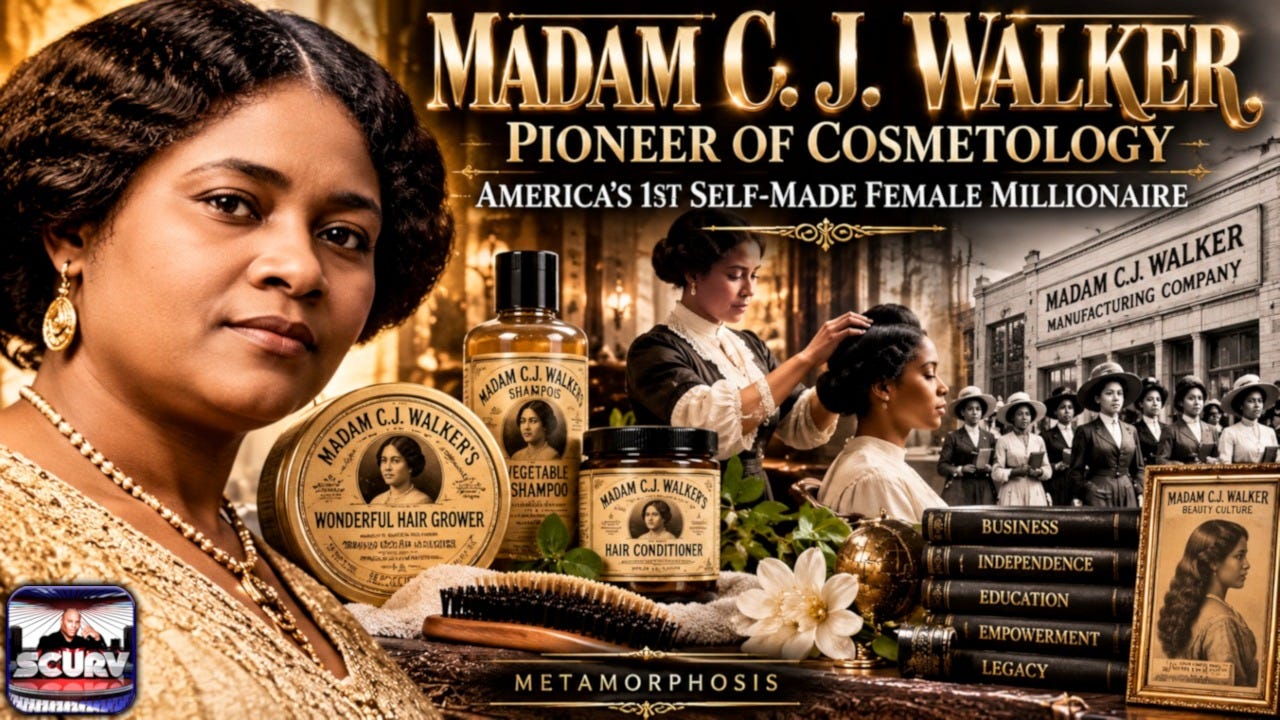
Sarah began developing and selling her own hair-care products. Among the products associated with her early business was a preparation marketed as Madam Walker’s Wonderful Hair Grower. The name promised improvement, but the broader commercial idea was just as important: she was creating a recognizable product line that could be sold repeatedly, rather than relying entirely on the hours of her own physical labor.
The difference between selling her labor and selling a product was enormous. A laundress could earn only by doing more work, and there were limits to how many hours one person could endure. A business owner could train other people to sell products, develop a distribution system, and reach customers in places she might never personally visit. That model offered a path toward growth that wasn’t tied solely to her own hands.
In 1906, Sarah married Charles Joseph Walker, a newspaper advertising salesman. She adopted the professional name Madam C. J. Walker, using a title that helped establish a polished public identity for her business. The name became part of the brand, giving customers something recognizable and allowing her to present herself as the leader of a growing commercial enterprise.
The name change also marked a personal transformation. Sarah Breedlove was the woman shaped by childhood loss, domestic labor, and the demands of survival. Madam C. J. Walker was the public identity of a woman determined to build a national business. The two weren’t separate people. One grew from the other. The experiences of Sarah gave Madam Walker her understanding of hardship, while the new identity gave her a way to present her ambitions to the world.
Her marriage, however, shouldn’t be reduced to a simple business partnership or a fairy-tale romance. Marriage involved personal expectations, shared experiences, and the pressures that come with two adults trying to build a life while one of them becomes increasingly ambitious. The relationship eventually ended in divorce, and she continued using the Walker name that had become central to her public identity.
That decision tells us something about the strength of her brand. By then, the name represented more than a husband. It represented the business she had built, the customers who recognized her, and the professional identity she had worked to establish. She had made the name her own, and she wasn’t going to surrender that identity simply because her marriage had ended.
BUILDING A BUSINESS IN A COUNTRY THAT DIDN’T WANT BLACK WOMEN TO WIN
The beauty industry Walker entered wasn’t operating on an equal playing field. Black women faced racial discrimination in stores, workplaces, public transportation, hotels, and other parts of American life. Access to business financing was limited, and many white-owned institutions were unwilling to treat Black entrepreneurs as equals. Even when a Black woman had a promising idea, she could encounter obstacles that had nothing to do with the quality of her work.
Walker understood that selling a good product was only one part of building a successful company. She also had to persuade customers to trust her, establish a reputation, develop reliable methods of production, and create a system that could operate beyond her immediate surroundings. She needed to turn individual sales into a business that could survive growth, competition, and the challenges of an openly discriminatory society.
She began by selling directly to women, using personal contact to introduce products and explain how they were intended to be used. That approach was particularly important in communities where customers couldn’t always find products suited to their needs in mainstream stores. A woman who bought from Walker wasn’t simply purchasing something in a container. She was entering a relationship with a salesperson who could demonstrate the product, explain its use, and offer guidance on maintaining her hair.
Walker understood the power of personal trust. A satisfied customer could become a repeat customer, and a satisfied customer could introduce other women to the business. In communities where people depended heavily on recommendations from friends, relatives, church members, and neighbors, that kind of relationship could be more valuable than an expensive advertising campaign.
She also understood that Black women needed to see themselves represented in the products they purchased. Packaging, advertising, presentation, and the appearance of the person selling the product all mattered. Walker presented herself as a successful Black businesswoman who understood her customers because she came from their world. Her image became part of the message: a Black woman could build a company, manage money, develop a public reputation, and lead others toward economic independence.
Her product line eventually included hair preparations and other beauty items. She marketed a system of hair care rather than relying on a single product to carry the entire business. The Walker Method combined products with instructions and personal service, creating a more complete commercial offering. This approach gave her agents something more substantial to sell and helped establish a consistent identity for the company.
But we must also understand the historical context of Black hair. Hair was never merely hair in a society that attached racial meaning to physical appearance. Black women faced pressure to meet beauty standards that often favored European features and hairstyles. Some women wanted to change their appearance to fit those standards, while others wanted healthier hair, greater styling options, or a more manageable routine. Their motivations weren’t identical, and their choices shouldn’t be treated as though every Black woman experienced beauty in the same way.
Walker operated within those complicated realities. Her products were designed to meet the needs of Black women, and her business helped many customers gain access to specialized care. At the same time, the hair-care methods of her era included pressing and straightening practices that could involve heat and products requiring careful use. Her work belongs to a history of Black beauty innovation, but it shouldn’t be turned into a claim that every method or beauty standard associated with the industry was beyond criticism.
The greater significance of her achievement lies in her ability to recognize a market, develop a brand, and build a business around a community whose needs were often overlooked. She took an area of everyday life and treated it as worthy of serious commercial attention. In doing so, she helped demonstrate that Black consumers represented a market with real purchasing power and that Black women could become the owners, managers, teachers, and distributors of products serving that market.
THE WOMEN WHO HELPED TURN A PRODUCT INTO AN EMPIRE
One of Walker’s most important business decisions was to develop a network of sales agents and trained hair-care professionals. She understood that her company could grow much faster if other women learned how to sell its products and provide its services. Instead of keeping every opportunity for herself, she created a model through which women could become part of a larger enterprise.
These agents weren’t simply names on a sales list. They were women who needed income, skills, confidence, and a chance to improve their circumstances. Many Black women at the time were confined to domestic service, laundry work, agricultural labor, or other jobs with limited opportunities for advancement. Walker’s business offered another route, although success still depended on sales, expenses, effort, and local economic conditions.
Through training, product knowledge, and a recognizable business identity, Walker helped women learn how to approach customers, explain products, and conduct themselves as professionals. The work could involve traveling, building relationships, managing inventory, and persuading customers to spend money. These weren’t effortless opportunities, but they offered women a chance to develop skills and earn income in a field where they could potentially become independent operators.
Think about what it meant for a Black woman to walk into a community as a trained representative of a growing company, carrying products under her own professional responsibility. She wasn’t merely waiting for someone to offer her a job. She was presenting a service, developing customers, and building a source of income through her own work. For some women, the opportunity offered a meaningful step toward financial independence.
The network also gave Walker a way to expand without personally visiting every customer. Her agents became the human connection between the company and communities across the country. They helped introduce products to new markets, demonstrated their use, and spread the Walker name. As the network expanded, the business could reach customers who would otherwise have remained beyond her immediate influence.
Walker encouraged a professional culture among her agents. Training, appearance, sales methods, and personal conduct were important parts of the brand. This emphasis on professionalism reflected her understanding that customers had to trust the people representing her company. It also reflected the pressures facing Black women who knew that their behavior was often judged more harshly because of their race and gender.
There was an important economic lesson in this model. Walker’s success didn’t come only from selling products to Black women. It also came from creating opportunities for Black women to participate in the selling process. The company made money through its commercial activity, while agents had the chance to earn income and develop business skills. Her enterprise linked consumer demand with employment, training, and community relationships.
We should be honest about the limits of that arrangement. A sales network wasn’t the same as guaranteed wealth, and the ability to earn depended on market demand and individual circumstances. Not every agent would become prosperous, and not every woman would experience the same degree of independence. Nevertheless, Walker created a business structure that gave many women access to opportunities they might not otherwise have encountered.
Her company grew into a major enterprise, with a national network of agents and a workforce that expanded over time. The exact numbers varied by period and source, but historical accounts consistently show that the business became far larger than a small operation selling products door to door. It became a commercial organization with manufacturing, training, distribution, advertising, and administrative needs.
That’s a major distinction. Plenty of people can sell a product successfully for a time. Far fewer can build an organization capable of supporting a broad network of workers and customers. Walker’s achievement required more than personal charm or a good formula. It required planning, management, persistence, and the ability to make decisions as the company grew.
Her business also helped establish a model for Black women who wanted to enter entrepreneurship. It demonstrated that a company serving Black consumers could develop a national reach, build a recognizable identity, and create a network of people whose livelihoods were connected to its success. That legacy remains one of the strongest reasons her name deserves a place in the history of American business.
DENVER, PITTSBURGH, AND THE ROAD TO NATIONAL RECOGNITION
Walker didn’t build her enterprise in one place and remain there forever. Her movement between cities reflected a willingness to follow opportunity and establish the facilities needed to support a growing business. Each location brought a different set of customers, relationships, and commercial possibilities.
Denver became an important early base for her work. There, she refined her business ideas, sold products, and developed her public identity. The city offered an environment in which she could begin building a customer base while gaining experience in the beauty industry. It also gave her a place to establish herself apart from the life she had known in the South and Midwest.
Her business subsequently expanded through other locations, including Pittsburgh, where she developed training and sales activities. These moves weren’t merely changes in scenery. They reflected the demands of an enterprise that needed to reach customers in multiple communities. As the company expanded, Walker had to think about how products would be supplied, how agents would be trained, and how the business could maintain a consistent reputation across different markets.
Advertising also became an important part of her strategy. Black newspapers offered a way to reach customers in communities often ignored or poorly served by mainstream advertising. By promoting her products through Black media, Walker helped establish a relationship between her company and a wider audience of readers. Her business became visible not only through personal recommendations but also through a recognizable public presence.
The importance of this strategy shouldn’t be underestimated. A business that depends entirely on face-to-face sales can grow only as quickly as its representatives can reach customers. Advertising allows a company to introduce itself to people who have never met its founder or spoken to one of its agents. Walker combined personal selling with broader promotion, allowing her business to move beyond the limits of one neighborhood or city.
Her expanding reputation also helped her attract attention as a Black woman who had achieved financial success during a period when such achievements were far from common. She wasn’t merely earning money. She was becoming a public figure whose business challenged assumptions about who could own a company, direct employees, and accumulate substantial wealth.
Yet public recognition brings its own problems. The more successful Walker became, the more important it was to protect the company’s name, maintain product quality, and make decisions that would support long-term growth. She had to think about competition, the actions of her representatives, and the risks of building an enterprise whose reputation was closely tied to her own identity.
Her name appeared on products and in advertising, making her both the face of the business and one of its most important commercial assets. That connection gave her considerable power, but it also meant that the company could be affected by anything that damaged public confidence in her. Her personal identity and professional identity became increasingly difficult to separate.
The woman who had once depended on washing clothes for other people was now managing an expanding enterprise with responsibilities that reached far beyond her own household. Her decisions affected workers, customers, distributors, and the future of the company. The pressure must have been considerable, although the private thoughts she experienced during those years can’t always be recovered from the historical record.
What we can establish is that she continued to pursue growth rather than settle for the success she had already achieved. She had discovered that her business could become much larger than a personal livelihood, and she worked to give it the structure needed to operate on a national scale.
INDIANAPOLIS: WHERE HER VISION BECAME A PERMANENT INSTITUTION
In 1910, Walker moved her company’s headquarters to Indianapolis, Indiana. This decision marked a major turning point in the development of the enterprise. Indianapolis offered an opportunity to establish a more centralized operation, and Walker invested in facilities that could support manufacturing, administration, and training.
The move was about more than finding a new address. A business with a growing national network needed an operational center. Products had to be manufactured and distributed, representatives needed support, and the company required a place where its activities could be coordinated. By establishing headquarters and manufacturing operations, Walker strengthened the foundation beneath the public image of her growing brand.
The Indianapolis operation became associated with the production of her hair-care and beauty products, as well as the education of women who sold and used them. The company wasn’t simply an idea carried around in a suitcase. It was becoming a structured enterprise with physical facilities, employees, and systems of work.
This development also mattered to the surrounding Black community. A substantial Black-owned enterprise could create employment, circulate money, and provide an example of what local business ownership could accomplish. It could help demonstrate that Black economic activity didn’t have to remain small or dependent on businesses owned by people outside the community.
Walker understood that a business headquarters could serve as a symbol as well as a workplace. Its existence made her company’s ambitions visible. It showed that the enterprise had grown beyond its founder’s personal labor and had become an institution with a presence in the commercial life of the city.
Her business also created a setting in which professional training could be connected to a broader economic mission. Women learned about products and sales, but the larger lesson was that they could develop practical skills and use them to pursue income. Walker’s model connected business development with an opportunity for women to change their economic position.
The company continued to grow, and its later headquarters building became an important landmark in Indianapolis. The prominent Walker Building on Indiana Avenue was completed in 1927, eight years after her death. It was planned in connection with the ambitions of her enterprise, but its construction belongs to the period after she was gone. Its history therefore reflects both her original vision and the efforts of those who carried aspects of that vision forward.
The building was more than an office block. Its design and later cultural role connected commerce with community life. It became a lasting reminder of a Black woman who had imagined her business as something that could have a presence beyond her own lifetime. Today, the building’s preservation helps keep that history visible to people who might otherwise encounter her story only in a textbook.
The achievement wasn’t simply that Walker made money in Indianapolis. It was that she established an organization with physical roots, a recognizable public identity, and a continuing place in the city’s history. A company that began through personal selling had grown into a significant institution.
That transformation is one of the clearest measures of her business ability. She had moved from earning money through her own labor to creating a company whose operations involved many other people. Her work demonstrates the difference between making a living and building an enterprise capable of leaving a lasting mark on the world.
HER HAIR-CARE LEGACY AND THE MEANING OF COSMETOLOGY
Walker is often remembered as a pioneer of Black cosmetology, and that description reflects the broad influence of her work. Her company manufactured products, trained agents, supported beauty services, and helped develop a commercial system focused on Black women’s hair and personal care. She contributed to a growing industry that recognized Black women as customers whose needs deserved specialized attention.
However, her place in this history should be understood accurately. She wasn’t the only Black woman working in hair care during her era, nor was she the first person to recognize the commercial potential of products designed for Black consumers. Other entrepreneurs had already developed products, businesses, and training systems. Walker’s distinction lies in how she built upon the opportunities and knowledge present in that environment to create a nationally recognized enterprise.
Her business helped show that cosmetology could be more than an informal service or a small local occupation. With training, products, marketing, and organized distribution, it could become a source of professional identity and economic activity. Women who entered the field could develop specialized knowledge, establish relationships with customers, and potentially build businesses of their own.
For Black women, these opportunities carried particular significance. Mainstream institutions frequently limited their employment options, and beauty services offered a field in which they could develop skills and serve customers within their own communities. A successful Black-owned company could provide products, training, and a commercial network that helped women pursue that work with greater confidence.
At the same time, we shouldn’t romanticize the industry or suggest that beauty standards are harmless simply because a business serving Black women succeeded. Hair care has long been connected to questions of identity, social acceptance, race, and personal choice. Some women used straightening methods because they preferred the look or manageability. Others felt pressure to change their hair to meet standards shaped by discrimination. Still others developed their own approaches to beauty that challenged those expectations.
Walker operated in a society where appearance could affect how Black women were treated. Her business offered products and services within that reality, while her own public success challenged assumptions about Black women’s abilities. The historical significance of her work doesn’t require us to pretend that every aspect of the beauty industry was free from social pressure or commercial controversy.
We can appreciate the opportunities she created while also recognizing that Black women deserved the freedom to define beauty for themselves. That distinction matters because economic empowerment shouldn’t require every woman to look the same, buy the same products, or follow the same style. The strongest legacy of a successful industry is its ability to offer choices, support skilled work, and allow people to participate on their own terms.
Walker’s contribution to cosmetology also demonstrates the importance of understanding a customer. She recognized that a business couldn’t succeed by treating Black women as an afterthought. Products had to address their needs, marketing had to reach them, and the people selling the products had to understand the communities they served. Her success helped make that commercial reality impossible to ignore.
Her influence therefore reaches beyond a particular formula or a particular hairstyle. It includes the development of a business model, the training of women, the growth of Black consumer markets, and the recognition that beauty services could become a path toward economic independence.
That’s why her story belongs not only in discussions of hair products but also in the history of entrepreneurship, women’s employment, Black economic development, and the long struggle to create opportunity where society had placed barriers.
THE WOMAN BEHIND THE MILLIONAIRE: MARRIAGE, MOTHERHOOD, AND PERSONAL COST
It’s easy to admire a successful woman from a distance without asking what her success demanded from her personal life. Walker’s story becomes more human when we remember that she wasn’t operating in a world where business responsibilities could be neatly separated from family obligations. She was a mother, a wife for part of her life, a public figure, and the leader of a company that demanded her attention.
Her daughter, Lelia, was central to her life. Sarah had given birth to her during her teenage years, and the two shared a bond shaped by the hardships of their early circumstances. As Walker’s financial position improved, she was able to provide her daughter with opportunities that had been unavailable to her own generation. Education, travel, social connections, and participation in the family’s growing enterprise became part of a very different future.
But opportunity can change family relationships as well as improve them. A mother who spends years fighting to establish herself may have strong expectations for the people closest to her. A daughter growing into adulthood may have ambitions and preferences of her own. The surviving historical record provides important information about their lives and work together, but it doesn’t allow us to reconstruct every private conversation, disappointment, or moment of affection.
What we do know is that Lelia eventually became an important figure in the family business. She helped support its operations and later played a role in the development of the company’s presence in Harlem. Her involvement showed that the enterprise wasn’t limited to her mother’s individual efforts. It was becoming a family institution with responsibilities that would continue beyond Walker’s lifetime.
The relationship between mother and daughter also existed within the expectations of their era. Walker had risen from poverty to wealth and had built a public identity that carried enormous meaning for her. She had reasons to protect the company and wanted it to survive. Those goals could bring pressure to family members who were expected to help carry the business forward, even as they pursued their own interests.
Walker also had to manage the effects of her changing social position. The woman who had once worked as a laundress was now moving in circles that included prominent businesspeople, community leaders, and public figures. Such changes could create distance from old surroundings while introducing new responsibilities. Wealth could provide comfort and access, but it couldn’t guarantee that every relationship would remain simple or that every personal problem would disappear.
Her marriage to Charles Joseph Walker eventually ended in divorce. Although he had been part of the period when her public identity and business were developing, the relationship didn’t last. The available historical evidence doesn’t justify reducing their marriage to one simple explanation, and it would be unfair to invent private motives that the record can’t establish.
What deserves attention is that Walker continued to build her business after the marriage ended. She retained the name under which customers knew her, and she continued to develop her professional identity. Her enterprise had become something she could direct through her own judgment and leadership, rather than a project dependent on the continuation of a marriage.
That independence didn’t mean she no longer needed other people. No major enterprise can survive without workers, customers, professional relationships, and support. But it did mean that the direction of her business was increasingly connected to her own decisions and ambitions. She had created something that could stand as a testament to her abilities, regardless of her marital status.
We should also recognize the emotional weight of being a woman who had to make her own way through so much adversity. Historical records can document business decisions and public appearances, but they can’t tell us everything about how Walker felt when she was alone. We can’t know every fear she experienced, every night she worried about the company, or every private moment when she wondered whether her efforts would be enough.
That uncertainty doesn’t weaken her story. It reminds us that the people we celebrate in history were human beings whose inner lives were larger than the documents they left behind. Walker’s achievements are remarkable without our needing to turn her into someone who never doubted herself, never made mistakes, or never felt the strain of responsibility.
VILLA LEWARO: THE HOUSE THAT TOLD THE WORLD SHE HAD ARRIVED
In 1916, Walker completed a dream that represented a dramatic change in her circumstances. She established Villa Lewaro, her grand estate in Irvington-on-Hudson, New York, north of New York City. The property became one of the most visible symbols of her wealth and ambition, standing in sharp contrast to the modest conditions in which she had grown up.
For a woman who had spent her early years working for other people, the ability to own an impressive home represented a profound shift in her life. She had gone from struggling to pay for basic necessities to controlling resources that could purchase property, support employees, and provide a comfortable setting for herself and her family. The estate offered a physical expression of what she had accomplished.
But Villa Lewaro was more than a private reward. Walker intended the property to serve a larger social purpose, and it became associated with gatherings and conversations involving people concerned with Black advancement. Her home was part of a public identity built around success, respectability, and the belief that Black Americans had the right to enjoy the fruits of their labor.
At the time, racial discrimination restricted where Black families could buy property and how they were treated in many communities. A Black woman owning an impressive estate in a wealthy area challenged assumptions about who belonged in such spaces. The house demonstrated that her success wasn’t something she had to hide or apologize for. She had earned her position through the growth of a real business.
Still, we shouldn’t measure her life only by the size of her home. A mansion can tell us something about financial success, but it can’t tell us everything about a person’s character or the value of their contributions. Walker’s deeper significance lies in the people she employed, the women she trained, the causes she supported, and the institutions she helped strengthen.
The estate also reminds us of a tension that often accompanies success. A person who rises from poverty may want to enjoy the comforts that were once out of reach. At the same time, that person may feel a responsibility to support others who remain trapped in the same conditions. Walker’s life suggests that these goals weren’t necessarily opposites. She could enjoy her wealth while also directing substantial resources toward education, social welfare, and racial advancement.
Her home was a statement of achievement, but her philanthropy gave that achievement a broader purpose. The significance of Villa Lewaro rests not simply in its architecture or cost but in what it represented at a time when Black wealth was frequently denied, minimized, or treated as an exception rather than a legitimate outcome of business success.
The property also offered a place where private life and public responsibility could meet. Walker could welcome guests, host gatherings, and use her standing to support discussions about the future of Black Americans. Her personal resources gave her access to spaces and opportunities that could be used to advance causes larger than her own business.
Villa Lewaro remains a reminder that wealth can be used in different ways. It can be accumulated for personal comfort, invested in an enterprise, or directed toward public causes. Walker’s story is compelling because she pursued more than one of these goals, creating a life in which personal achievement and community responsibility were connected.
A MILLIONAIRE WHO DIDN’T FORGET THE PEOPLE LEFT BEHIND
Walker’s wealth was extraordinary for a Black woman in the early twentieth century, but the way she used her money is just as important as the way she earned it. She supported educational institutions, social services, and organizations working to improve the lives of Black Americans. Her giving reflected an understanding that individual success could be meaningful without being sufficient to address the larger problems facing a community.
Her own childhood had been marked by limited access to education and financial security. She understood what poverty could take away from a person before that person had the chance to develop their abilities. As her resources grew, she supported institutions that offered education and assistance to people who faced barriers similar to those she had experienced.
Her charitable contributions reached schools and institutions serving Black students, including organizations dedicated to education and vocational training. These gifts mattered because access to education could influence a person’s employment prospects, independence, and ability to participate in public life. At a time when segregation and discrimination restricted opportunities for Black students, financial support for these institutions helped sustain important work.
Walker also supported social services and community organizations. Her giving reflected concern for people whose needs couldn’t be met by education alone. Families facing poverty, older people requiring care, and communities with limited resources all depended on organizations capable of providing practical assistance. Philanthropy could help fill some of those gaps, although it couldn’t replace the need for fair laws, public investment, and equal access to opportunity.
One of the most important aspects of her philanthropy was that it wasn’t reserved entirely for the end of her life. She gave while she was actively building her company, rather than treating charity as something to consider only after her career was over. This approach required balancing the needs of an expanding business with the needs of people and institutions outside it.
That balance wasn’t always simple. A growing company needs capital for production, staffing, marketing, and expansion. Money donated to another cause can’t be used for those business expenses. Walker had to make choices about how much she could give, which causes she would support, and how to maintain the resources necessary to keep her company operating.
Her giving nevertheless became a meaningful part of her public identity. She used her resources to support education and community institutions because she understood that the opportunities available to one person were shaped by the wider conditions surrounding them. A woman might be talented and hardworking, but if she lacked access to education, employment, or basic services, her ability to succeed could remain limited.
Walker also understood that Black progress required more than individual achievement. A successful businesswoman could demonstrate what was possible, but a stronger community needed institutions that could educate children, support families, and prepare future generations for leadership. Her contributions helped connect personal wealth with the development of those institutions.
It’s important, however, not to present philanthropy as a perfect solution to structural inequality. Donations can support valuable work, but they can’t single-handedly eliminate racism, poverty, or unequal access to education. Walker’s giving mattered because it supported real organizations and people, not because it made the larger problems disappear.
Her example raises a question that remains relevant today: what responsibility, if any, does a person have to the community that helped shape their success? People may disagree about the answer, but Walker’s life demonstrates one approach. She used a portion of her resources to support institutions and causes that she believed could improve the lives of others.
Her philanthropy wasn’t separate from her history. It grew from the same experiences that had shaped her ambition. She knew what it meant to lack security, and she understood that opportunity became more powerful when people had access to the tools needed to use it.

HER FIGHT AGAINST RACIAL INJUSTICE
Walker wasn’t only concerned with business and charity. She also became involved in efforts to challenge racial injustice. Her public life unfolded during a period of segregation, racial violence, and widespread discrimination against Black Americans. Wealth could offer a degree of personal independence, but it couldn’t protect her community from every form of injustice.
She supported organizations working for Black advancement and contributed to causes connected to civil rights and social improvement. Her involvement reflected the belief that Black Americans deserved equal protection, educational opportunity, and the ability to participate fully in the life of the country. She understood that financial success and racial justice were connected, even though one couldn’t automatically produce the other.
In 1917, racial violence in East St. Louis, Illinois, left numerous Black residents dead, injured, displaced, or without homes. The violence was part of a wider history in which Black communities faced attacks and often received inadequate protection from authorities. Walker supported efforts to protest the violence and bring attention to the conditions Black Americans were facing.
The episode illustrates the limits of private success. A person might own a business, employ workers, and accumulate wealth, yet still live in a country where racial hostility could threaten the lives and property of people who looked like them. Walker’s accomplishments didn’t place her outside the struggle for justice. They gave her additional resources and a public platform from which to participate in it.
She also became associated with efforts to pressure the federal government to address lynching. In 1917, she traveled to Washington, D.C., as part of a delegation seeking federal action against the practice. Lynching was not simply an act of individual violence. It was part of a wider system of racial terror that could be used to intimidate Black communities, punish independence, and reinforce white supremacy.
The demand for federal action reflected the belief that local authorities couldn’t always be trusted to protect Black citizens or prosecute those responsible for racial violence. The effort sought to make the national government confront a problem that had been allowed to continue for far too long. Walker’s participation demonstrated that she viewed her wealth and influence as tools that could be used beyond the marketplace.
Her activism also complicates the image of the wealthy entrepreneur as someone interested only in protecting personal property. Walker had built a business that depended on the ability of Black women to work, travel, sell products, and participate in economic life. The same discrimination that threatened those opportunities also threatened the safety and freedom of the communities in which her business operated.
Economic independence and civil rights were therefore connected parts of her world. A woman couldn’t fully enjoy the benefits of her work if she remained vulnerable to violence, discrimination, and unequal treatment. A community couldn’t build lasting prosperity if its members were denied basic protections or forced to live under constant threat.
Walker couldn’t end these injustices by herself. Her wealth, public standing, and charitable giving were meaningful, but the struggle required many people and institutions working over time. Her contribution should be understood as part of a broader movement rather than an isolated act by one extraordinary individual.
Her example nevertheless challenges the idea that business success and social responsibility must remain separate. She had built a company through commercial activity, yet she also used her influence to support causes addressing the conditions under which Black Americans lived. Her life showed that an entrepreneur could recognize the importance of both earning money and confronting injustice.
THE CHALLENGES, COMPETITION, AND BUSINESS CONFLICTS SHE FACED
No honest account of Walker’s life should make her success appear effortless. Her company operated in a competitive industry, and she had to establish its reputation while dealing with the practical challenges of manufacturing, sales, distribution, and management. She also worked in a society where Black entrepreneurs faced discrimination that could affect access to financing, commercial relationships, and public recognition.
Competition was part of the business environment. Other entrepreneurs were developing and selling hair-care products, and some had established businesses before Walker’s company reached its full scale. The growth of the Black beauty market created opportunities, but it also meant that companies had to compete for customers and distinguish their products from those offered by others.
Walker’s business developed within this existing industry. She learned from the commercial environment around her, built her own brand, and expanded through sales agents and training. Her success didn’t require us to pretend that she worked alone or that no one else had contributed to the field. In fact, recognizing the broader industry makes her achievement more meaningful because it allows us to see the particular choices and strategies that helped her company grow.
Her relationship with another Black beauty entrepreneur, from whom she had sold products, became a source of business conflict. The historical record shows that their commercial paths eventually diverged, and later accounts have sometimes presented their rivalry in dramatic terms. But it’s important to distinguish documented business competition from stories that exaggerate personal hostility or invent private confrontations.
Competition between Black businesswomen shouldn’t be treated as evidence that Black entrepreneurship was somehow uniquely divided or incapable of cooperation. Business owners in every community compete over products, customers, and market share. The important question is how those conflicts affect the people involved and what lessons can be learned from them.
Walker had to establish her own commercial identity and demonstrate that her products and business methods could attract customers. She couldn’t depend entirely on someone else’s reputation. She needed her own sales network, advertising, training system, and customer relationships. The company’s growth reflected her ability to turn those elements into a recognizable and increasingly organized enterprise.
The business also faced the challenges of expansion. As a company grows, the founder must learn to manage people, delegate responsibility, oversee production, and maintain standards. The skills that help someone start a business aren’t always the same skills required to operate a large organization. A founder who once personally handled sales may eventually have to trust employees and representatives to carry out important tasks without direct supervision.
That transition can be difficult because the business carries the founder’s name and reputation. If a representative disappoints a customer, the customer may blame the company. If production fails to meet expectations, the brand can suffer. If the business expands too quickly, its systems may struggle to keep pace. Walker’s success required attention to these ordinary but demanding realities of commercial life.
There were also personal costs. Building a major enterprise could mean long periods away from home, travel, demanding schedules, and pressure to make decisions that affected other people’s livelihoods. A founder may enjoy the rewards of success while carrying responsibilities that aren’t visible to the public. Walker’s life involved that kind of responsibility, even if the historical record doesn’t preserve every private struggle.
We should also recognize that success doesn’t erase earlier hardship. A person who has experienced poverty may continue to feel the need for security long after becoming wealthy. The fear of losing what has been built can become another form of pressure. We can’t know exactly how Walker experienced those feelings, but her background helps explain why financial independence and control over her future could have carried such powerful meaning.
Her story isn’t valuable because she never encountered defeat. It’s valuable because she continued building through difficult conditions, adapted as her company grew, and created an enterprise that reached far beyond her own labor. The setbacks and challenges are part of the achievement, not distractions from it.
HER FINAL YEARS: WEALTH, WORK, AND THE LIMITS OF TIME
By the final years of her life, Walker had become a prominent businesswoman and philanthropist. She had established a recognizable brand, developed a network of sales agents, built manufacturing operations, and acquired substantial wealth. She had also used her resources to support educational and social causes while becoming involved in efforts to challenge racial injustice.
Her life had changed dramatically from the conditions of her childhood. She had moved from poverty and domestic labor to a position in which she could make decisions about a large enterprise and direct resources toward causes she valued. The distance between those two realities was extraordinary, especially in a country where Black women faced severe barriers to economic independence.
Yet the demands of the business continued. A successful company requires attention even after it has reached a level of prosperity. Employees need direction, customers need products, and decisions about future operations must be made. Walker couldn’t assume that the business would automatically remain successful simply because she had already accomplished so much.
She had to think about continuity. What would happen to the company if she were no longer able to lead it? Who would make important decisions? How could the organization preserve its identity and continue serving its customers? These questions matter for every founder, but they become especially important when a business is closely associated with one person’s name and personality.
Walker placed significant responsibilities in the hands of people who worked within the enterprise, including her daughter. The involvement of others helped create a foundation for continued operations, although the years after her death would bring their own challenges and changes. The future of the company depended on more than the memory of its founder; it depended on the ability of those who followed to manage the business under changing conditions.
Her health became a serious concern in her final years. Walker died on May 25, 1919, at Villa Lewaro, at the age of fifty-one. Historical accounts identify hypertension and kidney-related complications among the medical problems associated with her final illness and death, although retrospective medical explanations should be treated with care.
Her death came while she was still relatively young by modern standards. She had spent much of her life working, traveling, managing, and expanding an enterprise that had become central to her identity. There were undoubtedly plans and ambitions that she would never have the opportunity to complete, although we can’t know exactly what she would have chosen to do if she had lived longer.
The loss was significant for her family, employees, and the wider community that had come to recognize her as a symbol of Black achievement. She wasn’t simply the owner of a successful company. She was a woman whose life had challenged expectations about what a Black woman could accomplish in America.
Her death also marked the beginning of a different chapter in the company’s history. The enterprise would have to continue without the person whose name, image, and leadership had helped define it. That challenge is one reason her legacy must be understood through both the organization she built and the work required to preserve it after she was gone.
HOW MUCH WAS SHE REALLY WORTH?
The claim that Walker was America’s first self-made female millionaire has become one of the best-known parts of her story. The phrase captures the extraordinary nature of her achievement, but historical wealth estimates require some explanation. Different accounts have used different figures for her fortune, and the meaning of a millionaire’s wealth in 1919 differs greatly from the meaning of the same dollar amount today.
Walker accumulated substantial wealth through her business and investments, including real estate. Her fortune at the time of her death has often been estimated in the hundreds of thousands of dollars, with some accounts placing it around $600,000 to $700,000. Estimates of what that wealth would represent in today’s money vary according to the method used to calculate inflation and purchasing power.
The exact modern equivalent isn’t the most important part of the story. What matters is that she accumulated a fortune of remarkable size for a Black woman in the early twentieth century, particularly one who had begun her adult life in poverty and spent years earning money through domestic labor.
The phrase self-made also deserves careful thought. Walker’s achievement involved extraordinary effort and initiative, but no successful business exists entirely outside its environment. She learned from an existing beauty industry, relied on employees and sales agents, served customers, and operated within networks of commerce and community. Recognizing those contributions doesn’t diminish her achievement. It shows how successful businesses actually work.
Her wealth also challenged common assumptions about Black economic life. At a time when Black Americans were frequently excluded from opportunities available to white citizens, Walker demonstrated that a Black woman could build a major enterprise, employ others, and accumulate substantial assets. Her success provided a powerful example of what could happen when business ability and opportunity came together, even under unequal conditions.
She also became a symbol of Black women’s economic independence. Her money wasn’t simply evidence that she had sold a large number of products. It reflected her ability to create and manage a business that gave other people opportunities to work, sell, and develop skills. Her fortune therefore had a wider significance than the balance of her personal estate.
At the same time, we shouldn’t treat millionaire status as proof that every part of her life was perfect or that wealth automatically solved the problems she had experienced. Money could provide security and access, but it couldn’t restore her parents, erase her childhood, guarantee a lasting marriage, or eliminate racial injustice. Her life remained human even after her financial circumstances changed.
The most useful lesson from her wealth is that financial success can create choices that poverty restricts. It can allow people to invest, employ others, support institutions, and influence public life. Walker used those choices in ways that extended beyond her personal comfort, helping connect her commercial success with a broader vision of Black advancement.
Her place in history rests not on a single dollar figure but on the scale of what she built, the conditions under which she built it, and the lasting example she left behind.
THE LEGACY THAT SURVIVED HER: WHAT HAPPENED AFTER MADAM WALKER DIED?
When Walker died in 1919, she left behind more than a fortune and a famous name. She left a company, a workforce, a network of trained agents, family responsibilities, charitable commitments, and a public example of Black economic achievement. Her death didn’t end the story, but it changed the nature of the challenge. The woman who had guided the enterprise through its early growth was no longer there to make decisions or personally represent the brand.
Her daughter and other people connected to the business had to deal with the difficult work of carrying that legacy forward. A company built around its founder’s identity can face special problems after the founder dies. Customers may have developed personal trust in the person whose name appears on the product, and employees may have depended on that person’s leadership. The next generation must preserve what works while making decisions about an entirely new set of circumstances.
The business continued after Walker’s death, although its history included changes in leadership, ownership, operations, and market conditions. The hair-care industry itself would continue to evolve as new products, technologies, consumer preferences, and competitors emerged. No company can assume that the market will remain unchanged simply because its founder once enjoyed great success.
That reality makes Walker’s achievement even more worthy of serious attention. She created something that could continue to exist after her own life ended, but the long-term survival of an enterprise requires constant work. A founder can establish a powerful identity, but later generations must maintain quality, understand customers, and respond to changing conditions.
The physical places associated with her life also became part of her legacy. The Walker Building in Indianapolis, completed in 1927, remained a significant landmark connected to her company’s history. Its later cultural role helped preserve the connection between Black entrepreneurship, arts, education, and community life. The building became a reminder that a business can leave an imprint on the landscape of a city as well as on the lives of its customers.
Villa Lewaro also continued to attract attention as a symbol of Walker’s achievements. Although it became a private residence and isn’t generally open to the public, its historical significance remains connected to the remarkable change in her circumstances. The home represents the possibilities she reached, while the story of her childhood reminds us of how far she traveled to reach them.
Her legacy also survived through photographs, letters, business records, advertisements, and other historical materials. These records allow later generations to study not only her public image but also aspects of the company and the people who helped operate it. They provide evidence of a businesswoman who worked in a real commercial environment, surrounded by other people, practical challenges, and decisions that shaped her success.
Historical memory can sometimes turn a complicated person into a simple symbol. Walker deserves better than that. Her legacy becomes more valuable when we recognize the full range of her activities: entrepreneur, employer, trainer, philanthropist, activist, mother, and woman who had to navigate the pressures of public success. Each part of her life adds something to our understanding of what she accomplished.
Her name continues to inspire people interested in entrepreneurship, Black history, women’s leadership, and community development. But inspiration should lead to more than admiration. It should encourage people to examine the methods she used, the obstacles she faced, the institutions she supported, and the decisions that allowed her business to grow.
The most meaningful way to honor her isn’t simply to repeat that she became wealthy. It’s to understand how she built her enterprise, how she created opportunities for other women, and how she used her resources to support causes that mattered to her. That’s where her story moves beyond the past and becomes useful to the present.
THE LESSONS MADAM C. J. WALKER LEFT FOR FUTURE GENERATIONS
One of the clearest lessons from Walker’s life is that your starting point doesn’t have to determine your destination. She began without the advantages that many successful businesspeople take for granted. She had limited formal education, little money, a child to support, and a lifetime of social barriers to overcome. Those conditions were real, and they made her journey more difficult, but they didn’t prevent her from recognizing opportunities and acting on them.
Her story also demonstrates the value of understanding a problem from the perspective of the people experiencing it. Walker knew the needs of her customers because she had lived through some of the same challenges. She didn’t build her business around an imaginary market. She developed products and services for women whose lives, concerns, and purchasing habits she understood. That connection between personal experience and commercial insight helped her establish a recognizable brand.
Another lesson concerns the importance of building systems rather than depending entirely on personal effort. Walker began by selling products directly, but she recognized that a larger enterprise required trained representatives, organized distribution, manufacturing, advertising, and management. She created a structure that allowed other people to participate in the business and helped it reach customers beyond her immediate surroundings.
Her example also shows that financial independence can become more powerful when it creates opportunities for others. Walker’s business offered women a chance to learn sales and beauty-care skills, earn income, and develop professional identities. Not every participant would achieve the same results, but the model opened a path that was unavailable to many Black women in other parts of the economy.
She also demonstrated that success and social responsibility can exist together. Walker enjoyed the benefits of her wealth, yet she supported educational institutions, social services, and efforts to challenge racial injustice. She didn’t need to surrender every personal comfort to contribute to her community. Instead, she used some of the resources she had accumulated to support causes that extended beyond her own household.
Her life also teaches us to look honestly at the difficulties of success. Competition, business disagreements, family responsibilities, and the pressure of managing a growing enterprise were part of her experience. Achievement doesn’t remove the need for sound judgment or guarantee that relationships will remain easy. Success can create new responsibilities just as it solves old problems.
Perhaps most importantly, Walker’s story reminds us that history is made by people who are willing to act within imperfect conditions. She couldn’t control every aspect of the society in which she lived. She couldn’t erase the consequences of slavery, eliminate racial discrimination, or guarantee that every Black woman would have equal opportunities. But she could make decisions within those conditions, develop a business, employ others, support institutions, and use her public standing to advocate for change.
Her example doesn’t mean that every person who works hard will become a millionaire. Circumstances, access to resources, social conditions, and chance all influence outcomes. We should never use one person’s success to suggest that poverty is simply the result of a lack of determination. Walker’s achievement is extraordinary precisely because she overcame barriers that were real and deeply rooted.
What her story does demonstrate is the power of combining determination with practical action. She identified a market, learned from experience, developed a brand, built relationships, trained other women, and expanded her operations. Her achievement involved more than positive thinking. It required sustained work and decisions that translated ambition into an operating business.
For today’s entrepreneurs, her life offers a reminder that the most important question isn’t always how to become famous or wealthy. Sometimes it’s how to solve a problem that people genuinely experience, how to create something they value, and how to build an organization that can serve them consistently. Walker’s business grew because it connected a commercial product with a community of customers and workers.
For Black communities, her legacy also raises important questions about ownership, cooperation, and economic opportunity. How can businesses create jobs and develop skills? How can wealth support education and community institutions? How can successful people contribute to a stronger environment for the next generation? These questions remain relevant because economic independence is not only about what one person owns. It’s also about the opportunities that exist for others.
Madam C. J. Walker’s life doesn’t offer a perfect formula that anyone can copy. The world has changed, and the conditions of modern business are different. But her story provides an example of how personal experience, commercial insight, professional organization, and community commitment can work together to create something lasting.
MADAM C. J. WALKER WAS MORE THAN THE FIRST SELF-MADE MILLIONAIRE
When we speak about Madam C. J. Walker, we should never reduce her to a photograph of a wealthy woman standing beside an impressive home. That image may capture a moment of success, but it cannot explain the years of labor, loss, uncertainty, and determination that came before it. The real story begins with a little girl born to parents who had been enslaved and follows her through a life that demanded far more from her than most people will ever have to imagine.
She was a child who lost both parents, a young woman who became a mother, a widow who had to support her daughter, and a laundress who understood the limits of working for wages that could barely sustain a household. She was also a woman who recognized an opportunity in the beauty industry, developed a business around the needs of Black women, and created a network that allowed others to participate in her success. Each stage of her life contributed to the person she eventually became.
Her wealth was extraordinary, but her achievement wasn’t simply the accumulation of money. She helped build a commercial enterprise that served Black consumers, created opportunities for women to develop skills and earn income, and supported institutions working to improve the lives of Black Americans. She also used her public standing to participate in efforts against racial injustice, demonstrating that business success could be connected to a wider concern for community welfare.
We should remember her victories without pretending she never encountered difficulties. We should acknowledge her business accomplishments without ignoring the other people who contributed to the beauty industry before and during her rise. And we should celebrate her philanthropy without suggesting that private generosity alone could eliminate the structural inequalities she confronted. An honest history doesn’t need exaggeration to make an extraordinary life worth studying.
Madam C. J. Walker died at fifty-one, but the significance of her life has reached far beyond the years she was given. Her story remains a powerful example of what can happen when a person refuses to accept the limitations imposed by poverty, discrimination, or social expectations. She didn’t merely imagine a different future. She worked to create one, and in doing so, she changed what many other women believed was possible for their own lives.
Ultimately, her story belongs to anyone who has ever felt that the world had already decided who they were allowed to become. It reminds us that our beginnings can shape us without completely defining us, that knowledge becomes more valuable when it’s put into practice, and that personal success can carry a deeper meaning when it creates opportunities for others. Madam C. J. Walker was a pioneer of Black beauty entrepreneurship, a determined businesswoman, a philanthropist, and a participant in the struggle for racial advancement. But before all those titles, she was Sarah Breedlove, a human being who lived through hardship and built a remarkable life from the circumstances she was given. That’s the woman we should remember, study, and pass on to the next generation.
