

HOW ONE BLACK WOMAN REVOLUTIONIZED THE WAY BILLIONS OF PEOPLE COMMUNICATE
For decades, the world has celebrated the newest gadgets, the latest apps, and the biggest technology companies, but far too often it has ignored the brilliant minds whose ideas made those breakthroughs possible. We live in an age where people expect to make a video call from thousands of miles away, send a voice message in seconds, or speak face-to-face with loved ones across oceans without thinking twice about the technology working behind the scenes. It’s become so normal that many people never stop to ask who made this modern miracle possible. That’s exactly why today’s conversation matters.
THE GENIUS HISTORY LEFT IN THE SHADOWS
Some people chase fame while others chase purpose. Some invent products that receive instant praise while others spend decades building the invisible foundation that allows entire industries to exist. Marian Croak belongs to that second group. Her name isn’t spoken nearly as often as the CEOs whose companies rely on technology like hers, yet her fingerprints can be found throughout today’s digital world. Every time millions of people communicate over the internet, they benefit from breakthroughs that she spent years developing, refining, and protecting through innovation and persistence.
What’s even more remarkable is that her journey wasn’t built on luck or special treatment. It was built on discipline, curiosity, education, determination, and an unwavering belief that problems were meant to be solved. She entered a field where very few Black women were welcomed, respected, or expected to lead. Instead of allowing those barriers to define her future, she quietly outworked expectations until the quality of her ideas became impossible to ignore.
MORE THAN AN INVENTOR
Far too often, society celebrates entertainers while overlooking engineers. It praises celebrities while ignoring scientists. It remembers personalities while forgetting pioneers. That’s one of the greatest ironies of modern history because inventions shape civilization far longer than headlines ever will. Marian Croak didn’t simply create another product to sell on store shelves. She helped transform the very way human beings connect with one another across the globe.
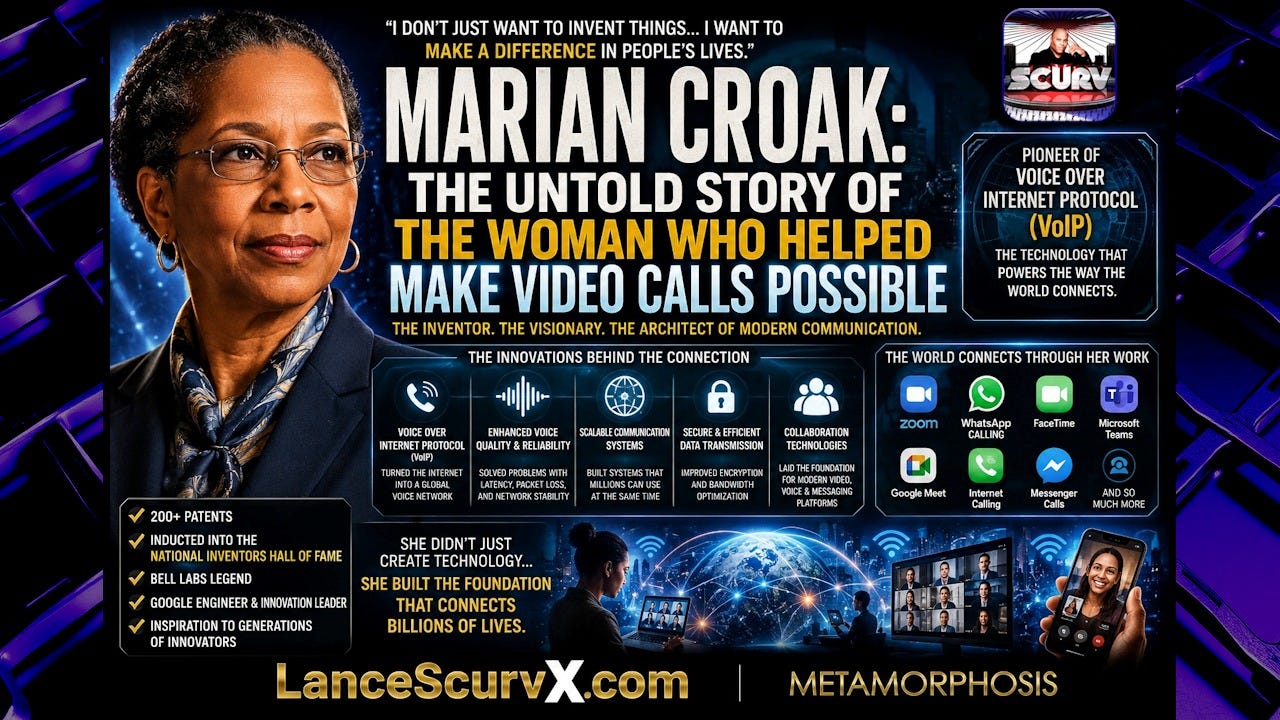
Think about the last time you called someone who lived in another state or another country. Think about the last business meeting held over video. Think about the last church service streamed online, the last virtual doctor’s appointment, the last classroom taught through a computer, or the last voice message received on your phone. Behind experiences like these are decades of technological advances in internet communication. While no single inventor created today’s communication platforms by themselves, Marian Croak’s groundbreaking work in Voice over Internet Protocol, better known as VoIP, helped build one of the essential foundations that made these experiences practical, reliable, and scalable for billions of people.
A STORY THAT DESERVES TO BE TOLD
Stories like this matter because history has a habit of remembering the loudest voices instead of the deepest contributions. Entire generations have grown up believing innovation belongs to a select few faces repeatedly shown in magazines, documentaries, and television specials. Meanwhile, countless brilliant Black inventors, engineers, scientists, and visionaries have watched their accomplishments remain hidden behind corporate logos and product names.
That’s why learning about Marian Croak isn’t simply about honoring one remarkable woman. It’s about correcting an incomplete historical record. It’s about recognizing excellence wherever it’s found. It’s about showing young people that greatness doesn’t always stand in front of a camera. Sometimes it sits quietly inside a laboratory, an engineering office, or a research center where someone is working day after day on ideas that eventually change the lives of billions.
BEFORE THE WORLD KNEW HER NAME
Long before international recognition, prestigious awards, and hundreds of patents, Marian Croak was simply a curious young girl growing up in New York City. She was born during an era when America was still wrestling openly with racial segregation and unequal opportunities. Society placed limits on what many believed Black children, especially Black girls, could become. Yet even during those difficult years, her imagination refused to accept those limitations.
Growing up in New York exposed her to an incredible mix of cultures, neighborhoods, professions, and ideas. She developed a fascination with understanding how things worked. She wasn’t satisfied with accepting the world exactly as she found it. She wanted to understand systems, improve them, and solve problems that affected everyday people. That mindset would eventually define her entire career.
Unlike many children who dreamed about becoming famous, Marian found excitement inside learning itself. Mathematics wasn’t something to fear. Science wasn’t something reserved for someone else. Engineering wasn’t an impossible mountain standing in the distance. To her, knowledge became an opportunity to create solutions that could improve lives. That hunger to learn would become one of her greatest strengths.
Her family also played an important role in shaping the person she would become. They valued education and encouraged intellectual curiosity. Those lessons stayed with her throughout her life. Even when obstacles appeared, she continued believing that preparation, discipline, and education could open doors that prejudice tried to keep closed.
As Marian entered adulthood, she pursued higher education with the same determination that had fueled her curiosity since childhood. She attended the prestigious University of Southern California, where she earned degrees in psychology as well as quantitative analysis. At first glance, those fields might seem unrelated to engineering, but they helped her understand something many technologists overlook: technology exists to serve people. The best inventions solve human problems rather than simply showing off technical skill.
Her educational journey didn’t stop there. As computers and digital communications began transforming the world, Marian recognized that the future belonged to those willing to adapt. She expanded her knowledge into computer science and engineering, positioning herself for a career that would eventually influence nearly every connected person on Earth.
WHEN OPPORTUNITY MET PREPARATION
In the early years of her professional career, Marian Croak joined Bell Laboratories, one of the most respected research institutions in the world. Bell Labs had already earned a legendary reputation for producing revolutionary scientific discoveries. Some of the brightest minds on Earth worked within its walls, constantly searching for solutions that could shape the future of communications.
Walking into that environment as a Black woman required extraordinary confidence and resilience. Engineering departments during those years were overwhelmingly male, and opportunities for African Americans remained painfully limited. Every meeting, every presentation, every proposal demanded that she prove herself repeatedly in ways many of her peers never had to experience.
Instead of allowing discrimination or doubt to discourage her, Marian focused on mastering her craft. She immersed herself in research, collaborated with fellow engineers, and steadily built a reputation for solving difficult technical problems. She understood something that remains true today: excellence has a way of demanding attention even when recognition arrives later than it should.
During these formative years, the internet was still evolving from a specialized network into something that ordinary people could use. Telephone systems remained the primary method of long-distance communication, and few imagined that one day voices would travel efficiently across internet connections instead of traditional phone lines. Marian Croak saw possibilities where others saw obstacles. Rather than asking whether internet communication could work, she began asking how it could work better, faster, and more reliably for everyone.
That question would eventually place her among the most influential inventors of the modern digital age. It would lead to hundreds of patents, international recognition, and innovations that quietly transformed how billions of people communicate every single day. Yet the greatest chapters of her remarkable journey were still waiting to be written.
THE FOUNDATION OF A DIGITAL REVOLUTION
As Marian Croak moved deeper into her career, the internet itself was going through a quiet but explosive transformation. What started as a limited academic and government network was quickly becoming a global system that would reshape how humans live, work, and communicate. Most people at the time still relied heavily on traditional telephone systems, but inside research labs, engineers were beginning to ask a radical question: what if voice communication could travel over the internet just like data?
That question became the doorway into Marian Croak’s most important work. She stepped into the emerging field of Voice over Internet Protocol, known as VoIP, at a time when it was still unstable, unreliable, and far from practical for mass use. Many experts doubted it would ever replace traditional phone systems. The challenge wasn’t just making voice travel over the internet, it was making it clear, stable, scalable, and dependable across unpredictable networks.
Marian Croak helped push that boundary forward with relentless focus. Her work centered on building systems that allowed voice signals to be broken into digital packets, transmitted across networks, and reassembled on the other side in real time. That sounds normal today, but at the time it was groundbreaking engineering work that required solving deep technical problems in signal quality, latency, and reliability.
THE INVISIBLE ARCHITECTURE OF MODERN COMMUNICATION
When people think about modern platforms like video calls or internet messaging, they often think of the user interface, the app design, or the company behind the product. What they don’t see is the invisible architecture underneath everything. Marian Croak’s contributions live in that invisible layer.
Her innovations helped make it possible for voice and eventually video to travel across internet systems without breaking apart into chaos. Without this foundation, platforms like Zoom Video Communications, WhatsApp, FaceTime, Microsoft Teams, and Google Meet would struggle to function at global scale. They didn’t directly come from her hand as products, but the scientific principles she advanced helped make their existence practical in the real world.
The internet was never originally designed to carry real-time voice. It was built for data exchange, not conversation. That means engineers like Marian Croak had to essentially force two different worlds to merge: the world of human speech and the world of packet-based digital communication. That required breakthroughs in how data is prioritized, how networks handle congestion, and how systems recover when packets are lost.
Every time someone joins a video call in a noisy environment or switches from Wi-Fi to cellular without dropping a conversation, they are benefiting from decades of engineering progress in which Marian Croak played a major role. Her work helped turn what was once fragile experimental technology into something people now rely on daily without even thinking about it.
BREAKING BARRIERS IN A CLOSED SYSTEM
While the technical challenges were enormous, the social challenges were just as real. Marian Croak worked in a field where Black women were rarely seen in leadership roles, especially in advanced engineering research. The environment was often shaped by assumptions about who “belongs” in technical spaces and who does not.
She didn’t respond to those limitations by trying to fit into narrow expectations. Instead, she focused on output. Her work ethic became her voice inside rooms where she might not always have been fully heard. Over time, results became undeniable. Patents began accumulating. Research contributions began gaining attention. Technical leadership became unavoidable.
Still, the path wasn’t easy. Innovation often requires convincing organizations to invest in ideas that don’t yet have a proven commercial model. VoIP technology was one of those ideas. At the time, traditional telecom systems were powerful, profitable, and deeply entrenched. Shifting toward internet-based communication required challenging established infrastructure and changing long-standing industry thinking.
Marian Croak helped lead that transition with patience and persistence. She worked not just as an inventor, but as an advocate for future-facing technology that many initially struggled to understand. That combination of technical brilliance and long-term vision is what eventually positioned her as one of the most important figures in modern communications engineering.
PATENTS THAT SHAPED GLOBAL CONNECTIVITY
Over the course of her career, Marian Croak became one of the most prolific Black female inventors in United States history, holding well over 200 patents across multiple fields. Many of those patents relate directly to improving how digital communication systems handle voice and data transmission.
Her work helped refine systems that allow internet calls to maintain stability even when network conditions fluctuate. She contributed to technologies that reduce dropped calls, improve audio clarity, and optimize bandwidth usage so that communication remains smooth even under pressure.
These advancements might seem invisible, but they are essential. Without them, internet communication would feel unreliable, lag-heavy, and inconsistent. Instead, it feels natural, immediate, and human.
This is where her genius becomes clear. She didn’t just invent isolated features. She helped shape entire systems that modern communication depends on. That kind of impact doesn’t always get public attention in real time, but it becomes undeniable when you look at how deeply the technology is woven into everyday life.
FROM RESEARCH LABS TO GLOBAL IMPACT
As her career progressed, Marian Croak moved into leadership roles where she could influence broader innovation strategy. She wasn’t just solving technical problems anymore, she was helping guide the direction of entire research teams focused on the future of communication technology.
Her leadership extended into large-scale research environments where she helped shape the evolution of internet communication infrastructure. She later continued her work at Google, where she focused on expanding access to reliable communication tools for people around the world.
One of the most important aspects of her journey is that her influence spans both technical invention and systemic change. She didn’t only contribute ideas, she helped bring those ideas into real-world systems used by billions of people.
That level of impact is rare. It requires not just intelligence, but endurance. It requires not just vision, but execution over decades. It requires the ability to work inside systems while also reshaping those systems from within.
RECOGNITION THAT CAME AFTER THE REVOLUTION
For many years, Marian Croak’s work existed behind the scenes, known mostly within engineering circles and research institutions. But over time, recognition began to catch up with impact. Her contributions were eventually honored with one of the highest distinctions in the field of invention, induction into the National Inventors Hall of Fame.
That recognition represented more than personal achievement. It represented acknowledgment of a lifetime spent building technologies that quietly power modern civilization. It also represented a broader shift in understanding, where contributions from Black women in science and engineering are finally being recognized at the level they always deserved.
Still, even awards don’t fully capture the reality of her influence. The true measure of her work isn’t found in ceremonies or titles. It’s found in the millions of conversations happening every second across the planet. It’s found in families staying connected across continents. It’s found in businesses operating globally without interruption. It’s found in classrooms, hospitals, and homes that depend on seamless communication.
And through it all, her work remains embedded in the background, doing its job quietly, reliably, and constantly shaping how the world stays connected.
THE LEGACY THAT CONTINUES TO SPEAK WITHOUT A VOICE
When the full story of modern communication is told, it cannot be separated from the invisible architecture that allows it to function. Marian Croak’s work doesn’t sit on a shelf as a finished invention, it lives in motion every second of every day. It moves through calls, messages, video streams, business meetings, classrooms, and family conversations across continents. That’s the kind of legacy that doesn’t fade because it becomes part of how the world breathes.
Her impact represents something deeper than technology alone. It represents what happens when intelligence, discipline, and vision are allowed to push through barriers that were never designed for certain voices to enter. It also exposes how many contributions have been hidden in plain sight, quietly powering industries while receiving far less recognition than the systems built on top of them.
THE POWER OF INVISIBLE GENIUS
One of the most important truths about Marian Croak’s journey is that the most powerful inventions are often the least visible to the public eye. People see apps, logos, and platforms, but they rarely see the communication systems underneath. That invisible layer is where her influence lives.
It’s easy to assume that modern communication just “works” because it always has. But nothing about it was automatic. Every smooth video call, every stable internet voice connection, every seamless transition between networks exists because engineers like her solved problems most people never even knew existed.
That’s why her story forces a deeper reflection. It challenges the idea that only front-facing creators matter. It challenges the idea that recognition always matches contribution. It also reminds us that the backbone of modern life is often built by people whose names are not always shouted from the rooftops.
THE BATTLE FOR RECOGNITION IN TECHNOLOGY
Marian Croak’s journey also highlights a broader truth about the technology industry itself. For decades, Black women in engineering have had to navigate environments where their presence was rare and their contributions often overlooked until proven beyond doubt.
Her success didn’t come from being placed in comfortable conditions. It came from consistency in environments where she had to prove value repeatedly. It came from producing results that could not be dismissed. It came from turning complex theoretical ideas into real-world systems that reshaped global communication.
Even now, her recognition serves as both celebration and correction. It celebrates what she achieved while correcting a long history of under-acknowledged brilliance. That balance is important because it reframes how innovation is remembered and who gets included in that memory.
WHY HER STORY MATTERS RIGHT NOW
In a world where communication has become instant and global, it’s easy to forget how recent this transformation actually is. Not long ago, connecting with someone across the world required expensive phone calls, long delays, and limited access. Today, it happens in seconds, often for free, across multiple platforms simultaneously.
That shift didn’t happen by accident. It happened through decades of research, experimentation, failure, refinement, and persistence. Marian Croak represents the type of mind that helped bridge that gap between limitation and global connectivity.
Her story matters because it challenges the way innovation is taught and remembered. It demands a more honest conversation about who builds the systems that shape daily life. It also encourages a new generation to understand that invention isn’t just about creating visible products, it’s about solving invisible problems that others depend on without even knowing it.
CLOSING REFLECTIONS
There’s a deeper lesson embedded in Marian Croak’s legacy that goes beyond engineering. It’s about persistence in spaces that were never designed to easily accept you. It’s about excellence that refuses to be ignored. It’s about building systems that outlive recognition and continue serving the world long after the headlines move on.
Her work reminds us that progress is rarely loud. Most of the time, it’s built quietly in research rooms, in code, in equations, and in experiments that slowly reshape how society functions. And when that work is done right, it becomes so integrated into life that people forget it was ever invented at all.
That’s the level of impact Marian Croak represents. Not just invention, but foundation. Not just contribution, but infrastructure. Not just recognition, but legacy written into the very way the world communicates.
The truth is simple but powerful. The modern world doesn’t just run on apps and platforms, it runs on ideas that came from minds willing to solve problems most people never see. Marian Croak stands as one of those minds, and her story deserves to be understood not as a footnote, but as a cornerstone of the digital age.
Her legacy continues every time a voice travels through the internet and arrives on the other side without interruption. That’s not magic. That’s engineering. And behind that engineering stands a lifetime of vision, discipline, and quiet genius that helped change the world.