

A QUIET LIFE THAT LEFT A LOUD IMPACT
History has a strange way of deciding who gets remembered. Some people become household names because they stood before cameras, commanded corporations, appeared in textbooks, or had entire institutions built around their accomplishments. Others leave behind ideas that eventually become part of everyday life, yet their names slowly fade into the background. Marie Van Brittan Brown belongs among those people whose contribution became larger than the public recognition she received. Her story is about intelligence, necessity, creativity, and the determination to solve a problem that affected ordinary people in their daily lives.
For me, this story carries an even deeper meaning because Marie Van Brittan Brown’s life was connected to Jamaica, Queens, New York City, the same community where I was raised. Jamaica, Queens isn’t simply a location on a map to me. It’s a place with its own rhythm, its own struggles, its own energy, and its own history. Anyone who has spent enough time in New York City understands that the environment can teach you to be alert, aware, and conscious of the world around you. You learn that every neighborhood contains stories that often go untold, and sometimes you can spend your entire life walking streets without realizing that someone nearby created something that would eventually affect millions of people around the world.
That’s what makes the story of Marie Van Brittan Brown so powerful. She wasn’t known because she chased celebrity, and she didn’t become a household name in the way that many modern technology figures have. Yet the idea she helped develop would eventually connect to an industry that now reaches into millions of homes. Every time someone looks through a security camera, checks a video doorbell, communicates with a visitor without opening the door, or monitors activity outside their home, they’re participating in a technological world that reflects the same basic problem Marie Van Brittan Brown confronted decades earlier.
Her invention emerged during the 1960s, a time when concerns about crime and personal safety were becoming increasingly serious for many New Yorkers. People didn’t always have the luxury of immediate emergency assistance, and answering a knock at the door could sometimes mean exposing yourself to a person whose intentions you couldn’t know. Marie Van Brittan Brown looked at that uncertainty and did something that far too many people fail to do when faced with a problem. She didn’t simply complain about it. She began thinking about how it could be solved.
Today, the solution may seem obvious because we’re surrounded by technology that allows us to see and communicate with people standing outside our homes. We can check our phones, watch live video, receive motion alerts, and monitor our property from almost anywhere in the world. But the ideas that now feel normal were once revolutionary. Before these technologies became common, someone had to imagine a different way of protecting the home. Marie Van Brittan Brown was one of the people who helped bring that vision into existence.
THE WOMAN BEHIND THE INVENTION
One of the challenges of telling Marie Van Brittan Brown’s complete life story is that the public historical record doesn’t preserve every chapter of her personal journey. There isn’t an extensive collection of widely available information documenting her childhood, her school years, the details of her family life, or the experiences that first shaped her interest in problem-solving and invention. That’s important to acknowledge because a responsible biography shouldn’t fill the empty spaces with imagination and present fiction as fact.
What history does clearly establish is that Marie Van Brittan Brown was an American nurse who lived in Queens, New York. She became closely associated with Jamaica, Queens, and it was there, during the 1960s, that the idea for her most important invention took shape. She and her husband, Albert Brown, developed an early home security system and filed for a patent that would later become an important part of the historical foundation of modern residential security technology.
The gaps in the historical record shouldn’t make us think that her life was somehow less significant. If anything, those gaps reveal something uncomfortable about the way history often works. Not everyone who changes the world receives the same level of documentation. Some lives are preserved in thousands of pages, while others are reduced to a few paragraphs, even when their ideas eventually influence entire industries.
Marie Van Brittan Brown’s story forces us to think about how many other people may have made contributions that were never properly recorded. How many ideas were developed in ordinary homes, workplaces, neighborhoods, and communities but never entered the history books? How many people looked at a problem, created a solution, and then disappeared from public memory while someone else later received the recognition?
Her legacy survived because the invention itself was too important to completely disappear. Even though many details of her personal life remain difficult to find, the patent she helped secure remains part of the historical record. That invention allows us to see the kind of mind she had. She was someone who looked at a problem affecting her daily environment and believed that a better answer was possible.
LIFE AND SAFETY IN JAMAICA, QUEENS
To understand the importance of the invention, we have to understand something about the world in which it was created. New York City during the 1960s was a massive, crowded, constantly changing environment. Millions of people lived close together, neighborhoods were experiencing social and economic changes, and concerns about crime and personal safety were becoming increasingly serious in many communities.
For people who worked irregular hours, the issue of personal security could become even more complicated. Someone might return home late at night or be alone inside the house when an unexpected visitor knocked at the door. Emergency services didn’t always arrive immediately, and the simple act of opening a door could sometimes involve uncertainty.
Marie Van Brittan Brown understood this problem not as some distant social theory, but as something connected to daily life. As a nurse, she worked in a profession that could involve hours outside the traditional workday. Her husband also worked hours that didn’t necessarily match a conventional schedule. This created situations where one of them could be home alone, dealing with uncertainty about who might be standing outside.
The problem was simple, but the consequences could be serious. How do you know who’s outside your home without immediately opening the door? What if the person isn’t standing directly in front of a peephole? What if the person inside has difficulty reaching the door? What if someone needs help but doesn’t want to expose themselves to danger?
Those questions became the foundation for an idea that was far ahead of its time. Marie Van Brittan Brown and her husband began developing a system that would allow someone inside the home to observe and communicate with a person outside while maintaining greater control over access to the house.
AN IDEA THAT WAS AHEAD OF ITS TIME
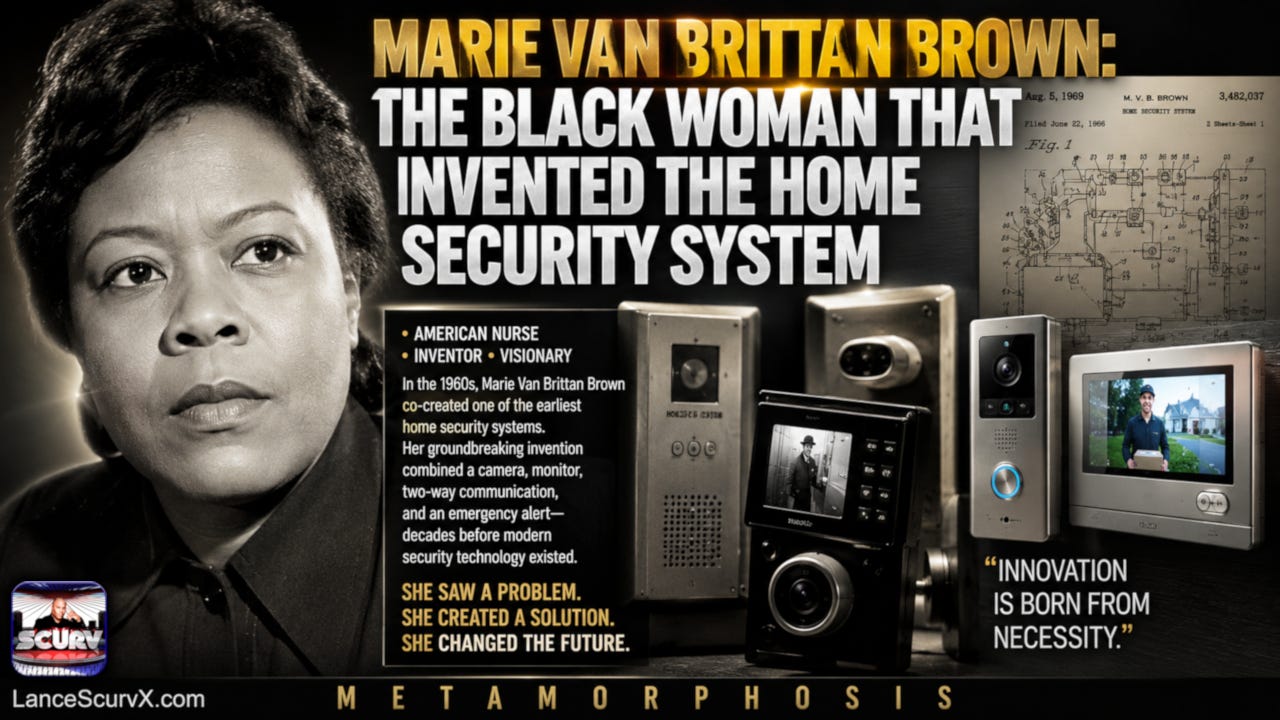
The invention that Marie Van Brittan Brown helped create was remarkably forward-thinking for the period in which it appeared. Their system involved a camera arrangement that could move and observe through different peepholes in the door. The visual information could then be transmitted to a monitor inside the home, allowing the occupant to see who was outside without physically opening the door.
The system didn’t stop with visual observation. It also included a way for the person inside to communicate with the visitor. In addition, it included a feature that could be used to signal for assistance. When you look at these elements together, it’s easy to recognize the early foundation of ideas that would later become common in modern security technology.
Today, we’re used to sophisticated devices that combine cameras, microphones, speakers, alarms, sensors, and remote access. We can watch live video from a phone, save recordings, receive alerts, and speak to someone standing outside while we’re miles away. But those modern conveniences didn’t appear out of nowhere. They developed over time from earlier concepts and inventions that introduced the basic principles.
Marie Van Brittan Brown helped establish one of those early concepts. Her invention centered on awareness, communication, and control. A person inside the home could see what was happening outside, communicate without immediately opening the door, and seek assistance when necessary.
That’s what makes the invention so important. It wasn’t simply about placing a camera near an entrance. It was about giving an ordinary person greater control over their own personal space. The homeowner didn’t have to surrender that control simply because someone knocked.
THE PATENT THAT HELPED DEFINE A FUTURE INDUSTRY
Marie Van Brittan Brown and Albert Brown filed their patent application in 1966, and the patent was granted in 1969. The timing is significant because this was decades before the internet, smartphones, wireless networks, and the compact digital cameras that now make home surveillance inexpensive and widely available.
The technology of the 1960s placed limits on what could easily be manufactured and installed in an ordinary home. Equipment was larger, more expensive, and far less convenient than the small devices available today. But the limitations of the technology don’t reduce the importance of the idea. In many ways, they make the vision even more impressive.
The Browns were imagining a system that connected visual monitoring, communication, controlled access, and emergency response at a time when these functions weren’t yet part of the standard American home. Their invention addressed a problem that technology would eventually become far more capable of solving.
That’s often how important innovation works. The original invention may not immediately become a mass-market success. The technology needed to make it affordable may not yet exist. The public may not fully understand the importance of the idea until years later. But the concept remains, waiting for the rest of the technological world to catch up.
As decades passed, cameras became smaller and more powerful. Video became easier to record and store. Wireless technology changed how security systems could be installed. Eventually, the internet and smartphones made it possible for homeowners to watch and communicate from almost anywhere in the world. But underneath all those technological improvements remained the same basic question that Marie Van Brittan Brown had helped answer: How can someone know what is happening outside their home while remaining safely inside?
A BLACK WOMAN WITH A POWERFUL IDEA
We also have to understand the social environment in which Marie Van Brittan Brown lived and created. She was a Black woman in America during the 1960s, a period marked by intense struggles over civil rights, opportunity, equality, and recognition. Black Americans were fighting for rights that should never have been denied in the first place, while women faced their own barriers in fields connected to science, technology, engineering, and invention.
The world wasn’t designed to make the path easy for a Black woman with an idea.
That’s part of what makes her accomplishment so meaningful. She didn’t come from the modern world of technology startups, venture capital, social media promotion, and instant publicity. She identified a problem in her environment, worked toward a solution, and became part of the process that secured a patent for that invention.
Her story reminds us that innovation doesn’t belong exclusively to universities, wealthy corporations, laboratories, or people with powerful financial backing. Sometimes an invention begins with something much more basic. It begins with a person who is tired of living with a problem.
That’s exactly what makes Marie Van Brittan Brown’s story so relatable. She saw something that could be improved and imagined another way. That type of thinking is one of the foundations of human progress.
FROM A HOME IN QUEENS TO A GLOBAL IDEA
There is something deeply powerful about the fact that an idea with such long-term influence was connected to an ordinary home in Queens. We often imagine world-changing inventions emerging from famous institutions, but history repeatedly proves that powerful ideas can begin anywhere.
They can begin in a kitchen.
They can begin in a garage.
They can begin in a workplace.
And sometimes they begin inside a home when someone looks at a problem that everybody else has accepted and decides that it doesn’t have to remain that way.
Marie Van Brittan Brown’s invention was built around a very human need: the need to feel secure in your own home. A home is supposed to be one of the places where you have the greatest sense of control. But that feeling can disappear when you don’t know who is outside or what their intentions may be.
Her system created a buffer between the person inside and the unknown person outside. It gave the homeowner an opportunity to observe first and react afterward. That basic principle continues to shape modern security systems.
Today, a person can be sitting in another country and still receive an alert when someone approaches their front door. They can see the visitor, speak to them, record the encounter, and decide whether any action is necessary. The technology has changed dramatically, but the concept remains remarkably familiar.
WHY HER NAME ISN’T KNOWN BY EVERYONE
Perhaps one of the most troubling aspects of Marie Van Brittan Brown’s story is the contrast between the importance of her idea and the limited public recognition attached to her name. Millions of people now use cameras, doorbell systems, and home monitoring devices without ever knowing who helped create an early vision of the technology behind them.
The products became famous.
The companies became famous.
The industry became massive.
But the name of the woman connected to one of its important early foundations often remained outside the public conversation.
That’s why telling these stories matters. Recognition isn’t just about looking backward and handing someone praise decades after the fact. Recognition teaches future generations what is possible. When young people see themselves reflected in the history of invention, they may begin to understand that intelligence and creativity aren’t limited by race, gender, neighborhood, or social class.
A young person living in an ordinary community may look at Marie Van Brittan Brown’s story and realize that they don’t have to wait for permission to think differently. They can identify a problem in their own environment. They can question why things are done a certain way. They can imagine a better solution.
That possibility may be the most powerful part of her legacy.
THE LATER YEARS AND HER PASSING
The publicly available record becomes thinner when it comes to many of the details of Marie Van Brittan Brown’s later life. We don’t have a complete public chronicle of her day-to-day experiences, thoughts, or activities during every decade after the patent was granted. A responsible account of her life has to acknowledge those limits instead of creating a fictional story to fill the empty spaces.
What we do know is that the importance of her invention continued long after it was patented. As technology developed, many of the ideas connected to her original design became increasingly practical and increasingly relevant. The world moved closer and closer to the kind of security environment that her invention had helped envision.
Marie Van Brittan Brown died in 1999. Her passing brought an end to her physical life, but it didn’t bring an end to the influence of her ideas. In many ways, her invention continued speaking long after she was gone.
Every major advancement in residential security doesn’t belong solely to one early inventor, and technology evolves through the work of many people over time. But Marie Van Brittan Brown’s contribution remains an important part of the historical foundation. Her work demonstrated an early vision of combining surveillance, communication, and security into a system designed for the home.

THE DEEPER LESSON IN HER LIFE
Marie Van Brittan Brown’s story is about much more than cameras and doors. It’s about refusing to accept a problem simply because everyone around you has learned to live with it.
Too often, people complain about what isn’t working, but they never move beyond the complaint. They wait for a corporation, a government agency, an institution, or some mysterious genius to come along and fix everything.
Marie Van Brittan Brown’s life offers another way of thinking.
If you see a problem, study it.
If something doesn’t work, question it.
If the existing solution isn’t good enough, imagine another one.
That’s how progress begins. It begins when someone refuses to believe that the present situation is the only possible future.
Her invention also reminds us that some of the greatest ideas are born from practical concerns. Not every invention begins with a desire to become famous. Sometimes the goal is simply to make life safer, easier, or more manageable.
The impact, however, can travel much further than the inventor ever imagined.
WHY MARIE VAN BRITTAN BROWN STILL MATTERS TODAY
We now live in a world surrounded by surveillance technology. Cameras watch homes, businesses, streets, vehicles, and public spaces. Homeowners can monitor their property from a phone. They can receive alerts when someone approaches. They can communicate with visitors without opening the door.
Of course, modern surveillance also raises serious questions about privacy, data collection, and how much technology we want watching our lives. Those are important conversations that society must continue to have.
But the original need behind the invention remains easy to understand. People wanted to feel safer. They wanted to know who was outside. They wanted greater control over access to their homes.
Marie Van Brittan Brown understood that need decades before today’s massive security industry existed. She looked at a real problem affecting ordinary people and helped develop a practical answer.
That’s why her story continues to matter.
A WOMAN FROM JAMAICA, QUEENS WHO HELPED CHANGE THE FUTURE
When I think about Marie Van Brittan Brown, I don’t want to reduce her life to one sentence that simply says she invented an early home security system. That’s historically important, but there’s something deeper in the story.
Behind the invention was a real person. She was a woman who lived and worked in Queens, New York. She existed in a time of major social change and serious uncertainty. She recognized a problem that affected daily life, and instead of simply accepting it, she helped create an answer.
Her story also reminds us of the hidden history that exists all around us. Sometimes the people who help shape the future live quietly among us. They don’t always receive statues. Their names aren’t always taught in school. Their faces may never appear on the covers of magazines.
But their ideas can outlive them.
For me, the connection to Jamaica, Queens makes this story even more meaningful. I know what it means for a neighborhood to shape your awareness. I know that behind every apartment door, every storefront, and every street corner, there are people carrying experiences and ideas that the rest of the world may never fully understand.
Some of those people will live and die without the recognition they deserve. Others will leave behind an idea that takes decades before the world fully understands its importance.
Marie Van Brittan Brown was one of those people. Her name deserves to be remembered, not simply as a historical footnote, but as the name of a woman whose thinking helped point toward a future that would eventually arrive in millions of homes.
Her story should challenge all of us to look differently at the problems around us. The next important idea may not come from a billionaire, a famous company, or a heavily funded laboratory. It may come from someone sitting quietly in their home, frustrated by a problem that everyone else has simply accepted.
That’s the beauty of invention. It begins with the willingness to imagine that something can be better.
Marie Van Brittan Brown did exactly that. From Jamaica, Queens came an idea that helped shape the future of personal security. Her life may not have been documented in every detail, and many parts of her personal story may remain hidden from us, but the evidence of her thinking remains clear.
She saw a problem.
She imagined a solution.
She helped create something new.
And decades later, the world is still living with the consequences of that idea.
That’s a legacy.
And that’s why Marie Van Brittan Brown deserves to be remembered.