

MAYA ANGELOU
(April 4, 1928 – May 28, 2014)
Poet, Author, Activist, Performer, Educator, and Global Voice of Black Womanhood
EARLY LIFE: ROOTS IN PAIN AND SURVIVAL (1928–1940)
Maya Angelou was born Marguerite Annie Johnson on April 4, 1928, in St. Louis, Missouri, during a period when America was rigidly segregated and deeply hostile toward Black existence. Her parents, Bailey Johnson and Vivian Baxter Johnson, had a volatile marriage that ended in separation when Maya was very young. As a result, Maya and her older brother, Bailey Jr., were sent to live with their paternal grandmother, Annie Henderson, in Stamps, Arkansas.
Stamps was a small, racially segregated Southern town where Black people lived under constant threat of humiliation, violence, and economic oppression. Annie Henderson owned a small general store, which provided some stability, but the environment itself was brutal and limiting. Maya was keenly aware, even as a child, of racial boundaries and the unspoken rules that governed Black life.
At the age of eight, Maya experienced a life-altering trauma. While briefly living with her mother in St. Louis, she was raped by her mother’s boyfriend, Freeman. He was convicted but served only one day in jail. Shortly after his release, he was murdered, likely by family members. Maya believed that her voice had caused his death, and as a result, she stopped speaking for nearly five years.
This prolonged silence was not emptiness—it was a period of intense observation. Maya absorbed language, rhythm, human behavior, and emotional nuance. Books became her refuge. She read Shakespeare, Dickens, Poe, Black folklore, the Bible, and poetry obsessively. Though silent, she was learning how language worked, how words carried power, and how stories shaped reality.
Her muteness ended gradually, encouraged by a teacher and family friend who introduced her to poetry and spoken expression. That return to speech marked the beginning of her lifelong relationship with language—not just as communication, but as liberation.
ADOLESCENCE AND EARLY ADULTHOOD: IDENTITY IN MOTION (1940s)
During her teenage years, Maya moved frequently between Arkansas and California. She attended George Washington High School in San Francisco and studied dance and drama. Remarkably, she became San Francisco’s first Black female streetcar conductor, breaking a racial barrier at a very young age.
After graduating high school, Maya pursued performing arts. She studied dance and acting, trained in calypso music, and worked as a singer and dancer. During this period, she became pregnant and gave birth to her son, Clyde “Guy” Johnson, shortly after graduation. Motherhood added another layer to her evolving identity—one shaped by responsibility, sacrifice, and resilience.
Throughout her early adulthood, Maya held numerous jobs—cook, waitress, sex worker, dancer, journalist—each experience deepening her understanding of human struggle, particularly for Black women navigating survival in a hostile society.
THE ARTIST EMERGES: PERFORMANCE, TRAVEL, AND REINVENTION (1950s)
In the 1950s, Marguerite Johnson adopted the name Maya Angelou, a name derived from her nickname and a version of her former husband’s surname. This name symbolized a rebirth—a deliberate crafting of self.
She gained recognition as a performer, touring Europe and Africa in the opera Porgy and Bess. These travels expanded her worldview and placed her within a global Black diaspora. She became fluent in several languages and immersed herself in international politics, culture, and Black liberation movements.
Angelou recorded a calypso album, appeared in films, and became known for her commanding presence and deep, resonant voice. Yet despite her success as a performer, she still felt that her true calling had not fully emerged.
ACTIVISM AND POLITICAL ENGAGEMENT (1960s)
The 1960s were a defining era in Angelou’s life. She became deeply involved in the Civil Rights Movement, working alongside major figures such as Martin Luther King Jr. and Malcolm X.
She served as the Northern Coordinator for the Southern Christian Leadership Conference (SCLC) under Dr. King. Later, she moved to Ghana, where she worked as a journalist and educator and became part of a tight-knit community of Black American expatriates. During this time, she formed a close relationship with Malcolm X and planned to help him build the Organization of Afro-American Unity.
Tragically, Malcolm X was assassinated in 1965. Three years later, Martin Luther King Jr. was assassinated on April 4, 1968—Angelou’s 40th birthday. These losses devastated her and forced her into deep reflection about purpose, legacy, and voice.
THE WRITER FINDS HER FORM: AUTOBIOGRAPHY AS REVOLUTION (1969)
Angelou’s literary breakthrough came in 1969 with the publication of I Know Why the Caged Bird Sings. The book was revolutionary. It was one of the first autobiographies by a Black woman to achieve mainstream success while speaking openly about rape, racism, trauma, silence, and self-discovery.
The book shattered conventions. Angelou’s prose was lyrical yet direct, poetic yet grounded. She used her own life not as spectacle, but as testimony. The book resonated deeply with readers across race and gender, particularly Black women who saw their own lives reflected with dignity and honesty.
Despite attempts to ban the book due to its frank subject matter, it became a classic and remains one of the most widely read autobiographies in American history.
Angelou went on to write six additional autobiographies, documenting her life with remarkable emotional clarity and intellectual discipline.
POETRY AND GLOBAL RECOGNITION (1970s–1990s)
Though she was already a respected writer, poetry elevated Maya Angelou to iconic status. Her poems spoke of Black endurance, womanhood, dignity, survival, joy, and resistance.
One of her most famous poems, “Still I Rise,” became an anthem of resilience. Its confident declaration of self-worth in the face of oppression resonated across generations.
In 1993, Angelou reached an unprecedented audience when she recited her poem “On the Pulse of Morning” at the inauguration of President Bill Clinton. She became the first poet in decades to perform at a U.S. presidential inauguration. Her voice—measured, powerful, and unapologetically Black—echoed across the nation.
EDUCATOR, ELDER, AND MORAL VOICE (1990s–2014)
In her later years, Angelou became a revered elder. She served as a professor of American Studies at Wake Forest University, despite never earning a formal college degree. She received dozens of honorary doctorates and countless awards, including the Presidential Medal of Freedom in 2011.
Angelou was often called upon to speak during moments of national crisis or reflection. Her words carried moral authority—not because she claimed perfection, but because she lived through pain, contradiction, and transformation.
She spoke candidly about love, betrayal, aging, forgiveness, and the necessity of compassion. Her philosophy emphasized courage, truth, and responsibility, especially for those who had been marginalized.
DEATH AND LEGACY
Maya Angelou passed away on May 28, 2014, at the age of 86, in Winston-Salem, North Carolina. Tributes poured in from around the world. Presidents, artists, activists, and everyday people honored her not just as a writer, but as a voice—one that spoke when silence was imposed, and sang when hope seemed fragile.
Her legacy endures through her books, poems, speeches, and the millions of lives she touched. Maya Angelou did not merely write about survival—she embodied it. She transformed personal suffering into collective strength and used language as a bridge between pain and power.
Maya Angelou’s life was a testament to the redemptive power of words. From a silenced child in the segregated South to one of the most influential voices of the 20th and 21st centuries, she demonstrated that truth, spoken with courage, can reshape both the self and the world.
Her life reminds us that survival is not the end goal—transcendence is. And through her voice, Maya Angelou taught generations how to rise.
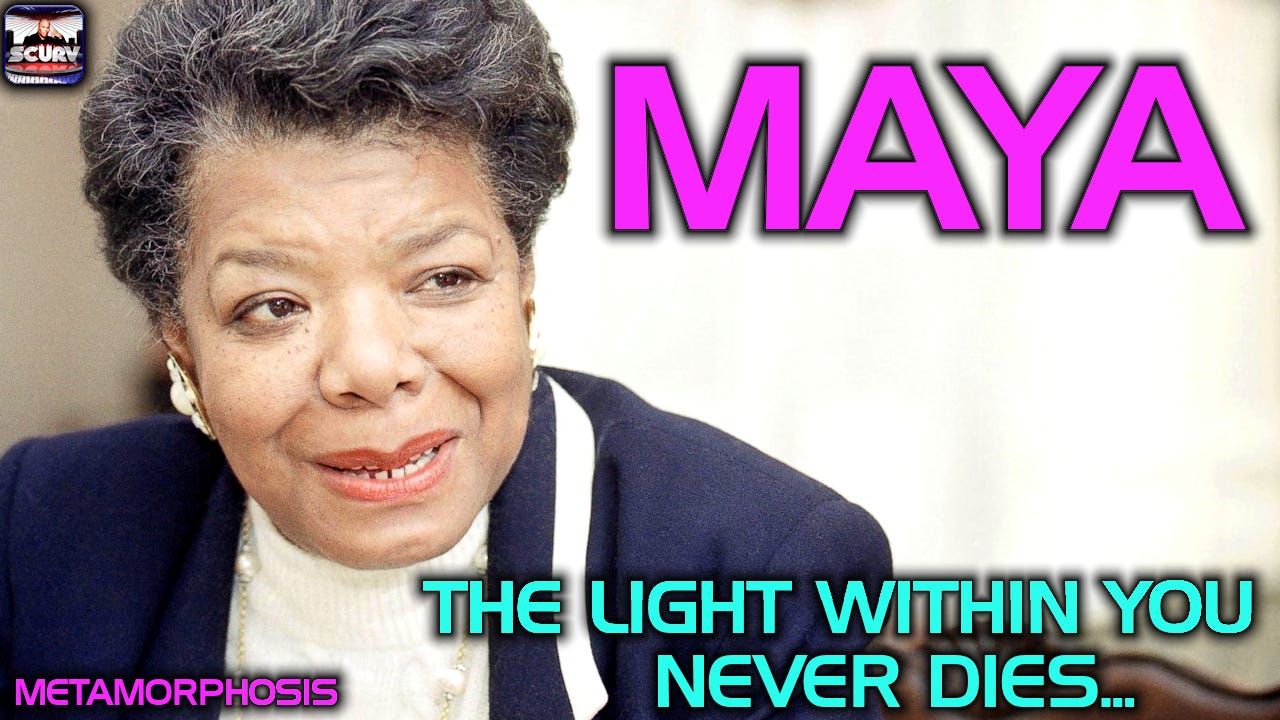
ADDENDUM
Maya Angelou: Poetry, Activism, and Psychological Transformation
I. HER POETRY: LANGUAGE AS LIBERATION
Maya Angelou’s poetry was never ornamental—it was functional, deliberate, and rooted in survival. She wrote in a voice that felt spoken rather than distant, rhythmic rather than academic, and emotionally direct rather than abstract. This accessibility was not accidental. Angelou believed poetry should reach people where they are, not intimidate them into silence. Her poems carried the cadence of Black oral tradition—sermons, blues, spirituals, and street wisdom—making her work feel alive and embodied.
Poems such as “Still I Rise,” “Phenomenal Woman,” “And Still I Rise,” and “Touched by an Angel” centered Black womanhood with pride and defiance. She did not ask permission to celebrate the Black female body, spirit, or presence. Instead, she confronted historical shame with unapologetic confidence. “Still I Rise,” in particular, became a global declaration of resilience—spoken by those facing racism, sexism, colonization, trauma, and erasure. The poem’s power lies in its simplicity: repetition, rhythm, and certainty.
Angelou’s poetry also refused bitterness. Even when addressing pain, oppression, or betrayal, she leaned toward dignity rather than vengeance. This balance—acknowledging brutality without becoming consumed by it—made her work deeply healing. Her poems were not just read; they were recited, memorized, and lived. In this way, Maya Angelou’s poetry functioned as emotional armor for millions of readers.
II. HER ACTIVISM: WORDS IN SERVICE OF JUSTICE
Maya Angelou’s activism was not performative. It was lived, consistent, and often costly. She did not merely comment on the Civil Rights Movement—she worked inside it. As a coordinator for the Southern Christian Leadership Conference, she organized, fundraised, and strategized alongside Dr. Martin Luther King Jr. Her political work was grounded in logistics, not slogans.
Her relationship with Malcolm X further shaped her worldview. While Dr. King represented moral appeal and nonviolence, Malcolm X emphasized Black self-determination and global Black identity. Angelou understood both approaches and refused to reduce liberation to a single method. Her years in Ghana placed her in direct contact with African leaders, revolutionaries, and intellectuals, deepening her understanding of colonialism and diasporic identity.
Importantly, Angelou’s activism extended beyond race. She spoke out on women’s rights, human dignity, education, and economic inequality. She believed oppression was interconnected and that silence was a form of participation. However, she never positioned herself as morally superior. Her activism came from empathy, not ego—a recognition that injustice deforms both the oppressed and the oppressor.
III. HER PSYCHOLOGICAL TRANSFORMATION: FROM SILENCE TO VOICE
Perhaps the most profound aspect of Maya Angelou’s life was her psychological evolution. As a child, trauma stole her voice. As an adult, she transformed that silence into one of the most recognizable voices of the modern era. This transformation was neither quick nor easy. It required years of introspection, reading, failure, reinvention, and courage.
Angelou openly acknowledged her fears, insecurities, and mistakes. She spoke about self-doubt even after achieving fame, revealing that confidence is often practiced rather than possessed. Her life demonstrated that healing is not linear. One can be strong and still wounded. Wise and still learning. Powerful and still afraid.
What set Angelou apart was her refusal to allow trauma to define her limits. She used memory not as a prison, but as raw material for growth. Her autobiographies are psychological documents—mapping how a Black woman navigated shame, survival, sexuality, motherhood, ambition, and aging in a society that rarely extended grace.
By the end of her life, Maya Angelou had become what many considered a moral compass. Not because she was flawless, but because she was honest. Her transformation taught that reclaiming one’s voice is not about volume—it is about truth.