


THE NAME BEHIND THE FILE YOU PROBABLY USE EVERY DAY
There’s a good chance that you’ve used Nathan Graham’s work without ever knowing his name. You may have opened a résumé, signed a contract, downloaded a government form, read a book, examined a technical manual, submitted an application, or sent somebody a document through a computer or phone. You may have done all of that without giving a second thought to the three letters sitting at the end of the filename: PDF. That’s the strange thing about technological history because the people who help change everyday life don’t always become household names. Sometimes their work becomes so normal that the human being behind it disappears completely from view.
Nathan Graham’s story deserves to be pulled back out of that darkness because his contribution sits inside one of the biggest changes in modern communication. PDF didn’t simply give people another way to save a document because it helped solve a problem that became increasingly painful as computers spread into homes, businesses, schools, government offices, publishing houses, and eventually almost every part of everyday life. A document created on one machine could look different on another machine, fonts could change, pages could shift, graphics could move, and printing could become unpredictable. The basic idea behind PDF was to make a document travel while holding onto the way it was supposed to look, and that seemingly simple goal required some very sophisticated thinking.
That sounds simple today because we’ve grown up inside the solution, but back then it wasn’t simple at all. The modern digital world was still being built, and people were trying to figure out how information could move between different computers, programs, operating systems, displays, and printers without falling apart along the way. Graham entered that world at a moment when personal computing, digital graphics, desktop publishing, electronic communication, and the old paper-based way of doing business were beginning to collide. His contribution came from understanding something powerful: sometimes the greatest technological breakthrough isn’t creating something completely new, but finding a better way to make different systems understand one another.
What makes Graham especially interesting is that his path didn’t begin with a childhood declaration that he would someday change digital documents. The available record paints something much more human because he grew up around the arts, taking drawing and pottery classes and later developing an interest in photography. Mathematics eventually entered the picture as well, and a strict third-grade mathematics teacher helped push him toward the subject before an early programmable calculator introduced him to the fascinating possibility that a machine could be instructed to perform tasks. Those interests may seem unrelated when viewed separately, but when you look backward, the connection becomes easier to see because art taught him to observe, mathematics taught him to structure, engineering taught him to solve, and computing eventually gave him a machine through which those abilities could work together.
That’s where the story becomes bigger than PDF because Nathan Graham’s life shows how a person doesn’t always follow a straight line into innovation. Sometimes the things that appear disconnected when you’re young become the very things that make your later work possible, and the artist and the mathematician don’t necessarily have to be two different people any more than the engineer and the software developer have to be separate identities. They can be different parts of the same mind, gradually finding a place where they can work together. Eventually, that combination helped create technology that would become almost invisible because the world would simply assume that documents should work this way.
BEFORE PDF, THERE WAS A MIND BEING BUILT
The first part of Graham’s story that deserves attention is his education because he studied mechanical engineering at MIT and eventually earned both undergraduate and graduate degrees. That educational path gave him a foundation in systems, mathematics, mechanics, and technical problem-solving, and it may seem surprising when we look at his later connection to PDF and software. The surprise partly comes from our modern tendency to divide technology into neat categories, even though the boundaries between engineering, computing, graphics, and document technology were much more fluid during the period when Graham was building his career.
Mechanical engineering teaches a person to think about systems because different parts have to work together and a seemingly small problem can affect an entire machine. It teaches precision, structure, efficiency, failure points, and the consequences of small mistakes, and those habits of thought can travel into other fields. Graham’s graduate work reflected an early interest in using computers to solve real-world engineering problems, including the use of computer models to study the economic effects of different tolerances in mechanical assemblies, while his coursework also included digital control theory. That placed him at an interesting intersection between physical engineering and emerging computational technology.
That distinction matters because Graham’s later contribution to PDF was also fundamentally about systems. A document isn’t simply a page because it’s text, fonts, graphics, spacing, positioning, images, instructions, and structure, and for a document to travel successfully, those elements have to remain connected and behave predictably. PDF eventually became a way of describing a page so that different systems could reproduce it consistently, which means Graham’s engineering background wasn’t some irrelevant detour before he entered the software world. It was part of the intellectual foundation that prepared him to think about complicated systems and find practical ways to make them work.
THE ARTIST INSIDE THE ENGINEER
One of the most fascinating details in Graham’s story is that technology didn’t replace his interest in art because technology eventually gave that interest another direction. His early exposure to drawing, pottery, and photography provides a glimpse of someone whose relationship with technology wasn’t purely mechanical. He wasn’t simply fascinated by machines for their own sake because he also had an appreciation for visual expression, composition, images, and the physical world around him.
That combination becomes especially meaningful when we remember the technological environment he eventually entered. Digital graphics, fonts, page description, printing, publishing, and computer-based design were becoming part of a new creative economy, while computers were beginning to transform not only mathematics and engineering but also the way human beings created and reproduced visual information. Graham’s artistic interests therefore had a natural place inside this changing environment, even though nobody could have known at the beginning where that combination of interests would eventually lead.
His movement toward technology appears to have happened gradually rather than through one dramatic moment. A childhood interest in mathematics eventually met the discovery that programmable machines could actually execute mathematical instructions, and that experience helped reveal something important about computers: they weren’t merely calculating machines, but tools for turning human ideas into repeatable processes. That concept would become increasingly important as Graham moved deeper into software and eventually began working on technology designed to reproduce information consistently across different environments.
There’s something compelling about that progression when you step back and look at the whole arc of his life. A child learns to draw, a child learns mathematics, a teenager discovers that a machine can be programmed, a student enters engineering, an engineer moves toward software, and eventually that person finds himself inside a company working at the edge of digital publishing. The path doesn’t necessarily look perfectly straight while you’re living it, but sometimes the connections only become visible after decades have passed.
FROM ENGINEERING TO SOFTWARE
Graham’s early professional career included work at Xerox before he moved to Adobe, and that transition says something about the technology world of the period because the boundaries between mechanical engineering, software, graphics, printing, and digital communications weren’t nearly as rigid as they might appear today. Companies working with computers and printing technology needed people who could understand both physical systems and digital systems, and Graham was entering precisely that environment.
His engineering background had trained him to think systematically, while his growing experience with computers was giving him another language for solving problems. The computer could now become part of the engineering process itself, allowing ideas to be modeled, tested, adjusted, and eventually transformed into working software. That combination would prove valuable as the technology industry moved increasingly toward the idea that computers could become tools not just for calculation, but for creating, manipulating, reproducing, and transporting information.
When Graham considered his next career move, Adobe wasn’t initially an obvious destination, but conversations surrounding the company revealed something that caught his attention: Adobe had a concentration of highly capable people. Graham later expressed the value of working around people who challenge you intellectually and push you to grow, and that observation gives us another glimpse into his approach to professional development. Innovation isn’t always about being the smartest person in the room because sometimes it’s about deliberately putting yourself in a room where you have something to learn.
THE ADOBE YEARS BEGIN
Graham joined Adobe in 1990, when the company was still much smaller than the global technology corporation it would eventually become. His first work involved early versions of Adobe Illustrator, which was a natural environment for somebody whose interests included both technology and visual creativity because here was an engineer working on software that allowed people to create and manipulate digital images.
Then came the career move that would change everything, because only months after joining Adobe, Graham became involved with the Acrobat project. This was a moment when the company was wrestling with a problem that would become enormously important as personal computers and digital communications continued to expand. People could create documents on computers, but creating a document wasn’t the same thing as being able to reliably move that document from one computer environment to another.
That problem sounds almost quaint now because we’ve become accustomed to digital documents opening across devices, but the convenience we take for granted had to be engineered. Somebody had to figure out how a digital page could preserve its appearance while moving through different systems, somebody had to figure out how text, graphics, fonts, positioning, and other elements could remain intact, and somebody had to create a practical way for ordinary users to generate those documents. Graham became one of the people working on that problem.
THE PROBLEM WAS BIGGER THAN PAPER
Before PDF became ordinary, digital documents had a serious problem because they didn’t always behave like physical documents. If you printed a physical page, the page existed as a physical object, with the words in a certain place, photographs in a certain place, margins in a certain place, and an appearance that remained fixed because the physical page itself preserved the arrangement.
Computers didn’t automatically give you that same stability. Different programs could interpret documents differently, different operating systems could produce different results, fonts might not be available, graphics could move, formatting could break, and printing could become a battle between software, hardware, and operating systems. The fundamental problem behind the PDF project therefore wasn’t simply how to make a digital document, but how to make a digital document behave consistently wherever it went.
The broader vision was to allow documents to move between different computer applications and systems while preserving their appearance and making them suitable for viewing and printing. The technology would eventually build upon page-description ideas associated with PostScript while adding document structures that allowed the resulting files to function as more than simple images of pages. That’s the foundation of the PDF world that most people now take for granted, even though the engineering challenge behind it was anything but ordinary.
THE PRINTER DRIVER THAT CHANGED EVERYTHING
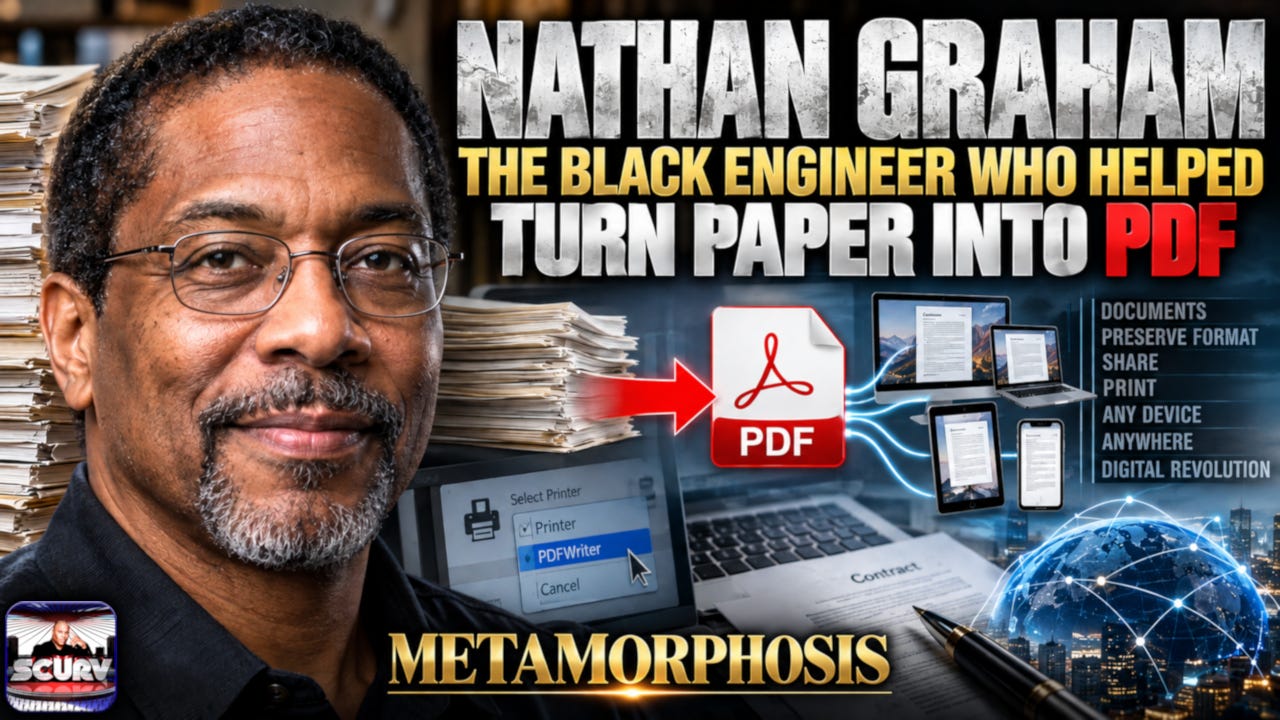
This is where Graham’s specific contribution becomes especially important because Adobe’s own historical account credits him with working on a printer driver that could create PDF files instead of sending the document to a physical printer. He later named that driver PDFWriter, and that detail gives us a much clearer understanding of what he actually contributed rather than simply attaching his name to the entire invention of PDF.
Think about how clever that idea was in the context of its time because people already understood printers, people already knew how to select a printer from a computer, and people already understood the basic concept of sending a document somewhere for output. Instead of forcing ordinary computer users to understand an entirely new technical process, the technology could use a familiar idea and redirect the output. Rather than sending the page toward physical paper, the system could create a digital document that could then be stored, transmitted, opened, and printed elsewhere.
You could almost think of it as creating a virtual printer whose paper wasn’t paper at all, because the output was a digital file that could travel. That’s an example of powerful innovation hiding inside simplicity, and PDFWriter helped make PDF creation feel less like an exotic computer-science operation and more like something ordinary computer users could understand. The technology took a familiar mental model and used it to introduce people to a completely different way of handling documents.
WHY PDFWRITER MATTERED
PDFWriter’s importance becomes clearer when you remember the era in which it appeared. The internet wasn’t yet the giant communications system it would become, cloud storage didn’t exist in the modern sense, smartphones weren’t sitting in people’s pockets, and many offices were deeply dependent on physical paperwork, printers, fax machines, photocopiers, filing cabinets, and postal delivery. A digital document had to cross barriers because it had to move from one computer to another, survive different software environments, maintain its appearance, and remain printable.
Those weren’t minor conveniences because they were serious obstacles to the idea of a truly digital office. PDF became powerful because it attacked those problems at their foundation, and Graham’s PDFWriter work therefore wasn’t simply another feature buried inside a software package. It was part of the bridge between the physical document world and the digital document world, and that bridge would eventually become one of the most heavily traveled pieces of infrastructure in modern information exchange.
THE HUMAN BEING INSIDE THE TECHNOLOGY
Here’s where Nathan Graham’s story becomes more interesting than a normal technology biography because we often talk about inventors as if they were machines themselves. We list degrees, companies, products, patents, job titles, and accomplishments, then we act as though we’ve explained the person, but we haven’t. A résumé can tell you where somebody worked, what somebody studied, and what somebody built, but it doesn’t necessarily tell you how that person looked at the world.
Graham’s available story gives us several clues because there was an artistic side, a mathematical side, an engineering side, and a programming side, along with a willingness to keep learning. That combination matters because technology doesn’t always reward people who fit neatly into one category. Some of the most useful innovations come from people who can move between worlds, allowing an artist to see a problem differently from an engineer, an engineer to structure the problem differently from an artist, and a programmer to translate both perspectives into something a machine can execute.
Graham’s career appears to have lived somewhere inside that intersection, where technical structure and creative thinking could reinforce each other rather than compete. That doesn’t mean we can know exactly what he thought about every project or every decision because the public record simply doesn’t give us that level of access, but the available evidence gives us enough to see that his technical career developed alongside interests that reached beyond pure engineering.
THE BLACK ENGINEER AT THE CENTER OF A DIGITAL REVOLUTION
There’s another part of the story that deserves attention because Graham’s presence at MIT is documented by the institution’s Black History Project, which identifies him as an MIT mechanical-engineering student who went on to become a senior software engineer. That matters because representation in technology isn’t simply about placing a photograph on a website decades later. It’s about recognizing who was actually present when important systems were being built and acknowledging that technological history is broader than the handful of names most people are taught.
The history of computing is often presented through a small collection of familiar figures, but major technologies are almost never produced by one person working alone. Behind the headline figure are engineers, programmers, designers, testers, researchers, project managers, and specialists whose names may never become widely known. Graham’s story is valuable precisely because it lets us see one of those people, somebody who wasn’t merely watching the digital revolution happen from a distance but was working inside the technological environment where the problems were being confronted.
His contribution deserves to be remembered without exaggeration and without reduction because the historical record doesn’t support the claim that he single-handedly invented PDF. What the record does support is a more precise and meaningful statement: he was an important engineer within the early Acrobat effort, and his work on the printer-driver approach that became PDFWriter helped make PDF creation practical for users.
THE ENGINEER WHO DIDN’T STOP WITH THE FIRST VERSION
Another reason Graham’s career deserves attention is longevity because a person can contribute to a major invention and then disappear from the field, but Graham continued working with PDF and Acrobat as the technology moved through several generations. Adobe’s account describes him remaining involved as the technology moved from physical media toward email and eventually toward cloud-based services, which means his career didn’t end with the initial breakthrough.
That’s a remarkable professional arc when you stop and think about it. Imagine the technology world of 1990, then imagine the changes that followed through the 1990s, the explosion of the internet, the growth of email, the arrival of smartphones, the expansion of cloud computing, and the transformation of online document services. The hardware changed, operating systems changed, the internet changed, the way people communicated changed, and the way businesses operated changed, yet Graham remained connected to the same fundamental problem: how do we make documents useful, portable, reliable, and accessible?
That’s more than participation in an invention because it represents stewardship of an idea. The technology had to keep changing because the world around it kept changing, and somebody had to continue solving new problems without losing sight of the original purpose.
FROM CDS TO EMAIL TO THE CLOUD
Graham personally described watching PDF and Acrobat move through several generations of technology, from CDs to email and eventually to cloud-based systems. That progression tells us something important about technology because the underlying problem can remain stable while the delivery system changes completely. In the beginning, the challenge was getting a digital document to work properly across different environments, then the challenge became sharing those documents, storing them, editing them, signing them, and eventually accessing them from almost anywhere.
PDF survived because it adapted to that reality. Modern PDF technology can do far more than the static pages associated with its earliest public life because documents can contain links, forms, interactive elements, security features, accessibility structures, signatures, and other functions. PDF eventually became an international standard rather than remaining permanently under the control of a single company, which helped establish it as a durable part of the digital information landscape.
That evolution makes Graham’s career even more interesting because he wasn’t simply connected to the birth of a file format. He remained connected to the problem as the meaning of the word “document” itself continued to change, and that kind of longevity tells us something about the difference between creating a technology and continuing to understand why that technology matters.
WHEN SOMETHING BECOMES INVISIBLE
Here’s the strange part about successful technology because the better it works, the less people think about it. Nobody celebrates the PDF attachment anymore, nobody stops to marvel at the engineering behind it, and people rarely think about the decades of development that made the experience feel routine. They simply click the file, open the document, read what’s there, and move on with their lives.
A person fills out a form and clicks save, a student submits an assignment, a business sends an agreement, a government office publishes a document, a lawyer sends a filing, a teacher distributes reading material, a family member sends an important record, and a person signs a contract from a phone. Underneath all of those ordinary actions sits decades of engineering, and that’s why stories like Graham’s matter because they remind us that convenience has a history.
THE POWER OF SOLVING A BORING PROBLEM
There’s another lesson buried inside Graham’s work because the world often celebrates glamorous inventions. People love rockets, robots, artificial intelligence, futuristic transportation, and machines that look like science fiction, but some of the most important technologies solve problems that sound almost boring. How do I keep this page from changing, how do I make this document open somewhere else, how do I preserve the formatting, how do I send this without printing it, and how do I make the document look the same on another computer?
Those questions don’t sound revolutionary when you say them out loud, but solve them for billions of people and suddenly you’ve changed the world. That’s what makes PDF such an important example of practical innovation because it didn’t have to look futuristic. It simply had to work, and when technology solves a problem so effectively that people stop noticing the solution, that may actually be one of the clearest signs that the technology succeeded.
THE PATIENCE BEHIND INNOVATION
Graham’s own observations about innovation may be one of the most revealing pieces of his public story because he has discussed the importance of holding onto ideas even when there isn’t immediately enough time, support, or opportunity to pursue them. The basic lesson is that an idea doesn’t necessarily become worthless simply because the moment isn’t right, and sometimes the difference between an abandoned idea and a useful innovation is simply the willingness to keep it alive until circumstances change.
Innovation isn’t always immediate because sometimes an idea sits quietly, sometimes technology hasn’t caught up, sometimes an organization isn’t ready, sometimes the market doesn’t understand the need, and sometimes the person with the idea isn’t in the right position yet. Then circumstances change, the pieces come together, and the same idea that once looked unnecessary can suddenly become essential. That’s a lesson that reaches far beyond PDF because every generation contains people carrying ideas that may not yet have found their moment.
WHY HIS STORY DESERVES TO BE REMEMBERED
Nathan Graham’s contribution can easily disappear behind the much larger story of Adobe and PDF, but that would be unfortunate because his specific contribution was meaningful in its own right. He was one of the engineers involved in the pioneering Acrobat effort, he worked on technology surrounding PDF, he developed the printer-driver approach for creating PDF files and named that technology PDFWriter, and he continued working on PDF and Acrobat through multiple technological generations.
That’s a substantial contribution, and there’s no need to exaggerate it because the truth already carries weight. Saying that Graham was an important contributor to the early development of PDF and Acrobat is historically stronger than pretending that he single-handedly created the entire technology, because the real story is more interesting than a manufactured legend. He was part of a team facing a difficult problem, and his particular solution became part of a technology that would eventually reshape the way the world handled documents.
THE DOCUMENT THAT ESCAPED THE PRINTER
Think about what PDF really represents because for centuries human beings treated documents as physical objects. A document lived on paper, you carried it, mailed it, copied it, filed it, stored it, damaged it, lost it, or destroyed it. Paper had weight and occupied physical space, and moving a document meant moving the object itself from one place to another.
The computer changed that relationship, but the first generation of digital documents still carried many assumptions from the paper world. PDF helped push the document into another dimension because the document no longer needed to physically travel in order for the information to travel. The appearance could travel, the structure could travel, the record could travel, and the page could exist without paper.
That transition changed far more than office work because it changed education, publishing, business, government, law, journalism, and personal communication. The PDF became a container for human information, and that’s an enormous transformation hiding behind three letters that most people now treat as nothing more than the ending of a filename.
THE REAL INVENTION WAS TRUST
There’s an even deeper way to understand what happened because people don’t simply want digital documents; they want to trust digital documents. When somebody sends you a document, you want to believe that what you see is what they intended you to see, and you don’t want the words rearranged, the pictures missing, the pages falling apart, or the document looking completely different on your computer than it looked on the sender’s computer.
The success of PDF therefore wasn’t only technical because it was also about confidence. The format gave people a practical way to preserve the appearance and structure of a document while moving it through different technological environments, and that consistency helped people develop a level of trust in digital documents that wasn’t easy to achieve during the early years of personal computing.
That’s why the format lasted because technology can be impressive and still disappear, while technology becomes durable when people trust it. PDF became part of everyday communication because people could rely on it to behave in ways that made sense.
A CAREER BUILT AROUND ADAPTATION
Graham’s professional story also shows that innovation doesn’t end when the first breakthrough happens. A person can spend decades adapting to the consequences of an original idea, and the PDF of the early 1990s wasn’t the same experience as the PDF of the cloud era because the tools evolved, expectations evolved, devices evolved, the way people created documents evolved, the way people shared documents evolved, security requirements evolved, accessibility requirements evolved, and business models evolved.
Yet the basic purpose remained recognizable. The technology continued to answer the same broad human need: people wanted information to move while retaining its meaning, structure, and usefulness. That ability to adapt is part of what makes Graham’s career worth examining because his contribution wasn’t frozen in one historical moment. It moved, evolved, and survived technological change.
THE MAN BEHIND THE PDF
When I look at Nathan Graham’s story, I don’t see only a software engineer because I see somebody whose life demonstrates the strange way human abilities can combine. The child interested in art eventually became interested in mathematics, the student who studied mechanical engineering eventually moved into software, the engineer who worked in one technological environment eventually moved into another, and the person who joined a growing technology company eventually became part of a project that would affect an enormous number of digital documents.
The engineer who helped build an early method of creating PDFs continued working on the technology as the world moved from physical media to email and eventually to the cloud. That’s a life story rather than merely a résumé because it shows how a person can keep adapting while carrying the same fundamental curiosity through completely different technological eras.
WHAT WE STILL DON’T KNOW
There’s also value in admitting what the public record doesn’t tell us because there aren’t enough widely available interviews to construct a complete picture of Graham’s private life. The public sources reveal pieces of his childhood interests, education, career choices, technical work, and professional philosophy, but they don’t provide a detailed family biography, a full personal memoir, or an exhaustive account of every project he ever worked on.
That absence shouldn’t be filled with fiction because too many biographies make the mistake of turning gaps into stories. If the record doesn’t tell us what somebody felt at age twelve, we shouldn’t pretend that we know, and if the record doesn’t tell us what happened around the family dinner table, we shouldn’t invent it. If the record doesn’t tell us what motivated every career decision, we shouldn’t manufacture a psychological explanation because respecting a person also means allowing parts of their life to remain private.
Even with those limits, there’s still more than enough here to tell a remarkable story. Sometimes the most honest biography is the one that clearly separates what we know from what we can only wonder about, because the truth doesn’t become less interesting simply because some doors remain closed.
THE LEGACY IS SITTING ON YOUR DESKTOP
The simplest way to understand Graham’s legacy is to look at what happens when you click a PDF. You probably don’t think about the engineering, the early computer systems, the problems of incompatible documents, the printer drivers, the page descriptions, the file structures, or the transition from paper to digital information because you simply open the file and continue with whatever you were trying to accomplish.
That’s precisely why this history matters because the greatest technologies often become invisible when they become dependable. They stop demanding attention, become part of the background, and eventually feel as natural as turning on a light. PDF became part of that background, and Nathan Graham helped build a piece of the infrastructure that allowed it to become so ordinary.
THE LESSON BEYOND PDF
There’s a lesson here for anybody who believes that innovation has to look spectacular because it doesn’t. Sometimes innovation looks like a person sitting at a computer trying to solve a frustrating technical problem, and sometimes it looks like taking something people already understand and making it work in a new way. Sometimes it looks like a printer driver, sometimes it looks like a file, and sometimes it looks like a format nobody understands yet.
Years later, millions upon millions of people can be using the result without ever knowing who helped build it. That’s one of the strangest forms of influence because the person disappears while the solution remains. The name may fade, but the usefulness survives, and that kind of legacy can be more enduring than fame.
A LEGACY THAT DOESN’T NEED TO SHOUT
Nathan Graham’s story deserves to be remembered because history isn’t only made by the people whose names become famous. Sometimes history is made by the engineer whose work disappears into the product, sometimes it’s the person who solves the problem nobody wants to think about, and sometimes it’s the person who builds the bridge that everybody else eventually walks across.
Graham became part of that kind of history when his work helped make the creation and movement of PDF documents practical. His contribution doesn’t need to be inflated into the claim that he single-handedly invented PDF because that wouldn’t be historically responsible. His actual contribution is enough, and the fact that he developed the printer-driver approach that became PDFWriter while working within the pioneering Acrobat effort gives us a meaningful historical story without turning it into mythology.
THE MAN WHO HELPED THE PAGE ESCAPE THE PAGE
There’s something almost symbolic about the technology Graham helped develop because for generations human knowledge was tied to physical boundaries. Paper had weight, paper occupied space, paper had to be transported, paper could be damaged, paper could be lost, and paper required physical storage. Digital documents changed that equation by allowing information to move without requiring the physical object to move along with it.
The page could now travel without the paper, the information could move without the physical object, and the document could cross an ocean in seconds. Eventually, the world stopped thinking of that as extraordinary, which is exactly what successful technology often does because once people become comfortable with a new capability, they stop thinking about how revolutionary it once was.
That’s the strange legacy of Nathan Graham because he helped work on technology that made the physical page less necessary while making the information on the page more mobile. The document escaped the printer, and once the world became comfortable with that freedom, the relationship between paper and information was permanently changed.
CLOSING PERSPECTIVES…
Nathan Graham’s story deserves to be remembered because it proves that history isn’t only made by the people whose names become famous. Sometimes history is made by the engineer whose work disappears into the product, the person who solves the problem nobody wants to think about, or the person who builds the bridge that everybody else eventually walks across. Graham became part of that kind of history when his work helped make the creation and movement of PDF documents practical, and his contribution remains meaningful precisely because it became part of something that millions of people could use without understanding the complicated engineering underneath it.
What makes his story even more compelling is the mixture of interests behind the engineer. Art, photography, mathematics, mechanical engineering, programming, graphics, and document technology may look like separate subjects when you place them on paper, but in Graham’s life they became connected parts of a larger intellectual journey. The creative eye and the technical mind didn’t have to compete with each other because they could work together, and that’s an important reminder for anybody who feels pressured to choose one identity too early. Sometimes your greatest strength comes from the combination of things you’ve been told don’t belong together.
The PDF itself may eventually change beyond recognition as technology continues to evolve, but the problem Graham helped solve remains relevant because human beings will always need ways to communicate information. We’ll always need ways to preserve meaning, structure, images, words, records, and ideas, and while the tools will continue changing, the human need won’t disappear. That’s why the work of people who solve communication problems can have such a long life, even when the original technology eventually becomes part of the background.
Nathan Graham didn’t simply help create another computer file because he became part of the transition between two worlds. One world depended heavily on physical pages, printers, filing cabinets, photocopiers, mailed documents, and physical storage, while the other world could move information electronically across enormous distances almost instantly. PDF became one of the bridges between those worlds, and Graham’s PDFWriter work became part of that bridge, helping make the idea of a portable digital document more practical for everyday users.
And maybe that’s the part of Nathan Graham’s story that deserves the most attention because his name may not be spoken every time somebody opens a PDF, but his work remains connected to the experience. It’s there in the application form somebody downloads, the book somebody reads, the contract somebody signs, the document that crosses an ocean in seconds, and every page that once would have needed paper but can now exist as information that travels. That’s the legacy of an engineer whose work helped make something extraordinarily complicated feel completely ordinary, and sometimes making the extraordinary ordinary is one of the most powerful things a human being can accomplish.
