

CLICK THE BANNER ABOVE AT 7 P.M. EASTERN STANDARD TIME!
There are inventions so ordinary that we barely notice them anymore. We reach for a handle, turn it, push a door open, walk through, and continue with whatever we were doing. We close the door behind us and never stop to think about the engineering hidden inside that simple movement. That’s one of the strange things about progress: when an invention becomes successful enough, it can disappear into everyday life. People use it constantly while forgetting that somebody once had to sit down, look at a problem, and imagine a better way. Osbourn Dorsey was one of those people. His name may not be familiar to most Americans, but his work deserves to be remembered because he was a young Black inventor whose mechanical thinking became part of the history of the modern doorway.
What makes Dorsey’s story even more remarkable is where the surviving record of his life begins. In 1862, during the Civil War, Washington, D.C. became the site of a historic transformation when Congress abolished slavery in the District. Among the records created during that process is an emancipation petition involving Cristena Dorsey and her children, including an infant named Osborn Dorsey. The document was filed on May 19, 1862, and described the children as people who had been released from another person’s claim to their labor under the District’s emancipation law. In other words, one of the earliest surviving records connected to the future inventor places him inside a family experiencing the transition from slavery to freedom.
That’s a detail we shouldn’t rush past. Before Osbourn Dorsey was an inventor, before his name appeared on a patent, before anybody could call him a genius, he was a baby born into a country where Black people were still fighting for the basic right to control their own lives. His mother and siblings were part of a system that treated human beings as property, and the document that records their freedom also records the financial claim of the person who had asserted control over them. The language of that document can feel cold to us today, but behind those legal words was a real family trying to move from one world into another.
That transition makes Dorsey’s later achievement difficult to ignore. Somewhere between that emancipation record and the filing of his patent, this young Black man developed the knowledge and confidence to create a mechanical device and claim his invention through the United States patent system. We don’t have a diary telling us how he got there. We don’t have a detailed childhood memoir explaining who taught him to work with tools. We don’t have letters describing his dreams or his frustrations. We don’t even have enough surviving information to reconstruct every chapter of his adult life with certainty. What we do have, however, is something powerful: evidence that he created something, understood how it worked, and put his name behind it.
And that’s where his story becomes much bigger than a door.
A CHILD BORN INTO A CHANGING AMERICA
Osbourn Dorsey appears in the historical record at a remarkable moment in American history. The Civil War was raging, slavery was being challenged, and the nation was beginning to confront the enormous question of what freedom would actually mean for millions of Black Americans. The District of Columbia had its own emancipation law, and the records created under that law give us glimpses into families whose lives were suddenly being documented in a different legal reality.
The petition involving Dorsey’s family is especially important because it shows just how young he was. He was an infant when the emancipation process reached his family, meaning he would grow up in the years immediately following emancipation. He belonged to the first generation of Black Americans who would experience childhood in a society where slavery had been abolished in the District, even though the larger nation was still fighting a devastating war over the future of the United States.
We should resist the temptation to create a fictional childhood for him. There are no reliable records that tell us exactly what his home life looked like, exactly what his mother taught him, or exactly when he became fascinated by mechanical objects. Those details would make a beautiful story, but beauty doesn’t give us permission to turn speculation into fact. What we can say is that Dorsey grew up during an extraordinary period of change, and by his teenage years he had developed enough mechanical skill to produce an invention that would eventually receive federal patent protection.
That alone should make us pause.
Because when we talk about the children of formerly enslaved people, we sometimes focus almost entirely on survival. We talk about what they endured, where they came from, and what they escaped. Those stories matter, but Dorsey reminds us that survival wasn’t the only thing happening. Black families were also raising children who were thinking, building, experimenting, designing, learning trades, solving problems, and imagining futures that their parents had never been allowed to imagine for themselves.
Dorsey’s life represents that transition in a very tangible way. The child who entered the historical record because his family was being freed eventually entered another American institution as an inventor. His name appeared on a patent because he had something to contribute to the technological life of the country.
THE YOUNG MIND BEHIND THE PATENT
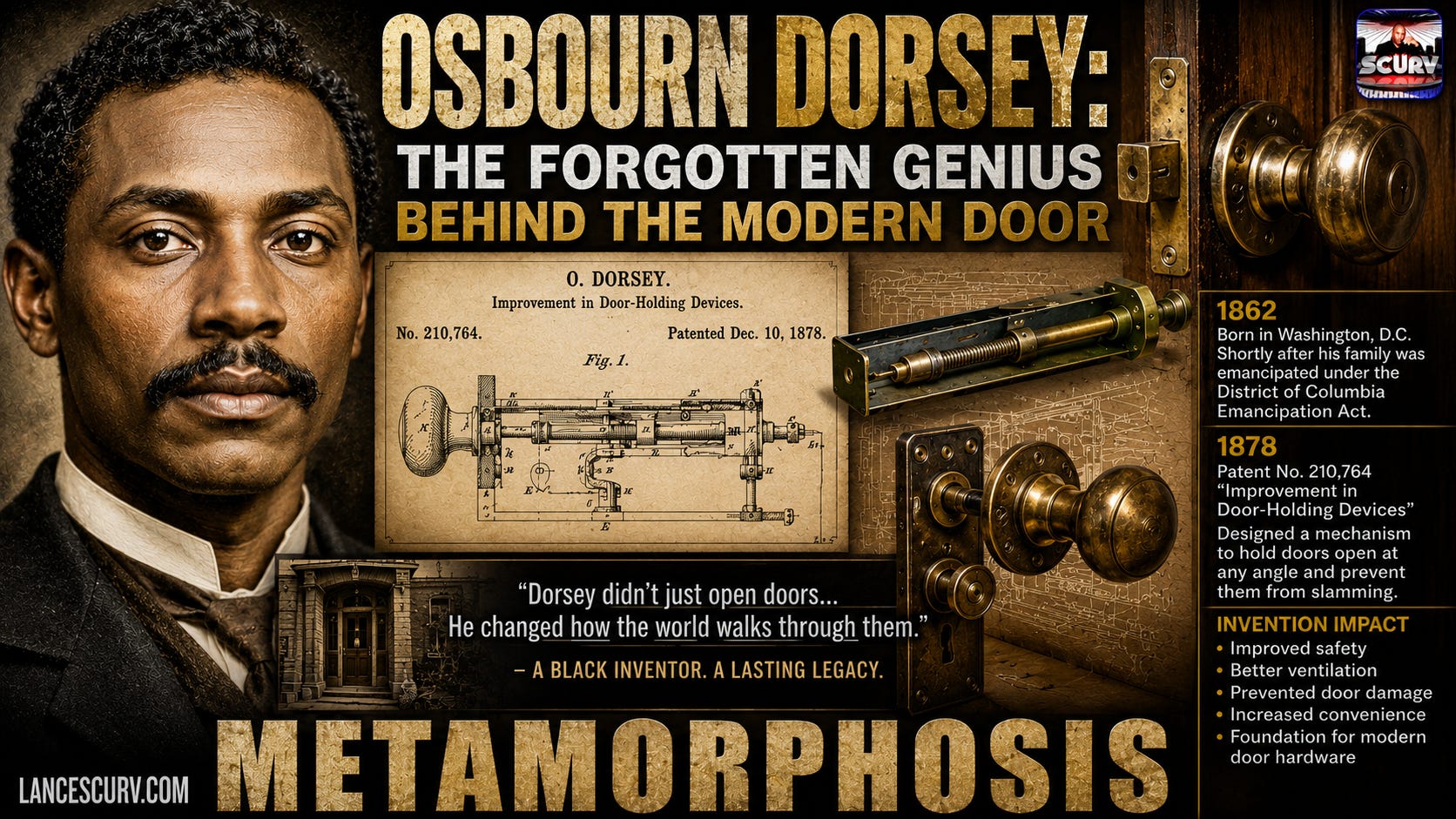
On December 10, 1878, the United States granted Osbourn Dorsey Patent No. 210,764 for what the official record calls an “Improvement in Door-Holding Devices.” The patent identifies Dorsey as being from Washington, District of Columbia, and describes a mechanical system designed to hold a door open at a desired angle while also interacting with the door’s closing mechanism.
That wording is important because the popular version of Dorsey’s story often reduces his accomplishment to one simple sentence: “He invented the doorknob.” That makes for a catchy historical fact, but the actual patent tells us something more precise and, in my opinion, more interesting. Dorsey’s documented invention involved a sliding bar, a rod, a lever, a spring, a notched mechanism, and a connection to the door’s knob spindle. The system was designed to prevent a door from being forced closed by a draft or other force and could hold the door at different angles.
That means Dorsey wasn’t merely thinking about the part of the door that a person grabs with their hand. He was thinking about the behavior of the entire door. He was thinking about movement, resistance, pressure, control, and how different mechanical components could work together. That’s engineering thinking, and it’s especially impressive when we remember how young he appears to have been.
The patent itself describes the invention in careful mechanical language, explaining how the bar moves through its casing, how the spring works, how the lever interacts with the knob spindle, and how the locking pin can engage with notches in the slide to hold the door in a selected position. The patent even explains how the mechanism could prevent the door from accidentally slamming shut.
Think about the problem he was solving. A door might swing shut because of a draft. It might slam and damage glass. It might need to remain open to allow air to move through a room. It might need to stay fixed at a particular angle. These sound like small problems today, but practical inventions are often born from exactly those kinds of everyday frustrations.
Dorsey saw a problem that people lived with and designed a better solution.
That’s what inventors do.
THE DOOR WAS ONLY THE BEGINNING
There’s something almost poetic about the object Dorsey chose to improve, although I want to be careful not to pretend that he personally intended his invention to carry some grand symbolic meaning. We don’t have evidence that he looked at the door as a metaphor for freedom, opportunity, or racial progress. That would be something we’re adding to his story rather than something he left behind himself.
But the symbolism exists whether he intended it or not.
His earliest surviving record connects him to a family whose freedom was being established through the emancipation process in Washington. Years later, his name appeared on a patent involving the mechanisms that control a door. One record represents the opening of a legal door into freedom. The other represents a young Black man entering the world of American invention.
That contrast is extraordinary.
The door has always represented access. It can separate you from something, but it can also give you entrance into something. A door can protect a home, provide privacy, create security, separate spaces, and allow people to move from one environment into another. Dorsey’s invention dealt with the practical mechanics of that boundary.
And more than a century later, people still walk through doors without thinking about the people whose ideas helped make those everyday experiences easier.
WHAT DID IT MEAN TO BE A BLACK INVENTOR IN 1878?
We have to place Dorsey in his proper historical setting. He received his patent only about thirteen years after the end of the Civil War. Reconstruction was underway, but the promises of freedom and equality were already facing enormous resistance. Black Americans were technically free, yet freedom didn’t automatically produce equal access to education, employment, capital, housing, political power, or business opportunities. Imagine being a young Black inventor trying to establish yourself in that environment. Having an idea was one thing, but building the device was another. Convincing people that the device mattered was another challenge altogether. Obtaining a patent, finding the money to manufacture the invention, finding customers, and eventually turning that invention into lasting financial security would have required even more determination. The patent proves that Dorsey successfully navigated at least one major part of that process because the federal government recognized his invention as worthy of patent protection. But a patent isn’t the same thing as wealth, and it doesn’t guarantee that an inventor becomes famous or that a factory begins producing the device on a massive scale. A patent establishes a legal claim to an invention, but everything that comes afterward can still be a struggle. That distinction matters because we sometimes tell the stories of Black inventors as though receiving a patent meant that everything afterward was easy. There’s no reason to believe Dorsey’s life suddenly became easy simply because his name appeared on a patent.
THE SILENCE SURROUNDING HIS LIFE
This is where Dorsey’s story becomes frustrating. We know enough to prove that he existed and that he invented something significant, but we don’t have the rich personal record that would allow us to tell you exactly what he felt. We don’t know what he thought when he received the patent, whether he celebrated with his family, or whether he immediately understood the historical importance of what he had accomplished. We don’t know whether he became financially successful, exactly what happened to his invention commercially, or enough about his relationships to confidently reconstruct his family life. We also don’t have a sufficiently reliable primary record that allows us to state his exact date of death with certainty. That may sound disappointing, but I think there’s a lesson in it. History is not always generous. Some people leave behind thousands of pages about their lives, while others leave behind a single document that changes everything we know about them. Dorsey belongs much closer to the second category. The patent survived, his name survived, and the emancipation record survived, but much of the man disappeared.
THE PROBLEM WITH FORGETTING PRACTICAL GENIUS
Maybe part of the reason Dorsey faded from public memory is that his invention was practical. Practical inventions can become invisible because they become part of the background of everyday life. If somebody invents a spectacular machine that transforms an entire industry, people may remember it because the invention itself becomes associated with a major historical change. But if somebody creates a mechanism that makes a common household object work more effectively, that contribution can disappear into the object itself. That’s what makes Dorsey’s story so important. Doors are everywhere. Homes have them, schools have them, offices have them, stores have them, hospitals have them, churches have them, and government buildings have them. Every day, millions of people interact with doors without thinking about the engineering involved. We simply expect them to work, and that expectation is itself a form of technological success. When an invention becomes part of ordinary life, people stop seeing the invention and start seeing only the convenience it created.
WE NEED TO BE CAREFUL WITH THE DOORKNOB CLAIM
There’s nothing wrong with celebrating Dorsey as a Black inventor associated with the history of door hardware, but accuracy matters, especially when we’re telling the story to younger generations who may use our work as a source of information. The surviving patent doesn’t claim that Dorsey invented the first doorknob in human history. It specifically describes an improvement in door-holding devices. The mechanism incorporated the door’s knob spindle and was designed to help hold and control the door. That doesn’t diminish his accomplishment. In fact, it actually makes the story stronger because Dorsey didn’t need to invent every part of the door from scratch to be a significant inventor. Innovation often comes from improving something that already exists. One person develops an idea, another person discovers a weakness, and someone else figures out how to make the system better. That’s how technology develops, and it’s an ongoing conversation between generations of problem-solvers. Dorsey became part of that conversation.
THE MYSTERY OF HIS ADULT LIFE
After the patent, the historical trail becomes much harder to follow. There are references in secondary sources and census material that help place Dorsey in Washington during his youth and suggest that he was connected to skilled work, but the surviving record doesn’t provide the kind of continuous biography that would allow us to confidently narrate his adult life year by year. That means we have to resist another temptation: turning every Internet claim into historical fact. There are various online accounts that attach different spouses, occupations, descendants, death dates, and personal details to Dorsey. Some may be accurate, some may represent other people with similar names, and some appear to have been copied from earlier secondary accounts without strong documentation. I would rather tell you that the evidence is incomplete than give you a biography built from somebody else’s life. Dorsey deserves better than that. He deserves the truth.
WHAT DID AMERICA GIVE HIM IN RETURN?
There’s a question that sits underneath the entire story, and it’s a question I think we should be willing to ask without pretending that we know the answer: what did Osbourn Dorsey receive in return for his intellectual contribution? Did his invention make him wealthy? We don’t have strong evidence that allows us to say so. Did he become famous? Clearly not in the way his accomplishment deserves. Did his name become a household name? No. Did America build monuments to him? No. Did generations of schoolchildren learn his story? Not nearly enough. That should bother us because we’re talking about a young Black man whose name entered the United States patent system during a period when Black Americans were fighting to establish themselves as full citizens after slavery. He contributed something useful to American life, yet the public memory of his existence became extremely faint. That’s not just a story about Dorsey. It’s a story about how history decides who gets remembered.
THE HUMAN BEING BEHIND THE INVENTION
When I talk about Dorsey, I don’t want to turn him into a mechanical diagram. He wasn’t a patent number, and he wasn’t a collection of screws, levers, rods, and springs. He was a human being. He had a childhood, a family, fears, hopes, frustrations, and ordinary days that nobody bothered to record. He probably had moments when he doubted himself and moments when he felt proud. That’s simply part of being human, although I want to be clear that these are reasonable human possibilities rather than documented facts about his inner life. What we can know is that creating something requires a person to believe, at least for a moment, that their idea deserves to exist. Dorsey put his name on that idea, and that tells us something about his confidence, his willingness to take a risk, and his belief that what he had created was worth protecting.
THE POWER OF A YOUNG BLACK MIND
There’s another reason Dorsey’s story needs to reach young people. He reminds us that genius doesn’t have to arrive through the traditional front door. A young person doesn’t have to come from wealth to have a powerful idea. They don’t have to have a famous last name, attend an elite school, or wait until middle age before they’re allowed to contribute something meaningful to society. Dorsey appears to have been very young when his patent was granted, and that matters because young people need examples of other young people who looked at the world and said, “I can make this better.” That mindset is more valuable than memorizing a list of famous inventors. The lesson isn’t simply to remember Dorsey; the deeper lesson is to look around you and ask what doesn’t work properly, what could be safer, what could be faster, what could be easier, and what problem people have simply accepted because they assume nothing can be done about it. That’s where invention begins.
THE DOOR WE STILL WALK THROUGH
Every time we walk through a doorway, we’re participating in a technology that has been refined over generations. We don’t think about the hinges, the latch, the spindle, or the mechanisms that prevent the door from slamming into the wall or closing unexpectedly. We just use it. That’s the strange beauty of useful invention. The inventor becomes invisible while the invention becomes normal. Perhaps that’s why Dorsey’s name deserves to be brought back into the conversation, not because we need to exaggerate what he did, but because we need to recognize what he actually did. He identified a practical problem and designed a mechanical solution. He secured a United States patent. He did it as a young Black man during a period when the country was still struggling to understand what freedom meant. And he left behind a technical document that allows us, more than a century later, to examine his thinking.
HIS LEGACY IS BIGGER THAN THE HARDWARE
The greatest thing about Dorsey’s legacy may not be the physical device itself. It may be the example his life provides. There are millions of young people today who have ideas that never leave their notebooks. Some are afraid somebody will laugh at them. Some don’t have money. Some don’t have mentors. Some have never been taught how to turn an idea into something tangible. Some come from families that have spent generations simply trying to survive. Dorsey’s story gives those people another possibility. Maybe the problem they’ve been staring at really can be solved. Maybe the thing everybody has accepted as normal can actually be improved. Maybe their circumstances don’t determine the limits of their imagination. And maybe the world needs something that only they can think of. That’s the part of Dorsey’s story that deserves to live.
THE DOOR AS A SYMBOL OF POSSIBILITY
There’s something deeply fitting about the fact that Dorsey’s contribution involved a door. A door can keep you out, but it can also let you in. It can separate one room from another, but it can also connect two spaces. It can provide privacy while still allowing movement. It can close behind you while opening in front of you. Black Americans have spent generations confronting doors that society tried to keep closed, including doors of education, employment, ownership, political power, technological opportunity, wealth, and recognition. Dorsey didn’t personally open all those doors, and we shouldn’t turn his life into a metaphor that he never claimed. But his existence demonstrates something important: Black people were not simply surviving American history. They were creating it. They were designing, building, inventing, solving problems, and contributing to the technological development of the country. Dorsey’s name is one of the names that proves it.
WE HAVE TO REMEMBER THE PEOPLE WHO MADE ORDINARY LIFE POSSIBLE
We live surrounded by inventions that have become invisible. We flip switches without thinking about the engineering behind electricity. We pick up phones without thinking about the generations of inventors and engineers who transformed communication. We drive vehicles without thinking about the thousands of separate problems that had to be solved before a modern automobile could exist. And we open doors without thinking about the people who spent generations refining the mechanisms that make those doors function. Civilization is built in layers. One person solves a problem, another person improves the solution, someone else makes it cheaper, someone else makes it safer, and someone else makes it easier to manufacture. Another generation makes it smaller, stronger, faster, or more convenient. Eventually, the original contributor can disappear from public memory. That’s what happened to many inventors, and that’s why we have to deliberately recover their names.
WE DON’T NEED TO INVENT A LIFE FOR DORSEY
There’s a temptation when telling an inspirational story to fill every empty space with something dramatic. We want to know what somebody felt, what their mother said, how their spouse reacted, whether they cried when the patent arrived, whether they became rich, and how everything eventually turned out. We want a beginning, a middle, and a perfect ending. But sometimes history doesn’t give us that. Dorsey’s story is powerful precisely because we can see the edges of the evidence. We know his name, his family’s connection to emancipation, his association with Washington, D.C., his patent, and what the patent was designed to do. We also know that the invention involved a sophisticated mechanical relationship between the door, the holding mechanism, and the knob spindle. But there are still unanswered questions, and instead of filling those questions with fiction, we can allow the mystery to remain.
THE TRAGEDY OF BEING ALMOST FORGOTTEN
The tragedy isn’t that we don’t know every detail of Dorsey’s life. The tragedy is that so few people know his name at all. Think about how many times a person can benefit from an idea without ever knowing who created it. Think about how many doors open and close every day without anybody asking who contributed to the technology behind them. That’s how history can erase somebody without actually removing their contribution. The invention survives, the inventor disappears, and eventually people begin telling the story without the person who made it possible. That’s why remembering Dorsey matters. It’s not because we need another name for a trivia contest. It’s because people deserve to be remembered for what they contributed.
A BLACK INVENTOR WHO DESERVES TO BE SEEN
Osbourn Dorsey deserves to be seen as more than a footnote and more than a catchy claim about the doorknob. He deserves to be remembered as a young Black inventor whose life emerged from the extraordinary transformation of emancipation and entered the technological history of the United States. His story reminds us that Black innovation didn’t begin in the modern era. It wasn’t created by social media, Silicon Valley, or modern universities. Black Americans were solving problems and creating useful technology long before the country became comfortable celebrating Black innovation. Dorsey was part of that history, and his patent remains a physical record of his mind at work. THE DOOR HE LEFT BEHIND
So the next time you reach for a door, I want you to think about what you’re actually touching. You’re touching the result of generations of engineering, experimentation, improvement, and problem-solving. Somewhere inside that ordinary act is the history of people whose names you may never have heard.
Osbourn Dorsey is one of those names.
He entered this world at a time when his family’s freedom was not guaranteed. His earliest surviving record connects him to the emancipation of enslaved people in Washington, D.C. He grew up during one of the most complicated periods in American history, and somehow, while still a young man, he developed a mechanical invention significant enough to receive a United States patent.
We don’t know every hardship he endured. We don’t know every dream he carried. We don’t know how much money he made, how widely his invention was manufactured, or exactly how he spent the final years of his life. We don’t even have enough reliable evidence to give you a definitive death date without qualification. But we know enough to understand that there was a human being behind that patent, and that human being deserves to be remembered.
That’s the part that matters to me. Osbourn Dorsey didn’t have to become a household name for his contribution to matter. He didn’t have to become wealthy for his mind to be valuable. He didn’t have to live long enough for history to celebrate him. He had an idea, he developed it, and he placed his name behind it. More than a century later, that idea remains part of a technological history that most people walk through every day without thinking about.
And maybe that’s the greatest lesson Dorsey leaves us. We should never underestimate what can come from an ordinary person who refuses to accept an ordinary problem as unsolvable. We should never assume that the person standing on the outside of the door has nothing valuable to contribute. Sometimes the person society overlooks is the very person who figures out how to make the door work better.
Osbourn Dorsey’s name may have nearly disappeared from public memory, but his story doesn’t deserve to remain hidden. He was born into a family touched by slavery, grew up during the turbulent transition into freedom, became a young Black inventor, and left behind a patented mechanical contribution that deserves a place in the broader story of American innovation. We may not know everything about the man, but we know enough to understand this much: he didn’t simply leave an invention behind. He left evidence that a young Black mind, given the opportunity to create, could change something ordinary and make it better.