


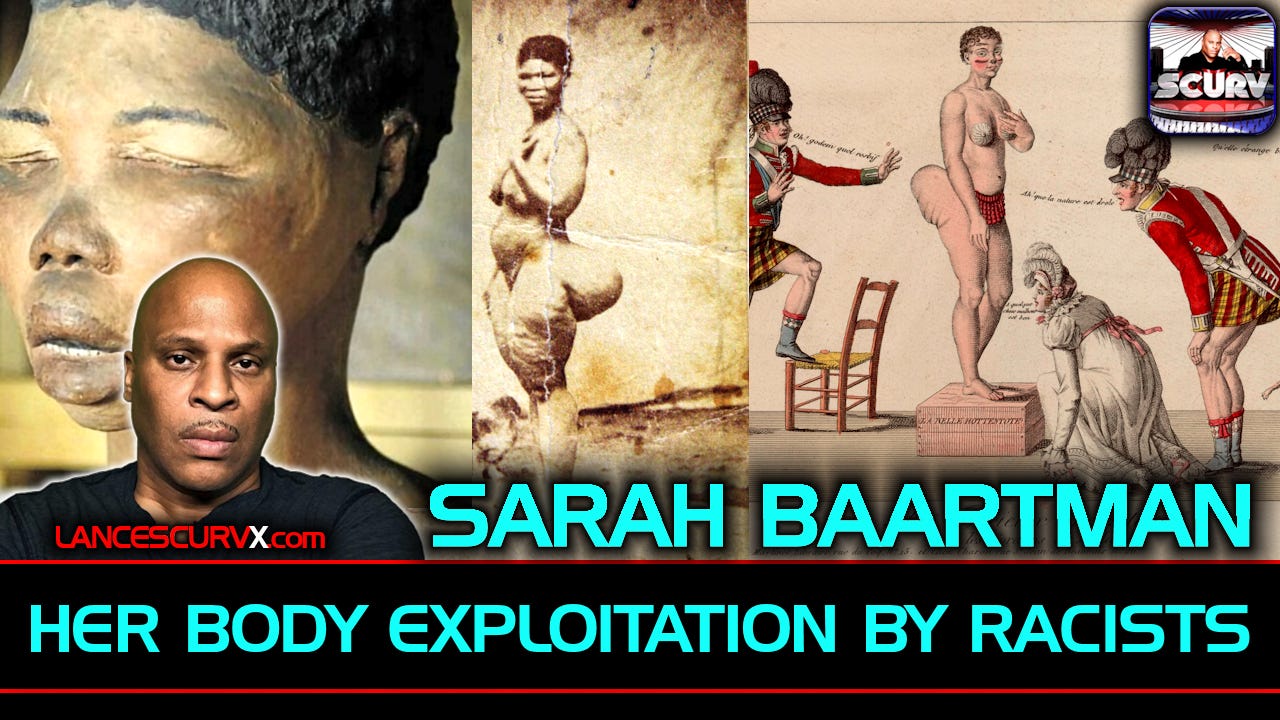
Sarah Baartman’s life tells a story that is painful, revealing, and deeply symbolic. Her body was turned into a public object, her humanity erased, and her identity stripped away in the name of entertainment, profit, and racist curiosity. She was not seen as a woman, not seen as a person, and not treated as human. She was presented as a spectacle, a product, and a display item for a society that believed it had the right to own, label, and sell Black bodies.
Her story is not just about one woman. It is about a system that built wealth by dehumanizing people. It is about how racism turned science, culture, and entertainment into tools of abuse. It shows how Black women’s bodies were turned into objects of obsession, mockery, and control under the excuse of curiosity and “education.”
Sarah Baartman did not choose fame. She did not choose the stage. She did not choose to become a symbol. She was trapped inside a machine that made money from humiliation and suffering. Her body shape, especially her hips and buttocks, became the reason for her public display, and those physical traits were used to label her as something unnatural and animal-like.
What happened to her was not accidental. It was planned, organized, and protected by law, business, and social power. She was marketed, transported, and displayed in spaces where people paid money to stare at her body like a museum object. Her identity was replaced with a nickname that reduced her to a stereotype and stripped her of dignity.
Her story matters today because it shows how exploitation can be dressed up as entertainment, science, and culture. It shows how racism does not always wear chains, but often wears suits, contracts, and polite language while doing the same damage.
THE CAPTURE OF A BODY FOR PROFIT
Sarah Baartman was born in Southern Africa and lived as a normal human being before being taken into a system that saw her body as valuable property. Her physical shape became the focus of attention, not her mind, not her voice, not her life story. The people who controlled her saw her body as a product, not a person.
She was transported to Europe under the promise of opportunity, but what awaited her was a life of public display. She was placed on stages, inside cages, and in exhibition halls where people paid to stare, point, laugh, and judge. Her body was framed as something strange and exotic, as if it did not belong to humanity.
She was forced to stand in front of crowds while people commented on her shape, her size, and her features. Her curves were not treated as natural human variation but as proof of “difference.” The racist system around her used her body to support false ideas that Black people were less human, more animal-like, and closer to nature than to civilization.
She was dressed, positioned, and displayed in ways meant to increase shock value. Her silence was part of the show. Her lack of control was part of the business. Her fear was invisible to the audience. Her pain was irrelevant to the profit.
People did not see her as someone being abused. They saw her as a curiosity. They treated her suffering as entertainment. The stage became a marketplace where her dignity was sold every day.
RACIST SCIENCE AND FALSE CURIOSITY
Sarah Baartman’s exploitation was not only public entertainment. It was also wrapped in fake science. Doctors, researchers, and so-called scholars used her body to support racist theories about human hierarchy. Her physical traits were measured, studied, and written about as if she were an object, not a living woman.
Her body was used to push the idea that African people were closer to animals than to Europeans. Her shape was labeled as evidence of inferiority. Her existence was turned into propaganda for white supremacy.
This “science” was not about truth. It was about control. It was about creating a story that justified slavery, colonization, and racial violence. Her body became a tool in a larger system that needed proof to support oppression.
Even after her death, the abuse did not stop. Her body was taken apart, preserved, and displayed in museums. Her remains were treated as artifacts instead of being respected as human remains. Her dignity was stolen even in death.
She was not allowed rest. She was not allowed peace. Her body continued to be owned by institutions long after her life ended.
THE PSYCHOLOGY OF DEHUMANIZATION
The most disturbing part of Sarah Baartman’s story is not just the violence done to her body, but the mindset that made it normal. People were trained to stop seeing her as human. They learned to see her as a thing.
Dehumanization works by changing perception. Once a person is seen as an object, abuse becomes acceptable. Mockery becomes normal. Violence becomes entertainment. Exploitation becomes business.
Her story shows how racism does not only harm the victim. It corrupts the mind of the oppressor. It teaches people to disconnect empathy from humanity. It trains society to accept cruelty as culture.
This same pattern repeats across history. When bodies become products, suffering becomes invisible. When people become symbols, their pain becomes irrelevant.
Sarah Baartman’s life exposes how systems of power can turn cruelty into tradition and humiliation into spectacle.
LEGACY OF RACIST SPECTACLE
Her story did not end in the 1800s. The same logic still exists today. Black bodies are still hypersexualized, objectified, and exploited for profit. The systems have changed, but the mindset is familiar.
Her legacy is a warning. It shows how easily society can turn human beings into entertainment. It shows how profit can override morality. It shows how racism can hide behind culture, curiosity, and commerce.
Remembering her is not about pity. It is about truth. It is about recognizing how systems work. It is about understanding how exploitation becomes normalized when power controls the narrative.
Her life stands as proof that racism is not just hatred. It is structure. It is business. It is ideology. It is industry.
MY CLOSING THOUGHTS…
Sarah Baartman’s story forces a confrontation with uncomfortable truth. It shows what happens when a society decides that some people are less human than others. It reveals how easily bodies can be turned into property when power is unchecked.
Her life reminds us that exploitation does not always look violent on the surface. Sometimes it looks organized, legal, and accepted. Sometimes it looks like entertainment. Sometimes it looks like culture.
Her story matters because it teaches that dignity must be defended, not assumed. Humanity must be protected, not trusted to systems built on profit.
She was not a symbol by choice. She was made into one by a racist system that needed her body more than it cared about her life.
Remembering Sarah Baartman is not just about the past. It is about recognizing the patterns that still exist and refusing to accept them as normal.