
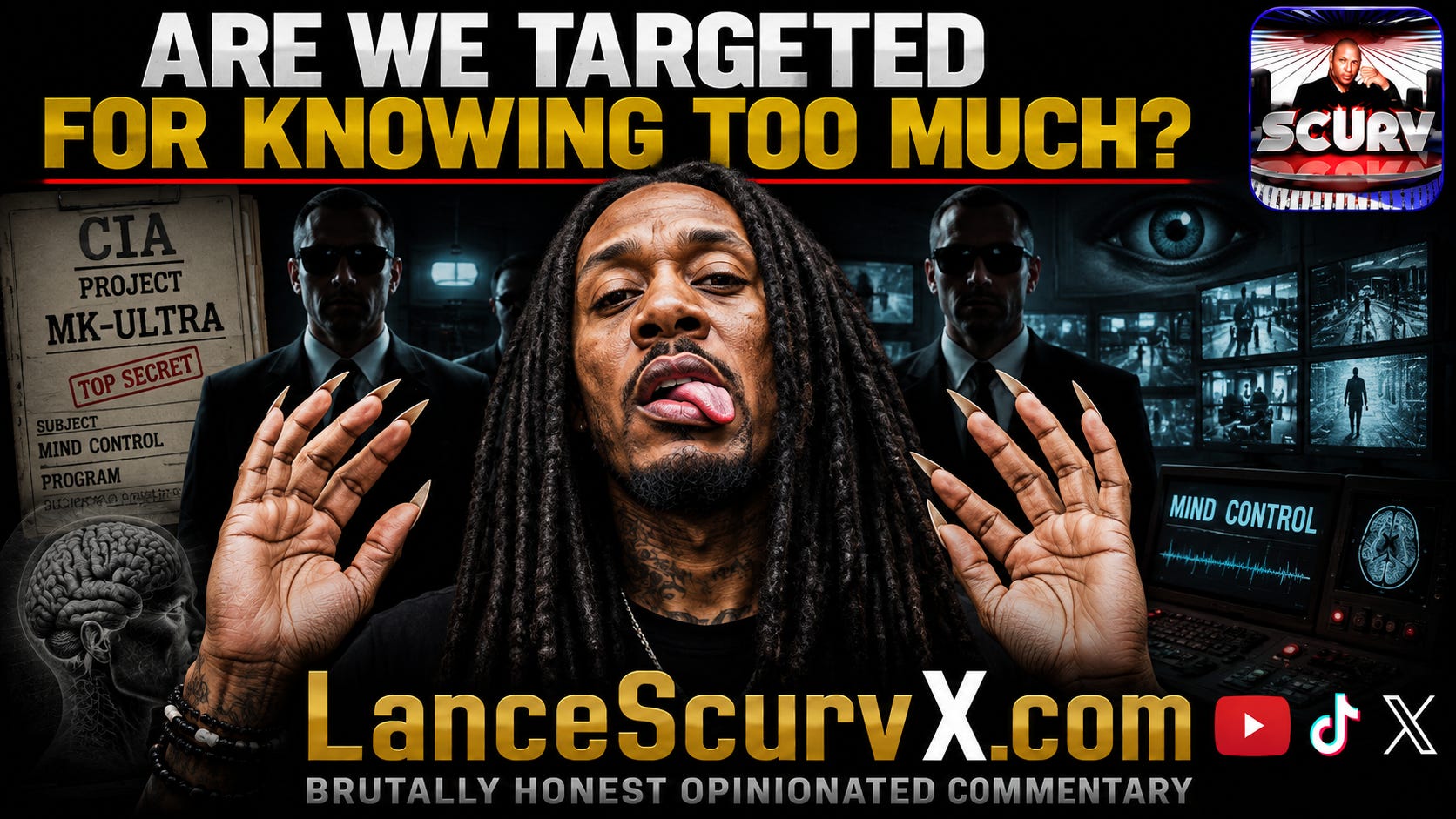
There’s a question that I believe we need to ask without fear: What happens when a person like Young Pharoah begins seeing things that powerful institutions would rather remain hidden? I’m not saying every strange event is a government operation, and I’m certainly not saying every unusual behavior proves mind control. But history has already shown us that governments have conducted secret programs involving surveillance, psychological operations, behavioral research, and manipulation. That’s not a conspiracy theory. That’s part of the historical record. The problem begins when people hear words like MKULTRA and immediately dismiss the entire subject as fantasy. That’s where I believe we make a serious mistake. MKULTRA wasn’t invented by Hollywood. It wasn’t created by people sitting around on the internet trying to scare one another. Declassified government records and congressional investigations established that the program existed and that experiments involving drugs, hypnosis, and behavioral modification were conducted.
So when I look at bizarre behavior, unexplained changes, psychological breakdowns, suspicious circumstances, or sudden transformations involving people like Young Pharaoh who have become highly visible, I believe we have a right to ask questions. Asking questions doesn’t mean claiming that we already know the answer. That distinction matters. I can say, “Something doesn’t look right to me,” without pretending that I possess evidence that I don’t have. That’s especially important when we’re talking about Black activists, independent commentators, influencers, and people who develop large audiences outside traditional institutions. History gives us enough reason to understand why surveillance and political interference shouldn’t automatically be dismissed. Congressional investigations documented intelligence abuses involving surveillance, infiltration, and disruption of political and civil-rights organizations. And that brings me to the question behind this entire discussion: What if knowing too much doesn’t make you powerful? What if, in certain circumstances, it makes you visible? What if the real danger isn’t simply what you know, but how many other people begin listening when you start talking about it?
Let’s start with what we actually know. MKULTRA was a real CIA program. Government records describe it as a covert research effort involving mind-control and chemical interrogation research. The historical record includes experiments involving psychoactive substances and other techniques intended to understand or influence human behavior. That fact alone should change the way we approach this entire conversation. We don’t have to invent a secret government mind-control program because one already existed. We don’t have to create a fictional example because the government itself left behind records showing that these kinds of experiments were pursued.
What I find especially disturbing is the use of unwitting people in some of these experiments. Government records and congressional investigations exposed the fact that intelligence agencies had conducted activities that ordinary Americans would never have imagined possible. That’s why the Church Committee hearings of the 1970s became so important. The committee investigated intelligence abuses involving agencies including the CIA, FBI, and NSA and uncovered programs involving surveillance, infiltration, and political disruption. That’s where I believe people need to slow down and think. If governments have historically engaged in secret surveillance and behavioral experiments, then skepticism toward official explanations isn’t automatically irrational. Sometimes skepticism is exactly what history teaches us to have.
But skepticism has to work in both directions. I can be skeptical of an official explanation while also being skeptical of an internet theory. I can question what authorities tell me while questioning what social media tells me. I can recognize that MKULTRA existed without believing that every strange person I see has been subjected to MKULTRA. That’s the balance I want to maintain.
When people hear “mind control,” they often imagine somebody sitting in a laboratory with electrodes attached to their head while someone presses a button and controls their thoughts. That’s the Hollywood version. Real influence can be much more subtle. Propaganda can influence perception. Psychological operations can influence behavior. Surveillance can create fear. Infiltration can destroy trust. Disinformation can make people question reality. Isolation can weaken a movement. Character attacks can destroy somebody’s credibility before the public ever investigates what that person was saying. And these methods don’t require science-fiction technology.
History demonstrates that governments have used surveillance and covert operations against political organizations and individuals. The Church Committee documented abuses involving domestic intelligence activities, including the FBI’s COINTELPRO program and surveillance operations. That’s why I don’t believe we should reduce the conversation to MKULTRA alone. The larger issue is control. Who controls information? Who controls the narrative? Who decides which voices receive legitimacy? Who decides which voices become dangerous? Who decides whether somebody is considered an activist, a troublemaker, a threat, a conspiracy theorist, or simply an independent thinker? Those questions matter because controlling a person doesn’t necessarily mean controlling their brain. Sometimes you only need to control their environment.
Think about what happens when people believe they’re being watched. They become careful. They change what they say. They change who they associate with. They begin second-guessing themselves. They may stop speaking altogether. That’s why surveillance can be powerful even when nobody physically touches you. The knowledge that you might be watched can influence behavior. Historical investigations showed that government surveillance wasn’t limited to foreign enemies. Domestic political organizations and civil-rights movements were also monitored. The Church Committee documented surveillance and disruption directed at political and civil-rights activity. That history should make every generation think carefully about the relationship between government power and individual freedom.
And today, surveillance doesn’t require somebody physically following you down the street with a camera. We live in a digital environment where people voluntarily document their lives. They reveal their locations. They reveal their relationships. They reveal their political beliefs. They reveal their routines. They reveal their fears. They reveal their financial struggles. They reveal their family members. They reveal their movements. We’ve created a world where a person can expose an enormous amount of information without realizing how valuable that information can become. That’s a completely different form of surveillance.
There’s another layer to this discussion that I believe deserves attention. Black political activism in America has a documented history of government surveillance and disruption. That’s not speculation. Congressional investigations documented intelligence operations involving civil-rights organizations and Black political movements. So when a Black activist says, “I believe I’m being watched,” I don’t think the automatic response should be laughter. But I also don’t think the automatic response should be, “You’re definitely being targeted.” Both reactions can be irresponsible.
The responsible response is: What evidence do you have? That’s the question I believe we should ask ourselves every single time. Because there’s a major difference between recognizing historical patterns and declaring that a particular person is currently being targeted. History can tell us what governments have done. History cannot automatically tell us what happened to a specific individual yesterday. That distinction is extremely important.
That brings me to the situation that caused me to think more deeply about this entire subject. I recently observed behavior from a highly controversial Black internet personality that struck me as extremely unusual. I’m not going to sit here and tell you that I know exactly what happened. I don’t. I wasn’t there. I didn’t perform a medical examination. I didn’t conduct a toxicology test. I don’t possess classified information. So I’m not going to pretend that I have evidence that I don’t have.
But I can tell you what I think. My opinion is that something appeared wrong. Could there be an innocent explanation? Absolutely. Could there be a medical explanation? Possibly. Could drugs or other substances be involved? That’s possible, but without evidence, I can’t responsibly say that they were. Could psychological stress explain unusual behavior? Certainly. Could somebody have intentionally interfered with this person? I believe that’s a question worth asking, but I don’t have evidence proving that happened. And could somebody immediately jump from that observation to MKULTRA? Yes. But that doesn’t make the conclusion correct. That’s where I draw the line between suspicion and fact.
I believe there’s a dangerous temptation within alternative media to take something that actually happened and use it to explain everything else. MKULTRA existed, therefore every strange event must be MKULTRA. Government surveillance existed, therefore everybody who feels watched must actually be under government surveillance. COINTELPRO existed, therefore every disagreement between activists must be an intelligence operation. That type of thinking can become just as dangerous as blindly believing everything the government says.
The truth doesn’t need us to exaggerate it. The documented history is already disturbing enough. The government conducted secret behavioral experiments. Intelligence agencies conducted surveillance. Political organizations were infiltrated. Government programs targeted people and movements. Congressional investigations uncovered abuses that many Americans had previously considered impossible. That’s enough to make me pay attention. I don’t need to manufacture another hundred claims.
There’s something else we need to understand. The most effective form of manipulation doesn’t always force you to believe something. Sometimes it simply creates confusion. If I can make you distrust everybody, then I don’t have to convince you of anything. If I can make you believe that every source is lying, you become incapable of determining what’s true. If I can flood you with contradictory information, you eventually stop looking for evidence. That’s why information warfare can be so powerful.
People think psychological warfare means somebody putting a secret message inside your head. Sometimes it’s much simpler. You overwhelm the population with so many competing stories that nobody knows what to believe. And once people stop believing anything, whoever has the greatest ability to shape the narrative gains an enormous advantage.
The technology available today also changes the conversation. Artificial intelligence can generate convincing images, voices, videos, and entire conversations. Social media algorithms can determine which information gets amplified. Platforms can rapidly spread rumors to millions of people. A person’s reputation can be destroyed in a matter of hours. That means modern psychological influence doesn’t necessarily require a secret government laboratory. A digital environment itself can become psychologically powerful.
And that’s why I believe we have to become smarter. We need to learn how to verify information. We need to compare sources. We need to separate observation from interpretation. We need to distinguish evidence from suspicion. And most importantly, we need to become comfortable saying, “I don’t know.” That might be one of the most powerful statements a person can make.
Now let’s get to the heart of the title. What does it mean to be “targeted for knowing too much”? I don’t believe it necessarily means that somebody has discovered a secret file containing every truth in existence. Sometimes knowing too much simply means understanding how a system works. You understand where the money goes. You understand who controls the information. You understand how narratives are created. You understand how public opinion can be manipulated. You understand how fear can be used. You understand how people can be divided. And then you start explaining those things to other people.
That’s when your influence becomes significant. A person with five followers can say something controversial and disappear into the internet. A person with hundreds of thousands of followers can say the same thing and suddenly create a conversation that institutions cannot easily control. That’s the difference. Influence changes everything.
There’s a danger in believing that every tragedy involving a controversial person must be an assassination, every breakdown must be psychological warfare, and every strange video must be evidence of government experimentation. That kind of thinking can destroy our ability to investigate anything seriously. If we want to expose real wrongdoing, we need evidence. If we want to challenge powerful institutions, we need facts. If we want people to take our concerns seriously, we need credibility.
That means I’m not going to tell you that I know what happened to the person whose behavior caused me to begin this conversation. I don’t. I’m telling you that I saw something that disturbed me. I’m telling you that I have questions. I’m telling you that history gives me reason not to dismiss the possibility of institutional interference as automatically impossible. But I’m also telling you that history doesn’t give me permission to invent evidence. That’s the difference between investigation and paranoia.
Maybe the question isn’t simply, “Does MKULTRA still exist?” Maybe the better question is, “What have we learned about the ways powerful institutions can influence human behavior?” That question is much bigger. Because influence doesn’t require somebody slipping something into your drink. Influence can happen through fear. Influence can happen through money. Influence can happen through social pressure. Influence can happen through propaganda. Influence can happen through surveillance. Influence can happen through reputation destruction. Influence can happen through isolation. Influence can happen through technology. And influence can happen through information.
Once we understand that, we stop looking for one giant machine labeled MIND CONTROL and start understanding the many different ways human beings can be manipulated.
I’m not asking you to believe that every activist is being targeted. I’m not asking you to believe that every unusual event is a government operation. I’m not asking you to believe that MKULTRA explains every unexplained behavior. I’m asking you to remember that history has already demonstrated that governments can keep secrets, intelligence agencies can abuse power, surveillance can be conducted against citizens, and psychological research can cross ethical boundaries. Those facts deserve to be remembered.
At the same time, I’m asking you to demand evidence before accepting extraordinary claims. That’s how we protect ourselves from manipulation. Because the easiest person to manipulate is the person who will believe anything. And the second-easiest person to manipulate is the person who refuses to believe anything. The person I want to be is somewhere in the middle.
I want to investigate. I want to question. I want to listen. I want to examine the evidence. And when I don’t know, I want to have the courage to say that I don’t know.
We’ve heard the phrase “knowledge is power” our entire lives. But I believe there’s another part of that sentence that people forget. Knowledge without discernment can become another form of vulnerability. You can know about MKULTRA and still be fooled by a fake MKULTRA story. You can know about surveillance and still falsely accuse somebody of surveilling you. You can know about government abuses and still become trapped inside an unfounded theory.
That’s why knowledge has to be accompanied by discernment. We have to know what we know. We have to know what we don’t know. And we have to recognize the difference.
That’s ultimately what this conversation is about for me. I’m going to continue asking questions that make people uncomfortable. I’m going to continue examining the history that many people would rather forget. I’m going to continue discussing surveillance, psychological operations, propaganda, government secrecy, technology, and the ways powerful institutions can influence ordinary people.
But I’m also going to challenge myself to remain intellectually honest. If the evidence supports something, I’ll say it. If the evidence contradicts something, I’ll say that too. And if something remains unanswered, I’m going to leave it as an unanswered question instead of turning speculation into fact. Because that’s how serious investigation works.
Maybe the greatest lesson here is that we shouldn’t allow anybody else to do our thinking for us. Not the government. Not the media. Not social media influencers. Not alternative media. Not me. Nobody. You should be able to hear what I’m saying, examine the evidence, challenge my conclusions, and come to your own decision.
That’s real independence. And if there’s one thing I believe powerful systems fear, it’s people who can think independently without needing permission. Because a person who can think independently is much harder to manipulate. That’s why I believe the most important battlefield isn’t necessarily inside some secret laboratory. It’s inside the human mind.
Maybe being targeted for knowing too much doesn’t always mean somebody is coming to physically eliminate you. Sometimes the target is your credibility. Sometimes it’s your audience. Sometimes it’s your reputation. Sometimes it’s your ability to communicate. Sometimes it’s your confidence. Sometimes it’s your relationships. Sometimes it’s simply creating enough confusion around you that people stop listening.
And that’s why I believe we need to become much more sophisticated when we talk about power. The old-fashioned image of control is somebody standing over you with a weapon. The modern image can be much more subtle. It can be an algorithm. It can be a smear campaign. It can be surveillance. It can be manipulation. It can be misinformation. It can be psychological pressure. It can be isolation. And sometimes, it can simply be making the truth so difficult to distinguish from fiction that people eventually give up searching for it.
So I’ll leave you with this question. What happens when an independent voice becomes too influential to ignore? What happens when that person begins challenging narratives that powerful institutions have spent decades protecting? What happens when thousands or millions of people begin listening?
I don’t have a universal answer. And I’m not going to pretend that I do. But history tells me that power has always paid attention to people who threaten its control over information. The documented record of surveillance and political disruption is enough to make that question legitimate.
At the same time, history teaches me something else. If I’m going to challenge powerful institutions, I have to hold myself to a higher standard than the institutions I’m challenging. That means evidence. That means documentation. That means skepticism. That means admitting uncertainty. And that means never allowing my passion for the truth to become an excuse for abandoning the truth.
I believe we should be able to talk about MKULTRA. I believe we should be able to talk about government surveillance. I believe we should be able to talk about psychological operations. I believe we should be able to talk about intelligence abuses. I believe we should be able to talk about the documented targeting of political organizations. And I believe we should be able to look at something disturbing and say, “Something doesn’t look right to me.”
But after we ask that question, we have another responsibility. We have to investigate. We have to verify. We have to separate fact from theory. We have to separate history from speculation. And we have to keep our minds open without allowing them to become empty containers for anybody else’s story.
That’s what I mean when I say TARGETED FOR KNOWING TOO MUCH. I’m not telling you that every unexplained event is a government operation. I’m telling you that history proves powerful institutions have sometimes operated in secret. I’m telling you that surveillance has happened. I’m telling you that psychological experimentation happened. I’m telling you that political movements have been infiltrated and disrupted. And I’m telling you that those facts are serious enough that we should never become so comfortable that we stop asking questions.
Because maybe the greatest protection we have isn’t knowing every secret. Maybe it’s having the courage, discipline, and intelligence to keep searching for the truth. And that’s where I stand. I’m going to question power. I’m going to examine history. I’m going to challenge narratives. I’m going to call attention to things that don’t make sense to me. But I’m also going to tell you when something is my opinion.
Because if I’m demanding truth from everybody else, I have to demand truth from myself first.
SCURV