

History often celebrates the faces that were allowed to stand in the spotlight while pushing others into the shadows. Among the many brilliant minds whose contributions helped shape the modern world, few stories are as powerful, inspiring, and frustrating as that of Granville T. Woods. He was a man whose inventions transformed transportation, communication, and electrical technology. Yet despite his remarkable achievements, many people today know very little about him.
Granville T. Woods was born during a time when opportunities for Black Americans were severely limited. The nation was still wrestling with slavery’s legacy, and racial barriers existed in nearly every aspect of life. Yet Woods refused to allow the circumstances of his birth to determine the limits of his future. Through determination, self-education, and relentless curiosity, he built a reputation as one of the most gifted inventors of his era.
Many called him the “Black Edison,” but that title does not fully capture who he was. In truth, Granville T. Woods was his own man. He developed technologies that solved real-world problems and improved public safety. His inventions helped prevent train collisions, improved railway systems, and advanced electrical communications at a time when the world was rapidly changing.
What makes his story even more remarkable is that he achieved so much without the educational advantages available to many of his contemporaries. Much of his expertise came through observation, experience, experimentation, and self-study. He became proof that genius can emerge from places society often overlooks.
Today, more than a century after his death, the fingerprints of Granville T. Woods remain all around us. Every time people ride electric transit systems, rely on improved communication technologies, or benefit from safer transportation networks, they are experiencing part of the legacy of a man whose contributions helped move civilization forward.
EARLY LIFE AND THE MAKING OF A GENIUS
Granville Tailer Woods was born on April 23, 1856, in Columbus, Ohio. His parents worked hard to support their family, but financial hardship meant that Woods received only a limited formal education. By the age of ten, he had already entered the workforce. While many children his age were sitting in classrooms, Woods was learning practical skills that would eventually become the foundation of his engineering career.
As a young man, he worked in machine shops and learned the trades of machinist and blacksmith. These experiences exposed him to machinery, tools, metals, and industrial systems. He developed a deep understanding of how machines worked and how they could be improved.
His thirst for knowledge never stopped. While working long hours, he spent countless evenings studying engineering concepts. He understood something that many people fail to realize: education is not limited to a classroom. Knowledge can be pursued wherever determination exists.
During his late teenage years and early adulthood, Woods worked on railroads and aboard steamships. These jobs placed him directly inside the technological revolution that was reshaping the world. He observed the strengths and weaknesses of existing systems. Every problem he encountered became a challenge waiting to be solved.
The railroads in particular fascinated him. Transportation was expanding rapidly, but communication between moving trains remained dangerous and unreliable. Woods recognized these shortcomings and began imagining solutions that would eventually make him famous.
THE INVENTOR WHO SAW THE FUTURE
By the early 1880s, Woods settled in Cincinnati and launched his own business devoted to electrical engineering and invention. This was an extraordinary achievement for a Black man living in America during that period. While others accepted limitations imposed upon them, Woods created opportunities through innovation.
His first patents focused on improving industrial equipment, including steam boiler technology. However, his ambitions reached much further. He saw electricity as the force that would shape the future.
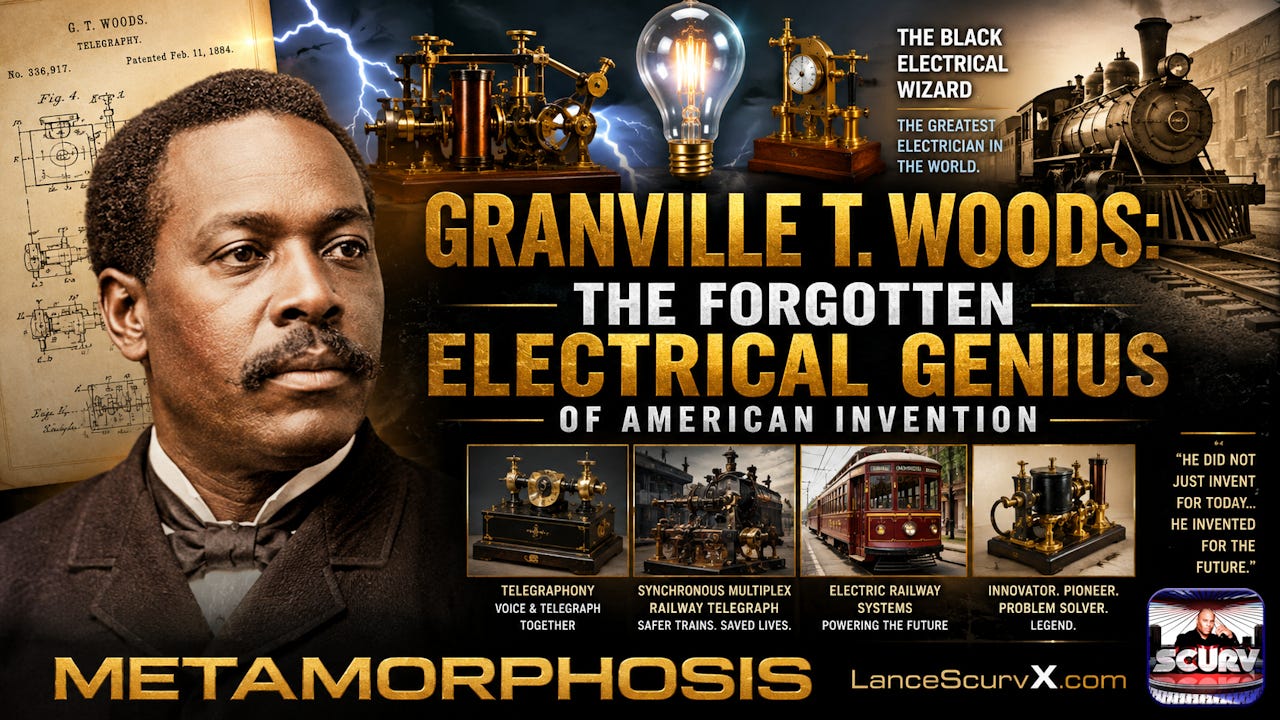
One of his earliest major breakthroughs was a device known as “Telegraphony.” This invention combined features of the telephone and telegraph into a single system. It allowed voice communication and telegraph messages to travel over the same wire. The invention was so valuable that the rights were purchased by a major telephone company, giving Woods additional resources to continue his work.
This achievement demonstrated a pattern that would define his career. Woods was not merely inventing gadgets. He was creating practical solutions to complex communication problems.
At a time when the world was becoming increasingly connected, Woods understood that communication technology would become one of the most important forces in human progress.
THE INVENTION THAT CHANGED RAILROADS FOREVER
Among all his inventions, perhaps none carried greater significance than his railway communication systems.
In the nineteenth century, trains moved across vast distances with limited ability to communicate. This created dangerous situations. Dispatchers often lacked accurate information regarding train locations, increasing the risk of collisions and delays.
Woods developed what became known as the Synchronous Multiplex Railway Telegraph. This revolutionary invention allowed communication between moving trains and railway stations. It enabled railroad operators to know where trains were located and to communicate critical information in real time.
The impact was enormous. Transportation became safer and more efficient. The system represented a major advancement in railroad technology and helped establish principles that influenced future communication networks.
This invention alone would have secured Woods a place in technological history. Yet he was only getting started.
THE BATTLES OVER HIS INVENTIONS
Success often attracts opposition.
As Woods gained recognition, his inventions became the targets of legal challenges. Several individuals and companies attempted to claim rights to technologies he had developed.
One of the most famous patent battles involved one of the era’s most prominent inventors. Woods successfully defended his patent rights in court, proving the originality of his work. His victories demonstrated not only his technical brilliance but also his determination to protect what he had created.
After losing these legal battles, an offer was made for Woods to join a major electrical enterprise. Woods declined. He preferred independence and remained committed to controlling his own creative work.
This decision speaks volumes about his character. He was not interested merely in financial reward. He wanted the freedom to pursue innovation on his own terms.
THE MANY INVENTIONS PEOPLE FORGET
When people discuss Granville T. Woods, they often focus only on railway communications. Yet his body of work extended far beyond a single invention.
Throughout his career, Woods secured more than fifty patents and is often credited with nearly sixty inventions and improvements. His work touched numerous industries.
He developed improvements for electric railways. He designed systems that helped electric streetcars receive power more efficiently. He created electrical control devices. He improved railway safety systems. He developed technology related to braking systems and electrical distribution.
His inventions contributed to the evolution of what would become modern mass transit systems. Many concepts he worked on continue to influence transportation infrastructure today.
Another overlooked aspect of Woods’ life was his willingness to lecture publicly about electricity and engineering. He understood the importance of sharing knowledge. He was not simply an inventor working behind closed doors. He was also an educator helping people understand the technological changes transforming society.
THE PRICE OF GENIUS
One of the most painful chapters of Woods’ story involves the financial reality of his later years.
Many people assume great inventors become wealthy from their inventions. That was not always the case. Woods frequently sold patent rights to larger corporations. While these sales provided temporary income, they often prevented him from benefiting fully from the long-term value of his creations.
His inventions generated tremendous benefits for industry and transportation. Yet he did not accumulate the level of wealth that many would expect from someone of his brilliance.
By the time of his death, the man whose ideas helped shape modern technology was struggling financially. On January 30, 1910, Granville T. Woods died in New York City following a cerebral hemorrhage. He was only fifty-three years old.
The tragedy deepens when we learn that he was buried in an unmarked grave. The inventor who had helped advance modern civilization left this world without the recognition his achievements deserved. Decades later, efforts were finally made to place a proper marker at his resting place.
THE LEGACY THAT REFUSES TO DIE
Although society failed to fully reward him during his lifetime, history has slowly begun correcting the record.
Granville T. Woods is now recognized as one of the most important inventors in American history. His work helped create safer transportation systems. His communication technologies paved the way for future advancements. His inventions demonstrated the power of innovation in solving practical problems.
His life also serves as a reminder that talent exists everywhere. Great minds can emerge from any neighborhood, any background, and any circumstance. The challenge is whether society is willing to recognize them.
For those who study the history of invention, Woods represents something larger than engineering. He represents perseverance. He represents intellectual courage. He represents the refusal to accept limitations imposed by others.
His story exposes a painful truth. Many pioneers who helped build the modern world never received the recognition they deserved while alive. Yet history has a way of eventually uncovering buried truths.
When we speak of innovation, transportation, communication, and electrical engineering, Granville T. Woods deserves to stand among the giants. His inventions changed lives. His vision shaped industries. His determination broke barriers.
More than a century after his passing, the Black Electrical Wizard still speaks to us through the systems, technologies, and advancements his genius helped create. The modern world carries his fingerprints, whether people know his name or not.