
There are moments in life when something inside of us whispers before reality begins to scream.
We cannot always explain the feeling. Nothing appears obviously wrong. There may be no evidence we can hold in our hands and no logical argument capable of convincing someone else. Yet something deep within us says, Don’t go there. Don’t trust this situation. Leave now. Make that phone call. Stay home today.
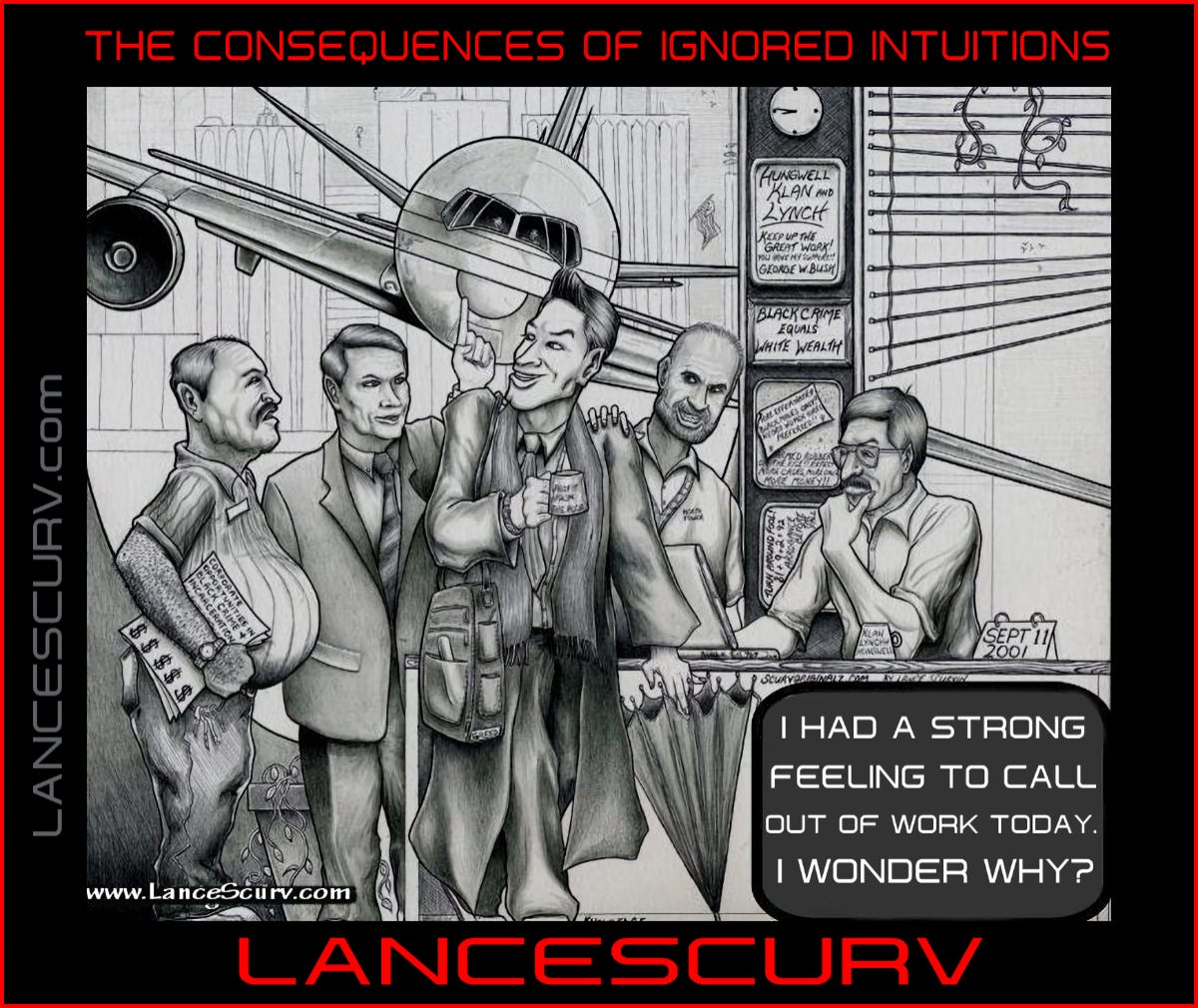
My illustration, “The Consequences of Ignored Intuitions,” takes that mysterious human experience and pushes it to its most extreme imaginable conclusion.
At first glance, the drawing depicts a group of attorneys at the offices of Hungwell, Klan and Lynch, inside an office high in the former World Trade Center on September 11, 2001. They appear comfortable, smug and completely absorbed in their own world. Their expressions suggest men who believe that tomorrow belongs to them simply because yesterday did.
But the viewer possesses information that the characters do not.
Behind them, impossibly close to the windows, is an approaching passenger aircraft.
The juxtaposition is intentional.
The men are preoccupied with power, money, status, racial prejudice and their own sense of superiority while an event infinitely larger than their office politics is bearing down upon them. Whatever titles they possess, whatever money they have accumulated and whatever people they believe themselves superior to are about to become meaningless.
That is where the illustration becomes more than a depiction of a historical catastrophe.
It becomes a meditation on human arrogance, intuition and mortality.
THE ARROGANCE OF BELIEVING TOMORROW IS GUARANTEED
Look closely at the central figure.
He is smiling.
He appears extraordinarily pleased with himself, gesturing upward with one finger as though delivering another brilliant pronouncement to the room. His posture communicates confidence bordering on invincibility.
Around him stand other men representing the same environment. Their clothing, expressions and body language establish an atmosphere of corporate authority. These aren’t men expecting their world to collapse. They appear convinced that they control it.
That illusion of control is one of the central themes of the drawing.
Human beings construct enormous systems around themselves—corporations, institutions, wealth, reputations, hierarchies and social status—and eventually we can begin mistaking those systems for immortality.
A person becomes powerful enough that people stop challenging him.
He becomes wealthy enough that consequences seem negotiable.
He becomes surrounded by people who reinforce his worldview.
Eventually, arrogance can produce one of the most dangerous psychological conditions imaginable:
the belief that the rules applying to everyone else somehow do not apply to you.
But mortality doesn’t recognize executive titles.
Time doesn’t recognize bank accounts.
And catastrophe doesn’t stop at the door because someone sitting behind it considers himself important.
THE RACISM IN THE ROOM IS NOT ACCIDENTAL
There is another deliberately uncomfortable layer to this drawing.
These aren’t merely businessmen.
The office is presented as an environment in which racial contempt has become normalized. The signs, papers and satirical language scattered throughout the scene suggest an institution where prejudice has become part of the culture rather than merely the private opinion of one individual.
That distinction matters.
An individual’s prejudice can damage people.
Institutionalized prejudice can damage generations.
The fictional law firm represented in the drawing has built part of its identity around opposing the interests of Black people. Within the imaginary world of the illustration, these men have become so accustomed to exercising power against people they consider beneath them that they no longer recognize their own moral deterioration.
And notice their faces.
Nobody appears ashamed.
Nobody looks uncomfortable.
Nobody appears to be asking whether what they are doing is wrong.
That was intentional.
When enough people inside an institution share the same corruption, corruption can stop feeling like corruption.
It becomes office culture.
It becomes policy.
It becomes tradition.
It becomes “That’s just how things are done around here.”
That phenomenon extends far beyond race. History contains countless examples of institutions where otherwise ordinary people participated in terrible practices because everyone surrounding them had agreed that those practices were acceptable.
The drawing therefore asks a disturbing question:
What happens when the people who believe themselves morally and socially superior become incapable of examining themselves?
THE AIRPLANE CHANGES EVERYTHING
The aircraft behind them provides the brutal answer.
The men don’t see it.
We do.
That is what creates the tension.
The illustration freezes the characters inside perhaps the final ordinary seconds of their lives. Someone is talking. Someone is listening. Someone is thinking about business. Someone is probably thinking about lunch, tomorrow’s meeting or what he will do when he gets home.
Life feels completely normal.
And then life isn’t.
This is one of the most haunting truths surrounding September 11.
Thousands of people began that morning expecting an ordinary Tuesday. People woke up. Showered. Ate breakfast. Kissed spouses goodbye. Took elevators. Answered telephones. Checked emails. Complained about work. Thought about dinner.
They did not know they were participating in the final ordinary moments of their lives.
My drawing uses fictional and exaggerated characters to explore that terrifying uncertainty surrounding human existence.
None of us actually knows what the next hour contains.
“I HAD A STRONG FEELING TO CALL OUT OF WORK TODAY”
And then we arrive at the line that gives the artwork its title.
One man says:
“I had a strong feeling to call out of work today. I wonder why?”
That sentence is the heart of the illustration.
Something warned him.
He felt it.
He recognized it strongly enough to remember it.
But he came to work anyway.
Now the audience can see something approaching behind him that explains the feeling he could not explain himself.
Whether someone interprets intuition spiritually, psychologically or biologically is almost secondary to the larger point.
Human beings frequently experience signals before consciously understanding their source.
Sometimes our subconscious notices patterns that our conscious mind hasn’t assembled yet. A person’s behavior feels slightly different. A room feels wrong. Something about a situation makes us uncomfortable even though we cannot immediately articulate why.
Other people interpret those moments spiritually—as warnings, premonitions, divine intervention or communication from something beyond ordinary perception.
I deliberately leave that question open.
The illustration doesn’t tell the viewer where intuition comes from.
It asks whether we should listen when it arrives.
SOMETIMES THE WHISPER COMES BEFORE THE STORM
Intuition doesn’t always announce itself dramatically.
Sometimes it is simply discomfort.
Something doesn’t feel right about a person.
Something tells you not to take a particular road.
You suddenly feel compelled to telephone someone.
You reconsider getting onto a plane.
You decide against entering a building.
You walk away from a relationship everyone else thinks is wonderful.
You delay a decision that looked perfect on paper.
Most of these moments will never become dramatic stories because nothing happens afterward.
And that creates the paradox.
If intuition successfully prevents something terrible from happening, we may never discover what it prevented.
Maybe nothing would have happened.
Maybe everything would have happened.
We will never know.
THERE IS ANOTHER KIND OF INTUITION WE IGNORE
But the drawing contains an additional interpretation that I find equally important.
Perhaps the warning isn’t merely about physical danger.
Perhaps human beings also possess a moral intuition.
We know when something we’re doing isn’t right long before consequences arrive.
We know when we’re mistreating someone.
We know when greed has begun changing us.
We know when our ego has grown too large.
We know when we are exploiting another person.
We know when hatred is consuming us.
We know when the crowd surrounding us is bringing out the worst parts of ourselves.
But just like the man who felt he shouldn’t come to work, we can override that internal warning.
We rationalize.
We explain.
We justify.
We tell ourselves everybody else is doing it.
And eventually the whisper becomes so quiet that we barely hear it anymore.
That may be the deeper consequence of ignored intuition.
The greatest danger isn’t always that something outside of us will eventually destroy us.
Sometimes the greater tragedy is that something inside of us tried repeatedly to save us from becoming the person we eventually became.
POWER CANNOT NEGOTIATE WITH MORTALITY
There is a reason I placed these arrogant fictional businessmen where I did.
I wanted the viewer to experience the collision between perceived power and actual vulnerability.
Inside that office, hierarchy matters.
One man may earn more than another.
One may possess the corner office.
Someone may have authority to hire or fire.
Someone may believe his race, education, wealth or professional status places him above millions of other human beings.
But outside that window is a force that doesn’t care.
In seconds, all those distinctions disappear.
That is not presented as celebration of anyone’s death. The real people murdered on September 11 were innocent human beings whose deaths remain an enormous tragedy. The illustration instead uses an invented scenario against the backdrop of a universally recognizable historical moment to confront the illusion that human status can somehow exempt us from human vulnerability.
It cannot.
Death is perhaps life’s ultimate equalizer.
The billionaire and the homeless man possess vastly different lives, but neither receives an exemption from mortality.
That realization should not make us hopeless.
It should make us humble.
WHAT DID YOUR INNER VOICE TELL YOU?
Ultimately, “The Consequences of Ignored Intuitions” isn’t really about an airplane.
It isn’t even primarily about the fictional businessmen.
It is about that strange conversation every human being occasionally has with himself.
Something doesn’t feel right.
How many times have you said those words?
How many times did you ignore them?
And how many times did you later wish you hadn’t?
There are situations where fear masquerades as intuition, so intuition should never replace reason, evidence or careful judgment. But neither should we automatically dismiss every internal warning simply because we cannot immediately explain it.
Sometimes our minds recognize danger before we can put the danger into words.
Sometimes our conscience recognizes moral danger before our ego is prepared to admit it.
And depending upon one’s spiritual beliefs, some will say that occasionally something even deeper is speaking.
Whatever explanation you choose, the message of this drawing remains the same:
Pay attention.
Because life doesn’t always send a second warning.
And sometimes, while we are busy believing that we control everything around us, something we cannot see is already approaching the window.
SCURV