

We all know that some viruses occur naturally, while others are engineered. For what purpose, everyone must decide for themselves. What cannot be ignored, however, is that there are people in this world who are driven by power and control and will do whatever it takes to influence the masses. That reality is why I’m always looking over the horizon, watching closely for what may be coming next.
After everything the world experienced with COVID-19—only to watch it seemingly fade away—it’s natural to question what might follow. It may not be another deadly virus or a full-scale pandemic. It could be something entirely different. Still, when I first heard about the Nipah virus, I felt it was important to look into it immediately.
Rather than getting swept up in fear-based narratives, I focused strictly on the facts. In moments like these, fear-mongering spreads quickly, especially through mainstream media and social platforms. Much of the news surrounding Nipah has surfaced within the past day or even the past few hours, so I decided to do my own research and see what information was actually available.
What follows is what I’ve found so far, based on reports from established news sources—“trusted” as much as that word can reasonably be applied today. While skepticism is healthy, these outlets would still face serious consequences for publishing outright fabrications. This is the product of that research.
I chose not to turn this into a YouTube video, knowing how sensitive platforms can be when it comes to discussions about viruses and health—especially given their connections to larger global organizations. Instead, I’m sharing this here so it can be read, considered, and discussed without unnecessary interference.
As you read on, understand that this situation may not be as severe as some are making it out to be, unless you live in regions directly affected. Still, it’s important to stay alert, follow developments closely, and do your own due diligence, because not everything makes it through the algorithms or headlines.
If new information emerges, feel free to share it in the comments. I wish you all continued health and awareness. Stay safe out there. What follows is my research.
WHAT IS THE NIPAH VIRUS
The Nipah virus is a rare but dangerous virus that can infect people and animals. Scientists first discovered it in the late 1990s during an outbreak in Malaysia and Singapore. Nipah comes from a group of viruses that live in certain animals, especially fruit bats. It can pass from animals to people and, in some cases, from person to person. These facts about how it spreads are known from past research and outbreak reports.
RECENT CASES IN INDIA
In late January 2026, health officials in West Bengal, India confirmed cases of the Nipah virus. Indian authorities reported only two confirmed cases since December and said those were being contained with close monitoring and quarantine of contacts. The most recent official update says these cases have been traced and contacts tested, with all contacts so far testing negative. The outbreak triggered concern because Nipah can be deadly.
WHY THE WORLD IS WATCHING
Because the Nipah virus has a high fatality rate and no approved vaccine or specific cure, health officials watch it closely. The World Health Organization lists Nipah as a “priority pathogen” because of its potential to cause outbreaks. Countries including Thailand, Singapore, Malaysia, Hong Kong, Nepal, and Taiwan have increased airport screening or health checks for travelers coming from affected areas as a precautionary measure. These screenings are meant to look for fever and symptoms in travelers, not because the virus is spreading widely across borders.
HOW NIPAH SPREADS
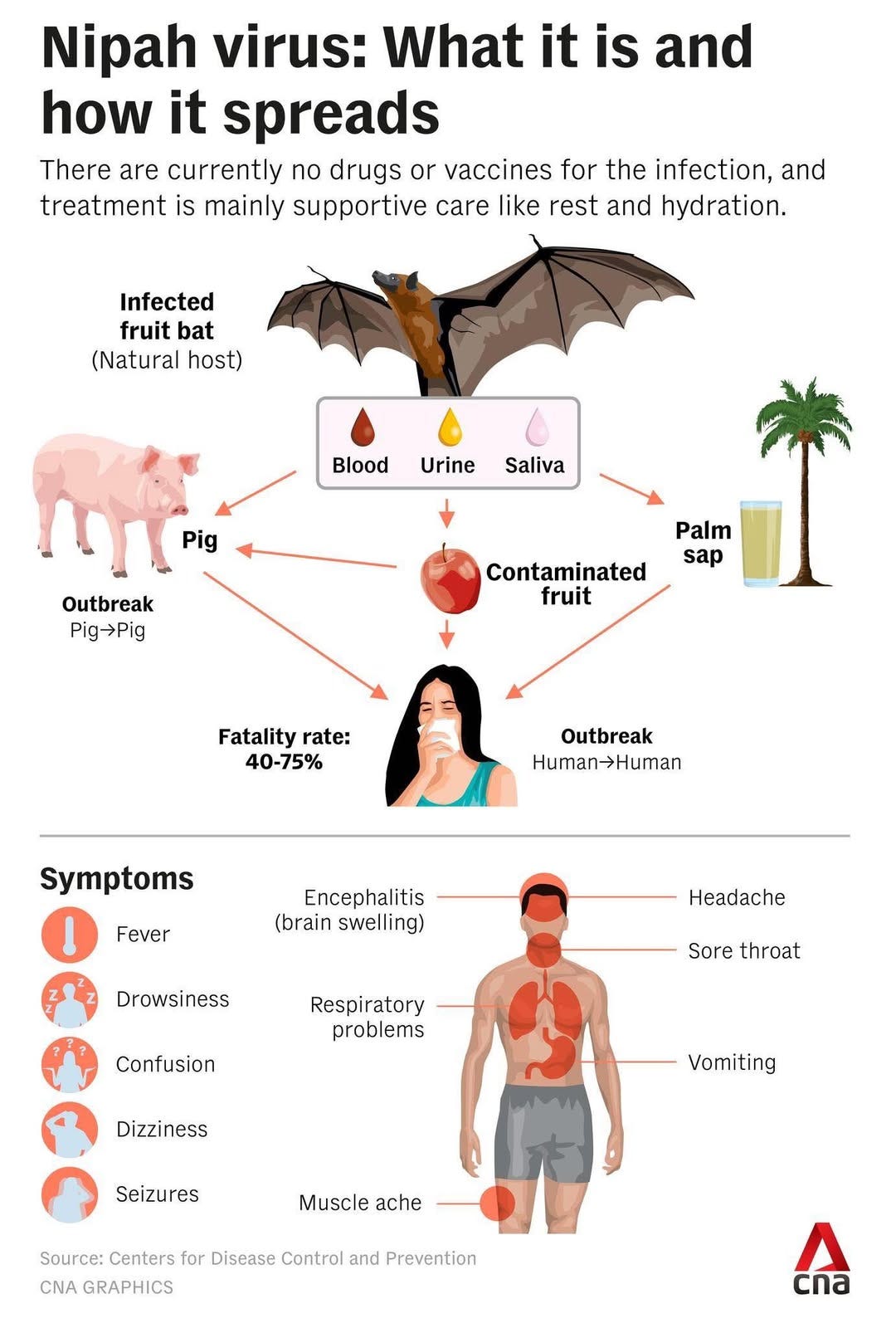
Nipah virus spreads in several ways. Fruit bats can carry the virus without getting sick and can pass it to animals or contaminate food and drink. People can get infected by eating food or fruit contaminated with bat saliva or urine. Close contact with a sick person — such as caring for them or being near their bodily fluids — can spread the virus too. It does not spread as easily as viruses like COVID-19.
SYMPTOMS AND FATALITY RISK
Symptoms usually start 4–14 days after exposure. Early signs include fever, headache, sore throat, cough, difficulty breathing, and vomiting. Severe cases can progress to encephalitis, which is swelling of the brain, confusion, and even coma. Nipah’s fatality rate in outbreaks has ranged from roughly 40 % to 75 %, depending on how quickly cases are identified and treated.
TREATMENT AND VACCINE STATUS
At this time there is no licensed vaccine or specific antiviral cure for Nipah virus infection. Healthcare providers use supportive care to help the patient’s immune system fight the infection. That includes rest, fluids, and treatment of symptoms as they arise. Researchers are studying possible treatments and vaccines, but none are broadly approved yet.
AIRPORT MEASURES AND BORDER SCREENING
After India reported these cases, several Asian countries implemented COVID-style health checks at airports. These include temperature scans, health questionnaires, and visual symptom monitoring for flights coming from West Bengal or nearby areas. These measures are preventive, not evidence that the virus has spread widely outside India. Some reports that airports were fully closed are not supported by official updates; screening and surveillance are what’s happening.
IS THIS GOING TO GET BIG?
Based on official health data, the situation in India is currently localized and monitored, not a widespread epidemic. Officials say the outbreak has been contained, with close contact tracing and testing. Public health agencies globally are alert, but there’s no evidence this cluster is turning into a global pandemic. Surveillance and containment are the tools being used right now.
WHAT YOU NEED TO KNOW NOW
The key facts are that Nipah virus is dangerous but not new. It has caused outbreaks before, especially in South Asia. The current event involves a very small number of confirmed cases that health authorities say are under control. Enhanced screening at some airports is precautionary. No approved cure or vaccine exists, but medical and scientific institutions are actively monitoring and responding.
MY CLOSING THOUGHTS
The Nipah virus reminds us why strong public health systems and quick surveillance matter. This virus can be serious, but right now it is limited geographically and being actively monitored. Knowing the facts — how it spreads, what symptoms to watch for, and how authorities respond — helps people stay informed without panic. Scientists continue to study Nipah and work toward better treatments. Public health teams in affected areas are working to keep this situation contained and under control.
Let’s hope this goes away as quickly as it appeared. stay healthy and stay safe!
Wishing you optimum health always,
SCURV