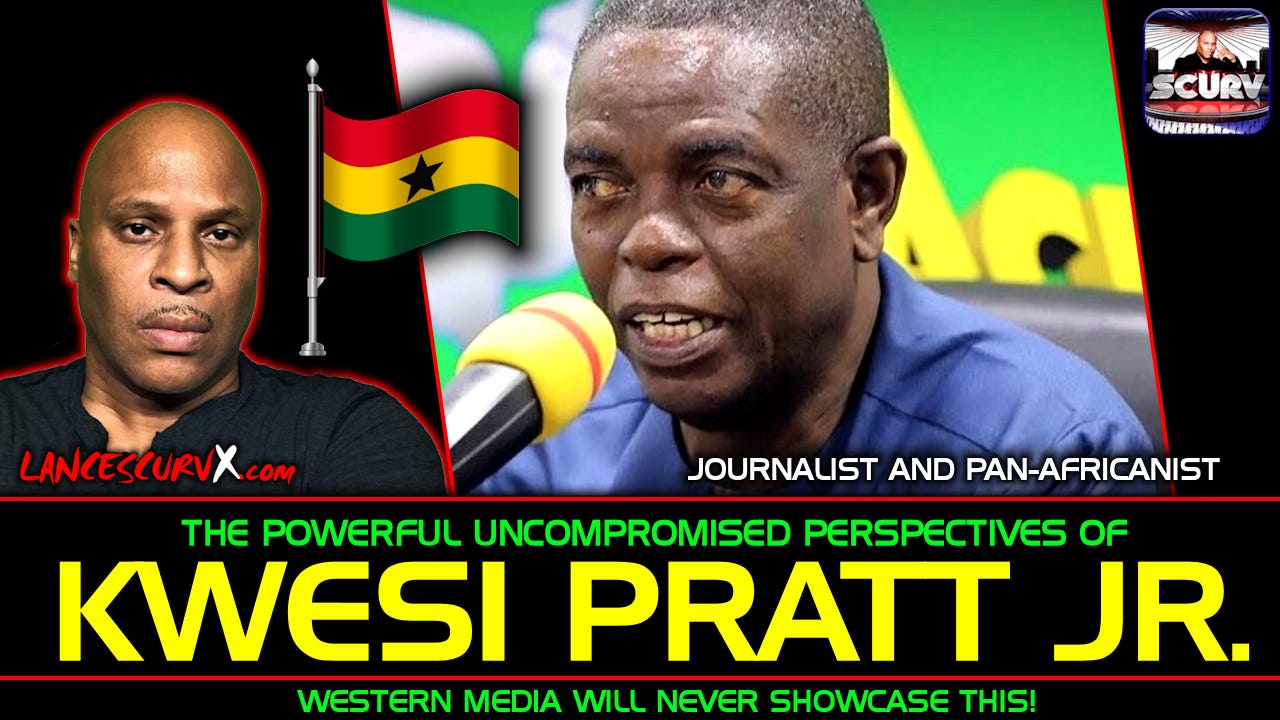

Kwesi Pratt Jnr stands as one of Ghana’s most enduring, uncompromising, and ideologically grounded journalists. For more than five decades, his voice has occupied a unique space in Ghana’s political and media landscape—situated at the intersection of investigative journalism, Pan-African thought, socialist critique, and grassroots political activism. To understand Kwesi Pratt Jnr is to understand a continuous thread of resistance journalism in Ghana, stretching from the era of military rule through constitutional democracy and into the present age of digital media warfare.
Born on 7 September 1953, Kwesi Pratt Jnr came of age during a turbulent period in Ghana’s post-independence history. The optimism of the Nkrumah era had given way to coups, counter-coups, military decrees, and ideological battles over Ghana’s future direction. It was within this politically charged environment that Pratt developed a deep skepticism toward power, especially power aligned with foreign interests, corporate exploitation, and elite compromise. His worldview was not formed in academic isolation, but in the lived realities of repression, censorship, and political struggle.
Early Journalism and Confrontation with State Power
Kwesi Pratt Jnr began his journalism career in the early 1970s as a court reporter, working under military regimes that exercised strict control over the press. This period was marked by surveillance, intimidation, and the constant threat of detention for journalists who crossed invisible lines. Reporting during this era was not merely a profession—it was an act of defiance. Pratt’s early exposure to state power and judicial manipulation sharpened his understanding of how authority operates and how easily law can be weaponized against truth.
Unlike many contemporaries who chose caution or neutrality, Pratt gravitated toward politically conscious journalism, seeing the press not as a passive recorder of events but as an active participant in national struggle. His reporting reflected a clear ideological orientation: the belief that journalism should serve the people, not the state, and certainly not foreign capital.
The Insight Newspaper and Investigative Resistance
Kwesi Pratt Jnr later rose to prominence as the Managing Editor of The Insight, a newspaper that became synonymous with fearless investigative reporting and radical critique. Under his leadership, The Insight consistently challenged government narratives, exposed corruption, and interrogated the structural inequalities embedded in Ghana’s political economy.
The paper earned a reputation for publishing stories that others would not touch—especially those involving multinational corporations, foreign mining interests, IMF-driven economic policies, and the complicity of local elites. Pratt’s editorial direction made The Insight both respected and feared. It was widely read by activists, students, and politically conscious citizens, while simultaneously drawing the ire of political establishments across party lines.
Political Activism and the Kume Preko Demonstration
Kwesi Pratt Jnr is not merely a commentator on political struggle; he has been a direct participant. He was a leading member of the Alliance for Change, one of the key organizers of the historic 1995 “Kume Preko” demonstration—a mass protest against economic hardship, structural adjustment policies, and rising living costs under IMF-influenced governance.
The Kume Preko protest marked a defining moment in Ghana’s democratic journey. It was a direct challenge to state authority and neoliberal economic orthodoxy. Pratt’s involvement placed him squarely in the crosshairs of power, reinforcing his reputation as a journalist-activist willing to put his body and freedom on the line for political conviction.
Socialist Ideology and Pan-African Commitment
Ideologically, Kwesi Pratt Jnr has long been associated with socialist politics and is a leading figure in the Socialist Movement of Ghana. His critique of capitalism is not rhetorical; it is rooted in historical analysis of colonial exploitation, neo-colonial dependency, and global inequality. He consistently argues that Ghana’s underdevelopment is not accidental but structurally engineered through debt, trade imbalances, and foreign control of natural resources.
Central to Pratt’s worldview is Pan-Africanism. He is a fierce defender of Kwame Nkrumah’s legacy and an outspoken critic of any political project that undermines African unity or economic sovereignty. For Pratt, Pan-Africanism is not cultural symbolism—it is a strategic necessity for survival in a hostile global order.
Pan African Television (PANAFRICAN TV)
Recognizing the limitations of traditional print media, Kwesi Pratt Jnr founded Pan African Television (PANAFRICAN TV), a media platform explicitly designed to counter Western narratives, corporate media framing, and local elite propaganda. PANAFRICAN TV has become a hub for radical political education, Pan-African discourse, and unapologetic critique of imperialism.
Through talk shows, long-form discussions, and historical analysis, Pratt uses the platform to challenge audiences to think structurally rather than emotionally. His programs reject sensationalism in favor of context, often revisiting historical events to expose patterns of exploitation that persist into the present.
Intellectual Focus in the 2020s and the 2025 Period
In the years leading up to 2025, Kwesi Pratt Jnr increasingly focused on themes of economic sovereignty, reparations, resource control, and Africa’s place in a multipolar world. He became especially vocal about Ghana’s gold, bauxite, and natural resource agreements, warning that foreign-dominated extraction leaves the country poorer despite its wealth.
In 2025, Pratt played a visible role in discussions around reparations, participating in forums and publications that framed reparations not as charity but as historical justice tied to slavery, colonialism, and ongoing economic extraction. His speeches during this period reflect a sharpened urgency, emphasizing that Africa cannot afford ideological confusion in a world rapidly reorganizing around power blocs.
The late-2025 speeches attributed to him are widely seen as a culmination of decades of analysis—less concerned with party politics and more focused on civilizational survival, ideological clarity, and African self-determination. His tone during this period is direct, often severe, but grounded in historical continuity rather than reactionary outrage.
Legacy and Continuing Influence
Kwesi Pratt Jnr occupies a rare position in Ghanaian public life. He is simultaneously respected, criticized, feared, and dismissed—often by the same people. Yet his longevity is itself evidence of relevance. Few journalists in Ghana have maintained ideological consistency across military rule, constitutional democracy, neoliberal reform, and the digital media age.
He represents a tradition of journalism that refuses neutrality in the face of injustice and rejects comfort in exchange for access. Whether one agrees with him or not, Kwesi Pratt Jnr has forced generations of Ghanaians to confront uncomfortable questions about power, dependency, and national direction.
For audiences encountering his late-2025 speech, this biography is essential context. The words spoken are not isolated commentary—they are the distilled expression of a lifetime spent challenging empire, interrogating power, and insisting that Africa must think, plan, and act for itself.