



We have been conditioned to believe that poverty is simply the absence of money, but what happens when we begin examining the world around us and realize that some of the greatest necessities of human existence were never meant to be treated as luxury commodities? The air we breathe, the sunlight that sustains life, the soil that produces food, the trees that provide shade, and the natural resources that surround us were here long before anyone invented a financial system. Yet somehow, humanity has reached a point where people must surrender enormous portions of their lives just to afford the basic necessities required to remain alive. Something about that arrangement deserves a serious examination.
I want us to consider something that may challenge the way we’ve been taught to measure success, wealth, and personal achievement. What if the very system we spend our lives trying to succeed in has conditioned us to overlook the resources that could provide us with a greater degree of independence? What if we’ve become so accustomed to purchasing everything that we’ve forgotten how much of what sustains us can be produced, cultivated, preserved, and shared through our relationship with nature? We’ve become consumers in a world that was originally designed around natural abundance, and somewhere along the way, we’ve confused the ability to purchase things with the ability to live well.
Look around you. We have people working multiple jobs, sacrificing their health, neglecting their families, and spending their most productive years chasing enough money to maintain a lifestyle that often leaves them with very little personal freedom. They may have a roof over their heads, a vehicle in the driveway, and a refrigerator filled with food, but they also have mounting bills, financial anxiety, and the constant fear that one unexpected interruption could bring their entire existence crashing down. Meanwhile, the natural world continues operating according to principles that have nothing to do with credit scores, rent payments, mortgages, or monthly utility bills.
I want to take this conversation beyond the usual arguments about capitalism, poverty, and economic inequality. Those discussions are important, but there’s another dimension that deserves our attention: the psychological condition of people who have been trained to believe that their lives cannot improve unless someone else gives them permission through a paycheck, an opportunity, a loan, or an institutional approval. That kind of dependence can become so deeply embedded in the human mind that even when opportunities for a different lifestyle appear, people struggle to imagine themselves living any other way.
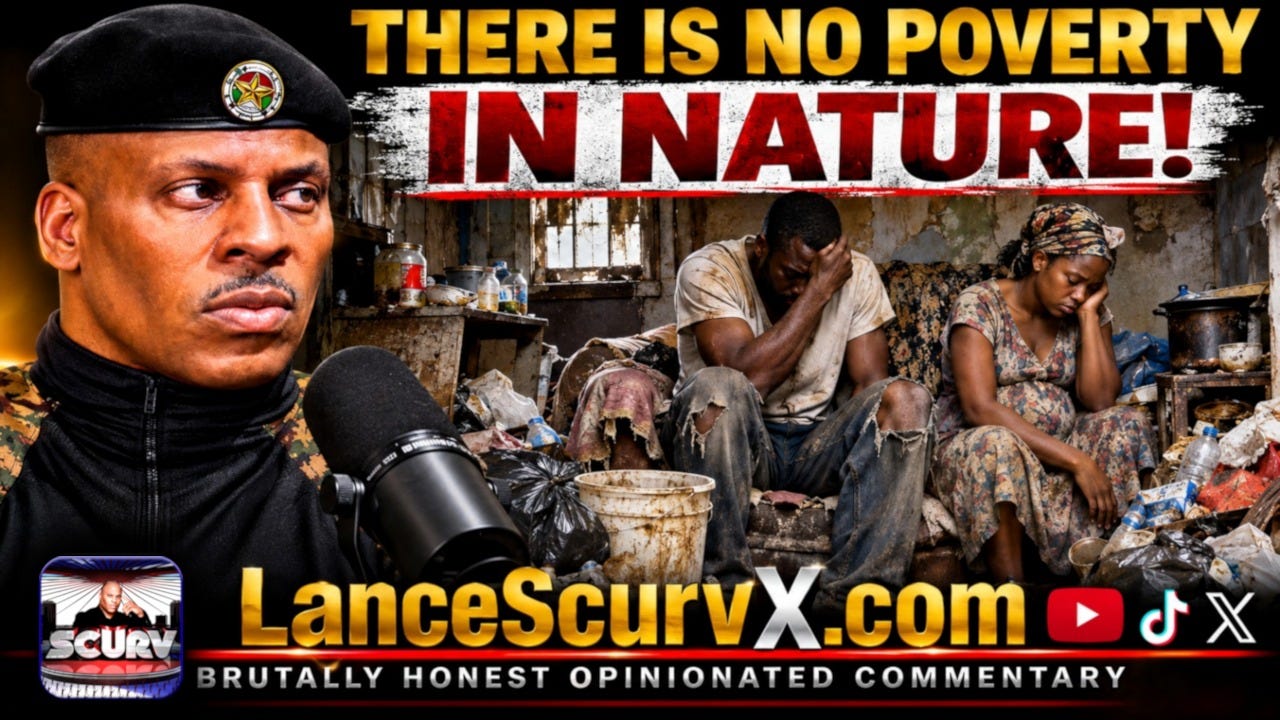
The title of this discussion is simple, but its implications are enormous: THERE IS NO POVERTY IN NATURE. I’m not suggesting that human beings can live without effort, responsibility, preparation, or resources. Nature requires participation, understanding, and respect. What I’m challenging is the idea that our only legitimate path to survival and prosperity must involve endless participation in an artificial economic arrangement that consumes our time, limits our choices, and frequently leaves us with less than we originally earned. Perhaps the real question isn’t how much money we can accumulate, but how much of our lives we can reclaim.
THE DIFFERENCE BETWEEN NATURAL ABUNDANCE AND MAN-MADE SCARCITY
When I look at nature, I see a system of relationships and resources that operates through continuous cycles. Trees produce fruit, leaves fall and return nutrients to the soil, plants absorb what they need, animals participate in the cycle, and the environment continues renewing itself. There’s an extraordinary balance taking place all around us, much of which we barely notice because we’ve become so distracted by the artificial world we’ve constructed.
Think about a mango tree. You can walk into a yard, reach up, pick a ripe mango, and enjoy something nutritious without having to present a credit card or negotiate a payment plan with the tree. The tree doesn’t send you a monthly statement for the fruit you’ve consumed. Nature doesn’t operate according to the same financial rules that govern the modern marketplace. Of course, somebody may own the land, maintain the orchard, or sell the harvested fruit, but the underlying biological process that produces the mango doesn’t require money to function.
Now consider what happens when we take something that nature provides and introduce it into a commercial system. That same fruit may be harvested, transported, packaged, refrigerated, marketed, and placed on a supermarket shelf. By the time it reaches the consumer, a price has been attached to it, and every stage of the process may add another expense. There’s nothing inherently wrong with organizing the distribution of goods, but we should understand the difference between the natural resource itself and the economic structure built around its distribution.
We’ve become so accustomed to the commercial arrangement that many people can no longer imagine surviving outside it. We don’t necessarily know how to grow food, preserve it, collect rainwater, maintain a garden, or create even a modest level of independence from public utilities. We’ve surrendered many practical skills to convenience, and convenience has gradually become dependency.
This is where I believe we need to start questioning the way we’ve been conditioned. Why should someone who has access to land, sunlight, water, and the ability to cultivate food feel completely helpless without a conventional paycheck? Why should a family believe that the only way to obtain a decent home is to enter a decades-long financial agreement? Why should people spend their entire lives working to purchase things that they might have learned to produce or maintain themselves?
I’m not saying money has no purpose. We all understand that money is necessary for participating in the current economic structure. What I’m saying is that money should be a tool rather than the master of our existence. When your entire life revolves around acquiring enough money to maintain the conditions necessary to continue acquiring money, you need to stop and examine the arrangement.
WHEN POVERTY BECOMES A PSYCHOLOGICAL CONDITION
One of the most disturbing things about poverty is that its effects can reach far beyond the bank account. It can influence how people think, how they communicate, how they raise their children, how they approach relationships, and how they view their own potential.
Consider the image of a couple living in a neglected environment. Their mattress is worn, their surroundings are dirty, their possessions are scattered, and the atmosphere suggests that hope has gradually disappeared. We don’t know their complete story, and we shouldn’t pretend that we do. But the image represents something that happens to people when difficult circumstances become so overwhelming that they begin affecting their ability to imagine a better future.
There’s a connection between our surroundings and our mental state. Living in a stressful environment can make it harder to organize your thoughts, maintain healthy habits, and develop the enthusiasm required to pursue meaningful goals. When every day becomes another exercise in survival, planning for tomorrow can feel like an impossible luxury.
And this is where poverty becomes particularly dangerous. When you’re worried about next month’s rent, the next utility bill, your children’s food, and whether your vehicle will make it through another week, your mind is constantly occupied with immediate problems. You may have tremendous talent, creativity, intelligence, and potential, but those qualities can remain buried beneath the pressure of simply trying to survive.
I’ve always believed that human beings have seeds of greatness within them. That doesn’t mean everybody possesses identical abilities or that everyone will achieve the same results. It means we shouldn’t dismiss the potential of another human being simply because their current circumstances don’t reflect what they might eventually become.
Some people have extraordinary artistic abilities. Others have a natural understanding of mechanics, mathematics, music, agriculture, communication, or problem-solving. There are individuals whose talents may never fit neatly into a conventional classroom or employment structure, but that doesn’t make those abilities worthless.
Unfortunately, many people never get the opportunity to discover what they’re capable of because their circumstances demand that they spend their energy dealing with immediate survival. That’s a tremendous loss, not only for the individual but for the entire community.
We need to understand that escaping poverty requires more than wishing for a larger paycheck. It requires developing a different relationship with our time, our abilities, our resources, and our expectations. Sometimes the first step toward a better life is recognizing that the way we’ve been living is no longer acceptable.
THE ENVIRONMENT YOU LIVE IN CAN SHAPE THE LIFE YOU EXPERIENCE
Housing is one of the clearest examples of how the economic system influences our quality of life. We’re often told that people can live wherever they want, but the reality is that their income frequently determines where they’re able to live.
You may walk through an affluent neighborhood and admire the beautiful homes, landscaping, spacious yards, and peaceful surroundings, but admiration doesn’t automatically translate into access. If your income doesn’t support the cost of living there, that environment remains outside your financial reach.
Meanwhile, people may spend enormous portions of their income renting small apartments in crowded urban environments. They work long hours to maintain those apartments, but because they’re constantly working, they rarely have enough time to enjoy the space they’re sacrificing so much to afford.
What kind of arrangement is that?
You’re paying thousands of dollars to maintain a place where you may spend only a few waking hours each day. You’re surrounded by traffic, noise, congestion, and people who are often just as stressed as you are. By the time you return home, you’re exhausted, and the following morning the process begins again.
And let’s not overlook the psychological effects of overcrowding and unstable housing. Families need room to breathe. Children need environments where they can develop without constant exposure to conflict and chaos. Adults need places where they can rest, think, and recover from the pressures of everyday life.
A person who grows up believing that this is simply how life must be may never question whether another arrangement is possible.
I’m not criticizing anyone who lives in an apartment or an urban neighborhood. There are many wonderful people living in cities, and there are practical reasons why some individuals must remain close to employment, family, medical facilities, and other services. I’m questioning why so many people have been conditioned to accept unnecessarily stressful living arrangements as the ultimate measure of normalcy.
A beautiful home isn’t necessarily the biggest home. Sometimes it’s the place that allows you to sleep peacefully, breathe fresh air, enjoy your surroundings, and wake up without immediately worrying about how you’re going to pay for everything.
THE HIDDEN COST OF BEING POOR
When people discuss poverty, they frequently overlook how expensive it can actually be to remain poor. The person with limited financial resources often pays more for convenience, transportation, emergency services, short-term borrowing, and products that don’t last.
Someone who can afford to purchase food in larger quantities may save money over time. Someone with limited resources may have to purchase smaller amounts repeatedly, paying more for the same necessities. Someone who cannot afford reliable transportation may spend additional money getting to work. Someone who cannot afford preventive healthcare may eventually face more expensive medical problems.
It’s a cycle that can become extremely difficult to break.
Limited access to quality education also contributes to this problem. I’m not talking exclusively about universities, degrees, and institutional credentials. I’m talking about practical knowledge, curiosity, reading, independent thinking, financial literacy, and the ability to understand the world beyond what somebody tells you.
I’ve always believed that learning should extend far beyond the classroom. You can meet somebody with several academic degrees who has very little practical understanding of how to manage their personal affairs. You can also meet somebody without an impressive academic background who possesses extraordinary insight, discipline, and common sense.
Education should empower people to understand their circumstances and improve them. It shouldn’t merely train individuals to memorize information and repeat what someone else wants them to say.
Health is another major concern. People living under financial pressure may struggle to afford nutritious food, adequate medical care, and suitable housing. They may work while sick because missing a day means losing income. They may live in environments where clean water, sanitation, and access to healthy food are limited.
When children grow up in these circumstances, the consequences can extend into adulthood. Poor nutrition, chronic stress, and inadequate healthcare can affect development and long-term well-being. These aren’t small inconveniences. They’re serious issues that can influence an entire generation.
And then there’s the emotional burden. Imagine waking up every morning knowing that you’re already behind before the day begins. Imagine working hard but never feeling financially secure. Imagine wanting to do something meaningful with your life but constantly hearing the voices of people who remind you of what you cannot afford.
That’s a heavy psychological burden.
THE FOOD SYSTEM AND THE LOSS OF SELF-SUFFICIENCY
One of the greatest advantages of reconnecting with nature is the opportunity to regain some control over what we consume.
We’ve become heavily dependent on food that passes through complicated commercial systems. Much of what we purchase is packaged, processed, transported over long distances, and marketed according to convenience rather than nutritional value.
Walk through certain neighborhoods and look at the food options available. You may find plenty of inexpensive snacks, sugary beverages, processed meals, and products designed to satisfy an immediate craving. But finding fresh vegetables, quality produce, and reasonably priced nutritious food may require additional time and transportation.
This creates a serious problem for families with limited resources.
Children are particularly vulnerable because their eating habits are shaped by what adults make available to them. When convenience becomes the primary consideration, nutritious meals can gradually take a back seat to whatever is inexpensive, accessible, and heavily advertised.
We have to take responsibility for changing that.
Instead of automatically purchasing every snack and prepared food product that catches our attention, why not learn how to prepare more meals ourselves? Why not grow tomatoes, peppers, herbs, leafy vegetables, and other useful crops when space permits? Why not teach children where food comes from and how much work goes into producing it?
These are practical skills that can benefit an entire household.
And we should also understand that food independence doesn’t mean everyone must become a farmer. Even a small garden can provide meaningful benefits. Growing a portion of your own food gives you experience, reduces some expenses, and creates a closer relationship with the natural processes that sustain human life.
There’s something empowering about walking outside, harvesting something you’ve grown, and preparing a meal from it. You begin to understand that food doesn’t magically appear on supermarket shelves. It comes from the earth, and the knowledge required to cultivate it should never be treated as irrelevant.
WHY ARE WE TEACHING OUR CHILDREN TO BECOME CONSUMERS?
One of the things that concerns me most is the way children are introduced to materialism at such an early age.
Some children grow up believing that their worth is connected to the clothing they wear, the sneakers they own, the phones they carry, and the products their parents can afford to purchase. Before they even understand how money works, they’re being trained to associate social acceptance with consumption.
That can become a dangerous foundation.
A child who believes that designer clothing makes someone superior may eventually become an adult who measures personal success by the same standards. Instead of developing skills, knowledge, creativity, and financial discipline, they may become obsessed with purchasing the latest products to impress people who aren’t contributing anything meaningful to their lives.
Parents have an enormous responsibility here.
We must teach children that there’s nothing wrong with appreciating beautiful things, but possessions should never become the foundation of personal identity. A person who owns an expensive pair of sneakers isn’t automatically more intelligent, capable, or valuable than someone wearing an inexpensive pair.
We should be teaching our children how to think, how to create, how to save, how to build, and how to recognize opportunities.
Why aren’t more communities organizing practical programs that teach young people financial literacy, gardening, entrepreneurship, budgeting, basic construction, and other useful skills?
Why should a teenager graduate from school without understanding how to manage a bank account, evaluate a business opportunity, or develop a realistic savings plan?
These are the kinds of abilities that can change the direction of someone’s life.
And parents must also examine their own habits. Children learn from what they observe. If they constantly see adults spending money to impress others, complaining about bills, and living beyond their means, those behaviors can become normalized.
We cannot demand financial discipline from our children while demonstrating financial irresponsibility ourselves.
THE CHURCH, THE COMMUNITY, AND THE RESPONSIBILITY TO BUILD
Another issue that deserves serious discussion is the relationship between religious institutions and impoverished communities.
In many neighborhoods, churches are everywhere. Yet the presence of religious institutions doesn’t automatically translate into economic improvement, stronger families, or greater independence.
I’m not questioning anyone’s right to worship or practice their faith. Spirituality can provide comfort, direction, and a sense of purpose. But I do believe that spiritual leadership should also encourage practical action.
If a community has several churches, why can’t those institutions work together to organize financial literacy workshops, food gardens, youth development programs, employment networks, and assistance for struggling families?
Why can’t people who have knowledge about budgeting help those who are struggling to manage limited incomes?
Why can’t experienced business owners mentor younger people who want to become entrepreneurs?
Why can’t religious institutions use their influence to encourage cooperation and the development of practical community resources?
Faith and action shouldn’t be enemies.
If we believe that people deserve better lives, then our concern should extend beyond telling them to remain hopeful. We should also help them develop the knowledge and resources necessary to improve their circumstances.
A community isn’t simply a collection of buildings located near one another. It’s a group of people who recognize their shared interests and are willing to contribute to one another’s well-being.
We have to restore that understanding.
FINANCIAL LITERACY: STOP LETTING MONEY PASS THROUGH YOUR HANDS
One of the biggest obstacles to escaping financial hardship is the inability to retain and properly manage whatever money comes into the household.
Some people earn a reasonable income but have nothing left at the end of the month. Others receive unexpected money and immediately spend it on things that provide temporary excitement without creating lasting value.
We have to develop a different mindset.
Money should have a purpose beyond immediate consumption. It should help create stability, provide options, support meaningful goals, and eventually reduce our dependence on constant employment.
That requires discipline.
We need to understand budgeting, saving, debt, interest, investments, and the difference between purchasing something that creates value and purchasing something that simply creates another expense.
And we should stop treating financial education as though it belongs exclusively to wealthy people or some particular racial or cultural group.
Knowledge about money is for everybody.
If you earn money and immediately hand it over to someone else without retaining anything, you’re constantly starting over. It’s like trying to fill a bucket that has a hole in the bottom. No matter how much water you pour into it, very little remains.
We need to build a foundation that allows us to retain some of what we earn.
That might mean reducing unnecessary subscriptions, cooking more meals at home, eliminating expensive habits, purchasing fewer luxury items, or finding ways to increase income through legitimate business opportunities.
The goal isn’t to become obsessed with money. The goal is to stop allowing money to control every decision you make.
THE CURRENCY OF TIME AND THE SHRINKING VALUE OF OUR LABOR
One of the most frustrating realities of modern economic life is that people can work just as hard as previous generations while receiving less purchasing power for their efforts.
You may receive the same paycheck you received last year, but groceries, housing, transportation, utilities, and other necessities have become more expensive.
That means you must surrender more of your labor to maintain approximately the same lifestyle.
Think about buying a bucket of chicken. Imagine paying the same price you paid years ago, only to discover that the bucket now contains pieces barely larger than chicken nuggets. You haven’t necessarily paid less, but you’ve received less for your money.
That’s what declining purchasing power can feel like.
Or imagine a worker trying to clean a large auditorium with a push broom the size of a toothbrush. The worker must exert considerably more effort to achieve the same result. That’s how many people experience modern economic pressure. They’re working harder, stretching their resources further, and somehow falling behind.
The most important thing we need to understand is that our time is a limited resource.
You can earn additional money, but you cannot purchase yesterday back. You cannot recover the years you spent exhausted, stressed, and constantly worried about maintaining an expensive lifestyle.
That’s why reducing your monthly overhead is so important.
If it costs you $3,000 every month to maintain your lifestyle, why not examine whether you can bring that down to $2,000? If you can eventually reduce it further without sacrificing your safety, health, or basic comfort, you’ve created more breathing room.
That additional freedom may be worth more than the luxury vehicle, expensive apartment, or designer possessions you once thought represented success.
THE AFRICAN DIASPORA MUST REEXAMINE ITS RELATIONSHIP WITH HOME
Having lived in America for most of my life and now living in Ghana, I’ve had the opportunity to observe two different environments and examine the advantages and challenges of each.
I don’t believe moving to Africa automatically solves someone’s problems. That would be dishonest.
You can relocate geographically and still carry the same financial habits, psychological limitations, unhealthy relationships, and materialistic expectations that created difficulties in your previous environment.
I often use the analogy of someone moving from an apartment filled with cockroaches into a beautiful new home, only to discover that the cockroaches have followed them. They were hiding in the moving boxes.
The address changed, but the problem traveled with them.
That’s exactly what can happen when people relocate without examining their own thinking.
Some individuals romanticize Africa without understanding the realities of living here. They see beautiful cultural clothing, welcoming expressions, natural scenery, and the excitement of reconnecting with ancestral history. But they may not understand the practical challenges involving property ownership, infrastructure, healthcare, employment, transportation, and the importance of properly verifying legal documents.
You must do your homework.
At the same time, I believe people should seriously examine the opportunities that may exist in environments where land, agriculture, community development, and a different pace of life can become part of a long-term plan.
There are challenges in Ghana, just as there are challenges in America. There are wonderful people and difficult people in both places. Neither country should be presented as a perfect destination.
But the ability to make a conscious decision about where and how you live is valuable.
And if you have the opportunity to move somewhere that offers a better balance between your resources, your expenses, and your personal well-being, why shouldn’t you examine that possibility?
The important thing is to move with knowledge rather than emotion.
LIVING OFF THE GRID: RECLAIMING CONTROL OVER YOUR EXISTENCE
When I talk about living off the grid, I don’t necessarily mean abandoning civilization, disappearing into the wilderness, or refusing to participate in modern society.
I’m talking about learning how to become less dependent on systems that can interrupt your ability to survive.
Imagine having a home where you can generate some of your own electricity through solar energy. Imagine collecting and properly treating rainwater, cultivating vegetables, growing fruit trees, and developing a household that doesn’t require an enormous monthly expenditure just to remain functional.
Imagine having a garden that produces food, a water supply that provides greater security, and a home designed around your actual needs rather than the expectations of a commercial real estate market.
That’s a different relationship with life.
Of course, these things require planning and initial investment. Solar systems need equipment and maintenance. Water systems require proper filtration and testing. Gardens require attention, knowledge, and patience. Buildings require safe construction, and local laws and property regulations must still be respected.
Off-grid living isn’t automatically inexpensive, and it isn’t suitable for everyone.
But the underlying philosophy deserves serious consideration.
The more you can produce for yourself, the less vulnerable you may become to certain outside disruptions. The more skills you develop, the fewer things you must pay someone else to do. The more you understand your environment, the better equipped you may become to handle unexpected circumstances.
There are also psychological benefits to developing greater self-sufficiency.
You begin to appreciate the value of simplicity. You become more conscious about what you purchase. You learn to maintain what you own instead of constantly replacing it. You become more attentive to the natural world and less obsessed with the artificial status symbols that dominate modern culture.
And there’s something particularly satisfying about building something gradually.
You don’t necessarily need millions of dollars to begin creating a different lifestyle. You may start with a small garden, a few fruit trees, a modest solar installation, or a more efficient household budget.
Every improvement becomes another step toward greater independence.
NATURE PROVIDES SOMETHING THAT MONEY CANNOT PURCHASE
One of the greatest advantages of spending time in natural surroundings is the opportunity to experience a different kind of peace.
When I wake up in the mountains of Ghana, I can hear the sounds of insects, birds, and other creatures moving through their environment. I can look across the landscape and appreciate the greenery, the sunlight, and the natural beauty surrounding my home.
There’s something about that experience that reminds me how much we’ve sacrificed in exchange for convenience.
Many people spend their entire week surrounded by concrete, traffic, artificial lighting, crowded buildings, and constant noise. Then, when they finally have an opportunity to take a vacation, they want to escape into nature.
They want the beach, the mountains, the countryside, or somewhere they can sit quietly and breathe.
But why should peace become something we only experience during vacation?
Why shouldn’t we consider incorporating more natural surroundings into our everyday lives?
Time outdoors, access to green spaces, sunlight, physical activity, and a quieter environment can support our overall well-being. Nature can provide an opportunity to slow down, reflect, and reconnect with ourselves.
We should also remember that nature isn’t simply decoration. Every ecosystem contains relationships that support life. Plants, animals, insects, soil, water, and microorganisms all contribute to processes that sustain the environment.
When we destroy those relationships through careless development and pollution, we’re damaging systems that human beings depend upon.
We cannot continue treating the natural world as an endless warehouse of resources while pretending that our actions have no consequences.
The earth isn’t merely something to exploit. It’s the environment that makes our existence possible.
RELATIONSHIPS, ENERGY, AND THE PEOPLE WHO KEEP YOU STUCK
There’s another form of poverty that deserves attention, and it has nothing to do with your bank account.
It’s the poverty of being surrounded by people who constantly discourage your growth.
You can have a beautiful home, financial resources, and access to wonderful opportunities, yet remain emotionally trapped because of the people you allow into your personal life.
Some relationships become cycles of dysfunction. People repeatedly hurt one another, separate, reconnect, make promises, and return to the same destructive patterns.
They may know that a relationship is unhealthy, but loneliness, familiarity, physical attraction, and emotional dependency keep pulling them back.
That kind of attachment can become another form of imprisonment.
Sometimes people remain connected to individuals who undermine their confidence, ridicule their ambitions, or constantly remind them of their limitations. Instead of encouraging personal development, these relationships reinforce the belief that nothing better is possible.
We must learn to recognize those patterns.
Healing sometimes requires becoming more focused on yourself. That doesn’t mean becoming selfish or losing compassion for others. It means understanding that you cannot rebuild your life while constantly allowing people to tear down what you’re trying to accomplish.
You may have to establish boundaries. You may have to reduce contact. In some situations, you may have to walk away completely.
Not everybody deserves unlimited access to your life.
And not everybody who smiles in your face genuinely supports your progress.
Protect your peace, examine your relationships, and surround yourself with people who encourage growth rather than stagnation.
YOU MUST CHANGE YOUR MIND BEFORE YOU CHANGE YOUR ENVIRONMENT
One of the biggest mistakes people make is believing that a different location will automatically produce a different life.
It won’t.
You can move from a crowded apartment into a beautiful house and still carry the same habits that made your previous environment difficult. You can relocate from America to Ghana, Europe, or anywhere else and continue spending money irresponsibly, surrounding yourself with toxic people, and making decisions that undermine your future.
The transformation must begin within you.
You have to become willing to question the beliefs that have governed your decisions. You have to examine what you’ve been taught about success, money, relationships, education, and personal achievement.
You must also recognize that changing your circumstances takes time.
Don’t become discouraged because somebody else appears to be further ahead. You’re not running their race.
I often think about a runner approaching the finish line. Their lungs are burning, their legs are tired, and everything inside them is telling them to stop. But they can see the finish line getting closer.
At that moment, the most important competition isn’t against the person running beside them. It’s against their own willingness to surrender.
That’s how we must approach personal development.
You may not have the resources somebody else has. You may not have their connections, education, or opportunities. But you can improve your own position through discipline, learning, preparation, and consistent effort.
Measure your progress against where you started.
If you save a little more this month, that’s progress. If you learn a new skill, that’s progress. If you grow your first vegetables, that’s progress. If you eliminate an unnecessary expense, that’s progress. If you finally remove a toxic influence from your life, that’s progress.
Every step matters.
BUILD YOUR DREAM BRICK BY BRICK
One of the most beautiful things about creating a life with greater independence is watching something develop through your own effort.
Imagine building a modest home gradually. You begin with a plan, establish a foundation, and start laying the blocks. You don’t need to complete everything immediately. You work within your resources and develop the property as your circumstances permit.
Every wall represents progress. Every window represents another part of the dream becoming real. Every improvement gives you another reason to believe that your future can look different from your past.
Compare that with spending decades paying for a home you can barely afford while constantly worrying about losing it.
There are certainly advantages to conventional mortgages and homeownership arrangements, and buying property isn’t automatically a bad decision. But we should question whether the financial obligations we’re accepting are actually serving our long-term interests.
Sometimes a smaller home that you own outright or can maintain comfortably may provide more freedom than a much larger property that consumes your entire income.
The same principle applies to everything else.
Build your savings. Develop your skills. Reduce unnecessary possessions. Learn how to grow food. Understand how energy systems work. Maintain your health. Create meaningful relationships. Teach your children practical knowledge.
You don’t have to transform everything overnight.
You simply have to begin moving in a different direction.
THE REAL DEFINITION OF WEALTH
After everything we’ve discussed, I want to return to the original question: What does it actually mean to be wealthy?
Is wealth having a million dollars in the bank while spending every waking hour worrying about losing it? Is wealth owning an expensive vehicle while struggling to afford the insurance and maintenance? Is wealth living in a luxurious apartment while being unable to take a week away from work without falling behind financially?
I don’t believe those things automatically represent freedom.
To me, wealth should include having control over your time, maintaining your health, enjoying meaningful relationships, possessing useful knowledge, and having enough resources to make decisions without constantly living in fear.
It should include the ability to wake up and enjoy your surroundings without immediately feeling the pressure of another financial obligation.
It should include having the confidence to say no to situations that compromise your well-being.
And perhaps most importantly, wealth should include the ability to recognize that your life has value beyond what you earn.
We have been conditioned to chase numbers, possessions, titles, and approval. But none of those things can replace the peace that comes from living in alignment with your actual needs and values.
The more we reconnect with nature, the more we may recognize that many of the things we spend our lives chasing were never the ultimate source of happiness in the first place.
THE FINAL THOUGHT: STOP ACCEPTING A LIFE YOU WERE NEVER MEANT TO LIVE
I’m not suggesting that everybody abandon their jobs, sell their homes, move to the countryside, or attempt to become completely self-sufficient. Every person’s circumstances are different. Some people have medical needs, family responsibilities, disabilities, and other obligations that make certain lifestyles impractical.
What I’m encouraging is a change in perspective.
Start examining how much of your life is being consumed by maintaining things that don’t genuinely improve your quality of existence. Start questioning whether the lifestyle you’ve accepted is actually the lifestyle you want. Start looking for ways to reduce unnecessary dependence and regain control over your resources.
And don’t allow your present circumstances to convince you that your future must look exactly the same.
You may be starting from a difficult position, but that doesn’t mean you have to remain there. You may have made mistakes, experienced setbacks, or spent decades participating in arrangements that no longer serve you. You can still learn, adjust, and begin building something better.
The natural world continues demonstrating the value of balance, renewal, patience, and cooperation. Perhaps we’ve become so disconnected from those principles that we’ve forgotten how much we can learn from simply observing the environment around us.
There is no poverty in nature in the sense that nature doesn’t recognize the artificial financial limitations we’ve created. But there are responsibilities, natural limits, and challenges that require knowledge and preparation. Our task is to understand those realities and stop confusing financial dependence with the only possible form of human existence.
I want people to dream again. I want people to build again. I want people to learn how to produce, preserve, create, and share resources instead of remaining permanently dependent on purchasing everything they need.
And I want us to stop teaching the next generation that their highest achievement should be spending the majority of their lives working to afford the very things that keep them trapped.
The race isn’t against your neighbor. It’s against the limitations you’ve accepted within yourself.
Keep your momentum. Keep learning. Keep building. Keep growing.
Because your circumstances may explain where you are today, but they don’t have to determine where you go tomorrow.
THERE IS NO POVERTY IN NATURE. PERHAPS IT’S TIME WE STARTED LIVING LIKE WE UNDERSTAND THAT.


