
WHEN ART BECOMES A MIRROR OF TRUTH
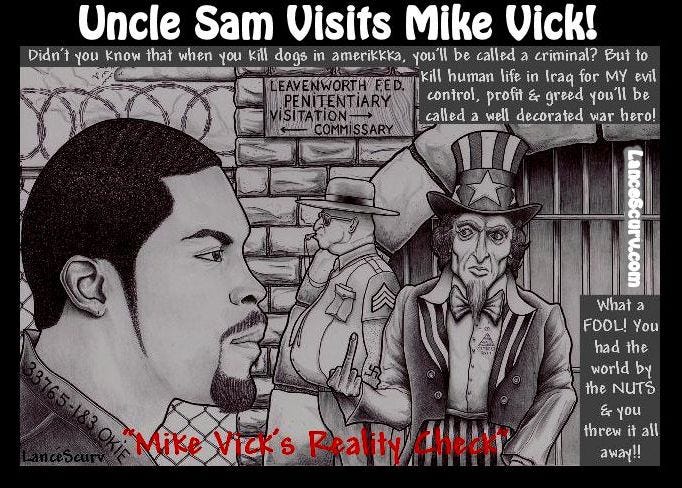
There are moments in life when art is not just art. It becomes a voice. It becomes a protest. It becomes a mirror held up to society that refuses to look away. This illustration titled “Uncle Sam Visits Mike Vick” was created in that spirit. It was never meant to entertain. It was meant to expose.
At the center of this piece is a hard conversation about justice, punishment, and the way society chooses its outrage. It reflects a time when one of the most controversial legal cases in sports history shook the nation and divided public opinion deeply.
This illustration places a powerful symbol of American authority face-to-face with a fallen athlete inside the federal prison system. It is not just about one man. It is about the system that judged him, the system that shaped public reaction, and the system that often reveals double standards in plain sight.
What makes this piece hit harder is not just the image itself, but the message embedded within it. It forces the viewer to ask uncomfortable questions about morality, war, punishment, and selective outrage.
This is not a comfortable story. It was never meant to be. It is a truth-telling moment captured in ink.
THE BACKDROP: A FALL FROM PUBLIC FAVOR
During the height of his career, Michael Vick was one of the most electrifying figures in professional football. His speed, his arm strength, and his ability to change the game made him a household name. He was celebrated, marketed, and elevated as a symbol of athletic greatness.
But everything changed when he became the center of a federal investigation involving dogfighting operations. The case led to criminal charges, a conviction, and incarceration within the federal prison system. Public opinion shifted quickly and harshly. Sponsors disappeared. Fans split. Headlines turned brutal.
At the time, the national conversation was not just about the crime itself, but about what it represented. Many saw it as a moral breaking point. Others saw it as selective outrage in a country where other forms of violence were often normalized or overlooked depending on context.
This tension is what made the moment so culturally explosive. It was not just about accountability. It was about comparison. It was about what society chooses to punish loudly versus what it accepts quietly.
Inside that climate, this illustration was born.
THE IMAGE: UNCLE SAM AS THE SYMBOL OF POWER AND CONTRADICTION
In the illustration, Uncle Sam stands fully dressed in his iconic American regalia. He is not smiling. He is not neutral. He is positioned in a direct confrontation, making a bold and offensive gesture that immediately demands attention.
Across from him is Michael Vick, shown in a side profile from the neck up, placed in the setting of federal incarceration. The emotional tone is heavy. There is no celebration in his expression. There is only consequence and confinement.
The visual tension between the two figures represents more than a personal story. It represents a national contradiction. The quote placed within the illustration is intentionally sharp and provocative, designed to challenge moral consistency in society. It draws a direct comparison between how certain acts are judged depending on context, politics, and national interest.
The purpose of this imagery is not to excuse wrongdoing. The purpose is to question the hierarchy of outrage and the uneven lens through which justice is often viewed.
When viewers engage with this piece, they are forced into a mental confrontation. Not with the subject alone, but with the system that shapes public perception.
THE FEDERAL PRISON CONTEXT AND PUBLIC RESPONSE
The federal incarceration of Michael Vick became a national headline not only because of his celebrity status, but because it collided with deeper cultural emotions surrounding animal cruelty, accountability, and redemption.
At the time, the response was intense. Public debate expanded beyond sports and entered moral philosophy. Some demanded permanent exclusion from professional life. Others believed in rehabilitation and second chances.
This is where the illustration steps in and interrupts the emotional cycle. It does not tell the viewer what to feel. It forces the viewer to examine why they feel it.
The presence of Uncle Sam in the illustration is not random. It is a symbolic representation of national identity, authority, and contradiction. It raises questions about how justice is applied, how punishment is assigned, and how society ranks suffering and wrongdoing.
The message is not simple. It is layered. It is uncomfortable by design.
THE DEEPER MESSAGE: SELECTIVE MORALITY AND NATIONAL CONTRADICTIONS
At its core, this illustration is about selective morality. It is about how societies often respond strongly to certain actions while overlooking or justifying others depending on political framing, cultural narrative, or national interest.
It challenges the viewer to think beyond emotion and into structure. Why are some acts condemned with permanent branding while others are absorbed into history, celebrated, or quietly ignored?
This is not about excusing harm. It is about questioning consistency. It is about recognizing that justice systems exist within larger cultural systems that shape perception long before judgment is ever delivered.
The illustration becomes a conversation starter about how narratives are built, how public figures are destroyed, and how redemption is either offered or denied depending on the audience.
ART THAT REFUSES TO BE SILENT
This piece was never designed to be comfortable. It was designed to be remembered. It was designed to stay in the mind long after the first reaction fades.
It stands as a reminder that art can challenge authority without asking permission. It can raise questions that textbooks avoid. It can expose contradictions that headlines soften.
When I look at this illustration, I do not just see two figures. I see a reflection of a society wrestling with its own sense of justice. I see the tension between punishment and perspective. I see the struggle between image and reality.
The conversation it sparks is still relevant today. Because the questions it raises have not gone away. They are still here, living in the same system, repeating in different forms.
And maybe that is the real purpose of this work. Not to give answers, but to force awareness.
Because once you see the contradiction, you cannot unsee it.
And that is where real thinking begins.