

There’s something deeply wrong with a society that can take a perfectly healthy human being, place that person in front of enough screens, advertisements, mirrors, cameras, celebrities, influencers, filters, and carefully edited images, and eventually convince that person that the face and body they were born with are somehow unacceptable. We’re living in an age where dissatisfaction has become an industry. Somebody makes money when you hate your stomach. Somebody profits when you fear your wrinkles. Somebody gets paid when you believe your hair, skin, muscles, nose, lips, teeth, weight, height, or age needs to be changed. The business model works best when you never quite feel good enough.
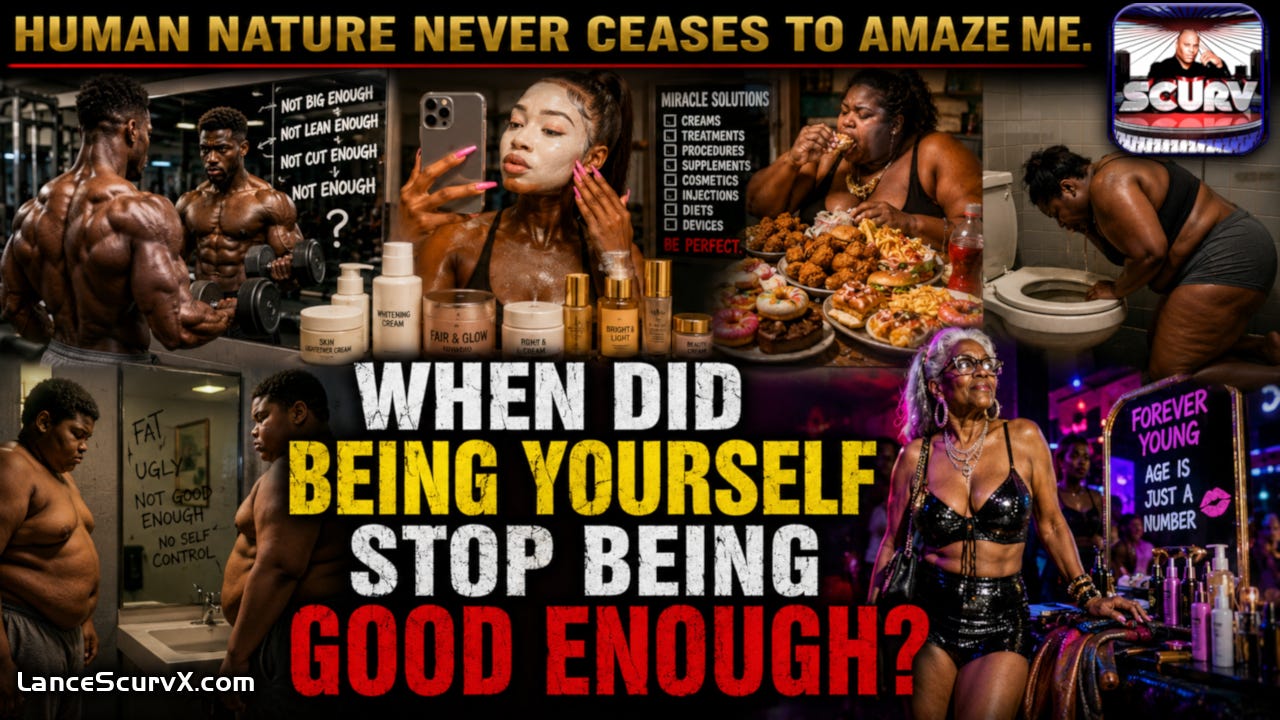
I understand the pursuit of physical transformation because I lived inside that world myself. As a teenager, I became involved in competitive bodybuilding and continued until I was about 22 years old. I never used steroids or other performance-enhancing drugs, but that doesn’t mean my approach was moderate. I became extreme about training, food, discipline, and the pursuit of physical improvement. Eventually, I began asking myself what all of this was costing me. The body may have been developing, but too much of my life was beginning to revolve around maintaining and improving that body. I also watched people around me take increasingly extreme measures to reach a standard that the natural human body was never designed to maintain.
That experience taught me something I’ve never forgotten: there’s a tremendous difference between improving yourself and becoming obsessed with yourself. There’s nothing wrong with wanting to become stronger, healthier, better groomed, more confident, or physically fit. There’s nothing wrong with losing unhealthy weight, building muscle, dressing well, caring for your skin, or wanting to look your best. The danger begins when your appearance becomes the ruler by which you measure your worth. When the mirror becomes your judge, food becomes your enemy, exercise becomes punishment, aging becomes terrifying, and other people become competition, something much deeper is happening.
Today that pressure has been multiplied beyond anything previous generations could’ve imagined. Decades ago, advertising certainly existed, and unrealistic beauty standards existed too. Human beings have struggled with body image and eating disorders for a long time, so these problems aren’t completely new. What’s different today is the scale, speed, intimacy, and persistence of the message. The advertisement isn’t only on a billboard anymore. It’s inside the device beside your bed. It follows you into the bathroom, sits beside you while you eat, travels with you to work, watches what you click, learns what attracts your attention, and serves you more of it. There’s almost nowhere left to escape comparison unless we deliberately create that space ourselves.
We also have to follow the money because there’s an enormous beauty industry that benefits when people don’t feel comfortable with themselves. Think about the business model for a moment. If you wake up every morning satisfied with your face, comfortable with your natural features, accepting of your age, and confident in your body, there are countless products you may never feel desperate enough to purchase. But if somebody can convince you that your pores are too large, your skin isn’t smooth enough, your stomach isn’t flat enough, your hair isn’t thick enough, your lips aren’t full enough, your eyelashes aren’t long enough, your teeth aren’t white enough, or your face looks older than it supposedly should, suddenly there’s a product waiting to solve every manufactured problem. That’s why insecurity can be so profitable. The customer who finally believes she’s good enough may eventually stop buying the promise of becoming good enough, while the customer who remains dissatisfied can be sold another cream, treatment, procedure, supplement, cosmetic, injection, diet, device, or miracle solution for years.
Women have carried an especially heavy burden from this machinery because female beauty has been marketed as though it has an expiration date. A woman can be told she’s too heavy and then told she doesn’t have enough curves. Her lips can be too thin, her nose too wide, her breasts too small, her waist too large, her hair too short, her skin too dark, her skin too pale, her face too plain, and eventually, if she survives all of those judgments, she can simply become “too old.” The standard keeps moving because a moving standard keeps the customer chasing it. That doesn’t mean every beauty product or cosmetic company is deliberately plotting to destroy women’s self-esteem, but we shouldn’t be naive about the economics involved. An industry built around improving appearance has a financial incentive to continually remind consumers that there’s something left to improve. When dissatisfaction becomes profitable, the last thing the marketplace needs is a generation of women looking into the mirror and saying, “I’m healthy, I’m aging naturally, I’m comfortable with myself, and I don’t need to purchase somebody else’s definition of beautiful.”
That brings me to the question at the center of everything I’m writing here: when did simply being human stop being enough? When did aging become something shameful? When did every wrinkle become a defect, every pound become a crisis, every imperfect photograph become something that needed a filter, and every ordinary body become a renovation project? More importantly, what happens psychologically when millions of people spend years comparing their real bodies, real faces, real lives, and real aging process against images that may not even be real themselves?
THE BUSINESS OF MAKING YOU FEEL INADEQUATE
Insecurity can be extremely profitable, and that’s something we need to think about seriously. If I can convince you that something is wrong with you, I don’t have to force you to buy anything. I simply have to sell you the supposed solution. If you believe you’re too heavy, I can sell you weight loss. If you believe you’re too thin, I can sell you muscle. If you believe you look too old, I can sell you youth. If you dislike your skin, I can sell you another complexion. If you dislike your hair, I can sell you another texture. If you dislike your face, somebody can sell you another face. And after you purchase one solution, the machine can introduce another problem.
That’s why we have to understand the difference between healthy self-improvement and manufactured dissatisfaction. Healthy improvement has an ending point. You decide to become healthier, you establish reasonable goals, you work toward them, and you continue living your life. Manufactured insecurity never allows you to arrive. There’s always another flaw. There’s always another procedure. There’s always another diet, supplement, treatment, injection, surgery, cosmetic product, fitness program, photograph, filter, or trend. You’re running toward a finish line that keeps moving, and that’s the trap.
SOCIAL MEDIA PUT THE BEAUTY CONTEST IN OUR POCKETS
Social media didn’t invent human insecurity, but it gave insecurity a microphone, a camera, an audience, and a scoreboard. That scoreboard matters more than we sometimes admit because likes can be counted, followers can be counted, views can be counted, comments can be counted, and shares can be counted. Suddenly social approval has numbers attached to it. A teenager can upload a photograph and within minutes receive what feels like a public judgment on their attractiveness, popularity, clothing, body, lifestyle, and social value.
Imagine what that can do to a developing mind. Teenagers are still discovering who they are. Their identity isn’t fully formed. Their confidence can change quickly, and acceptance matters enormously during those years. Now place that developing person inside an environment where attractive people appear to receive endless attention while ordinary human imperfections are filtered away. The young person begins learning a dangerous equation: attention equals value. Then another equation appears: beauty equals attention. Eventually another one follows: if I’m not receiving enough attention, something must be wrong with me. That’s where the psychological trap becomes powerful.
Filters make the situation even stranger because people can begin competing against faces that don’t actually exist. Eyes can be enlarged, skin can be smoothed, teeth can be whitened, jawlines can be sharpened, waists can be narrowed, muscles can be enhanced, and lighting can erase imperfections. Photographs can be taken dozens or hundreds of times before one image is selected. Then that carefully manufactured image gets uploaded as though somebody simply woke up looking that way. The viewer compares an ordinary Tuesday morning reflection in the bathroom mirror against somebody else’s digital production. How can reality compete with fantasy? It can’t.
WHEN THE PERSON IN THE MIRROR BECOMES THE ENEMY
One of the most painful consequences of appearance obsession is that people can lose the ability to see themselves accurately. Body dysmorphic disorder is a recognized mental health condition involving intense concern about perceived flaws in appearance that may appear minor or may not be noticeable to other people. Someone experiencing it may spend large amounts of time examining a feature, hiding it, comparing it with other people, seeking reassurance, grooming, changing clothes, researching cosmetic procedures, or avoiding situations where others might see them.
This isn’t ordinary vanity. Most of us have something about our appearance we wouldn’t mind changing. The difference comes when the concern becomes persistent and begins interfering with daily life, relationships, work, school, social activity, or emotional well-being. A person might receive compliments from 50 people and still believe the mirror instead of everybody else. That’s because the problem isn’t necessarily located in the body. The suffering is happening in the person’s perception of the body, and that distinction is extremely important.
MUSCLE DYSMORPHIA AND THE FEELING OF NEVER BEING BIG ENOUGH
There’s another appearance struggle that deserves special attention because men especially may suffer quietly with it. Muscle dysmorphia, sometimes informally called “bigorexia,” involves an obsessive belief that the body isn’t muscular or large enough even when other people may see a highly developed physique. I understand how seductive this mentality can become because competitive bodybuilding taught me how quickly the definition of “enough” can change.
You build your arms, but now your shoulders seem too small. You develop your shoulders, but now your chest needs improvement. Your chest grows, but your back isn’t wide enough. Then your legs aren’t large enough. Then you aren’t lean enough. Then somebody walks into the gym who’s larger than you, and suddenly everything you accomplished yesterday feels inadequate today. The goalposts move.
Training can gradually stop being something you do and become the center of who you are. Missing one workout can produce guilt or anxiety. Meals become mathematical equations. Social activities can be rejected because they interfere with training or eating schedules. The person may continue training despite injury. Some people may become tempted to use dangerous substances because natural progress no longer feels fast enough. Fitness should expand your life, but when fitness begins consuming your life, something deserves attention.
ANOREXIA NERVOSA AND THE FEAR OF WEIGHT GAIN
Anorexia nervosa is far more serious than simply “wanting to be skinny.” It’s an eating disorder that can involve severe restriction of food, intense fear surrounding weight gain, and a disturbed perception of body weight or shape. Someone may become significantly undernourished while continuing to believe they need to lose more weight.
That’s what makes these disorders so dangerous. Telling somebody to “just eat” misunderstands the psychological struggle underneath the behavior. Food may have become connected with fear, control, guilt, identity, anxiety, or self-worth. Anorexia can become medically dangerous and potentially life-threatening. Anyone showing signs of severe food restriction, rapid or significant weight loss, fainting, weakness, heart symptoms, or other physical deterioration needs professional medical attention rather than internet advice or criticism from family and friends. Compassion and qualified treatment matter.
BULIMIA NERVOSA AND THE BINGE-PURGE CYCLE
Bulimia nervosa can involve repeated episodes of consuming unusually large amounts of food while feeling unable to control the eating, followed by attempts to compensate through behaviors such as self-induced vomiting, misuse of laxatives, fasting, or excessive exercise. What outsiders may see as strange behavior can actually be part of a painful cycle in which restriction leads to overwhelming hunger, binge eating leads to shame, shame leads to purging, purging creates promises that it’ll never happen again, and then restriction begins again.
The cycle continues, and the person may hide the behavior extremely well, meaning you can’t necessarily determine whether somebody has bulimia simply by looking at their body. Repeated purging can also cause serious medical complications. This isn’t something to romanticize, imitate, or attempt to manage alone.
BINGE-EATING DISORDER AND USING FOOD TO ESCAPE
Binge-eating disorder involves recurring episodes of eating large amounts of food while experiencing a sense of lost control, often followed by distress, shame, guilt, or disgust. This isn’t simply overeating during a holiday dinner because the emotional component matters. Food can become comfort when somebody is lonely. Food can become sedation when somebody is stressed. Food can become companionship when somebody feels abandoned. Food can become a temporary escape from emotions that seem too painful to confront.
That’s why telling someone to simply develop more willpower can completely miss the point. Sometimes the question isn’t merely, “Why are you eating so much?” The deeper question may be, “What feeling are you trying not to feel?”
ARFID AND WHEN FOOD BECOMES EXTREMELY LIMITED
Avoidant/restrictive food intake disorder, often called ARFID, is another eating disorder, but it isn’t necessarily driven by a desire to become thin. A person may severely limit foods because of sensory sensitivity, fear of choking or vomiting, lack of interest in eating, or other concerns surrounding food. That distinction matters because we sometimes assume every eating disorder is about beauty, and it isn’t. Human psychology is complicated, and eating disorders can take different forms.
ORTHOREXIA AND WHEN “HEALTHY” EATING BECOMES AN OBSESSION
There’s also a term commonly used for an unhealthy obsession with eating foods considered pure or healthy: orthorexia. It isn’t recognized as a separate diagnosis in every major diagnostic system, but the behavior it describes can still become seriously disruptive. The irony is obvious because someone begins trying to become healthier, and then health itself becomes an obsession.
More foods become forbidden. The acceptable food list becomes smaller. Eating at restaurants becomes stressful. Family gatherings become difficult. Somebody feels morally superior when eating according to their rules and ashamed when breaking them. Healthy eating should support life, but life shouldn’t become completely organized around eating “perfectly.”
COMPULSIVE EXERCISE AND WHEN REST FEELS LIKE FAILURE
Exercise is one of the healthiest things many people can include in their lives, but even something healthy can become unhealthy when driven by compulsion. Some people feel unable to take a day off without guilt. They may exercise while sick or injured. They may use exercise primarily to punish themselves for eating, or they may organize their entire day around burning calories.
The body requires recovery, and rest isn’t weakness. When somebody feels emotionally distressed because circumstances prevent them from exercising, it may be worth examining what exercise has come to represent psychologically. Are you training because you love your body, or are you training because you hate it? Those are two very different motivations.
COSMETIC PROCEDURES AND THE SEARCH FOR A FINISH LINE
Cosmetic procedures deserve a balanced conversation. Not everyone who gets cosmetic surgery has a psychological disorder. Adults make personal decisions about their bodies for countless reasons, and cosmetic treatment by itself doesn’t prove anything is wrong mentally. The warning sign appears when no procedure ever seems sufficient.
One operation becomes another. One injection becomes another. One corrected feature reveals another supposedly unacceptable feature. The person keeps chasing satisfaction but never catches it. This is especially concerning when someone expects changing the outside to repair pain originating inside. Surgery can alter physical features, but it can’t automatically heal rejection, childhood wounds, loneliness, low self-worth, social anxiety, or the fear of aging. If the wound is psychological, changing the mirror may not heal it.
THE FEAR OF AGING HAS BECOME AN INDUSTRY
We also need to talk about something that reaches far beyond teenagers because older adults are being sold insecurity too. Look around at the language surrounding aging. Everything is “anti-aging.” Wrinkles are treated like enemies. Gray hair becomes something that must be defeated. Normal changes in skin become defects. People are encouraged to “turn back the clock.”
But where exactly are we supposed to turn it back to? Twenty-five? Thirty-five? Forty-five? And what happens when we arrive at 75? Aging isn’t a personal failure. It’s evidence that you’re still here. That doesn’t mean somebody has to stop caring about appearance after a certain birthday. Dress well. Exercise. Eat well. Groom yourself. Take care of your skin. Maintain your strength. Enjoy looking good. But understand the difference between maintaining yourself and declaring war against time. Time is undefeated, and none of us are staying here forever.
WHEN DID WE STOP RESPECTING THE OLDER FACE?
There was once greater cultural space for elders simply to look like elders. A grandfather looked like a grandfather. A grandmother looked like a grandmother. The lines in their faces represented years lived. Today we’re increasingly encouraged to see visible aging as something requiring correction, and we need to ask what kind of message that sends to younger people.
If a 60-year-old believes looking 60 is unacceptable, what does the 40-year-old learn? If the 40-year-old is terrified of looking 40, what does the 20-year-old learn? Everybody begins running backward, and nobody wants to inhabit the age they actually are. That’s another form of stealing the present moment.
SOCIAL COMPARISON AND THE LIFE YOU NEVER GET TO ENJOY
Comparison may be one of the biggest thieves operating in modern life. You can have a beautiful home and feel poor after watching somebody tour a mansion. You can have a healthy body and feel unattractive after scrolling through fitness models. You can have a loving relationship and feel inadequate after watching somebody’s carefully staged anniversary video. You can have a successful career and feel like a failure after seeing someone announce another promotion. Nothing about your actual life changed. Only your reference point changed.
That tells us something powerful. Sometimes unhappiness doesn’t come from what we lack. It comes from what we repeatedly compare ourselves against. Social media provides an unlimited supply of people who appear richer, younger, leaner, stronger, happier, more popular, more successful, and more desirable than we are. The word “appear” is doing a tremendous amount of work in that sentence.
THE FILTERED FACE CAN BECOME MORE FAMILIAR THAN THE REAL ONE
Something psychologically strange happens when people repeatedly alter photographs of themselves. Eventually the edited version can become familiar, and the natural face begins looking wrong. The artificial version becomes normal, and reality begins feeling defective.
A person smooths the skin, changes facial proportions, adjusts the jaw, modifies the nose, brightens the eyes, changes the lips, and then stares at that image repeatedly. After enough exposure, the bathroom mirror can feel disappointing. But the mirror didn’t change. The standard changed.
That’s why digital beauty culture deserves serious discussion. We’ve entered a period where human beings can construct idealized versions of themselves in seconds and then compare their biological bodies against their digital avatars. The human body can’t win that competition.
BODY CHECKING AND CONSTANT SELF-SURVEILLANCE
Another behavior worth recognizing is repeated body checking. Some people constantly inspect themselves in mirrors, windows, cameras, or photographs. They pinch their stomach. They measure body parts repeatedly. They weigh themselves many times. They constantly examine whether certain features have changed. Others do the opposite and avoid mirrors completely because seeing themselves causes distress.
Neither behavior alone automatically proves a disorder, but when appearance checking or avoidance consumes significant time or causes serious emotional suffering, it deserves attention. You shouldn’t have to spend your entire day policing your own body.
REASSURANCE SEEKING CAN BECOME ANOTHER PRISON
Questions such as “Do I look fat?”, “Does my nose look strange?”, “Do I look old?”, “Are my arms getting smaller?”, or “Can you see this wrinkle?” may seem harmless because everybody asks for reassurance sometimes. The problem comes when reassurance never lasts.
Someone says you look wonderful, and you feel better for ten minutes. Then doubt returns. You ask somebody else, and they reassure you. The doubt returns again. Eventually no compliment is powerful enough because the person isn’t really asking other people what they see. They’re fighting against what their own mind keeps telling them. That’s another situation where professional therapy can become extremely valuable.
APPEARANCE ANXIETY AND SOCIAL AVOIDANCE
Some people become so worried about being judged physically that they begin avoiding life. They don’t attend the reunion because they gained weight. They don’t go swimming because they’re embarrassed about their body. They refuse photographs. They avoid dating. They hide from old friends because they believe they’ve aged badly. They postpone living until they finally become attractive enough.
Think about what that means. Imagine postponing your life until your body receives permission to participate. Years can disappear that way. The perfect body may never arrive. The perfect face certainly won’t remain forever. Meanwhile life keeps moving.
LOW SELF-ESTEEM ISN’T ALWAYS ABOUT APPEARANCE
Appearance obsession can sometimes be the visible symptom of a deeper problem. Maybe someone was constantly criticized growing up. Maybe they were bullied. Maybe affection felt conditional. Maybe they were compared with siblings. Maybe they were rejected romantically. Maybe someone repeatedly mocked their body. Maybe they learned early that attractive people received attention they desperately wanted.
Eventually the mind may create a story that says, “If I can finally look perfect, nobody can reject me again.” But perfection can’t provide that guarantee. Beautiful people get rejected. Fit people get betrayed. Young people experience loneliness. Wealthy people struggle with insecurity. Famous people can hate themselves. External advantages don’t automatically create internal peace.
PERFECTIONISM CAN WEAR A BEAUTIFUL DISGUISE
Perfectionism sounds respectable because our culture often praises it. Somebody says, “I just have high standards,” and maybe they do. But sometimes those high standards are actually fear wearing expensive clothing. Fear of criticism. Fear of failure. Fear of rejection. Fear of being ordinary. Fear of somebody seeing a flaw.
A healthy person can pursue excellence while accepting imperfection. A perfectionistic mindset says imperfection makes you unacceptable. That belief can become exhausting because human beings are permanently imperfect.
THE NEED FOR VALIDATION CAN BECOME ADDICTIVE
When self-worth comes primarily from other people’s reactions, the person becomes emotionally dependent on an audience. You post the photograph, the likes come, and you feel good. Tomorrow you need another photograph, and then another. Soon the attention that once made you excited becomes the minimum required to feel normal. If engagement drops, anxiety rises.
Now you aren’t controlling the platform. The platform is controlling you. This doesn’t mean everybody who enjoys likes has a psychological problem because human beings naturally enjoy approval. The danger comes when approval becomes emotional oxygen. You need an identity that still exists when nobody is clapping.
WHY THERAPY CAN MATTER
Therapy isn’t an admission of weakness. Sometimes we need another trained human being to help us identify patterns we can’t see from inside our own minds. A qualified mental health professional can help someone explore where appearance fears began, what triggers them, what beliefs maintain them, and what behaviors reinforce them. Evidence-based approaches may help people challenge distorted thoughts, reduce compulsive checking and avoidance, develop healthier relationships with food and exercise, and separate personal worth from physical appearance.
Eating disorders and severe body-image disorders may require a treatment team that includes mental health professionals and medical or nutrition professionals. That’s especially important because eating disorders can affect the heart, digestion, hormones, bones, teeth, electrolytes, and other parts of physical health. There’s no shame in needing treatment. If your leg were broken, you wouldn’t insult yourself for seeing a doctor, and the brain deserves care too.
DON’T DIAGNOSE YOURSELF FROM AN ARTICLE
I want to make something extremely clear. Reading about a disorder and recognizing one or two behaviors in yourself doesn’t mean you have that disorder. Human behavior exists on a spectrum. Someone can dislike photographs without having body dysmorphic disorder. Someone can occasionally overeat without having binge-eating disorder. Someone can love the gym without having muscle dysmorphia. Someone can get cosmetic surgery without having a mental illness.
Diagnosis belongs in the hands of qualified professionals. The better question after reading something that feels familiar isn’t, “Which disorder do I have?” Ask instead, “Is this causing me distress or interfering with my life?” If the answer is yes, talking with a qualified professional may be worth it.
LEARN TO CONTROL WHAT ENTERS YOUR MIND
One practical solution is becoming much more selective about what you repeatedly consume. Your social media feed isn’t harmless background noise. If following certain accounts consistently leaves you feeling ugly, old, poor, unsuccessful, undesirable, or inadequate, ask yourself why you continue feeding those images into your mind.
Unfollow them. Mute them. Reduce your exposure. Take breaks and follow people and information that encourage health without creating obsession. The algorithm doesn’t have a constitutional right to your attention. Your attention belongs to you, so take ownership of it.
STOP COMPARING YOUR BEHIND-THE-SCENES WITH SOMEBODY ELSE’S HIGHLIGHT REEL
Remember what you’re actually seeing online. You don’t see the argument before the photograph. You don’t see the loneliness after the livestream. You don’t see the financial problems behind the luxury photograph. You don’t see how many photographs were deleted before the perfect one appeared. You don’t always know what procedures, substances, filters, lighting, makeup, editing, posing, dehydration, dieting, or other techniques produced a particular appearance.
You see the final product, and then you compare it with your unedited existence. That’s not a fair comparison.
REDEFINE WHAT A GOOD BODY ACTUALLY IS
Maybe we need a new definition of a beautiful body. A good body is one that carries you through your life. A good body allows you to hug somebody you love. A good body lets you walk through your neighborhood. A good body allows you to laugh until your stomach hurts. A good body has survived things. It has scars. It changes. It ages. It isn’t a mannequin.
This doesn’t mean neglecting your health. Quite the opposite. Care for the body because you value it, not because you despise it. Exercise because you want mobility and strength. Eat nourishing food because your body deserves fuel. Sleep because recovery matters. Visit your healthcare providers and take your health seriously. But stop treating your body like an enemy that must be beaten into submission before you’re allowed to love yourself.
GIVE CHILDREN AN IDENTITY BIGGER THAN THEIR APPEARANCE
Adults have an enormous responsibility here. If children constantly hear adults criticizing their own bodies, children learn that bodies are things to criticize. If a mother constantly says she looks old and ugly, what does her daughter learn about aging? If a father believes masculinity depends entirely on having enormous muscles, what does his son learn about being a man? If adults constantly praise children primarily for being pretty, handsome, thin, muscular, or fashionable, children may begin believing appearance is the foundation of their value.
Tell young people what else they are. They can be creative, reliable, compassionate, intelligent, funny, disciplined, curious, courageous, resourceful, and loyal. Their bodies will change repeatedly throughout life, so their identity needs deeper roots.
AGE WITH GRACE WITHOUT APOLOGIZING FOR IT
I believe there’s tremendous freedom in accepting the season of life you’re actually living. That doesn’t mean surrender, and I’m not saying stop exercising because you’re older. I’m saying exercise because you’re older. Stay strong. Stay sharp. Keep learning. Keep creating. Keep dressing well. Keep laughing. Keep moving. Keep loving. Keep living.
But don’t spend the final decades of your life grieving because you no longer look like you did in the first few decades. You weren’t supposed to. The older face has earned its place. The gray hair has earned its place. The changing body has earned its place. There’s something powerful about a person who walks into a room without apologizing for their age.
YOUR BODY ISN’T YOUR ENTIRE IDENTITY
This may be the most important lesson I carried away from bodybuilding. Eventually I realized I needed a life bigger than my physique. The body changes. Strength changes. Muscle changes. Hair changes. Skin changes. Everything physical eventually changes. If your entire identity rests on appearance, aging will feel like your identity is being stolen from you.
That’s why we need deeper foundations such as character, purpose, wisdom, relationships, creativity, integrity, knowledge, service, experience, humor, and love. These things don’t fit neatly inside a photograph, and that may be exactly why social media doesn’t always know how to value them.
THE MOST IMPORTANT TRANSFORMATION MAY BE INTERNAL
I’m not against transformation. I believe in transformation, but maybe we’ve been transforming the wrong things. Instead of endlessly changing the nose, change the belief that says the nose determines your worth. Instead of starving the stomach, challenge the voice telling you that being smaller will automatically make you lovable. Instead of desperately hiding every wrinkle, challenge the culture telling you that growing older makes you irrelevant.
Instead of building another inch of muscle because you still feel small inside, ask what made you feel small in the first place. Instead of chasing another thousand followers, ask why strangers are being given the authority to determine whether your day feels successful. That’s transformation.
YOU WERE NEVER SUPPOSED TO LOOK LIKE EVERYBODY ELSE
Human beings weren’t manufactured on an assembly line. We have different faces, bodies, heights, bone structures, complexions, hair textures, metabolisms, abilities, ages, and genetic backgrounds. That diversity isn’t a manufacturing defect. Yet modern beauty culture repeatedly narrows acceptable appearance into whatever happens to be fashionable at the moment.
Yesterday one body type was celebrated. Today another one is. Tomorrow something else will become fashionable. Imagine permanently altering yourself to satisfy a temporary trend. That alone should make us question how much authority we give popular culture over our bodies.
GET YOUR LIFE BACK FROM THE MIRROR
At some point we have to decide whether we’re going to live or spend our lives preparing to live. There’s always going to be somebody younger. Somebody will have more hair. Somebody will have a smaller waist. Somebody will have larger muscles. Somebody will have smoother skin. Somebody will photograph better. Somebody will have more followers. If your peace requires defeating every person you compare yourself with, peace will never arrive.
I walked away from competitive bodybuilding when I was young because I could see where extreme obsession could lead. I still believe in discipline. I still respect physical development. I still believe people should take care of themselves. But there’s a line between discipline and captivity, and once your entire existence begins revolving around maintaining an image, you have to ask whether you own the image or the image owns you.
We also have to stop allowing corporations, algorithms, influencers, advertisers, entertainment, and strangers to define human beauty for us. There’s something absurd about handing somebody else the authority to tell you whether the face you’ve lived in your entire life is acceptable. Their standard changes whenever the market changes. Your worth shouldn’t change with it.
And maybe aging with grace needs to become rebellious again. Let yourself become older. Let yourself gain wisdom. Let the face change. Take care of yourself without becoming ashamed of time. There’s nothing tragic about no longer looking 25 when you’re 65. The tragedy would be reaching 65 and realizing you spent 40 years worrying about how you looked instead of appreciating the fact that you were alive.
The mirror was never supposed to tell you what you’re worth. A camera can’t measure character. A scale can’t weigh wisdom. A filter can’t create peace. A surgeon can’t operate on self-worth. Followers can’t guarantee love, and youth can’t be permanently preserved. Take care of your body, protect your health, seek professional help when your relationship with appearance, food, exercise, or aging begins controlling your life, and then get back to living. Because after all the likes disappear, after the filters become outdated, after the trends change and the years continue moving, the greatest freedom may simply be reaching the point where you can look at yourself and finally say: I don’t have to become somebody else to deserve my own life.
SCURV