


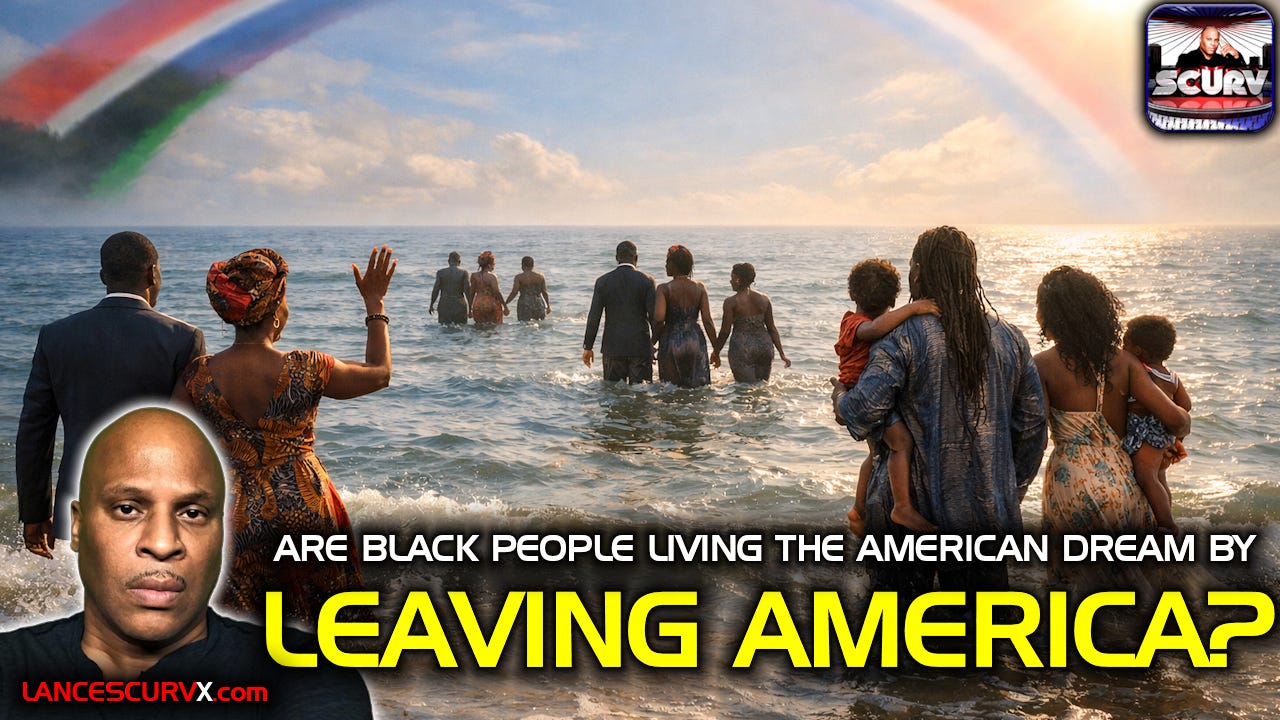
America is 250 years old, and for Black people, most of that history has been struggle. We built this place with our blood, sweat, and broken backs. From the cotton fields to Wall Street culture, our labor and creativity shaped a nation that still questions our humanity.
Now something powerful is happening.
Black Americans are quietly packing up. Selling homes. Pulling children out of schools. Shipping containers across oceans. Applying for dual citizenship. Booking one-way tickets. Not because it sounds cute on social media. Not because it’s trendy. But because they are tired.
Tired of grinding just to survive. Tired of burying loved ones too early. Tired of watching their children rehearse active shooter drills like it’s normal. Tired of being told America is the greatest country in the world while their rent goes up again.
For a growing number of us, the American Dream doesn’t look like staying. It looks like leaving.
THE QUIET BLACK EXODUS
The United States does not track how many Black Americans leave by race. But we know millions of Americans now live overseas. Estimates range from 4 to 9 million total citizens abroad. And relocation agencies that focus on Black families say inquiries have exploded in the last five years.
In 2019, Ghana launched the “Year of Return,” marking 400 years since the first enslaved Africans were dragged into America. Over one million visitors traveled there that year. Many were African Americans who felt something shift in their spirit. Since then, Ghana’s “Beyond the Return” program has pushed long-term residency and investment.
But this movement is not just about Ghana.
Black Americans are relocating to Kenya, Senegal, Rwanda, and other African nations offering diaspora visas, land access, and business opportunity. Real estate purchases from African Americans have steadily increased in major cities like Accra and Nairobi.
This is not fantasy. This is paperwork, property deeds, and passports.
WHY THEY ARE LEAVING
Let’s stop pretending we don’t know why.
Housing costs in major U.S. cities have doubled in many areas over the past decade. Rent can easily hit $2,000 to $3,000 a month. Healthcare bills crush families even with insurance. Black wealth still trails white wealth by a massive gap. Gun violence continues to rip through urban neighborhoods.
Parents are looking at their children and asking hard questions. Do I want my son growing up constantly viewed as a threat? Do I want my daughter drowning in social media cultural standards that tell her she’s not enough or that her half naked body is all she has to offer? Do I want my child rehearsing for bullets instead of dreaming freely?
Meanwhile, remote work changed the game. A Black IT professional earning U.S. dollars can live comfortably in Nairobi. A retired couple collecting Social Security can stretch that check much further in West Africa. Entrepreneurs can buy land instead of renting apartments forever.
Quality of life matters more than a big salary that disappears before the month ends.
A nurse from Chicago relocates to Senegal and pays a fraction for private healthcare. A family from Atlanta sells their suburban home, buys property in Ghana outright, and eliminates their mortgage. A veteran from Texas moves to Kenya and receives affordable care without drowning in paperwork.
These are not celebrities. These are regular Black people who decided survival is not enough.
MENTAL FREEDOM AND DIGNITY
There is something else people don’t talk about.
Stress.
The constant background noise of being Black in America. The police stops which often leads to harrassment and possibly death. The workplace code switching. The unspoken tension. The feeling of being watched. Judged. Measured.
Many who relocate say they didn’t realize how tight their chest felt until it loosened.
In many African nations, Black Americans experience something rare: blending in. No longer being the minority in every room. Seeing leadership, billboards, media, and authority figures that look like them. That shift alone changes how you breathe.
Africa is not perfect. Let’s keep it real. There are infrastructure challenges. Corruption in some places. Power outages. Slower systems. But many say the trade-off is worth it. Because what they gain is belonging.
And belonging is priceless.
UNDERREPORTED AND UNDERSTOOD
Mainstream media rarely highlights this movement in depth. Why would it? Black Americans hold over $1.7 trillion in spending power in the United States. Our labor fuels industries. Our culture drives global influence. Losing even a fraction of that impacts local economies.
But still, the story grows.
Nearly one in five Americans has considered leaving the country in recent years. Passport applications hit record highs after the pandemic. African governments are expanding diaspora pathways. Social media now gives step-by-step guides to relocating.
This is not a stampede.
It is a steady current.
And currents reshape coastlines over time.
MY FINAL THOUGHTS
Let me be clear.
This is not about hating America.
It is about loving yourself enough to demand peace.
It is about choosing ownership over endless rent. Safety over sirens. Cultural grounding over confusion.
It is about looking at your life and asking, “If I have options, why am I afraid to use them?”
Africa is not for everybody. Relocation requires research, savings, humility, and patience. But for many Black Americans, it represents something powerful.
Not escape.
Return.
The American Dream once meant arriving on these shores.
For some of us now, it means walking away from them.
Permanently leaving the United States has been a beautiful progressive reality for me personally, and finally, I now have a peace in my life that has saturated my soul to the core that I could never have experienced in the hostile living environment called Amerikkka.
It may not be for everyone as they feel success can only be achieved in such oppressive living conditions, but for me, West Africa is my happy place.
