

THE SILENT CRISIS THAT TOO MANY PEOPLE IGNORE
There was a time when youth represented hope. Young people looked forward to tomorrow because tomorrow felt wide open. Even if life was hard, there was still excitement in dreaming about what could happen next. A child could enjoy being a child. A teenager could slowly grow into adulthood without carrying the full weight of the world on their shoulders. But today, something has changed in a painful and dangerous way. More young people are dealing with depression, anxiety, emotional exhaustion, and thoughts of suicide at ages where life should still feel full of possibility.
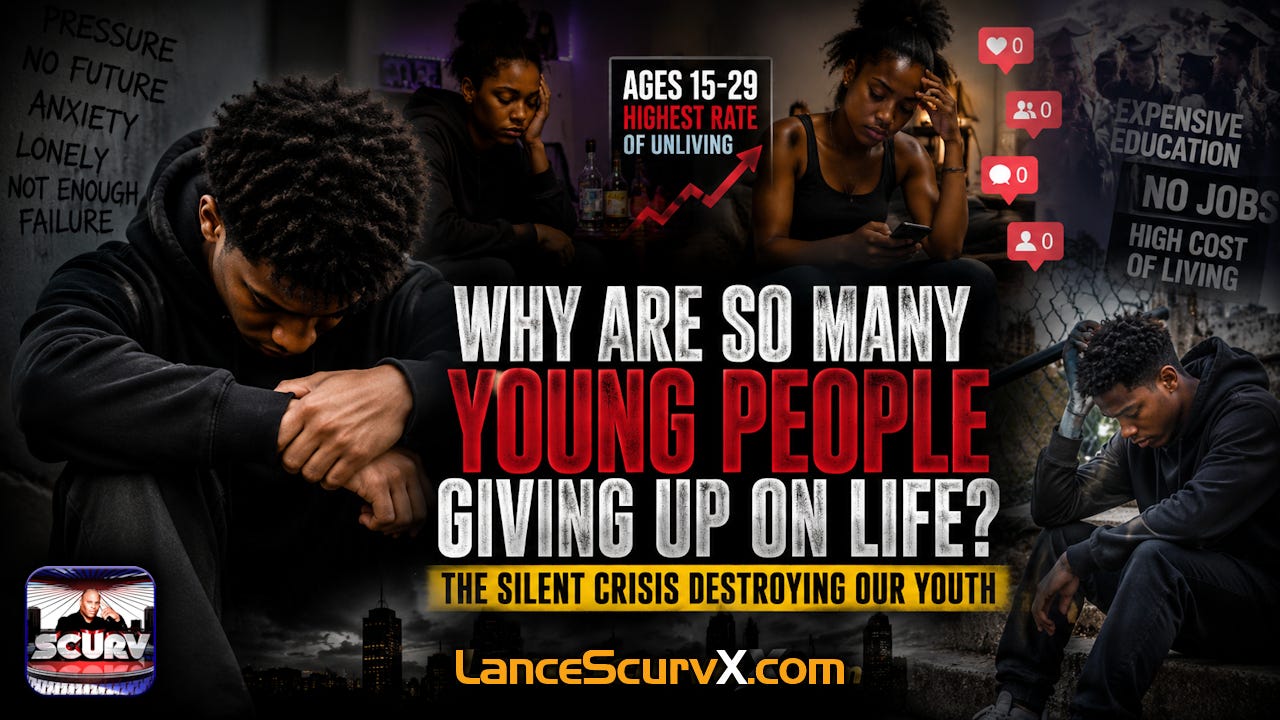
Recent statistics continue to show that suicide rates among people between the ages of 15 to 29 remain alarmingly high in many parts of the world. What makes this even more heartbreaking is that this generation has more technology, more entertainment, more access to information, and more ways to communicate than any generation before it. Yet despite all of that connection, many young people feel deeply disconnected inside. They are surrounded by people online every day, but emotionally they feel alone. They are constantly watching the lives of others while secretly feeling like failures in their own lives.
In many communities, especially in the Black community, this conversation still does not happen enough. Many young people are silently suffering while trying to appear strong. Some are afraid to speak because they do not want to be judged. Others feel like nobody would understand what they are going through. Many older people grew up in a different time and cannot fully understand the emotional pressure placed on this younger generation. But the reality is that today’s youth are growing up in an environment filled with nonstop pressure, nonstop comparison, nonstop stimulation, and nonstop uncertainty about the future.
Social media has changed the psychology of childhood itself. A young person no longer compares themselves only to classmates or neighbors. Now they compare themselves to millions of people every single day. They see expensive lifestyles, perfect bodies, luxury vacations, popularity, relationships, and financial success flashed in front of them twenty-four hours a day. What they often do not realize is that much of what they are seeing is carefully edited, filtered, exaggerated, or completely fake. But emotionally, the damage is still real because the human mind responds to what it sees repeatedly.
At the same time, the economic realities facing many young people are frightening. Housing costs are rising. Jobs feel unstable. Careers do not seem secure anymore. Many young people see adults working hard for decades while still struggling financially. They see debt, stress, burnout, and emotional exhaustion everywhere around them. So even before they fully become adults, many are already losing faith in the future. They begin asking themselves painful questions. What is the point? Will life ever get easier? Will I ever feel stable? Will I ever truly be happy?
HOW CHILDHOOD IS DISAPPEARING BEFORE OUR EYES
One of the biggest tragedies of modern life is that children are losing the sweetness of childhood too early. In previous generations, many children slowly learned about the world over time. Their innocence acted as protection while their minds emotionally developed. But today, a child can pick up a phone and instantly be exposed to violence, pornography, hatred, arguments, fear, crime, humiliation, and emotional toxicity before they are mentally prepared to process any of it.
When a young mind is overloaded with adult realities too early, it changes how they experience life. The mystery and wonder that once belonged to childhood gets replaced with emotional numbness, confusion, anxiety, and pressure. Many young people now feel emotionally older than they actually are. They know too much too fast, yet emotionally they are still children trying to understand themselves.
This constant exposure affects mental health deeply. Young people are consuming endless streams of negative information every single day. They hear about war, death, economic collapse, racism, corruption, violence, climate disasters, layoffs, betrayals, and social division nonstop. The human brain was never designed to absorb this much negativity twenty-four hours a day. Adults struggle with it, so imagine the effect on a teenager whose identity and emotional foundation are still developing.
Another painful reality is the destruction of patience. Social media has trained many young people to expect instant results. Instant attention. Instant validation. Instant popularity. Instant success. But real life does not work that way. Building confidence takes time. Building a career takes time. Healing emotionally takes time. Developing wisdom takes time. Relationships take time. But many young people are living in a world where patience feels almost unnatural. When success does not happen quickly, they feel like failures.
At the same time, emotional maturity is struggling to fully develop because many young people are constantly distracted. There is little silence. Little reflection. Little emotional stillness. Phones are always buzzing. Videos are always playing. Notifications are always interrupting thought. Many people no longer sit quietly with themselves long enough to understand who they truly are. Without emotional grounding, every disappointment begins to feel catastrophic.
TEN MAJOR REASONS WHY SO MANY YOUNG PEOPLE FEEL HOPELESS
The first major factor is social media comparison. Young people are constantly measuring themselves against unrealistic images. They feel pressure to appear attractive, wealthy, successful, funny, popular, and emotionally perfect all at once. Even adults struggle under this pressure.
The second factor is economic fear. Many young people feel that no matter how hard they work, stability keeps moving farther away. Homes cost more. Education costs more. Food costs more. Transportation costs more. Yet wages often do not match the rising cost of living.
The third factor is loneliness. Ironically, this is one of the most connected generations in history, yet many feel emotionally isolated. Digital communication cannot fully replace genuine human connection, physical presence, and emotional understanding.
The fourth factor is broken identity. Many young people no longer know who they are outside of public approval. Their self-worth becomes tied to likes, followers, views, and validation from strangers.
The fifth factor is emotional overload. Young people today are exposed to far more emotional stimulation than previous generations. Their nervous systems rarely get rest.
The sixth factor is unstable family structures. Many young people are growing up without consistent emotional guidance, support, or protection. Some are emotionally raising themselves while their parents are overwhelmed trying to survive financially.
The seventh factor is bullying and humiliation online. In the past, bullying often stopped when a child came home. Today humiliation can follow a young person twenty-four hours a day through social media.
The eighth factor is fear of failure. Many young people believe they must become successful quickly or their lives have no value. They are terrified of falling behind.
The ninth factor is loss of spiritual grounding and inner purpose. Many young people are searching for meaning in a culture obsessed with appearance, money, and attention. But material things alone cannot satisfy the human spirit.
The tenth factor is emotional exhaustion. Many young people are mentally tired before life has even fully begun. They are carrying stress levels that previous generations often did not experience until much later in adulthood.
THE UNIQUE PAIN INSIDE THE BLACK COMMUNITY
In the Black community, these struggles often carry additional layers of pain. Many Black youth are growing up while witnessing violence, economic inequality, racial stress, social pressure, and community instability all at once. Some are trying to survive environments where trauma has become normalized.
At the same time, mental health conversations are still heavily misunderstood in many spaces. Young people are sometimes told to simply “be strong” without being given the emotional tools needed to process pain in healthy ways. As a result, many suffer silently while smiling publicly.
Black youth are also heavily influenced by entertainment culture that glorifies materialism, hypersexuality, emotional coldness, and unrealistic lifestyles. Young people begin believing their worth depends on money, appearance, popularity, and status symbols. When they cannot achieve those things quickly, feelings of inadequacy begin to grow.
Many are also dealing with the pressure of trying to escape poverty while lacking stable opportunities. They are told to dream big while simultaneously watching doors constantly close around them. That emotional contradiction creates frustration and hopelessness.
Yet despite all of this, there is still power, beauty, intelligence, creativity, resilience, and greatness inside our young people. They are not weak. They are overwhelmed. There is a difference.
WHY OLDER GENERATIONS MUST LEARN COMPASSION
Older generations sometimes dismiss younger people because their struggles look different from the struggles of the past. But pain does not have to look identical to be real. Today’s youth are fighting psychological battles that previous generations never had to face on this level.
Many older people grew up in a slower world. They had time to mentally process life. Today’s youth are growing up in a nonstop digital storm. Their minds are under attack constantly by noise, pressure, fear, comparison, temptation, and distraction.
This does not mean young people should avoid responsibility. But it does mean they need understanding, guidance, patience, and emotional support. Too many young people feel unheard. Too many feel invisible. Too many feel like nobody truly understands the emotional weight they carry daily.
We must create environments where young people can speak honestly without shame. They need safe conversations. They need mentorship. They need real connection. They need reminders that life is not a race and that their value does not come from social media popularity or financial status.
Most importantly, they need hope. Real hope. Not fake motivational slogans. Real hope built through community, purpose, emotional healing, meaningful relationships, spiritual grounding, and realistic encouragement.
WE CANNOT AFFORD TO LOSE ANOTHER GENERATION
Every young person who takes their life leaves behind unanswered questions, broken hearts, and permanent pain. And many times, people around them never fully realized how much they were suffering internally. That is why these conversations matter so deeply.
We must stop pretending that endless entertainment and technology automatically create happiness. They do not. Human beings still need love, stability, purpose, connection, peace, and emotional balance. Without those things, no amount of followers or online attention will heal the emptiness inside.
We also must stop raising young people to believe they are only valuable when they achieve perfection. Life is not perfection. Life is struggle, growth, mistakes, healing, learning, and evolution. Young people need permission to be human without feeling like failures.
The truth is that many young people are not trying to die. They are trying to escape emotional pain they do not know how to carry anymore. That is why compassion matters. Listening matters. Presence matters. Love matters.
And to every young person silently struggling right now, understand this clearly. Your current pain is not your final destination. Feelings change. Situations change. Life changes. There are people who care about you even when it does not feel that way. There is still purpose in your life even if you cannot see it yet. Hold on long enough to discover who you are truly meant to become.
Trust me, better days are definitely ahead…
Sincerely,
Scurv