
THE POWER EVERYONE PRETENDS THEY DON’T HAVE
There is a truth that many people don’t want to face. It’s not hidden. It’s not complex. It’s not something buried in books or locked behind some secret system. It’s simple. And because it’s simple, it exposes something deeper about human behavior that makes people uncomfortable.
We live in a world where people say they want change. They talk about fairness. They talk about justice. They say they believe in equality. But when the moment comes to act in a way that costs them almost nothing, suddenly things get complicated.
Let me make this clear from the start. I’m not talking about laws or governments. I’m not talking about politicians or policies. I’m talking about everyday people. Regular people. The ones who say, “That’s wrong,” but keep walking anyway.
History has already shown us what works. It has shown us what changes systems and what keeps them alive. And the truth is, systems don’t survive only because of those who openly support them. They survive because of those who quietly go along with them.
That’s the part people don’t want to admit. Because it means the power was always there. And if the power was always there, then the question becomes very uncomfortable: why wasn’t it used?
THE SIMPLEST FORM OF RESISTANCE
Let’s strip this down to its core. You don’t need a protest. You don’t need a speech. You don’t need a movement with signs and slogans. All you have to do is refuse to participate.
If a place treats people unfairly, don’t go there.
If a system excludes people, don’t support it.
If a business disrespects people, don’t spend money there.
That’s it.
No shouting. No marching. No risking your life. Just a simple decision: “I’m not taking part in this.”
Now imagine if a large number of people made that same simple decision at the same time. Not everyone. It doesn’t take everyone. Just a strong percentage. Thirty percent. Forty percent. Half.
That’s enough.
Because businesses don’t run on opinions. They run on participation. They run on money. They run on people showing up. The moment a noticeable chunk of people stop showing up, the pressure begins immediately.
And here’s the key part: the people applying that pressure lose almost nothing. They give up a little comfort, maybe a little entertainment, maybe a little convenience. That’s it.
Meanwhile, the system they are pressuring starts to feel real consequences.
So the idea that change requires massive sacrifice from everyone is not always true. Sometimes it just requires a refusal to play along.
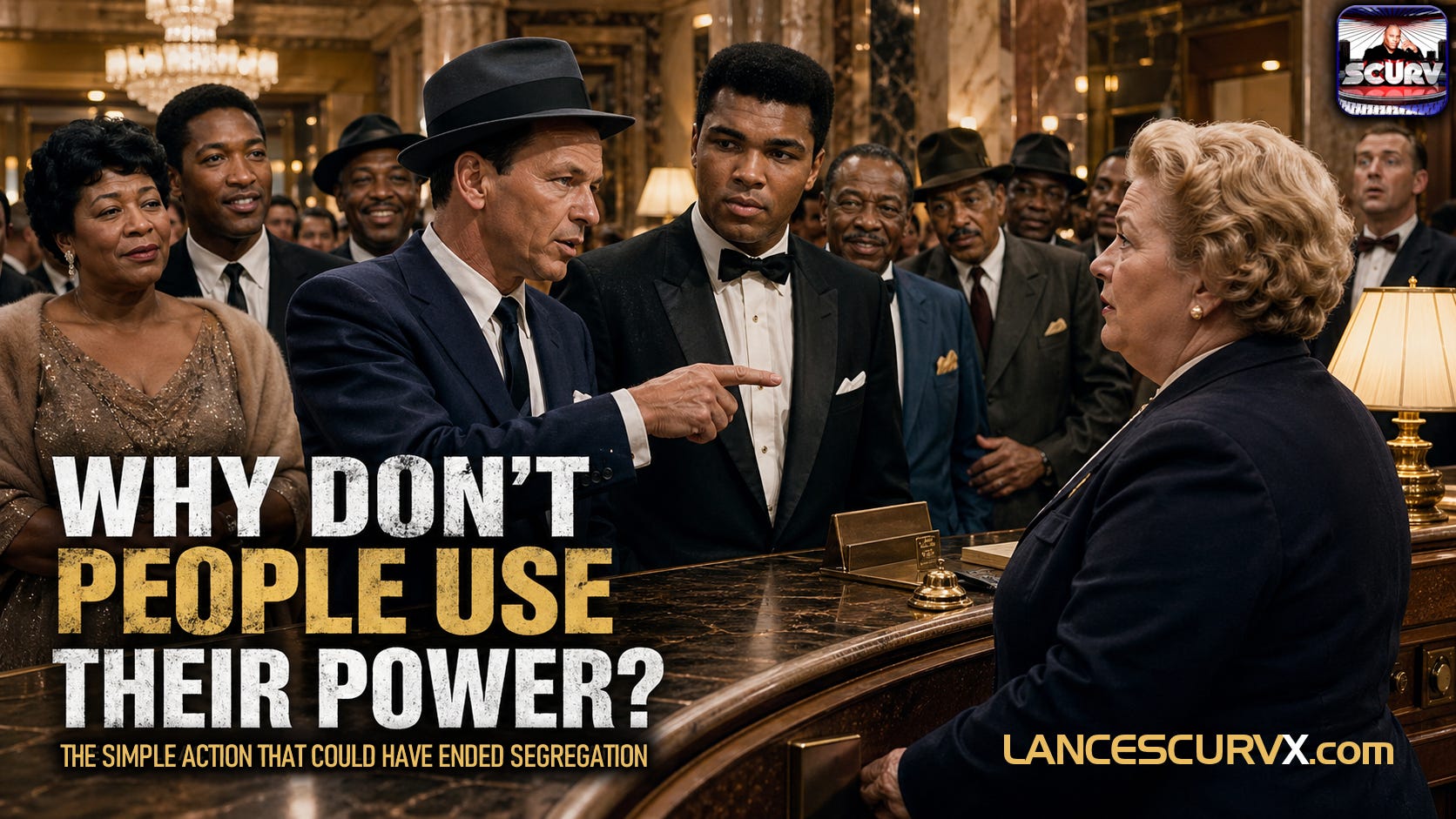
WHAT HAPPENED BETWEEN FRANK SINATRA AND MUHAMMAD ALI
THE REMOTE CONTROL ANALOGY
Think of it like this. You’re sitting in a room. The solution is right there in your hand. A remote control. The batteries are fresh. Everything is working.
All you have to do is press a button.
But instead of pressing the button, you start doing everything else. You stand up. You walk around. You check the back of the TV. You look for problems that don’t exist. You delay. You stall. You distract yourself.
Why?
Because pressing that button would actually change something.
That’s what passive behavior looks like. It’s not always loud. It’s not always hateful. Sometimes it looks like confusion. Sometimes it looks like delay. Sometimes it looks like good intentions with no action behind them.
But at the end of the day, the result is the same.
Nothing changes.
And when nothing changes, systems that should have ended continue to operate.
PASSIVE AGREEMENT IS STILL AGREEMENT
There are people who openly support unfair systems. That’s obvious. But they are not the only reason those systems survive.
The bigger force is the silent majority. The people who don’t agree with the system, but still participate in it. The people who shake their heads in private but show up in public.
That kind of behavior sends a clear message, even if it’s not spoken out loud.
It says, “This is acceptable enough for me to continue.”
And systems don’t need full support to survive. They just need enough participation.
That’s why small acts of refusal matter so much. Because they interrupt that participation. They break the pattern. They force a response.
Without that interruption, nothing shifts.
THE DIFFERENCE BETWEEN WORDS AND ACTION
It’s easy to say you care. It’s easy to speak against injustice. It’s easy to post, to talk, to express feelings.
But real impact shows up in choices.
Where you go.
What you support.
What you refuse.
Those are the things that move systems.
If someone says they care, but they never change their behavior, then what they say and what they do are not aligned. And when that gap exists, the system keeps running exactly as it was.
Because systems don’t respond to words. They respond to patterns.
WHAT THIS REALLY MEANS
This isn’t about blaming every single person. It’s about understanding how change actually happens.
It’s about recognizing that power doesn’t always look like loud action. Sometimes it looks like quiet refusal.
And it’s about facing the uncomfortable truth that many of the biggest changes in history could have happened faster if more people chose to act in simple, consistent ways.
Not dramatic ways. Not dangerous ways. Just intentional ways.
Because at the end of the day, the question is not whether people had the power.
The question is whether they chose to use it.
MY FINAL PERSPECTIVES…
The truth is, change doesn’t always require a revolution. Sometimes it requires a decision. A clear, simple decision to stop supporting what you know is wrong.
And that decision, when shared by enough people, becomes force. Not loud force. Not violent force. But effective force.
We have to stop pretending that power is out of reach. It’s not. It’s in everyday choices. It’s in participation. It’s in what people are willing to walk away from.
When people say they want change but refuse to take even the smallest step toward it, that contradiction tells a story. And that story needs to be examined honestly.
Because systems don’t just exist on their own. They are fed. They are supported. They are maintained by the actions of people who choose comfort over disruption.
And until that choice changes, the system stays exactly where it is.