

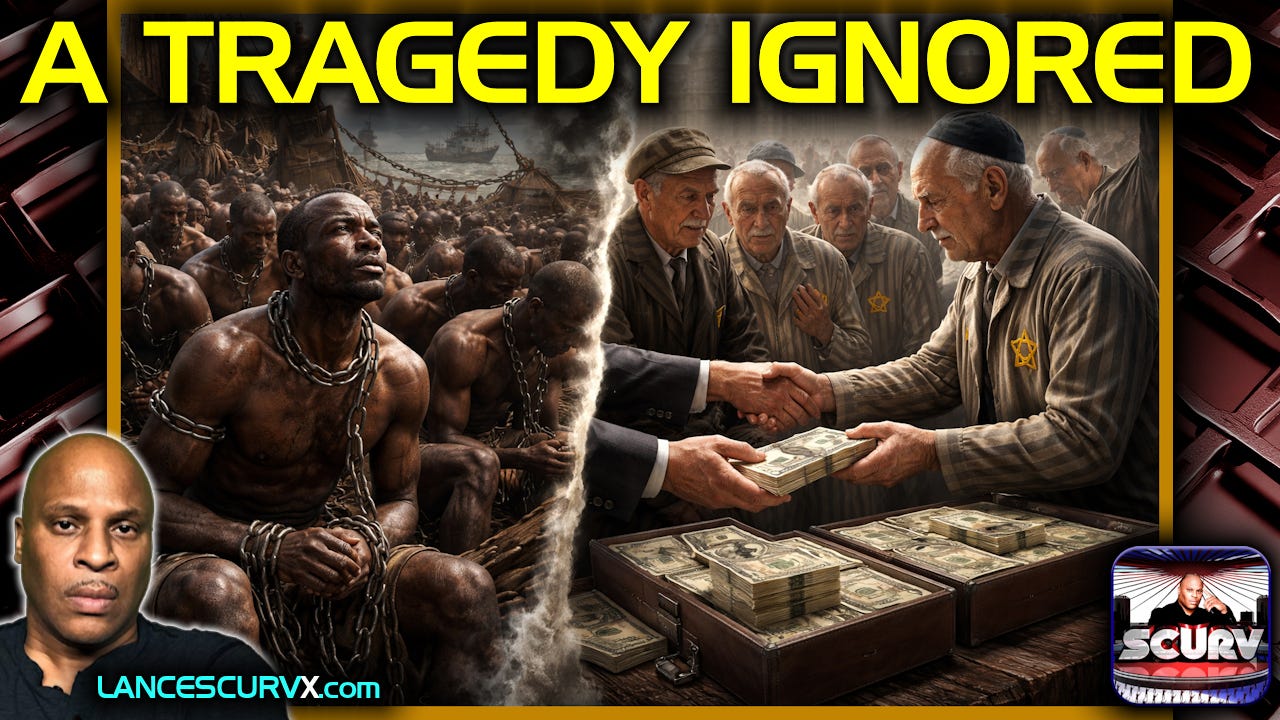
THE TRUTH THAT MAKES PEOPLE UNCOMFORTABLE
There are certain conversations that people don’t want to have. Not because they aren’t important, but because they shake the foundation of how the world has been taught to think. This is one of those conversations.
When we talk about human suffering, we must be honest. We must be factual. We must be bold enough to put everything on the table without fear of being silenced or labeled. Because truth does not need permission to exist.
Two of the most painful chapters in human history are the Holocaust and the transatlantic slave trade. Both were horrific. Both caused unimaginable suffering. Both should be remembered with deep respect. But when comparisons are made, people get uncomfortable.
Why? Because comparisons expose imbalance. They expose what is remembered, what is emphasized, and what is quietly pushed aside.
So let’s deal with the facts. Not emotions. Not politics. Just reality.
DURATION OF SUFFERING
The Holocaust lasted approximately 12 years, from 1933 to 1945, with the most intense period of mass killings occurring between 1941 and 1945.
The transatlantic slave trade, along with the system of chattel slavery that followed, lasted over 400 years. From the early 1500s into the late 1800s, and in some places even beyond that, Africans were captured, transported, and enslaved.
This is not a small difference. This is the difference between a moment in history and centuries of sustained exploitation.
Generations were born into slavery, lived in slavery, and died in slavery—never knowing freedom.
SCALE OF HUMAN LOSS
During the Holocaust, approximately 6 million Jewish people were killed. In addition, millions of others—including Romani people, disabled individuals, and political prisoners—were also murdered.
In the transatlantic slave trade, it is estimated that between 12 to 15 million Africans were forcibly transported across the Atlantic. But that number does not include those who died during capture, forced marches, and the horrific Middle Passage.
When those deaths are included, many historians estimate that the total loss of African life could range from 20 million to over 50 million people.
And that doesn’t include the countless lives destroyed through generations of forced labor, brutality, and systemic oppression.
CONDITIONS OF SUFFERING
The Holocaust was marked by concentration camps, gas chambers, forced labor, starvation, and systematic extermination. It was organized, industrialized, and brutally efficient.
The transatlantic slave trade was marked by kidnapping, chaining, overcrowded ships, torture, rape, forced breeding, family separation, and lifelong unpaid labor.
Enslaved Africans were treated as property. Not as humans. Not even as prisoners. As property.
They could be bought, sold, beaten, and killed without consequence.
And this wasn’t for a few years. This was a way of life imposed over centuries.
LOSS OF IDENTITY
This is where the conversation becomes even deeper.
During the Holocaust, people suffered immense loss—of life, dignity, and security. But many retained knowledge of their identity, culture, language, and religious roots, even in the face of oppression.
In the transatlantic slave trade, Africans were stripped of everything.
Names were erased. Languages were forbidden. Spiritual systems were destroyed or replaced. Families were broken apart intentionally to prevent unity.
People did not just lose their freedom. They lost their identity.
Generations later, many descendants are still trying to reconnect with who they were before slavery.
ECONOMIC IMPACT AND BENEFIT
The Holocaust did not serve as a long-term economic system that built global wealth over centuries.
The transatlantic slave trade did.
Entire economies were built on the backs of enslaved Africans. Nations grew rich from free labor. Infrastructure, industries, and financial systems were developed using stolen bodies and stolen resources.
And the effects of that system are still visible today.
Wealth accumulated then did not disappear. It was passed down.
Meanwhile, those who were enslaved were left with nothing.
GLOBAL RECOGNITION AND MEMORY
The Holocaust is widely recognized around the world. It is taught in schools. Memorials exist. Denial is widely condemned.
The transatlantic slave trade is acknowledged, but often minimized. Its full scale and lasting impact are not always taught with the same intensity or seriousness.
There is a difference in how these histories are remembered.
And that difference matters.
INTERGENERATIONAL IMPACT
The Holocaust left deep scars that are still felt today.
But the system of slavery created a long-term structure of inequality that continued through segregation, discrimination, and systemic barriers that still exist in many forms today.
The trauma did not end when slavery ended.
It evolved.
THE HARD QUESTION
So when people ask which was worse, they are often asking the wrong question.
The real question is this:
Why is one tragedy universally recognized at full depth, while another—longer, broader, and just as devastating—is often reduced, debated, or minimized?
This is not about competition in suffering.
This is about completeness in truth.
THE TRUTH WE CAN’T RUN FROM
We cannot move forward if we are selective about what we remember.
We cannot demand empathy for one group while dismissing the suffering of another.
We cannot build a fair world on an incomplete version of history.
Both tragedies deserve acknowledgment. Both deserve respect. But honesty demands that we recognize the differences in duration, scale, and long-term impact.
This is not about division. It is about clarity.
THE QUESTION OF REPARATIONS AND WHO RECEIVED THEM
There is another layer to this conversation that many people avoid, and it cuts just as deep as everything already discussed.
It’s the question of reparations.
After the Holocaust ended, there were financial reparations paid. Beginning in the 1950s, the government of Germany agreed to pay billions of dollars to the state of Israel as well as to individual Holocaust survivors. These payments were meant to acknowledge the crimes committed and to provide some level of material compensation for the suffering endured.
Over time, those reparations amounted to tens of billions of dollars. Individual survivors also received pensions, payments, and continued support in many cases.
Now let’s be clear—no amount of money can ever truly repay that level of suffering. But the acknowledgment came not just in words, but in sustained financial action.
Now compare that to the descendants of enslaved Africans.
After over 400 years of forced labor, brutality, and economic exploitation, formerly enslaved Africans in places like the United States were not given reparations. In fact, many were left with nothing. There were brief promises made—like land redistribution—but those promises were quickly reversed.
No large-scale, sustained financial compensation was ever delivered to the descendants of those who built entire economies through unpaid labor.
Not then. Not now.
FOREIGN AID VS HISTORICAL REPARATIONS
Now here’s where the conversation gets even more complex—and uncomfortable for some.
The United States has provided significant financial aid to Israel for decades. This aid, which is often in the billions annually, is primarily framed as military and strategic support tied to geopolitical alliances in the Middle East—not as direct reparations for the Holocaust.
That distinction matters.
Because some people see large sums of money flowing and assume it is tied to historical suffering alone—but in reality, modern foreign aid is driven by political, military, and economic interests.
Still, the perception remains.
And when people look at that reality side by side with the complete absence of reparations for descendants of enslaved Africans, it raises serious questions.
THE GAP THAT STILL EXISTS
One group received formal acknowledgment backed by structured compensation from the nation responsible for their suffering.
The other group—whose suffering lasted far longer and impacted far more generations—was released into a world where they had to build from nothing, while the systems that benefited from their labor continued to thrive.
And those systems didn’t disappear.
They evolved.
We are still living in the aftermath of those economic advantages today.
WHY THIS CONVERSATION MATTERS
This is not about taking away from anyone’s pain.
This is about recognizing inconsistency.
It’s about asking why justice, when it comes in financial form, seems to apply in some cases—but not in others.
It’s about understanding that acknowledgment without action can feel incomplete.
And it’s about making sure that history is not just remembered—but addressed in a way that reflects its full impact.
THE FINAL TRUTH ON THIS ISSUE
Reparations are not just about money.
They are about recognition, accountability, and repair.
One tragedy saw structured efforts—however imperfect—to compensate and acknowledge.
The other saw silence where compensation should have been.
And until that imbalance is honestly addressed, this conversation will continue to rise again and again—because truth has a way of demanding to be heard.
History is not meant to make us comfortable. It is meant to teach us.
When we avoid these conversations, we allow misunderstanding to grow. We allow imbalance to continue.
There is power in truth. Even when that truth is difficult to hear.
We must be willing to face it fully.
Because until we do, we are not truly honoring the past—we are shaping it to fit our comfort.
And comfort has never been the place where truth lives.
Sincerely,
SCURV
CONTACT: 1.407.590.0755 (WhatsApp Text)