


WHAT IF THE ATTACK ISN’T ALWAYS SOMETHING YOU CAN SEE?
When people talk about oppression in America, they usually look for something obvious. They look for discrimination, police encounters, unequal treatment, economic inequality, unfair housing practices, educational disparities, or the many other forms of pressure that have shaped Black life in America. Those issues deserve serious attention, but there’s another form of pressure that often escapes the conversation because it doesn’t always look like oppression when you first see it. Sometimes the problem isn’t what somebody says to you or what somebody does directly to you. Sometimes the problem is what surrounds you every single day. Look at what’s available in many struggling Black neighborhoods, especially the poorest communities, and you’ll often find fast-food restaurants, liquor stores, convenience stores, smoke shops, corner stores and shelves packed with inexpensive processed foods. Meanwhile, the supermarket with fresh vegetables, quality meats, fish and other nutritious foods may be far away. That difference matters because the environment surrounding people can influence the choices they make long before they fully understand the consequences.
That’s why the conversation about food deserts needs to go much deeper than telling people to simply “eat better.” That advice sounds reasonable until you ask what choices people actually have. Somebody with reliable transportation, money and time can drive across town and buy fresh food in bulk, prepare meals at home and make healthier choices throughout the week. But somebody living paycheck to paycheck, without a dependable vehicle and surrounded by stores selling inexpensive processed food may face a completely different reality. When hunger arrives, convenience becomes powerful. When money is tight, price becomes powerful. When somebody is exhausted after working all day, convenience becomes even more powerful. And when the unhealthy choice is right around the corner while the healthier choice requires a long trip and more money, the environment itself begins influencing behavior.
I’m not interested in using that reality as an excuse for people making destructive decisions. Personal responsibility matters, and adults have to take responsibility for what they put into their bodies and what they expose their children to. But personal responsibility doesn’t mean pretending that everybody is making choices under the same circumstances. Knowledge matters. Access matters. Money matters. Transportation matters. Education matters. Family structure matters. Stress matters. When you put all of these things together, you begin to understand why certain communities can become trapped in cycles that appear to be individual failures when they’re actually much more complicated than that. A person who has never been taught how nutrition affects the body is starting from a different place than somebody who has been taught these things from childhood.
What concerns me even more is what happens when this environment becomes normal for children. A child doesn’t understand insulin resistance, diabetes, metabolic disease, addiction or the long-term consequences of excessive sugar consumption. A child understands what tastes good, what makes them feel good and what everybody around them is eating. If the neighborhood constantly presents sugary drinks, candy, chips, fast food and highly processed meals as normal parts of everyday life, the child can grow up believing that this is simply what food looks like. The habits formed during childhood can follow that person into adulthood, and what started as an innocent preference can eventually become a serious health problem.
That’s why I believe we have to stop looking at these issues as isolated problems. Food, poverty, health, addiction, family instability, education, violence and incarceration can overlap and reinforce one another. None of these things automatically causes another, and I’m not going to pretend that a hamburger creates a criminal or that smoking marijuana automatically makes somebody violent. That would be foolish. But I am saying that when unhealthy environments, poverty, chronic stress, substance misuse, poor nutrition, limited opportunity and family instability exist together for years, the consequences can become devastating. We have to be mature enough to examine the entire environment instead of blaming everything on one individual decision.
THE NEIGHBORHOOD CAN BECOME THE TEACHER
Children don’t learn only from what their parents tell them. They learn from what they see. They learn from what adults around them purchase, what businesses surround them, what advertisements constantly tell them, what their friends consume and what behaviors receive attention and acceptance. Before a child understands the language of nutrition, marketing or economics, that child is already absorbing lessons about what people eat, what people drink and how people cope with stress. The neighborhood itself can become a classroom, even when nobody realizes that a lesson is being taught.
That’s why the environment surrounding children deserves more attention than it receives. If a child can walk a few minutes and find candy, soda, chips, fast food, alcohol or other substances, but has to travel much farther to find fresh produce and quality groceries, the child is receiving a message about availability. The message isn’t necessarily being spoken out loud, but it’s being communicated through the physical environment. What’s easy to obtain becomes easier to normalize. What’s difficult to obtain becomes something people may learn to live without.
This becomes especially important when families are struggling financially. A parent who is trying to stretch a limited amount of money across rent, utilities, transportation, clothing, school expenses and food may make decisions based on immediate survival rather than long-term nutritional theory. A large inexpensive processed meal can appear to make more financial sense than purchasing a variety of fresh ingredients. That doesn’t make the parent ignorant or uncaring. It means poverty changes the choices available to people.
But once these patterns become established, they can become difficult to break. Children grow up with certain foods, those children become adults, and those adults eventually raise another generation. Suddenly the food environment isn’t simply influencing an individual. It’s influencing a culture. The question then becomes whether we’re going to accept that culture as permanent or whether we’re going to consciously build something healthier.
HUNGER CAN MAKE CHEAP CALORIES LOOK LIKE A SOLUTION
There’s a major difference between filling the stomach and nourishing the body. Food can make hunger disappear temporarily without providing the balance of nutrients the body needs for long-term health. Highly processed foods can deliver large amounts of calories, sugar, sodium and refined carbohydrates, and when those foods become a major part of someone’s diet, the consequences can accumulate over time. The problem becomes even greater when these foods replace more nutritious options rather than appearing occasionally as part of a balanced diet.
Somebody who is genuinely hungry isn’t always thinking about what their blood sugar will look like ten years from now. They’re thinking about what they can afford today. They’re thinking about what will fill them up. They’re thinking about what they can buy quickly before getting home. That’s why simply telling people to make better choices without addressing access, education and economics can be an incomplete conversation.
Over time, however, those choices can become expensive in another way. Poor nutrition combined with other risk factors can contribute to obesity, insulin resistance, type 2 diabetes, high blood pressure, fatty liver disease and other chronic health problems. What once seemed like a cheap meal can eventually become a lifetime of doctor visits, laboratory tests, medication and medical expenses. The money that couldn’t be spent on quality food can eventually be spent trying to manage the consequences of poor health.
That’s one of the contradictions we have to confront. We often tell people to take responsibility for their health while leaving them inside environments that can make unhealthy choices remarkably easy. We tell people to exercise while some neighborhoods lack safe spaces to walk. We tell people to eat fresh food while quality grocery stores may be far away. We tell people to avoid excessive sugar while sugary drinks and processed snacks are aggressively marketed and widely available. The individual still has responsibility, but the environment deserves responsibility too.
WHEN THE FOOD ENVIRONMENT BECOMES A MEDICAL ENVIRONMENT
This is where I believe we have to look at the entire cycle instead of looking at one moment. Somebody may live in a community where healthy food is difficult to access, consume an unhealthy diet for years, develop metabolic problems and eventually enter the healthcare system. Once the diagnosis arrives, medication may become part of the treatment plan. That treatment may be appropriate and necessary, but the medication doesn’t erase the environmental conditions that contributed to the problem.
I want to be careful here because I’m not interested in spreading another form of misinformation. Medication isn’t automatically the enemy. Metformin, for example, is commonly used to treat type 2 diabetes and can be an effective medication for many people. Like other medications, it can have side effects and isn’t appropriate in exactly the same way for every person. Decisions about medication should be made with a qualified healthcare professional who understands the individual’s health situation.
But medication shouldn’t become the entire conversation either. Health involves nutrition, physical activity, sleep, stress, weight, genetics, environment and many other factors. A prescription can help manage a condition, but it doesn’t teach a person how to shop differently. It doesn’t teach a child how advertising works. It doesn’t put a supermarket in a neighborhood. It doesn’t create transportation. It doesn’t repair a family. It doesn’t eliminate poverty. It doesn’t teach emotional regulation. Treatment matters, but prevention matters too.
That’s why I question any approach that focuses entirely on treating symptoms while ignoring the conditions surrounding the symptoms. If somebody keeps getting sick because their environment keeps pushing them toward unhealthy behavior, treating the disease without addressing the environment can leave the underlying cycle intact. The body gets treated, but the circumstances remain.
THE LIQUOR STORE ON THE CORNER
Alcohol creates another difficult conversation because we have to separate reality from exaggeration. Not everybody who drinks becomes addicted, violent or irresponsible. But alcohol can impair judgment, lower inhibitions and contribute to dangerous decisions, especially when heavy drinking is combined with anger, stress, trauma, relationship conflict or other serious problems. When alcohol becomes a regular method of escaping emotional pain, the temporary relief can eventually create problems much larger than the original pain.
Now imagine somebody living under constant financial pressure, carrying unresolved anger, dealing with relationship problems and seeing very few pathways toward a better future. If alcohol becomes one of the easiest ways to change how that person feels for a few hours, it can become attractive. The problem is that the underlying circumstances remain after the intoxication disappears. The bill still exists. The relationship problem still exists. The unemployment still exists. The anger still exists. The pain is still waiting.
That’s how an escape can become a cycle. People don’t always destroy themselves because they want destruction. Sometimes they’re desperately trying to escape something they don’t know how to confront. That doesn’t excuse destructive behavior, especially when innocent people are harmed, but understanding the psychology behind the behavior can help us understand why simply punishing the person may not solve the underlying problem.
WEED, ESCAPE AND THE NEED FOR HONEST CONVERSATION
Marijuana requires that same level of honesty. I’m not interested in pretending that cannabis explains every problem in Black communities, because it doesn’t. Cannabis affects people differently, and the scientific evidence surrounding its risks is more complicated than the simplistic arguments often made on either side. At the same time, we shouldn’t pretend that cannabis is completely harmless simply because it has become more socially accepted.
Frequent or heavy cannabis use can create problems for some people, particularly adolescents and people who are vulnerable to certain mental-health conditions. Smoking also introduces combustion products into the lungs, and young people deserve special protection because their brains are still developing. The fact that something can provide temporary relaxation doesn’t automatically mean that it’s harmless when used frequently or irresponsibly.
The bigger issue is what role substances play in a person’s life. If somebody uses alcohol, marijuana, food, pornography, gambling, social media or anything else as the primary method of escaping uncomfortable emotions, the substance or behavior can become a substitute for dealing with the real problem. The question shouldn’t simply be whether the substance is legal or illegal. The question should be whether the person is becoming dependent upon something outside themselves to regulate every difficult emotion.
That’s especially important when we’re talking about children. Children shouldn’t have to learn how to escape reality before they’ve had an opportunity to understand reality. They need structure, love, discipline, education, physical activity, creativity, healthy food, meaningful relationships and opportunities to develop confidence. If we teach young people that every uncomfortable feeling should immediately be smoked away, drank away, eaten away or distracted away, we may be preventing them from developing the emotional strength they’ll need later in life.
THE CHILDREN ARE WATCHING
A child doesn’t understand metabolic disease. A child doesn’t understand addiction. A child doesn’t understand how excessive sugar consumption can contribute to serious health problems over time. A child doesn’t understand the way alcohol affects the brain and nervous system. A child doesn’t understand how advertising companies study human behavior to make products more attractive.
The child simply sees what’s normal.
That’s why education has to begin early. We should be teaching children what food actually does inside the body. We should teach them why protein matters, why vegetables matter, why fiber matters, why water matters and why excessive amounts of sugar and highly processed foods can create problems. We should teach them how to read labels and understand marketing instead of allowing corporations to become their nutrition teachers.
Most importantly, children need to understand that their bodies are valuable. When a child learns to respect their body, they’re beginning to develop a form of self-preservation that can extend far beyond food. The same child who learns to protect their health can eventually learn to protect their finances, their relationships, their time, their mind and their future.
WHEN THE FOOD DESERT BECOMES A LIFE DESERT
A food desert rarely exists by itself. It can exist alongside unemployment, inadequate transportation, poor housing, unsafe streets, underfunded schools, addiction, chronic stress and limited economic opportunity. That’s why the food issue can become a window into a much larger problem. When people live in survival mode, long-term thinking can become difficult. If you’re constantly worried about rent, electricity, transportation, food and safety, you may not have the mental space to think about what your life should look like ten years from now. Survival demands immediate decisions, and when your entire existence becomes centered around getting through tonight, getting through tomorrow, finding the next paycheck, putting the next meal on the table and dealing with the next crisis, the future can become increasingly difficult to imagine. That’s why rebuilding communities requires much more than simply putting a grocery store somewhere nearby. People need opportunity, education, safe places to exercise, stable families, employment, transportation, mental-health resources and positive examples of what their lives can become.
FROM THE DINNER TABLE TO THE COURTROOM
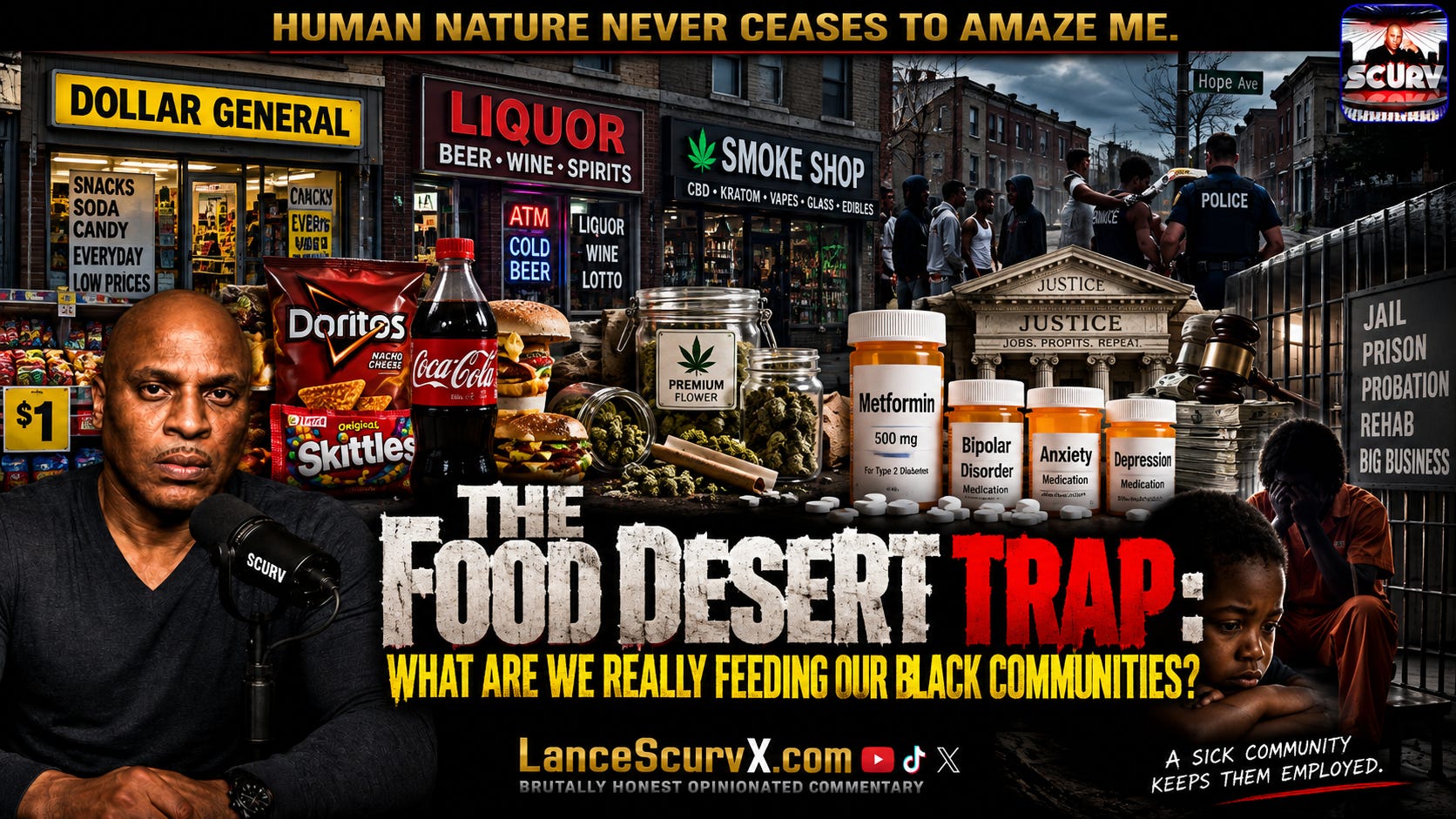
Now we get to the part of the conversation that makes people uncomfortable. How can these conditions connect to incarceration? The answer isn’t that eating fast food turns somebody into a criminal or that alcohol and marijuana automatically produce violent behavior. Human behavior doesn’t work that simply. The connection can emerge through a combination of factors that reinforce one another over time. Chronic poverty, childhood adversity, substance misuse, untreated mental-health problems, family instability, poor educational opportunities, unemployment, violence and neighborhood disadvantage can interact in ways that increase the likelihood of harmful behavior and contact with the criminal-justice system. Once somebody enters that system, an enormous network of institutions becomes involved, including police, courts, attorneys, judges, jails, prisons, corrections officers, probation and parole systems, rehabilitation programs, hospitals and healthcare providers. Each institution may have a legitimate function, and the people working within those institutions may simply be doing their jobs, but the deeper question becomes what happens when an entire system becomes highly developed around managing the consequences of problems that remain deeply rooted in the community.
A system can benefit economically from a problem without having created that problem in the first place, and that distinction matters. We don’t need to imagine a secret room where everybody gathers to plan the destruction of a community in order to recognize that certain industries and institutions can grow around human suffering. When crime exists, police and prisons are needed. When addiction exists, rehabilitation services are needed. When chronic disease exists, healthcare is needed. When people are sick, pharmaceutical companies sell medication. None of that automatically proves that these institutions created the problems they respond to, but it does raise an important question about whether enough attention is being devoted to changing the conditions that produce those consequences in the first place. If a community continually produces the same problems, and the response remains focused primarily on managing those problems after they occur, then we have to ask whether prevention is receiving the attention it deserves.
THE BLACK FAMILY CANNOT BE LEFT OUT OF THE CONVERSATION
We also have to talk about the family because children don’t raise themselves. A stable family can provide guidance about food, behavior, education, discipline, responsibility and long-term thinking. When families are damaged by poverty, incarceration, addiction, abandonment, violence or chronic instability, children can lose some of that structure, and when that structure weakens, other influences can become stronger. Friends can become more influential. Social media can become more influential. Advertising can become more influential. The neighborhood can become more influential. The street can become more influential. Some of those influences may provide companionship or temporary excitement, but they don’t necessarily care about the child’s long-term survival or development. That’s why strengthening families has to be part of strengthening communities.
We can’t talk about diabetes while ignoring food access. We can’t talk about violence while ignoring childhood trauma. We can’t talk about addiction while ignoring hopelessness. We can’t talk about incarceration while ignoring economic opportunity. These issues may look separate when we discuss them individually, but they can become deeply connected in the real lives of people experiencing them. When a child grows up surrounded by instability, unhealthy food, substance use, violence, financial stress and limited opportunity, those conditions can begin shaping expectations about what life is supposed to look like. That’s why the fight for healthier communities has to include a fight for stronger families, better education, economic opportunity and environments where children can imagine a future beyond the circumstances they inherited.
PERSONAL RESPONSIBILITY STILL MATTERS
But after everything I’ve said, I still have to come back to personal responsibility. At some point, adults have to make decisions, and I can’t blame the corner store forever, the fast-food restaurant forever, the government forever, racism forever or the pharmaceutical industry forever. Eventually, I have to look in the mirror and ask myself what I’m doing with the circumstances I’ve been given. What am I putting into my body? What am I teaching my children? What am I spending my money on? What habits am I normalizing? What am I doing to improve my circumstances? What am I doing to make my family stronger? Those questions can be uncomfortable, but they’re necessary because empowerment begins when we stop pretending that somebody else has complete control over every decision we make.
Understanding the environment should make us more strategic, not more helpless. If I understand that marketing is designed to influence my desires, I can become more resistant to it. If I understand what excessive sugar can do to my body, I can become more selective about what I consume. If I understand addiction, I can become more cautious about using substances to escape emotional pain. If I understand poverty and economic pressure, I can become more intentional about building skills, creating opportunities and developing greater economic independence. Knowledge becomes powerful when it changes behavior, because information sitting inside somebody’s head without action doesn’t transform a life. The goal should be to take what we learn and use it to make better decisions, even when the environment around us makes those decisions difficult.
WE HAVE TO STOP CALLING SURVIVAL NORMAL
One of the greatest dangers facing struggling communities is the normalization of dysfunction. When something becomes common enough, people can stop asking whether it’s healthy. If everybody is drinking sugary beverages, excessive sugar consumption can begin to look normal. If fast food becomes dinner several times a week, that pattern can begin to look normal. If obesity and diabetes become widespread, people can begin treating those conditions as inevitable parts of life. If addiction becomes common, some people can begin treating it as entertainment. If incarceration becomes common, children can eventually grow up believing that prison is simply another stage of life rather than a devastating disruption of freedom, family and opportunity. That’s dangerous because what becomes familiar can stop being questioned.
We have to become uncomfortable with things that should never have become normal. Something being normal doesn’t automatically mean it’s healthy, something being common doesn’t automatically make it acceptable, something being popular doesn’t automatically make it beneficial, and something being legal doesn’t automatically make it harmless. A community has every right to examine what surrounds its children and ask whether those things are helping or hurting the future. The goal shouldn’t be to shame people who are struggling. The goal should be to develop enough awareness to recognize destructive patterns before those patterns become another generation’s inheritance.
WE NEED TO BUILD A DIFFERENT FOOD CULTURE
The solution can’t simply be telling poor people to “eat healthy.” That statement becomes meaningless if healthy food is inaccessible, unaffordable or difficult to transport. We need better access to supermarkets, farmers markets, community gardens and affordable nutritious food. We need nutrition education that begins in childhood and continues throughout adulthood. We need families sharing practical knowledge about preparing inexpensive meals, and we need communities supporting businesses that provide healthier choices rather than simply accepting whatever happens to be available. The goal isn’t to create a fantasy where everybody eats perfectly every day. The goal is to make nutritious choices more realistic for ordinary people living ordinary lives.
At the same time, we need to stop assuming that every healthy meal requires expensive specialty products. There are basic foods that can provide substantial nutrition without requiring somebody to spend a fortune. Beans, eggs, vegetables, certain fruits, fish and other simple foods can form the foundation of nutritious meals depending upon an individual’s dietary needs and health situation. The important thing is direction. If somebody moves from drinking multiple sugary drinks every day toward drinking more water, that’s progress. If somebody reduces fast food and prepares more meals at home, that’s progress. If a family teaches its children to appreciate vegetables, protein and other nutritious foods, that’s progress. Small changes can become cultural changes when enough people make them consistently.
HEALTH IS ALSO A FORM OF FREEDOM
There’s something powerful about understanding your own body. When I understand what food does to me, I become harder to manipulate. When I understand advertising, I become harder to manipulate. When I understand addiction, I become harder to manipulate. When I understand money, I become harder to manipulate. When I understand my emotions, I become harder to manipulate. That’s why education is so important, because knowledge gives people another layer of protection against the forces constantly competing for their attention, money, habits and behavior.
Health isn’t merely about appearance. It’s about having the physical and mental capacity to participate in your own life. A person who is constantly sick, exhausted, addicted or mentally overwhelmed can have fewer choices available to them. The healthier and more knowledgeable a person becomes, the greater their ability to make decisions from a position of strength. That’s why taking care of the body should never be dismissed as vanity. It’s part of independence, because maintaining your health can give you more freedom to work, think, create, provide for your family and participate fully in the life you’re trying to build.
WE CANNOT WAIT FOR SOMEBODY ELSE TO SAVE US
I don’t want Black communities sitting around waiting for somebody else to rescue them. We should demand better access to healthy food, better schools, safer neighborhoods, economic opportunity and responsible businesses, but while we demand those things, we also have to become participants in our own recovery. We can create gardens, support farmers markets, teach children about nutrition, share affordable recipes, encourage physical activity, stop glorifying addiction, stop treating destructive behavior as entertainment, become more conscious consumers and support businesses that serve the community instead of simply extracting money from it. Change becomes more powerful when people stop viewing themselves only as victims of their circumstances and start seeing themselves as builders of something different.
We can also stop pretending that everything harmful is harmless simply because everybody else is doing it. A community begins changing when its people become uncomfortable with the conditions they’ve been taught to accept. That discomfort can become the beginning of consciousness, and consciousness can become the beginning of action. We don’t have to wait for perfect circumstances before making better decisions, just as we don’t have to accept poor circumstances as justification for abandoning the demand for better conditions.
THE FUTURE CANNOT BE BUILT ON SICKNESS
When I look at this issue, I don’t simply see a bag of chips, a bottle of soda, a liquor store, a fast-food restaurant or a smoke shop. I see a larger question about the future. What kind of adult does a child become after growing up surrounded by poor nutrition, chronic stress, addiction, violence, poverty and limited opportunity? What happens when that child eventually raises another child under similar circumstances? That’s how cycles become powerful. They repeat until repetition begins to look like destiny, but repetition doesn’t have to become destiny because people can change, families can change, neighborhoods can change and cultures can change. The fact that something has existed for generations doesn’t mean it has to exist for another generation.
WE HAVE TO BREAK THE CYCLE CONSCIOUSLY
Breaking the cycle requires more than anger. Anger can wake people up, but knowledge has to tell them where to go next. We need discipline, education, stronger families, healthier food, better economic opportunities, responsible businesses, community investment and adults willing to protect children from destructive influences. We also need intellectual honesty because not every problem is caused by a secret conspiracy, not every corporation is plotting against a particular race, not every doctor is trying to keep somebody sick, not every medication is poison, not every person who drinks is an alcoholic, not every person who uses marijuana is dangerous and not every fast-food restaurant is intentionally targeting one particular community. But none of those statements means we should ignore patterns.
We can examine patterns without inventing conspiracies. We can recognize inequality without denying personal responsibility. We can criticize institutions without declaring every person inside them evil. We can demand better conditions while demanding better choices from ourselves. That’s a much stronger position because it allows us to confront the real problems without allowing our argument to collapse under claims that we can’t support. We don’t need a secret master plan to recognize that unhealthy environments, poverty, inadequate food access, substance misuse, family instability and chronic stress can produce serious consequences. The evidence of those consequences is already enough to demand action.
THE REAL BATTLE IS OVER THE FUTURE
The real question isn’t simply what’s being sold in the neighborhood today. The real question is what those products, habits, conditions and choices produce twenty years from now. What happens when a child grows up surrounded by poor nutrition and chronic stress? What happens when that child becomes an adult with health problems, limited economic opportunity and unresolved emotional pain? What happens when another generation grows up inside the same environment? Those are the questions we need to ask because the consequences of today’s environment may not appear immediately. Sometimes they emerge years later in the form of disease, addiction, broken relationships, financial instability, violence or incarceration.
If we only focus on individual behavior, we may miss the environment. If we only focus on the environment, we may remove personal responsibility. We need both sides of the conversation because people have responsibility, communities have responsibility, businesses have responsibility, government has responsibility and families have responsibility. Every one of those responsibilities becomes more meaningful when we stop pretending that one side explains everything. The goal should be to create conditions where people have better choices while also encouraging people to make those choices.
THE SYSTEM CAN ONLY CONTINUE IF WE KEEP PARTICIPATING
Here’s where I bring this entire conversation home. I’m not claiming that every unhealthy product in a Black neighborhood was deliberately placed there as part of some secret plan to destroy Black people. I don’t need to make that claim to recognize that unequal access to nutritious food, concentrated poverty, aggressive marketing, substance availability, chronic stress, family instability and limited community resources can produce devastating outcomes. If those outcomes repeatedly harm the same communities, we have every right to demand answers, examine policies and question the economic and social incentives surrounding those conditions.
But we also have to answer some questions ourselves. What are we buying? What are we feeding our children? What are we teaching them? What are we accepting? What are we supporting? What are we building? The ultimate form of empowerment isn’t simply identifying who might benefit from our problems. The ultimate form of empowerment is becoming less dependent upon the systems that surround those problems. That means learning how to nourish ourselves, learning how to protect our minds, strengthening our families, teaching our children and creating healthier environments.
It means refusing to accept sickness as normal, refusing to accept addiction as entertainment, refusing to accept hopelessness as culture and refusing to accept incarceration as destiny. Above everything else, it means understanding that our bodies, our minds, our families and our children are not disposable. We have to become serious about what we’re consuming, what we’re teaching and what kind of environments we’re creating because the future will eventually reflect the choices we make today.
MY CLOSING THOUGHTS…
We’ve spent generations talking about the visible forms of oppression, and those conversations still matter. But there’s another battle taking place in communities where people are simply trying to survive, and that battle involves health, environment, knowledge, economics, family stability and the choices that become normal over time. When unhealthy products are everywhere while healthier choices are harder to reach, we have to recognize that environment as part of the equation. We can’t continue telling people to simply “make better choices” while refusing to examine the conditions surrounding those choices, because personal responsibility becomes far more meaningful when people have realistic access to better options.
But recognizing the environment cannot become an excuse for surrender. I don’t want helplessness. I want consciousness. I want people looking at what they buy, what they consume, what they feed their children, what they teach their families and what businesses they support. I want people asking whether something is truly nourishing them or simply giving them a temporary feeling of satisfaction while creating a long-term problem. We have to develop the courage to question habits that have become so common that questioning them makes people uncomfortable.
I also want us to understand that personal responsibility and systemic responsibility aren’t enemies. Both can exist at the same time. We can demand better access to healthy food while demanding better choices from ourselves. We can challenge poverty while teaching financial discipline. We can challenge addiction while refusing to glorify it. We can demand stronger communities while becoming stronger individuals. That’s not a contradiction. That’s maturity, and maturity requires us to understand that changing our circumstances requires both external pressure and internal discipline.
The goal shouldn’t be to create another generation that simply survives the environment. The goal should be to create a generation capable of changing it. That transformation starts with knowledge, but knowledge has to become behavior. We have to take what we learn from conversations like this and carry it into our kitchens, our grocery carts, our families, our schools and our neighborhoods. We have to stop waiting for somebody else to care more about our future than we care about it ourselves, because nobody can build the future of our communities for us.
Because the final question isn’t whether somebody somewhere benefits from dysfunction. The final question is whether we’re finally willing to stop participating in it. If we want stronger communities, we have to build healthier people. If we want healthier people, we have to build healthier environments. And if we want a different future, we have to stop treating the conditions that are destroying that future as though they’re simply the way life is supposed to be. Our communities deserve more than survival, and our children deserve more than inheriting the problems we were never brave enough to confront.