
SOMETHING IS OFF IN THE WORLD WE USED TO TRUST
There is a growing feeling that something fundamental has changed in the way truth moves through society. It feels slower when it should be faster, and louder when it should be clearer. People are watching events unfold in real time, yet still feel like they are only getting part of the story.
We live in an era where information is everywhere, but understanding is harder to find. Every headline competes with another. Every clip can be edited. Every statement can be questioned. And the average person is left trying to piece together reality from fragments.
This is not just about technology. This is about trust. And trust is the foundation of how people see institutions, celebrities, and even each other.
When that foundation shakes, everything else starts to feel unstable.
And that is exactly what many people are sensing right now.
A WORLD WHERE TRUTH ARRIVES LATE BUT CHAOS ARRIVES FAST
We are living in a strange contradiction. News travels instantly, but clarity takes time. Rumors spread in seconds, but truth takes months or even years to fully settle.
By the time the full picture comes out, public opinion has already been shaped, reshaped, and emotionally locked in. This creates confusion, frustration, and distrust.
People are no longer just asking what happened. They are asking why it took so long for anything to be said at all.
This delay between truth and exposure has become one of the defining features of the modern digital age.
HOLLYWOOD, POWER, AND THE STRUCTURE OF SILENCE
When we talk about the entertainment industry, we are not just talking about music, movies, or fame. We are talking about an entire system built on access, influence, and image control.
In Hollywood and the wider entertainment world, silence is often part of the structure. Not always because people do not know things, but because knowing things does not always lead to speaking out.
There are careers, relationships, contracts, and opportunities tied to proximity. And when survival depends on access, silence can become a form of protection.
This is why when controversies emerge, the public reaction is rarely just about the individual situation. It becomes about the entire system surrounding it.
People begin asking how long things were known, who had insight, and who chose to remain quiet while benefiting from the environment.
This is where frustration builds, because the public often feels like they are the last to know what many inside circles already understood.
THE CASE OF SEAN DIDDY COMBS AND PUBLIC SCRUTINY
The ongoing public attention surrounding Sean Diddy Combs has intensified this exact conversation. Not just about allegations or legal proceedings, but about how long narratives like this take to fully surface in the public space.
When a figure of that level of influence faces scrutiny, it forces people to re-examine the entire structure around them. The industry, the media ecosystem, the inner circles, and the culture of protection that often exists around high-profile individuals.
What the public wrestles with is not only the story itself, but the timing of the story. Why do these conversations emerge in waves? Why do they often surface after years of speculation, whispers, and fragmented reports?
This is where accountability becomes the central question. Not just personal accountability, but systemic accountability.
Because when someone operates at a high level in entertainment, they are never operating in isolation. There are networks around them—supporters, gatekeepers, observers, and sometimes even silent participants in the ecosystem of fame.
And when things finally surface, the public is left trying to understand how much was known behind the scenes long before anything became public knowledge.
This is why these moments are so powerful. They force society to confront not only individuals, but the environments that allow silence to persist.
THE DIGITAL AGE AND THE COLLAPSE OF TRUST
The internet was supposed to bring clarity. Instead, it has multiplied confusion.
With AI, editing tools, viral algorithms, and constant content overload, truth is no longer automatically believed. It has to be defended, proven, and often argued over.
This creates emotional exhaustion. People do not know what to trust anymore, so they begin to trust less overall.
And when trust collapses, even real truth struggles to stand out.
We are now in a cycle where exposure does not automatically create understanding. It often creates division.
WHY THIS MOMENT FEELS DIFFERENT FOR EVERYONE
People across all backgrounds are feeling a shift. It shows up in conversations, in comment sections, in living rooms, and in online spaces.
Some feel overwhelmed. Some feel awakened. Some feel disconnected entirely.
But underneath all of it is the same question: what is real anymore?
That question is no longer philosophical. It is practical. Because decisions are being made every day based on information that may or may not be complete.
And that is the tension of the modern age.
LIVING IN THE AGE OF DELAYED TRUTH
We are not just dealing with information overload. We are dealing with truth delay.
Where reality takes time to catch up to perception.
Where stories evolve in public before they are ever finalized in fact.
Where silence, once broken, changes everything retroactively.
And where people are left trying to make sense of it all while still living their lives in real time.
The lesson in all of this is awareness. Not panic. Not assumption. Awareness.
Because the more you understand how information flows, the less likely you are to be misled by the speed of it.
Truth may still exist, but in this age, it often arrives late.
And by the time it arrives, the world has already moved on.
_________________________________________________________________________
WE ARE ENTERING A NEW REALITY
There is a shift happening in the world that many people are not fully prepared for. It is not loud at first. It does not always announce itself. But once you see it clearly, you cannot unsee it.
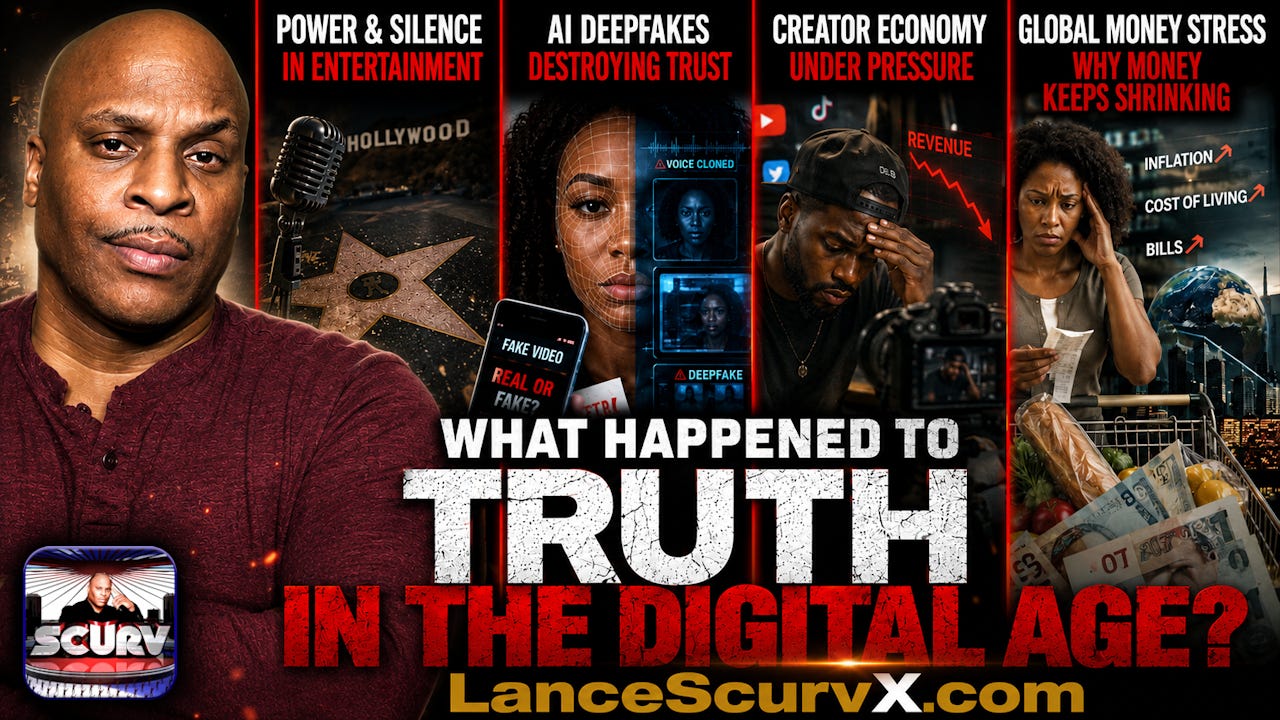
We are entering an era where the line between real and fake is no longer stable. What used to be evidence can now be generated. What used to be proof can now be manufactured. And what used to be trusted on sight alone now requires questioning.
This is not just about technology anymore. This is about perception itself. The human ability to trust what we see and hear is being challenged at the deepest level.
And most people are still living as if the old rules apply.
They do not.
The digital age has changed the rules completely.
WHEN SEEING IS NO LONGER BELIEVING
For most of human history, seeing was believing. If you saw it, you trusted it. If you heard it, you assumed it came from a real source.
That foundation is now broken.
Artificial intelligence has introduced a new layer to reality where images, voices, and videos can be created without the original person ever being involved. A face can be mapped. A voice can be cloned. A moment can be generated that never happened at all.
And the scary part is how real it looks.
We are not talking about obvious fakes anymore. We are talking about content that can pass casual inspection. Content that can circulate online, get shared, and influence opinion before anyone realizes it was artificial.
This changes everything.
Because society is built on shared agreement about what is real.
When that agreement breaks, confusion becomes normal.
THE NEW AGE OF DIGITAL IMPERSONATION
One of the most dangerous parts of this technology is how personal it has become.
It is no longer just about entertainment or experimentation. It is now possible for someone’s identity to be copied with alarming accuracy.
A voice can be replicated so closely that even family members may hesitate. A video can be generated that shows someone saying words they never spoke. An audio clip can be created that sounds completely authentic but has no real origin.
This opens the door to a new kind of vulnerability.
People are no longer only protecting their privacy. They are now forced to protect their identity itself.
Because identity can now be imitated.
And imitation, when it spreads fast enough online, can cause real-world consequences before truth has time to catch up.
THE COLLAPSE OF TRUST IN DIGITAL CONTENT
Trust is fragile even in the best of times. But in this new environment, trust becomes something people hesitate to give at all.
Every clip becomes questionable. Every statement becomes suspect. Every piece of viral content carries an invisible question mark.
Is this real? Or is this generated?
That question alone changes how people consume information.
Instead of reacting with certainty, people begin reacting with doubt. And when doubt becomes the default, communication itself becomes unstable.
The internet was supposed to bring clarity. Instead, it has introduced uncertainty at scale.
And uncertainty spreads faster than truth.
WHY COMMUNITIES ARE ESPECIALLY VULNERABLE
In communities where reputation carries deep meaning, this technology creates a serious concern.
A single manipulated clip can travel faster than any correction. A false impression can spread before facts are even gathered. And even after something is proven false, the emotional impact often remains.
This is where deepfakes become more than a technological issue. They become a social issue.
Because damage does not wait for verification. It spreads immediately.
And in a world where attention moves faster than truth, the correction is always playing catch-up.
That imbalance creates frustration, confusion, and sometimes permanent misunderstanding.
THE NEW STRUGGLE FOR TRUTH
We are now forced to rethink how truth is verified. It is no longer enough to simply see something. It is no longer enough to hear something.
Truth now requires confirmation, context, and often multiple layers of validation.
This slows everything down.
And in a fast-moving digital world, slowing down feels unnatural. But it is necessary.
Because without verification, anything can be made to look real.
And if anything can look real, then nothing can be accepted blindly.
LIVING IN A WORLD WHERE REALITY CAN BE ENGINEERED
We are standing at the beginning of a new phase of human communication.
A phase where reality is no longer fixed. It can be edited, shaped, and generated.
This does not mean truth disappears. It means truth must now be protected more carefully than ever before.
The responsibility shifts to the audience. To the viewer. To the listener. To the thinker.
Because in this environment, awareness is protection.
And ignorance is vulnerability.
We are no longer just consuming content.
We are now navigating engineered reality.
And the sooner that is understood, the better prepared people will be to move through it without being misled.
_________________________________________________________________________
WHAT HAPPENED TO THE PROMISE OF FREEDOM?
There was a time when the idea of creating content online felt like pure freedom. You could speak your mind, share your ideas, build an audience, and slowly turn attention into opportunity.
That promise still exists on the surface. But underneath, the reality has changed in a major way.
Today, the creator economy is no longer just about creativity. It is about survival inside a system that constantly shifts its rules.
Many people are still chasing the old version of the dream, not realizing the environment has already changed.
And that gap between expectation and reality is where frustration begins.
THE SHIFT FROM FREEDOM TO SYSTEM CONTROL
At first, the creator space felt open. If you posted consistently and understood your audience, growth felt possible. There was room for experimentation, and even small voices could break through.
But over time, platforms evolved into tightly controlled ecosystems. Algorithms began deciding what gets seen and what disappears. Monetization rules started changing without warning. And visibility became something that had to be constantly earned and re-earned.
Nothing is stable anymore.
A creator can build momentum for months and lose it in days because of a shift they did not create and cannot control.
This is where the emotional pressure begins to build.
Because effort no longer guarantees outcome.
THE ALGORITHM DOES NOT CARE ABOUT YOUR STRUGGLE
One of the hardest truths about the creator economy is that the system is not designed around fairness or emotional investment. It is designed around engagement.
That means content is constantly measured, ranked, and redistributed based on behavior patterns, not effort or intent.
A video can take hours or days to create, but if it does not match what the system is currently rewarding, it may never reach the audience it was meant for.
This creates a deep frustration for creators who are doing everything “right” but still not seeing consistent results.
It is not always about talent. It is about timing, format, and alignment with an ever-changing system.
And that system does not stay still long enough for anyone to fully master it.
THE EXPLOSION OF COMPETITION AND ATTENTION OVERLOAD
Another major shift in the creator economy is volume.
Millions of people are now creating content at the same time. Every platform is saturated with voices, opinions, entertainment, education, commentary, and reaction-based media.
Attention has become the most valuable currency in the world.
But attention is also limited.
This means every creator is now competing not only with professionals, but with everyday users, AI-generated content, and global media networks all fighting for the same limited screen space.
In this environment, even good content can get lost.
Not because it lacks value, but because the volume of content has overwhelmed the attention system itself.
THE EMOTIONAL COST OF CONSTANT ADAPTATION
To survive in the creator economy, people are forced to adapt constantly.
Change your format. Adjust your style. Follow trends. Shift your strategy. Relearn the platform. Rebuild your reach.
And just when something starts working, the rules change again.
This creates a cycle of pressure that many creators do not talk about openly.
Because behind the content, there is real exhaustion.
Not just creative exhaustion, but emotional exhaustion from trying to stay visible in a system that never stops moving.
This is why burnout is becoming so common.
Not because people are weak, but because the environment is unstable.
THE ILLUSION OF CONSISTENT INCOME
One of the biggest misconceptions in the creator economy is stability.
People often assume that once you “make it,” income becomes steady. But in reality, income is often tied directly to platform behavior, audience engagement, and unpredictable algorithm shifts.
This means earnings can rise and fall without warning.
A viral moment can bring sudden growth. But maintaining that level is often far more difficult than reaching it.
This creates financial uncertainty even for established creators.
And uncertainty changes how people think, create, and plan their future.
THE NEW QUESTION EVERY CREATOR IS ASKING
With all of these pressures combined, the real question becomes clear.
How do you build something sustainable in a system that keeps changing the rules?
There is no simple answer.
Some people diversify across platforms. Some build direct audience connections. Some move toward offline income streams. Some step away completely.
But one truth remains consistent.
Adaptation is no longer optional.
It is required for survival.
THE CREATOR ECONOMY IS NOT FAILING—IT IS EVOLVING
We are not watching the end of the creator economy. We are watching its transformation.
What used to feel like open opportunity is now a structured environment with shifting layers of control, competition, and unpredictability.
And in the middle of all of it are creators trying to express themselves while also trying to stay financially stable.
The pressure is real. The instability is real. The exhaustion is real.
But so is the opportunity for those who understand the system clearly.
Because once you see how the structure works, you stop blaming yourself for every fluctuation.
You start adapting with awareness instead of frustration.
And in a system that never stops changing, awareness becomes the most valuable tool of all.
——————————————————————————————————
WHY DOES IT FEEL LIKE MONEY IS DISAPPEARING?
There is a growing question that people are asking in different ways all around the world. Why does it feel like money is shrinking?
Not just in one country. Not just in one community. But across borders, across income levels, and across everyday conversations.
People are working, earning, and trying to manage life the same way they always have. But something feels different.
What used to be enough no longer stretches the same way. What used to be manageable now feels tight. And what used to feel stable now feels uncertain.
This is not just imagination. This is a shared global experience.
And it deserves a deeper look.
THE GAP BETWEEN INCOME AND REALITY
One of the biggest reasons people feel financial pressure is the growing gap between income and cost of living.
In many cases, income has stayed the same or increased very slowly. But the cost of basic life has continued to rise.
Food, rent, transportation, utilities, healthcare, and daily needs are all increasing in ways that are noticeable even to the average person.
This creates a simple but powerful effect.
Even if someone is doing the same job, with the same effort, their lifestyle begins to shrink.
Not because they changed, but because the environment changed around them.
That is where the frustration begins.
Because people do not feel like they are doing worse. They feel like the system is moving faster than they can adjust.
THE PSYCHOLOGICAL PRESSURE OF CONSTANT STRAIN
When money stops stretching, the mind starts feeling it before the bank account does.
People begin adjusting mentally before they even make physical changes. They start thinking twice before every purchase. They start calculating more often. They start feeling the pressure even in small decisions.
This creates stress that builds over time.
Not from one big event, but from constant small pressure points.
And the worst part is that it does not always feel like a crisis. It feels like ongoing survival.
That slow pressure changes how people think, plan, and move through life.
Even people who are managing are still feeling it.
Because financial strain is not only about running out of money. It is about constantly feeling like you have to stretch what you have further than before.
GLOBAL PRESSURE, LOCAL IMPACT
Across different parts of the world, the experience looks different but feels the same.
In some places, it shows up as rising food prices. In others, it shows up as unstable currency value. In others, it shows up as job insecurity or reduced buying power.
But the emotional result is shared.
People feel like they are working harder just to maintain the same position they already had.
In many communities, survival has become more creative. People are relying on side work, informal income, shared resources, and community support just to stay balanced.
This is no longer just about budgeting. It is about adaptation.
People are adjusting their entire lifestyle just to stay afloat in a changing environment.
THE QUESTION PEOPLE ARE SILENTLY ASKING
As this pressure continues, a deeper question starts to form.
Is this only personal struggle? Or is something larger happening in the structure of money itself?
When millions of people across different regions begin asking similar questions without coordination, it usually points to a shared experience, not an individual failure.
People are not just asking why things are expensive.
They are asking why everything feels like it is shifting at the same time.
That is where awareness begins to grow.
Because once people stop blaming themselves, they start observing the system more clearly.
WHY IT FEELS LIKE MONEY IS SHRINKING EVEN WHEN IT IS NOT
In many cases, money is not literally shrinking. But its value feels reduced.
That feeling comes from multiple forces working together.
Prices rise. Income lags behind. Expenses increase across multiple areas at once. And the result is a constant sense of catching up.
Even when someone is financially stable on paper, the experience can still feel tight.
Because stability is not just numbers. It is perception.
And when everyday life becomes more expensive across multiple categories at the same time, the mind interprets it as loss of control.
That is why the feeling is so strong globally.
It is not just math. It is lived experience.
LIVING INSIDE A SHIFTING SYSTEM
We are living in a time where multiple systems are changing at once.
Financial systems, information systems, job markets, and even social expectations are all shifting in real time.
And in the middle of all of this are everyday people trying to maintain balance.
Trying to stay stable in a moving environment is what creates the pressure.
Because even when you make progress, the target keeps moving.
That is the reality many people are feeling right now, whether they fully understand it or not.
AWARENESS IS THE FIRST FORM OF CONTROL
The first step in dealing with financial pressure is not panic. It is awareness.
Because when you understand that your experience is shared globally, you stop internalizing it as personal failure.
You begin to see patterns instead of problems.
And patterns can be studied. Patterns can be adapted to. Patterns can be navigated.
The world is changing quickly. And money is part of that change.
But people are not powerless inside it.
The more clearly you see what is happening, the more strategically you can move within it.
And in times like these, clarity becomes a form of strength.
Sincerely,
SCURV