

BEFORE WE TALK ABOUT THE LEGEND, LET’S ACKNOWLEDGE THE CONCERN
There’s something happening around Gladys Knight right now that’s difficult for those of us who grew up listening to her music to watch. At 82 years old, recent performances have caused concern among longtime fans after videos circulated showing moments in which she appeared, to some viewers, to be confused, disconnected, or uncertain about what was happening around her. Those images have naturally led to questions about her health, including speculation about dementia. At the same time, people close to her have disputed the idea that she has been diagnosed with dementia, and her husband has said that she will be evaluated by a doctor. Knight has also announced that she intends to reduce her performances as she moves into another stage of her life. Whatever the eventual explanation may be, I think the responsible approach is to acknowledge what people are seeing without pretending that a few minutes of video footage can tell us what’s happening medically inside another human being.
But I don’t want the current concern surrounding Gladys Knight to become the headline that defines her legacy. There’s something deeply unfair about allowing the final chapters of a person’s public life to overshadow the decades of work that made that person meaningful to millions. We can recognize that people are concerned about her without turning those concerns into a diagnosis, and we can talk about the reality of aging without forgetting the extraordinary life that came before it. Before Gladys Knight became an 82-year-old woman whose health is being discussed online, she was a young girl with an extraordinary voice who grew into one of the most respected entertainers of her generation. That’s the Gladys Knight I want to remember, because when I think about her, I don’t first think about whether she can still perform the way she did fifty years ago. I think about what she gave us when she could.
I WAS A LITTLE BOY WHEN HER VOICE FOUND ME
I was a young boy when Gladys Knight’s voice became part of my world, and I had absolutely no idea that I was listening to somebody who would eventually become a permanent part of American musical history. I wasn’t thinking about record charts, awards, music executives, or the history of soul music. I was simply hearing songs coming through the radio and through the everyday environment of childhood, and something about her voice reached me. I was around seven years old when “If I Were Your Woman” was released, and I certainly didn’t have the life experience necessary to understand every adult emotion inside that song. Yet somehow, I could feel it. That’s one of the strange and beautiful things about great music: sometimes the heart understands something long before the mind has enough experience to explain it.
A child may not understand the complicated realities of adult relationships, but a child can still recognize sincerity. You can hear somebody sing about heartbreak without ever having experienced heartbreak yourself, and somehow you can still recognize the sadness. You can hear somebody sing about love before you’ve ever been in love and still understand that something important is happening. Gladys Knight possessed that kind of emotional authority. She didn’t sound like somebody simply reading lyrics from a page. She sounded like somebody who understood the emotional world inside those lyrics and knew exactly how to make the listener feel it too.
As I grew older, the songs began to reveal more of themselves to me. The things I could only feel as a child eventually became things I could understand as an adult. The same music that once simply sounded beautiful began to sound truthful. I could hear the disappointment differently. I could understand the sacrifice differently. I could recognize the vulnerability differently. That’s what makes great music so powerful: the song can remain exactly the same while the listener changes completely.
SHE PROVED THAT TALENT COULD SPEAK FOR ITSELF
One of the things I appreciate most about Gladys Knight is that she came from an era when an entertainer could become enormously successful without making sexuality, profanity, or controversy the center of the presentation. She didn’t have to expose her body to convince an audience that she was attractive. She didn’t have to constantly shock people to remain relevant. She didn’t have to fill her songs with profanity to make them sound authentic, and she didn’t have to manufacture outrageous moments to keep her name in the public conversation. She could walk onto a stage dressed with dignity, stand behind a microphone, and let the quality of her voice carry the entire performance.
I’m not saying that every artist today has to look or behave exactly as artists did in the past. Every generation develops its own style, and music has always changed with the times. My point is that Gladys Knight represents an era when the music itself could still be the main attraction. The singer didn’t necessarily have to become the spectacle because the song had enough substance to hold the audience’s attention. There was room for imagination, romance, vulnerability, and emotional tension without everything having to be spelled out or turned into something explicit.
That kind of artistry deserves to be remembered because there was a particular dignity attached to it. A woman could sing about love and desire without having to make her body the centerpiece of the performance. A man could sing about heartbreak without being portrayed as weak. People could express longing, disappointment, commitment, and tenderness without turning every emotion into profanity or sexual imagery. Gladys Knight was one of the artists who demonstrated that emotional honesty could be powerful all by itself.
“IF I WERE YOUR WOMAN” TAUGHT ME SOMETHING BEFORE I KNEW WHAT IT WAS
When I hear “If I Were Your Woman” today, I hear much more than a song from another era. I hear a piece of my childhood. The song was written by Pam Sawyer and Clay McMurray, but Gladys Knight and the Pips gave it a vocal performance that made the emotions feel personal and immediate. When I first heard it, I didn’t understand the adult circumstances behind the lyrics, but I could sense that there was pain, longing, and love contained inside that performance. Now, with decades of life behind me, I can hear things in that song that I simply couldn’t hear when I was seven.
That’s the power of music that lasts. It doesn’t have to remain trapped in the decade when it was recorded. It can follow you through life and reveal different meanings as you grow. When you’re young, you may simply enjoy the melody. When you become older, you begin to understand the story. When you experience love, disappointment, marriage, separation, sacrifice, and loss, you suddenly discover that the same song contains pieces of your own life. The artist may have recorded it decades ago, but somehow the song keeps meeting you wherever you are.
Gladys Knight had the rare ability to take a song written by somebody else and make millions of people feel as though she was singing directly to them. That’s not simply vocal ability. That’s interpretation. That’s emotional intelligence. That’s knowing how to use a voice as an instrument capable of communicating things that words alone sometimes can’t express.
THEN SHE GAVE US “MIDNIGHT TRAIN TO GEORGIA”
And then there’s “Midnight Train to Georgia,” a song that became so deeply embedded in popular culture that its opening is almost like a cultural handshake. You don’t have to be told what song it is for very long before you recognize it. Released in 1973, it became the signature recording of Gladys Knight and the Pips and reached number one on the Billboard Hot 100. Yet none of those statistics explain why the song continues to affect people so strongly.
The reason is simple: the story is human. It’s about dreams that didn’t turn out the way somebody expected. It’s about disappointment and the realization that the life you imagined might not become the life you actually live. It’s about somebody trying to find happiness, discovering that things haven’t worked out, and eventually heading back toward something familiar. That story can belong to almost anybody because almost everybody has experienced disappointment at some point.
Maybe you had a career that didn’t work out. Maybe a relationship ended differently than you expected. Maybe you moved somewhere believing your life would improve and eventually discovered that happiness wasn’t waiting for you there. Maybe you had dreams when you were young that life eventually forced you to reconsider. That’s why “Midnight Train to Georgia” reaches beyond a particular genre. It’s not simply a soul song. It’s a human story delivered through soul music.
And there’s something especially powerful about the way Gladys Knight delivered it. She didn’t have to overact the emotion. She understood that sometimes restraint makes emotion stronger. Her voice carried the weight of the story, and that’s why people could hear themselves inside it.
“BEST THING THAT EVER HAPPENED TO ME” WAS ABOUT GRATITUDE
“Best Thing That Ever Happened to Me” carries a different kind of emotional power because it’s rooted in appreciation. It’s about looking at life and recognizing that despite the disappointments, struggles, and unexpected turns, another person became one of the greatest blessings in your journey. That’s a message that can hit differently as you get older because age has a way of teaching you that gratitude isn’t something to postpone.
We live in a culture that constantly tells people to look for the next thing. The next relationship, the next house, the next car, the next accomplishment, the next destination, the next level of success. There’s always something else to chase. Songs like this remind us that sometimes the most meaningful thing in life is realizing what you already have and appreciating the person standing beside you.
There’s nothing weak about expressing gratitude. There’s nothing weak about admitting that another person made your life better. There’s nothing weak about telling somebody that they mattered. In fact, there’s tremendous strength in being vulnerable enough to say it. Gladys Knight had a way of delivering that kind of emotion without making it sound sentimental for the sake of sentimentality. She made it believable.

HER MUSIC BECAME PART OF THE BLACK FAMILY EXPERIENCE
For many Black families, music wasn’t simply entertainment. It was part of the household atmosphere. It played while people cooked, cleaned, talked, relaxed, celebrated, traveled, raised children, fell in love, and grew older. Certain voices became associated with particular rooms, particular cars, particular family gatherings, and particular stages of life. Gladys Knight became one of those voices.
Her music could exist across generations. An older person could appreciate the depth of the lyrics, a young adult could recognize the relationship struggles, and a child could simply hear a beautiful voice and remember the melody. That ability to cross generations is one of the clearest signs that an artist has created something lasting.
For Black culture, that matters because music has always been more than entertainment. It has been a way of preserving stories, expressing emotions, documenting experiences, and creating community. We have used music to celebrate, mourn, protest, worship, fall in love, recover from disappointment, and simply make it through another day. Gladys Knight became part of that tradition, and her music carried emotions that people could recognize regardless of their circumstances.
SHE NEVER HAD TO CHASE ATTENTION
I also appreciate the fact that Gladys Knight never seemed to need constant controversy to prove that she was still relevant. Her career was built around the work itself. She didn’t have to spend every year reinventing her personality for the public. She didn’t have to create some outrageous moment every few months so people would remember her name. She could simply sing.
That kind of longevity tells you something about substance. When the work is strong enough, it doesn’t have to constantly scream for attention. The audience eventually comes back because the work has given them something they can’t replace.
That’s why her catalog matters. The songs didn’t depend upon a particular hairstyle, fashion trend, scandal, or social-media moment. They survived because the emotions inside them remained recognizable. People still fall in love. People still get hurt. People still sacrifice for the people they love. People still make mistakes. People still dream. People still lose. People still go home.
And as long as human beings continue experiencing those things, music that speaks honestly about them will have somewhere to live.
WHAT HAPPENED TO THAT KIND OF MUSIC?
That’s where Gladys Knight’s legacy makes me think about the direction of popular music today. What happened to songs that could be romantic without being explicit? What happened to music that could discuss desire without making the body the entire marketing strategy? What happened to songs that could make a woman feel beautiful without requiring her to expose herself? What happened to music that could allow a man to admit that he was hurt without making him feel ashamed?
I’m not going to sit here and pretend that everything from the past was perfect, because it wasn’t. Every generation has its problems, and every era has produced music that wasn’t exactly wholesome. But there was still a strong tradition of artists who understood that you could communicate adult emotions without making vulgarity the foundation of the art.
Today, attention has become an enormous part of the entertainment business. When attention becomes the currency, people naturally begin looking for whatever will produce the strongest reaction. Sometimes that means controversy becomes more important than creativity. Sometimes the image becomes more important than the song. Sometimes sexuality becomes more important than musicianship. Sometimes profanity is treated as authenticity simply because it sounds raw.
Gladys Knight represents another path. She reminds us that you can be passionate without being vulgar, powerful without being outrageous, and memorable without turning yourself into a spectacle. That doesn’t mean modern music has to go backward. It means we shouldn’t forget that another standard once existed.
THE SONGS GREW UP WITH ME
One of the beautiful things about growing older is realizing that the music you heard when you were young can grow alongside you. When I first heard “If I Were Your Woman,” I was too young to understand the relationship behind the words. I could only feel the emotion. Years later, I could understand the situation. Later still, I could recognize the deeper human experience inside it.
That’s why certain songs become more valuable with age. They don’t simply remind you of the past; they help you understand the present. A song you heard as a child can suddenly explain something about your adult life. A melody you once heard casually can become a reminder of somebody you loved. A voice you once heard coming from a radio can suddenly transport you back to a home, a neighborhood, a family member, or a time when life seemed much simpler.
Gladys Knight gave people that kind of music.
She gave people songs that could grow with them.
WE SOMETIMES FORGET TO APPRECIATE PEOPLE WHILE THEY’RE HERE
That’s also why the current concern surrounding Gladys Knight should remind us of something larger than her individual situation. We live in a culture that can be incredibly quick to celebrate somebody after they’re gone while taking their presence for granted while they’re still alive. Once a person dies, suddenly everybody remembers the songs. Everybody remembers the concerts. Everybody remembers where they were when they first heard that voice.
I would rather give people their flowers while they can still smell them.
I would rather tell somebody that their work mattered before the obituary is written. I would rather acknowledge the impact somebody had on my life while they’re still here to hear it. And that’s why I don’t want my thoughts about Gladys Knight to be centered around speculation about her health. I want them centered around gratitude.
Whatever is happening with her today, she has already accomplished something that cannot be undone. She gave the world music that became part of people’s lives.
SHE DOESN’T OWE US ANOTHER PERFORMANCE
If Gladys Knight wants to reduce her schedule, she has earned that right. If she wants to spend more time with family, she has earned that right. If she wants to perform occasionally, she has earned that right. And if she eventually decides that she has performed her final concert, then I hope people have enough gratitude to understand that she doesn’t owe us another song.
She doesn’t have to compete with the young woman she once was. She doesn’t have to prove that she can still produce the same physical energy she had decades ago. She doesn’t have to recreate the past in order to deserve respect in the present.
The greatness already happened.
The music already happened.
The memories already happened.
The impact already happened.
That’s enough.
THE BODY AGES, BUT THE MUSIC DOESN’T HAVE TO
The human body changes as we get older, and with that change come differences in our voices, our energy, our appearance, our stamina, and eventually the way we move through life itself. None of that should automatically be viewed as a failure, because aging is simply part of being human. We can spend our lives trying to preserve our youth, but eventually every person has to accept that the body has its own timetable. What matters is that the passage of time doesn’t erase the value of what a person has already accomplished, because the physical limitations that may come with age have nothing to do with the emotional impact that somebody has already made on the world.
That’s where recordings have a strange kind of immortality. When you press play on an old Gladys Knight recording, the young woman who originally stood behind that microphone is suddenly present again through the power of her voice. The decades disappear for those few minutes, and the emotion doesn’t feel old at all. Her voice doesn’t know that half a century may have passed since the recording was made, and the listener may have changed completely during that time, but the performance remains exactly as it was when she gave it to the world. That’s one of the beautiful things about music, because it allows us to preserve moments that time would otherwise take away from us.
That’s why music can make grown people cry, even when the song itself isn’t necessarily sad. Sometimes a familiar song opens a door to a part of your life that you thought you had forgotten, taking you back to a place that may no longer exist, reminding you of people who may no longer be here, or reconnecting you with a version of yourself that disappeared decades ago. A melody can bring back an entire period of your life in just a few seconds, and suddenly you’re remembering what you were doing, where you were living, who you loved, what you were dreaming about, and who you were before life changed you. Gladys Knight’s voice has become one of those emotional doors for millions of people, and that’s something no passage of time can erase.
I WAS TOO YOUNG TO UNDERSTAND, BUT OLD ENOUGH TO FEEL
When I think about myself as that little boy hearing Gladys Knight, I realize how remarkable it is that something I encountered so early in life remained with me for so many decades. I didn’t know that I was hearing history, and I certainly didn’t understand that I was listening to one of the great voices of her generation. At that age, I wasn’t thinking about music history or the cultural significance of what was coming through the radio. I was simply a child hearing a voice that somehow made me feel something, and it wasn’t until I became older that I could look back and understand why those songs had such a lasting effect on me.
That’s perhaps the purest relationship an artist can have with an audience, because before the critics tell you what to think, before awards establish somebody’s importance, and before the music industry decides who deserves attention, there’s simply a listener and a song. Something happens when those two meet, and when the connection is real, the listener doesn’t need anybody else to explain it. That’s what happened between Gladys Knight and me. I heard her music when I was too young to understand everything she was singing about, but I was old enough to feel the emotion coming through her voice, and that feeling stayed with me long after I had grown old enough to understand the words.
THANK YOU FOR THE MUSIC, GLADYS
If I could speak directly to Gladys Knight, I wouldn’t begin by asking her to explain the concerns surrounding her health, and I wouldn’t ask her to prove that she can still perform with the same energy she possessed decades ago. I wouldn’t ask her to recreate the woman she was fifty years ago because the woman she was back then has already given us everything she needed to give. Instead, I would simply want to thank her for the songs that became memories, for a voice capable of communicating emotions that ordinary conversation couldn’t always express, and for showing generations of women that strength and dignity could exist together. I would thank her for demonstrating that a woman could command an audience without making her body the centerpiece of the performance, and I would thank her for proving that love songs could be passionate without being vulgar and that heartbreak could be powerful without relying on profanity.
I would also thank her for giving families music that could live comfortably inside the home, music that parents could play around their children without feeling that they had to apologize for what was coming through the speakers. I would thank her for giving children something beautiful to hear and for helping create a soundtrack that crossed generations and became part of Black cultural memory. Most of all, I would thank her for giving a little boy something he couldn’t fully understand at the time but would eventually grow old enough to appreciate, because sometimes we don’t understand the value of what we’re experiencing until decades later when life finally gives us the perspective to recognize what we were blessed to hear.
A GOD-GIVEN GIFT SHOULD BE HONORED
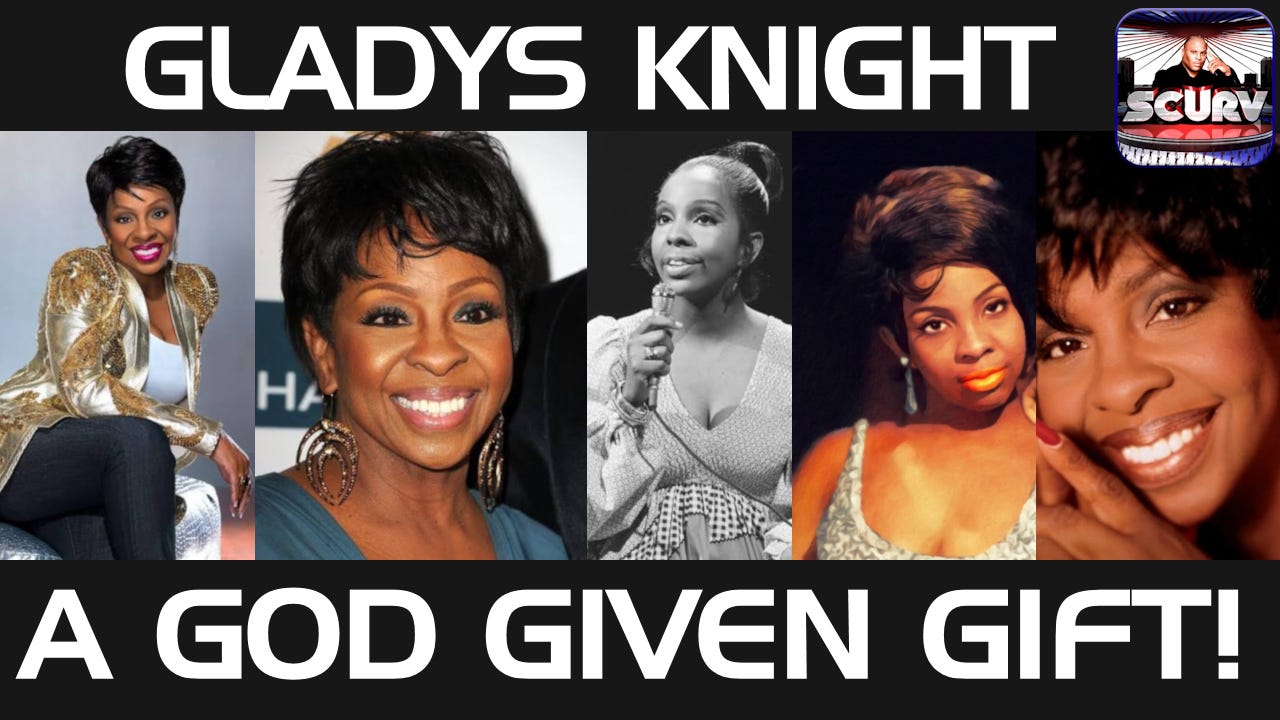
When I look at photographs of Gladys Knight throughout the decades, I don’t simply see an entertainer getting older; I see an entire life unfolding in front of me. I see a young girl discovering a gift, a young woman developing that gift, a performer reaching millions of people, and eventually an older woman who has lived long enough to watch her work become part of musical history. There’s something deeply moving about watching a person age through photographs because you’re not simply seeing changes in appearance; you’re seeing the evidence of an entire journey, and in Gladys Knight’s case, that journey includes generations of people who were touched by what she was able to do.
That’s why I call Gladys Knight a God-given gift. Some gifts can’t be manufactured, purchased, or created by a marketing campaign, because although you can train your voice, study your craft, develop your technique, and work tirelessly to become better, there’s still something mysterious about the ability to reach directly into another person’s emotions. Gladys Knight had that ability, and it’s what separated her from somebody who could simply sing the correct notes. She could take words written by somebody else and make them sound as though they came from her own memories, take a melody and make it feel like a personal confession, and take somebody else’s story and make millions of people recognize themselves inside it. That’s more than technical skill; that’s the rare connection between an artist and an audience that cannot be taught entirely in a classroom.
LET’S NOT LET THE FINAL CHAPTER ERASE THE BOOK
So yes, I understand why people are concerned about Gladys Knight today, and I understand why longtime fans may become emotional when they see a beloved performer appearing different from the woman they remember. I understand why people may wonder whether age or illness is affecting her, because when somebody has been part of your life for so many decades, seeing them become physically different can force you to confront the reality that time eventually catches up with everybody. But I refuse to allow those concerns to become the entire story of Gladys Knight, because a few moments from the present cannot erase an entire lifetime of achievement.
When I think about Gladys Knight, I want to remember the voice that came through the radio and television, the songs that became part of people’s lives, the emotion that made those songs memorable, and the dignity that surrounded her career. I want to remember the woman who could stand before an audience and make people feel as though she was singing directly into their personal lives, because that kind of connection is what separates a truly memorable artist from somebody who simply had a successful career. Most of all, I want to remember that little boy hearing her music before he was old enough to understand exactly why it moved him, because that little boy represents something that statistics and awards can never measure: the emotional impact an artist can have on another human being.
That’s the real measure of an artist. It’s not how long they can remain young, how long they can remain fashionable, or how long they can keep up with an entertainment industry that constantly changes its definition of relevance. The deeper question is whether something that person created remains alive inside somebody else long after the original moment has passed. Gladys Knight accomplished that in a way that few performers ever do, because decades after those songs were recorded, people are still listening, still remembering, still feeling, and still discovering something inside her music that speaks to their own lives.
HER MUSIC WILL KEEP FINDING US
One day, decades from now, somebody who wasn’t even alive when Gladys Knight was performing at the height of her career will hear “Midnight Train to Georgia” and recognize something inside that story. Somebody will hear “If I Were Your Woman” and feel the emotion in that performance, while somebody else will discover “Best Thing That Ever Happened to Me” and understand gratitude through a voice that came from another generation. That’s how cultural legacies survive, because they aren’t kept alive simply by forcing younger people to study them; they survive when the work continues to make people feel something.
That’s why I don’t believe Gladys Knight’s legacy belongs only to the past. The performances may belong to history, but the recordings still belong to anybody willing to listen, the songs still belong to the people who need them, and the memories still belong to those of us who grew up with them. As long as somebody can press play and find comfort, understanding, love, sadness, or inspiration inside one of those songs, the gift continues to live. Time may move forward, but great music has a way of reaching backward and forward at the same time, connecting people who may have been born generations apart through the same human emotions.
THIS IS HOW I WANT TO REMEMBER HER
I don’t want to remember Gladys Knight simply as an aging celebrity surrounded by questions about her health. I want to remember her as a woman who spent a lifetime giving people something beautiful, beginning with the young girl who possessed a remarkable voice and continuing through the performer who developed that gift into an extraordinary career. I want to remember the woman whose music became part of the emotional history of millions of people, including people like me who encountered her music as children and carried it with us into adulthood without realizing at the time how important those early musical experiences would eventually become.
I want to remember an era when you could hear a woman sing about love without needing her to expose herself, when emotional vulnerability could be beautiful instead of embarrassing, and when a singer could command an audience simply by possessing a voice capable of making people stop whatever they were doing and listen. I want to remember the elegance of an artist who understood that you could communicate desire without being vulgar, heartbreak without profanity, and strength without turning yourself into a spectacle. That’s what Gladys Knight gave us, and it’s part of what makes her legacy so meaningful.
Her music respected the listener because it trusted people to understand emotion without having everything spelled out in the crudest possible language. Her performances carried emotion without exploitation, romance without vulgarity, and power without the need to constantly scream for attention. She created memories without ever knowing the names of the people who would eventually carry those memories through their lives, and somewhere inside all of those people is a little piece of Gladys Knight that will never grow old because the music gave them something that time cannot completely take away.
GIVE HER THE FLOWERS NOW
So before we rush to judge what Gladys Knight can or cannot do at 82, before we allow rumors to become facts, and before we reduce an extraordinary lifetime to a few moments captured on a cellphone, let’s remember the larger picture. Let’s remember the little girl, the singer, the entertainer, the woman, the artist, and the voice that became part of our lives. Let’s remember that nobody stays young forever, that every performer eventually has to step away from the stage, and that a person’s value doesn’t disappear simply because their physical ability to perform changes.
Gladys Knight has already given us something that no diagnosis, rumor, viral video, or passage of time can take away: a body of music that became part of the lives of generations. That’s why I call her a God-given gift, and that’s why I believe she deserves her flowers while she’s still here to receive them. She doesn’t deserve those flowers because she owes us another performance; she deserves them because she already gave us enough performances to last several lifetimes. She doesn’t need to prove that she’s still the woman she was fifty years ago because she proved who she was a long time ago, and we don’t need another song from her to validate her greatness because the songs she already gave us are still speaking.
When I hear that voice, I hear my childhood, and I hear the Black music that surrounded the environment in which I grew up. I hear soul, love, heartbreak, and dignity, and I hear a generation that understood that you could say something powerful without screaming it or reducing it to profanity. I hear an artist who didn’t have to expose herself to be seen, a singer who didn’t have to curse to be heard, and a woman who didn’t have to manufacture controversy to be remembered. Most importantly, I hear a God-given gift, and I’m grateful that I was alive to hear it.
SCURV