
I have been thinking about artificial intelligence for a long time now, and the more I watch it spread into every corner of our lives, the more I believe that we are looking at something far bigger than a simple tool. Many people celebrate it as the next great invention. They talk about how fast it works, how much time it saves, and how it can do things that once took hours or even days to complete. I understand why people are excited. I understand why businesses are embracing it. I even understand why everyday people are becoming dependent on it. But despite all of that, I cannot shake the feeling that something is wrong.
The feeling is difficult to explain because it goes beyond technology. It goes beyond economics. It goes beyond politics. What troubles me is something that sits much deeper in the soul. There is something about AI that feels disconnected from the human spirit. It feels cold. It feels empty. It feels as if it is moving us toward a future where human value is no longer measured by our creativity, wisdom, experience, or unique gifts, but by how efficiently we can compete against machines that were built to replace us.
Now before anyone misunderstands what I am saying, let me be clear. I am not claiming to have all the answers. I am not claiming that every person who uses AI is doing something wrong. In fact, many of us use AI every day without even realizing it. The issue is not simply whether AI can be useful. The issue is whether usefulness is causing us to ignore dangers that may be hiding beneath the surface.
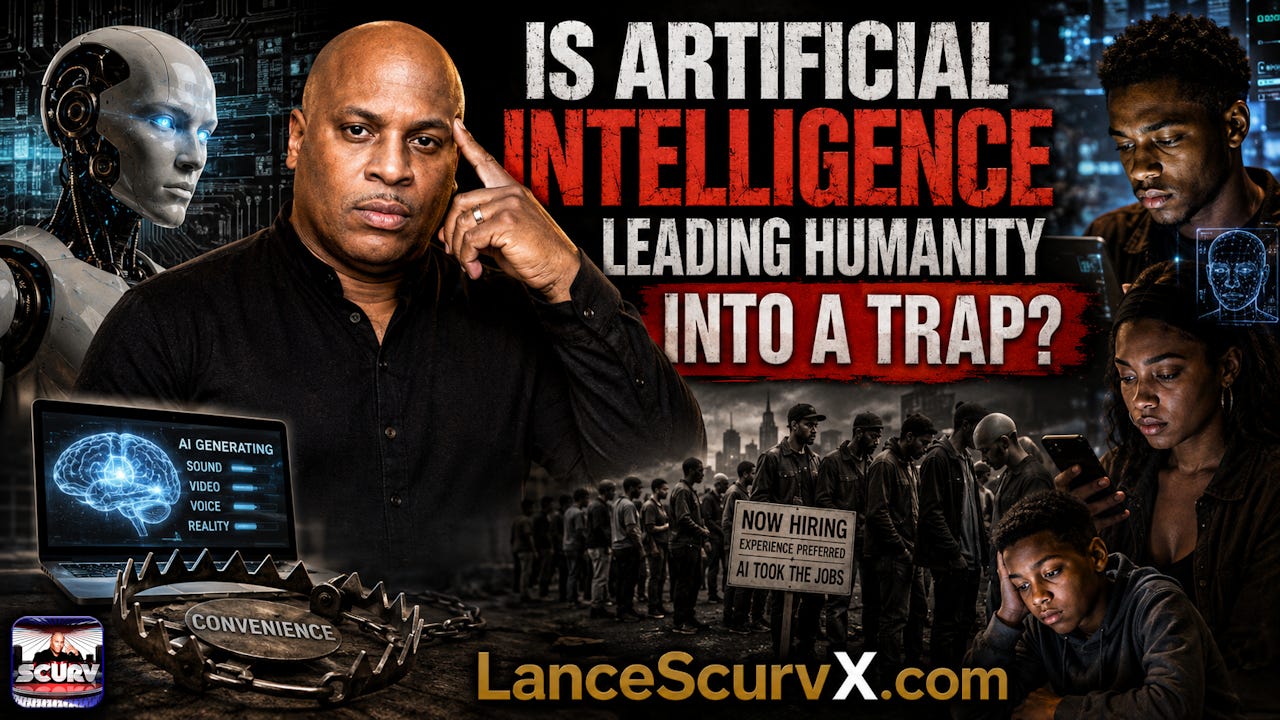
Sometimes the most dangerous things in life arrive wrapped in convenience. They arrive looking helpful. They arrive offering solutions. They arrive promising to make life easier. Human beings have always been vulnerable to things that offer comfort without requiring us to think about the long-term consequences. That is why I believe we must have honest conversations about what AI really is and where it may ultimately be taking us.
The truth is that many people are so fascinated by what AI can do that they never stop to ask what it may eventually do to us. They are amazed by the speed. They are impressed by the accuracy. They are entertained by the novelty. But very few people seem interested in asking whether we are slowly surrendering something precious in exchange for convenience. That question deserves serious consideration.
THE POISONED MEAL ANALOGY
The best way I can describe my concerns is through a simple analogy. Imagine that you have not eaten in weeks. You are starving. Your body is weak. Your mind is fading. You are desperate for food. Then suddenly, a beautiful meal appears in front of you. It smells incredible. It looks perfect. It promises to satisfy every hunger you have.
Then you learn that the meal contains poison.
Not the kind of poison that kills you immediately. Not the kind that causes instant pain. This poison allows you to enjoy the meal first. It lets you feel satisfied. It lets you believe everything is fine. Only later does the damage appear.
That is what AI feels like to me.
We live in a world where people are overwhelmed. Many are struggling financially. Many feel exhausted by information overload. Many feel disconnected from purpose and community. AI arrives at exactly the moment when society is desperate for solutions. It promises faster answers, easier work, greater efficiency, and endless convenience. The temptation is powerful because the benefits are real.
Yet I cannot help but wonder what hidden costs may be attached to those benefits. What happens when people stop learning because AI does the thinking for them? What happens when artists stop creating because AI can generate content in seconds? What happens when businesses stop hiring because AI can perform the work? What happens when human relationships become less important because machines are always available to simulate conversation and companionship?
These questions are not science fiction anymore. They are becoming part of everyday life. The more we depend on AI, the more we risk losing the skills and qualities that make us human in the first place.
WHEN TOOLS BECOME REPLACEMENTS
For most of human history, tools existed to help people accomplish tasks. A hammer helped a carpenter. A camera helped a photographer. A computer helped a worker process information faster. The human being remained at the center of the process.
AI represents something very different.
Instead of helping people perform tasks, AI is increasingly being developed to perform the tasks itself. That distinction matters. It changes everything. The goal is no longer assistance. The goal is automation. The goal is replacement.
Entire industries are already feeling the pressure. Creative professions are being transformed. Writers, artists, designers, editors, voice actors, and many others are being forced to compete against software that can generate work at astonishing speed. What took years to master can now be imitated in seconds.
Many people dismiss these concerns because they believe new jobs will emerge. Perhaps some will. History shows that technology often creates opportunities while eliminating others. But there has never been a technology quite like this one. Previous inventions enhanced human productivity. This technology seeks to replicate human capability itself.
That is why so many people feel uneasy. They may not be able to explain it, but they sense that something fundamental is changing.
THE DEATH OF AUTHENTICITY
One of the most troubling aspects of AI is its ability to imitate human beings. Voices can be copied. Images can be generated. Videos can be altered. Entire personalities can be recreated.
This creates a serious problem because trust is one of the foundations of human society. We need to know who is speaking. We need to know what is real. We need to know whether something is authentic.
Today, people can listen to a voice and have no idea whether it belongs to a real person. They can watch a video and have no idea whether it was genuinely recorded. They can read words and have no idea whether a human being actually wrote them.
The danger is not merely technological. The danger is psychological. Once people lose confidence in what is real, confusion becomes the new normal. Truth becomes harder to recognize. Deception becomes easier to spread.
A society that cannot distinguish reality from imitation becomes vulnerable to manipulation on a massive scale.
THE SPIRITUAL QUESTION
What troubles me most is not what AI can do but what it represents. Human beings are more than information processors. We are more than data points. We are more than algorithms. We possess creativity, intuition, compassion, morality, and spiritual awareness.
AI can imitate many things, but imitation is not the same as possession. A machine can generate words about love without ever feeling love. It can write about courage without ever experiencing fear. It can discuss faith without ever possessing a soul.
That distinction matters.
The more society embraces artificial substitutes for human qualities, the greater the risk that we begin to forget the value of the real thing. We may eventually become so fascinated by simulation that we stop appreciating authenticity.
THE CHOICE BEFORE US
I am not suggesting that AI will disappear. I am not suggesting that people stop using every form of technology. What I am suggesting is that we approach this moment with caution, wisdom, and discernment.
The future is being shaped right now. Decisions are being made that will affect generations to come. The question is whether we will remain awake enough to recognize what is happening around us.
Technology should serve humanity. Humanity should never serve technology.
As AI continues to advance, we must ask ourselves difficult questions. Are we becoming stronger or more dependent? Are we becoming wiser or merely more efficient? Are we preserving what makes us human or slowly surrendering it?
These are not questions that can be answered by machines.
They can only be answered by us.
And the answers we choose today may determine what kind of world our children inherit tomorrow.
The conversation is not about fear. The conversation is about awareness. It is about refusing to sleepwalk into the future simply because the future arrives wrapped in convenience. It is about protecting the qualities that make human life meaningful before those qualities become treated as outdated obstacles to progress.
We stand at a crossroads unlike any other in history. One path leads toward greater dependence on artificial systems. The other leads toward preserving human creativity, human judgment, human relationships, and human dignity. The choice may not be as obvious as many people think.
That is why I believe AI is not just a tool.
It is a test.
And history will judge how we respond.